
Quick Answer
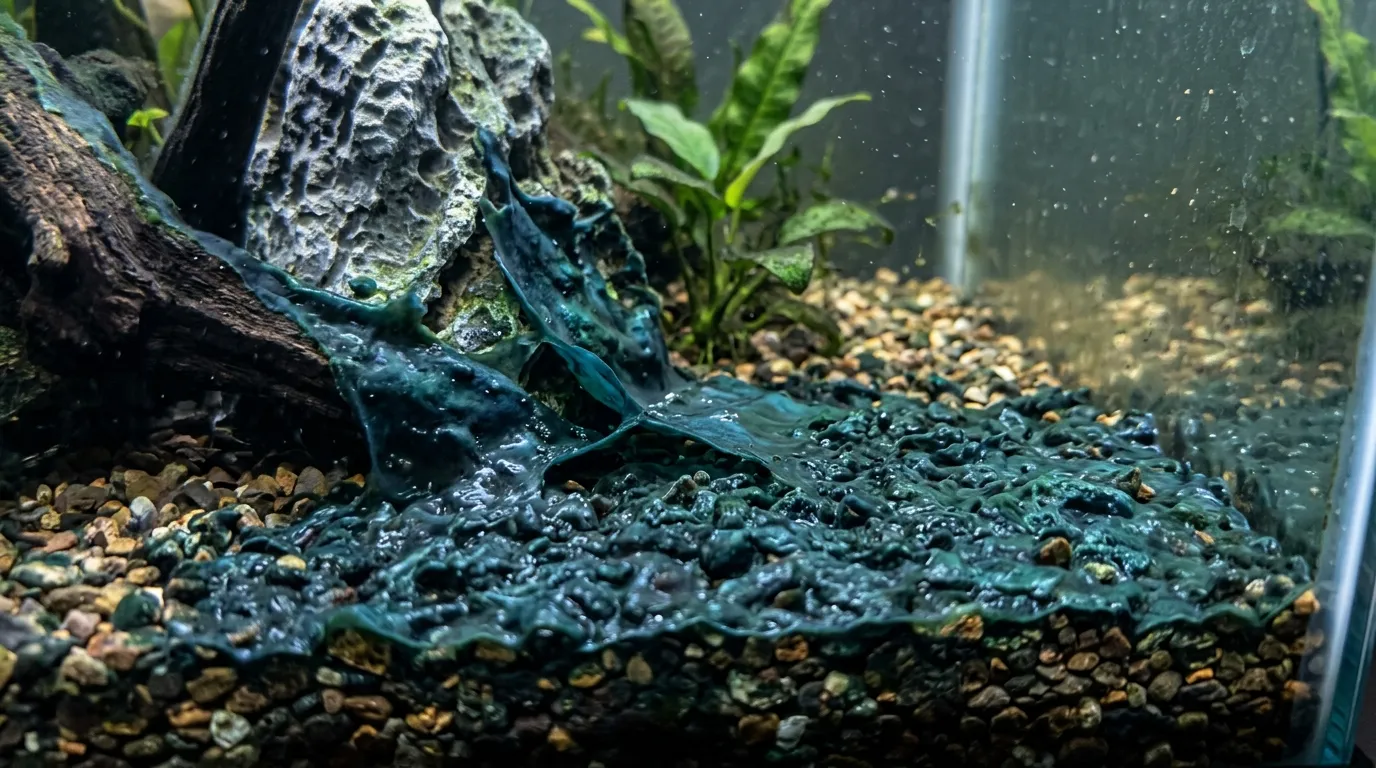
Cyanobacteria (often called blue-green algae, though it's actually a bacteria) forms a slimy film with a distinctive musty smell, usually in areas of poor water flow. It's typically caused by organic buildup and stagnant flow rather than excess light -- improving circulation and manually siphoning it out during water changes are the safest first steps.
Key Takeaways
- Cyanobacteria is a photosynthetic bacteria, not a true algae -- it peels off in sheets and has a musty smell
- Poor water flow and organic buildup are the primary triggers, not simply excess light
- Manual siphoning during water changes and improved circulation are the safest first steps
- A 3-day blackout is effective for outbreaks that don't respond to flow and cleaning fixes
- Antibiotic treatment (erythromycin) is a last resort due to its impact on beneficial bacteria
What Is Cyanobacteria?
Despite the common name 'blue-green algae', cyanobacteria isn't a true algae -- it's a photosynthetic bacteria. It forms thin, slimy sheets in shades of blue-green, dark green, or occasionally red/purple, and it's easily identified by two traits true algae don't share: it peels off the substrate or glass in intact sheets rather than scraping off in flecks, and it has a distinctive musty, swampy smell.
Why It Grows
Cyanobacteria thrives in tanks with poor water circulation (dead spots where debris settles), high organic waste, and often low nitrate combined with available light -- which is counterintuitive, since most algae problems are linked to excess nutrients rather than a deficiency. Old, undisturbed substrate and light leaking into the tank outside the normal photoperiod (from room lighting) are also common contributors.
Step-by-Step Removal
- Manually siphon it out during water changes -- lift it gently rather than disturbing it aggressively, since bursting the sheets can spread spores through the water column.
- Improve water flow throughout the tank, paying particular attention to corners and low-flow zones where it tends to establish first.
- Do a 3-day blackout combined with reduced feeding if manual removal and improved flow aren't enough -- cyanobacteria generally can't sustain itself without light.
- Consider a UV sterilizer for persistent cases, which helps control it in the water column.
Prevention
Consistent gravel vacuuming to prevent organic buildup, improved circulation (an additional powerhead in dead zones), and checking for stray light entering the tank outside your set photoperiod are the most effective long-term preventions. If nitrate is consistently near zero, allowing it to rise slightly (via feeding or a nitrate-containing fertilizer) can sometimes help outcompete cyanobacteria's advantage.
A Note on Antibiotic Treatment
Some hobbyists use erythromycin to treat severe cyanobacteria outbreaks. This is an antibiotic and carries real downsides -- it can disrupt your biological filter and shouldn't be used routinely. Manual removal, improved flow, and a blackout period are the safer first-line approach for most cases.