
Quick Answer
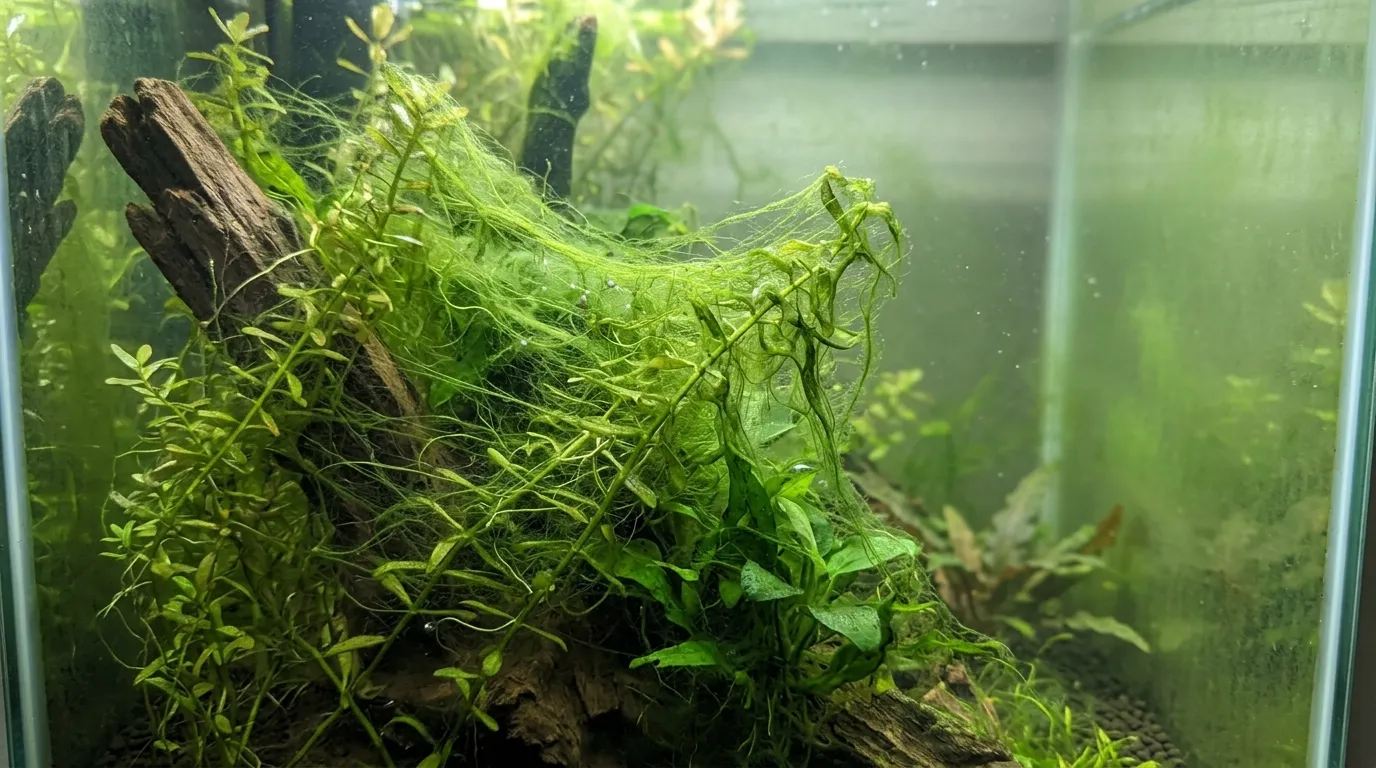
Green hair algae is long, stringy green algae that tangles around plants and decor, usually triggered by too much light relative to available CO2 and nutrients. Manual removal (twirling it out with a toothbrush) combined with reducing photoperiod and balancing dosing is the most reliable fix.
Key Takeaways
- Green hair algae is long, stringy, and spreads quickly through planted tanks
- It's almost always caused by too much light relative to CO2 and nutrient dosing
- Manual removal with a toothbrush removes most of the biomass immediately
- A 3-day full blackout is an effective last resort for severe outbreaks
- Amano shrimp are the most reliable biological control for this algae type
What Is Green Hair Algae?
Green hair algae grows as long, thin, bright-to-dark green filaments, often several centimeters long, tangling around plant stems, decor, and filter intakes. It's one of the fastest-spreading algae types in planted tanks and can smother slower-growing plants if left unchecked.
Why It Grows
The classic trigger is a light-to-CO2/nutrient imbalance -- specifically, more light than the tank's CO2 and fertilizer dosing can support. This is common after increasing photoperiod, adding a stronger light, or when CO2 injection is inconsistent while lighting stays high. Excess iron combined with strong light is another frequently cited contributor.
Step-by-Step Removal
- Manually remove as much as possible by twirling it around a toothbrush or similar tool -- this alone removes a large percentage of the biomass.
- Spot-dose 3% hydrogen peroxide or liquid carbon (Excel) directly onto remaining patches.
- Reduce photoperiod to 6-8 hours per day while treating.
- Consider a 3-day blackout (covering the tank completely) for severe infestations -- most plants tolerate this fine, and hair algae generally doesn't survive extended darkness.
Prevention
Balance light, CO2, and nutrients together rather than adjusting one in isolation -- a common approach is Estimative Index (EI) dosing paired with stable, adequate CO2 for the light level running. Keep photoperiod consistent at 6-8 hours rather than increasing it to 'grow plants faster', which is a common cause of outbreaks.
Algae-Eaters That Help
Amano shrimp are the single most effective biological control for green hair algae and will actively graze on it. Siamese Algae Eaters and mollies will also pick at it, though less aggressively than Amano shrimp.