
Molly (Poecilia sphenops (primary); P. latipinna; P. velifera; P. mexicana)
Quick Answer
The Molly (Poecilia sphenops and related species) is a peaceful, active livebearing fish native to the Americas. It requires a minimum 20-gallon (75 liter) tank for short-finned varieties and 30 gallons (113 liters) for Sailfin types, with water parameters of pH 7.0-8.5, dGH 10-30, and temperature 72°F-82°F (22°C-28°C). As an omnivore with a strong herbivorous bias, it demands abundant vegetable matter and algae. Prolific breeding occurs without special triggers; population control requires planning.
Quick Facts
| Scientific Name | Poecilia sphenops (primary); P. latipinna; P. velifera; P. mexicana |
|---|---|
| Common Names | Molly |
| Family | Poeciliidae |
| Genus | Poecilia |
| Type | Freshwater (brackish and marine tolerant) |
| Temperament | peaceful |
| Care Difficulty | beginner |
| Lifespan | 5 years |
| Maximum Size | Up to 4.5 in (11 cm) |
| Diet | Omnivore |
| Temperature | 72–82°F (22–28°C) |
| pH | 7–8.5 |
| Hardness | 10–30 dGH |
| Minimum Size | 20 gallons |
Key Takeaways
- Require hard alkaline water (dGH 10-30, pH 7.0-8.5); soft water causes fatal shimmies disease
- Herbivore-leaning omnivores needing 60% vegetable matter; spirulina and algae are dietary staples
- Prolific livebearers; population control requires male-only tanks or dedicated nursery management
- Highly salt-tolerant; thrive in brackish water up to specific gravity 1.010
- Sailfin varieties require 30+ gallons and bright light for proper dorsal fin development
- Balloon Mollies have deformed spines and reduced lifespans; ethical concerns exist
- Never house with soft-water species such as discus, cardinal tetras, or German blue rams
- Farm-raised stock frequently carries internal parasites; 14-day quarantine is mandatory
Overview
Species Overview
Mollies belong to the genus Poecilia within the family Poeciliidae (order Cyprinodontiformes), a group of small tropical fish renowned for their livebearing reproduction and remarkable adaptability. The most commonly kept aquarium species include the Short-finned Molly (Poecilia sphenops), the Sailfin Molly (P. latipinna), and the Giant Sailfin Molly (P. velifera). Through over a century of selective breeding, these wild species have been hybridized into dozens of color and fin varieties including Black, Dalmatian, Lyretail, Balloon, Gold Dust, Marble, and Albino forms.
Taxonomy and Natural History
The genus Poecilia was originally classified as Mollienisia in 1846, giving rise to the common name Molly. The current consensus recognizes at least four primary species in the aquarium trade: P. sphenops (short-finned, including Black Mollies), P. latipinna (true sailfin), P. velifera (giant sailfin or Yucatan molly), and P. mexicana (broadfin). Most commercially available Mollies are hybrids of these species, making precise species assignment largely arbitrary. The IUCN lists all primary species as Least Concern due to wide distribution and abundant populations.
Physical Characteristics
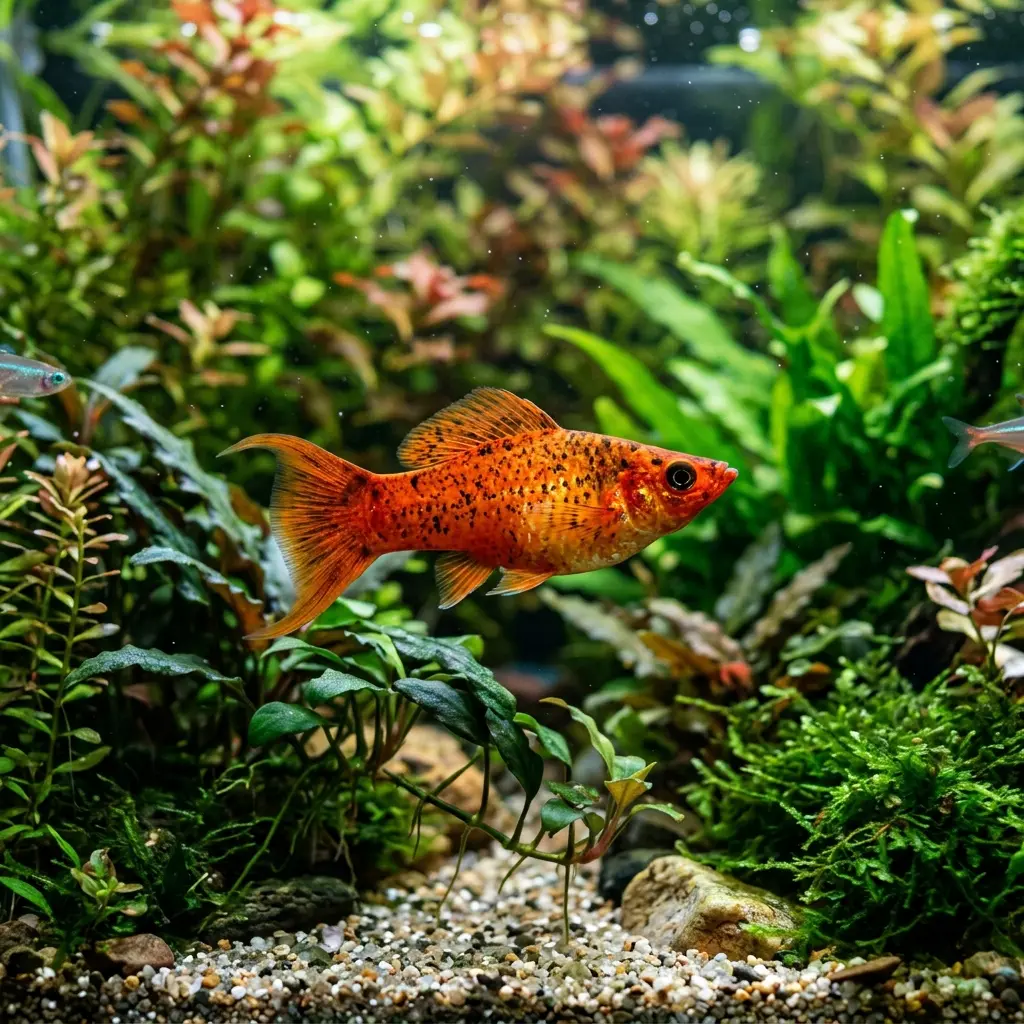
Short-finned Mollies reach 3 to 4.5 inches (7.5 to 11.5 cm), while Sailfin varieties can attain 5.5 to 6 inches (14 to 15 cm) under optimal conditions. Males are generally smaller and more slender than females, with the distinctive gonopodium—a modified anal fin used for internal fertilization. In Sailfin species, mature males develop an enormous dorsal fin that can exceed the body height when fully erected; this fin is a reliable indicator of genetic fitness and health. Females develop a gravid spot near the anal fin during pregnancy, darkening as birth approaches. Coloration varies enormously by variety: Black Mollies display velvety, light-absorbing pigmentation; Dalmatians exhibit black spotting on a silver background; Gold Dust Mollies shimmer with metallic yellow-gold scales.
Natural Habitat and Distribution
Wild Mollies inhabit a remarkable diversity of aquatic environments across the southern United States (from the Carolinas to Texas), Mexico, Central America, and northern South America. Their range includes freshwater marshes, lowland streams, swamps, estuaries, brackish coastal lagoons, and even full marine environments around mangrove roots and harbor structures. This ecological flexibility explains their exceptional hardiness in captivity, but it also creates a critical husbandry requirement: all Molly habitats share high mineral content, alkalinity, and calcium levels, regardless of salinity. Mollies kept in soft, acidic water universally fail to thrive.
Care
Housing and Environmental Requirements
Tank Size and Dimensions
The minimum tank size for a small group of short-finned Mollies is 20 gallons (75 liters) with a footprint of at least 24x12 inches (60x30 cm). For Sailfin Molly varieties, you must provide 30 gallons (113 liters) minimum due to their larger adult size and more active swimming behavior. A 29-gallon (110 liter) or 40-gallon breeder (36x18x16 inches / 90x45x40 cm) is ideal for a mixed community of 6-8 Mollies with compatible tank mates. The general rule is 3-5 gallons (11-19 liters) of water per adult Molly beyond the first two. Tall narrow tanks are unsuitable; horizontal swimming space is the critical dimension. Water parameters are less stable in smaller tanks, making 20 gallons the responsible minimum even for beginners.
Filtration and Water Flow
Mollies prefer moderate water flow and well-oxygenated conditions. Use a hang-on-back filter or canister filter rated for at least 1.5x the tank volume, providing 5-10x turnover per hour. They appreciate gentle current but will avoid areas with strong turbulent outflow. Ensure the filter creates mild surface agitation to maintain oxygen exchange, as Mollies are active swimmers with a high metabolic rate. In brackish setups, ensure filter components are corrosion-resistant. Air stones or bubble wands provide supplementary oxygenation that supports their active lifestyle and aids in maintaining the aerobic conditions necessary for nitrifying bacteria in hard-water systems.
Substrate and Hardscape
Use dark fine gravel or sand substrate to enhance color perception and provide a natural foraging surface. Mollies spend most of their time in the middle and upper water column but will forage along the bottom for fallen food and algae. Dark substrate intensifies the coloration of Black Mollies and provides visual contrast for lighter varieties. Incorporate smooth rocks, driftwood, and caves to create territorial boundaries and break lines of sight. Ensure all hardscape is stable; active swimming may dislodge insecure decorations. Crushed coral or aragonite can be mixed into the substrate or placed in the filter to maintain hardness and pH.
Plant Recommendations
Provide dense planting along the sides and rear of the aquarium while leaving a central open swimming lane. Use robust species such as java fern, anubias, cryptoryne, and vallisneria, which tolerate hard, alkaline water. Fine-leaf plants including java moss, hornwort, guppy grass, and water sprite serve as essential fry refuge, as adult Mollies will consume their young if given the opportunity. Floating plants such as salvinia, frogbit, or red root floaters diffuse light and reduce skittishness. In brackish setups, select salt-tolerant plants or use marine-grade macroalgae. Avoid delicate stem plants that may be uprooted by active swimming.
Cover and Security
Mollies are capable jumpers and will clear the water surface when startled, during water changes, or when chased by aggressive tank mates. You must install a tight-fitting lid with no gaps exceeding 0.25 inches (0.6 cm). Jumping is most common during the first 48 hours after introduction and during aggressive courtship chasing by males. A secure lid is mandatory equipment, not an optional accessory.
Diet
Feeding and Nutritional Requirements
Dietary Composition
Mollies are omnivores with a pronounced herbivorous specialization. In the wild, they are nearly exclusive plant and algae eaters, grazing continuously on periphyton, biofilm, and aquatic vegetation. In captivity, you must provide a diet comprising approximately 60% vegetable matter and algae, 30% protein, and 10% fat. This high plant-fiber ratio supports their long digestive tract, prevents constipation, and maintains vibrant coloration. Diets lacking sufficient vegetable matter cause malnutrition, faded color, and digestive disorders within weeks.
Staple Foods
Feed high-quality spirulina flakes, vegetable-based granules, and algae wafers as the dietary foundation. Select products listing spirulina, kelp, or vegetable matter as the primary ingredient. These should be offered once or twice daily in portions consumed within 60 seconds. Mollies are enthusiastic surface feeders and will graze on algae growth throughout the tank, reducing the quantity of prepared food required in mature, well-lit aquariums.
Protein Supplements
Rotate frozen or live foods including brine shrimp, bloodworms, daphnia, and mysis shrimp 2-3 times weekly. These provide essential amino acids for growth, breeding condition, and immune function. Live blackworms are excellent for conditioning gravid females. Avoid tubifex worms from unreliable sources due to parasite transmission risk. Protein foods should be offered in moderation; excessive protein causes constipation and fatty liver disease in their herbivore-adapted digestive system.
Vegetable Matter and Algae
Plant fiber is non-negotiable for long-term health. Offer blanched zucchini, cucumber, spinach, peas, lettuce, and nori sheets twice weekly. These provide essential fiber, prevent constipation, and supply carotenoids for color maintenance. Mollies will graze on hair algae, soft green algae, and diatoms in the aquarium, making them minor algae-control agents. You must never feed beef heart, mammalian meat, or bread products; livebearers lack the digestive enzymes to process these materials, leading to fatty liver disease and organ failure.
Feeding Schedule
- Daily: Spirulina flakes, vegetable granules, or algae wafers
- 2-3x weekly: Frozen brine shrimp, bloodworms, or daphnia
- Weekly: Blanched vegetables (zucchini, spinach, cucumber, peas)
- Fast day: Skip feeding once weekly to clear digestive systems
Feeding Behavior Notes
Mollies are competitive, active feeders that will swarm the surface during feeding time. In community tanks, they may outcompete slower or more timid species. Use feeding rings or target feeding to ensure all inhabitants receive adequate nutrition. Their constant grazing behavior makes them excellent indicators of tank health; a Molly that stops grazing or loses interest in food is an early warning sign of water quality problems or illness.
Health
Health Management and Disease Prevention
Mollies are generally hardy when maintained in appropriate hard, alkaline water but are notoriously sensitive to soft-water conditions, poor water quality, and mineral deficiencies. Their high mineral requirement means they are often the first fish to show stress when water chemistry drifts. Quarantine all new specimens for a minimum of 14 days. Maintain nitrates below 20 ppm through disciplined weekly water changes. Monitor for early warning signs including shimmying, clamped fins, faded coloration, or reduced grazing activity.
General Health Maintenance
Ensure water hardness remains above 10 dGH at all times; this is the single most important health factor for Mollies. Use crushed coral, aragonite, or mineral blocks in the filter to maintain calcium and magnesium levels. Perform weekly 25% water changes with temperature-matched water. Avoid sudden parameter swings exceeding 0.3 pH units or 2°F (1°C) per day. In brackish setups, monitor salinity with a refractometer and maintain stability within +/- 0.001 specific gravity per 24 hours.
Molly Disease / Shimmies (Livebearer Disease)
A non-infectious collection of stress symptoms caused by inadequate water mineralization, low pH, and soft water. The most common health problem in captive Mollies.
- Constant shaking or shimmying motion as if shivering, clamped fins, lethargy, loss of appetite, faded coloration, hanging near the bottom, difficulty maintaining equilibrium
dGH below 10, pH below 7.0, inadequate calcium and magnesium levels, osmotic dysfunction, electrolyte imbalance, chronic stress from soft water conditions
Correct water chemistry immediately: raise dGH to 15-20 with crushed coral or mineral blocks; add 1-2 teaspoons aquarium salt per gallon or marine salt mix at 1 tablespoon per 5 gallons; maintain temperature at 78°F (25.5°C); perform 25% water changes with hard water; use medicated mineral blocks with copper and sulfa blends for advanced cases; perform 30-minute salt baths with methylene blue twice daily for 4-7 days if secondary infections present
Ichthyophthirius multifiliis (Ich / White Spot Disease)
A protozoan parasite causing white cysts on skin, fins, and gills. Common in new arrivals and during temperature fluctuations.
- White salt-like spots across body and fins, flashing against substrate, labored breathing, clamped fins, rubbing against decorations
Introduction via infected fish or plants, temperature fluctuations, stress from poor water quality or soft water weakening immune response
Quarantine all new additions for 14 days; raise temperature gradually to 82°F-86°F (28°C-30°C) for 4 days to accelerate parasite life cycle; treat with formalin-malachite green combination or copper at 0.2 mg/L; Mollies tolerate salt baths up to 5 ppt exceptionally well; maintain dGH above 15 and pH above 7.5
Velvet Disease (Piscinoodinium pillulare)
A parasitic dinoflagellate infection resembling ich but with much smaller gold-dust cysts. Highly contagious and photosynthetic.
- Fine gold or rust-colored dusting on skin and fins, scratching against objects, clamped fins, rapid breathing, lethargy, refusal to eat, hanging near filter outflows
Introduction via infected fish or plants, stress from suboptimal parameters, the parasite utilizes photosynthesis making lighted tanks more susceptible, inadequate quarantine
Darken the tank completely for 48 hours to inhibit parasite photosynthesis; treat with copper sulfate at 0.15-0.20 mg/L for 10-14 days; Mollies tolerate salt up to 10 ppt which kills velvet at 1.012 specific gravity; increase aeration during treatment; quarantine all new additions for 14 days
Fin Rot (Aeromonas / Pseudomonas / Flavobacterium infection)
Bacterial degradation of fin tissue, frequently secondary to poor water quality, fin-nipping, or soft-water stress.
- Frayed or receding fin edges, white or red inflamed margins, lethargy, loss of appetite, fins appearing shorter than normal
Elevated nitrates above 20 ppm, ammonia or nitrite spikes, soft water below 10 dGH causing immunosuppression, fin damage from rough handling or aggressive tank mates, inadequate water change frequency
Maintain pristine water quality with weekly 25% changes; keep dGH above 15 and pH above 7.5; treat with broad-spectrum antibiotics such as erythromycin, kanamycin, or Seachem KanaPlex in hospital tank; add 1-2 teaspoons salt per gallon to support osmoregulation; remove carbon during medication
Internal Parasites (Nematodes / Trematodes / Cestodes)
Common in commercially farm-raised livebearers. Camallanus worms, intestinal flukes, and tapeworms frequently infect mass-produced Mollies.
- Wasting despite normal appetite, stringy or white feces, bloated abdomen, lethargy, reduced color intensity, visible red worms protruding from vent (camallanus), scratching against substrate
Introduction via farm-raised stock, contaminated live food, poor quarantine protocols, accumulation of organic detritus in substrate
Quarantine all new specimens for 14 days minimum; treat prophylactically with Praziquantel for flukes and tapeworms; use levamisole at 2 ppm for 24 hours if camallanus worms are visible; feed medicated food containing metronidazole for flagellates; vacuum substrate thoroughly during water changes; avoid tubifex worms from unreliable sources
Breeding
Captive Breeding Protocol
Natural Reproductive Biology
Mollies are prolific livebearers that require absolutely no special environmental triggers to reproduce. The male inseminates the female via a modified anal fin called a gonopodium. Females can store viable sperm for months, producing multiple broods from a single mating. After a gestation period of 4 to 5 weeks, the female gives birth to 20 to 100 free-swimming fry. Under optimal conditions, a healthy female produces a new brood every 28 to 35 days for her entire reproductive life. This prolific breeding is the primary challenge of Molly keeping, not a difficulty to overcome.
Sexing and Broodstock Selection
Sexing is straightforward: males possess the gonopodium, a slender, rod-like modified anal fin, while females have a broad, fan-shaped anal fin. Males are typically smaller and more slender; females are larger with a rounder abdominal profile. In Sailfin varieties, only males develop the enlarged dorsal fin. Select sexually mature fish aged 4 to 6 months. Maintain a ratio of 1 male to 2-3 females to prevent female exhaustion. In male-only display tanks, keep 4-5 males with no females to eliminate breeding entirely.
Breeding Tank Setup
No special breeding tank is required; Mollies breed in any adequately maintained aquarium. However, if you intend to raise fry, set up a 10-gallon (38 liter) nursery tank with a sponge filter, dense java moss, hornwort, or guppy grass, and a bare bottom or smooth sand substrate. Keep parameters identical to the main tank: pH 7.5, dGH 15-20, temperature 78°F (25.5°C). Add a small amount of aquarium salt (1 teaspoon per gallon) to reduce stress and improve fry survival.
Fry Management
Adult Mollies provide no parental care and will consume fry immediately if given the opportunity. To maximize survival, either provide dense vegetation where fry can hide, use a breeding net or box to isolate the gravid female during birth, or maintain a dedicated nursery tank. Remove the female immediately after she gives birth, as she will eat her own young. Newborn fry measure approximately 0.25 inches (6 mm) and immediately accept crushed flakes, powdered spirulina, and liquid fry food. Transition to baby brine shrimp nauplii within 3-5 days. Perform daily 10% water changes in the nursery tank. Sexual maturity occurs at 3 to 4 months, at which point males must be separated from females if you wish to control breeding.
Population Control Strategies
Controlling Molly population requires proactive management. The most reliable method is maintaining single-sex tanks. A group of 4-5 males without females lives harmoniously and eliminates all breeding. Alternatively, allow natural predation in a sparsely planted community tank, though this is unreliable and some fry invariably survive. For dedicated breeders, raise fry in nursery tanks and sell or trade juveniles at 6-8 weeks. Never release Mollies into local waterways; they are invasive in many tropical and subtropical regions.
Tips
Expert Tips and Common Mistakes
Critical Success Factors
- Water Hardness is Non-Negotiable: Mollies are not forgiving of soft water. dGH below 10 triggers the shimmies, immunosuppression, and premature death. This is the single most common cause of Molly mortality in home aquariums. Crushed coral, aragonite, or mineral blocks in the filter are mandatory equipment in soft-water areas.
- Minerals Over Salt: While Mollies tolerate salt well, what they truly require is calcium, magnesium, and carbonate hardness. Marine salt mix is superior to aquarium salt because it provides the complete mineral profile. If your tap water is soft, use marine salt mix at 1 tablespoon per 5 gallons rather than just adding sodium chloride.
- Vegetable Matter Majority: Their digestive system is adapted for high plant fiber. Diets lacking spirulina, algae, and vegetables cause constipation, fatty liver, and faded coloration within weeks. Vegetable matter must constitute 60% of their intake.
- Proactive Population Control: Decide your breeding strategy before purchasing. A single pregnant female can produce 500+ fry in her first year. Male-only groups, dedicated nursery tanks, or natural predation are your three options.
Common Mistakes to Avoid
- Soft Water Maintenance: Keeping Mollies in soft acidic water (dGH below 10, pH below 7.0) is the most common and fatal mistake. They will develop the shimmies, lose color, and die within months. They are not suitable for Amazon biotope tanks or discus communities.
- Undersized Tanks: Housing Sailfin Mollies in 10 or 20-gallon tanks causes stunting, suppressed sailfin development, and premature death. Sailfin varieties demand 30+ gallons for long-term health.
- Overfeeding Protein: Exclusively flake-based diets lacking vegetable matter cause digestive disorders. Mollies are not carnivores; they are herbivore-leaning omnivores.
- Ignoring the Gravid Spot: The dark spot near the female's anal fin darkens as birth approaches. Failing to provide dense vegetation or a breeding net results in 100% fry predation by adults.
- Mixing with Soft-Water Species: Cardinal tetras, discus, German blue rams, and other acid-loving species cannot thrive in Molly-appropriate water, and Mollies cannot thrive in theirs. Parameter mismatch guarantees stress for all parties.
- Skipping Quarantine: Farm-raised Mollies frequently carry internal parasites and subclinical infections. Always quarantine for 14 days minimum.
Advanced Techniques
- Brackish Community Setup: Mollies thrive in specific gravity 1.002-1.005 with salt-tolerant plants and tank mates. This salinity level prevents ich, velvet, and many external parasites while supporting robust health. Use marine salt mix and monitor with a refractometer.
- Green Water Fry Culture: For maximum fry survival, culture single-celled algae (green water) in the nursery tank. Fry graze continuously on suspended algae, supporting rapid growth and reducing the need for frequent feeding.
- Seasonal Temperature Cycling: Simulating natural seasonal temperature variations of 74°F-82°F (23°C-28°C) over the year stimulates more natural behavior and can increase breeding vigor in established colonies.
- Wonder Shell Mineral Supplementation: Mineral blocks that dissolve slowly provide a constant supply of calcium, magnesium, and electrolytes. These are particularly valuable in soft-water areas and prevent the shimmies more effectively than periodic water changes alone.
Compatible Tank Mates






Species Comparison
| Feature | Short-Finned Molly | Sailfin Molly | Platy | Swordtail |
|---|---|---|---|---|
| Scientific Name | Poecilia sphenops | Poecilia latipinna / P. velifera | Xiphophorus maculatus | Xiphophorus hellerii |
| Adult Size | 3 - 4.5 inches (7.5 - 11.5 cm) | 4 - 6 inches (10 - 15 cm) | 2 - 3 inches (5 - 7.5 cm) | 4 - 5.5 inches (10 - 14 cm) |
| Minimum Tank Size | 20 gallons (75 L) | 30 gallons (113 L) | 15 gallons (57 L) | 20 gallons (75 L) |
| Temperament | Peaceful / Active | Peaceful / Active | Peaceful | Peaceful / Males may spar |
| Water Hardness (dGH) | 10 - 30 dGH (requires hard water) | 15 - 30 dGH (requires very hard water) | 10 - 25 dGH | 10 - 25 dGH |
| Breeding Type | Livebearer; 20-100 fry every 28-35 days | Livebearer; 20-100 fry every 28-35 days | Livebearer; 20-40 fry every 28-30 days | Livebearer; 20-80 fry every 28-30 days |
| Special Requirements | High mineral content; salt-tolerant; prone to shimmies in soft water | Very large tank; needs direct sunlight or bright light for sailfin development | Less demanding; more forgiving of soft water than Mollies | Males possess tail extension; needs jump-proof lid |