
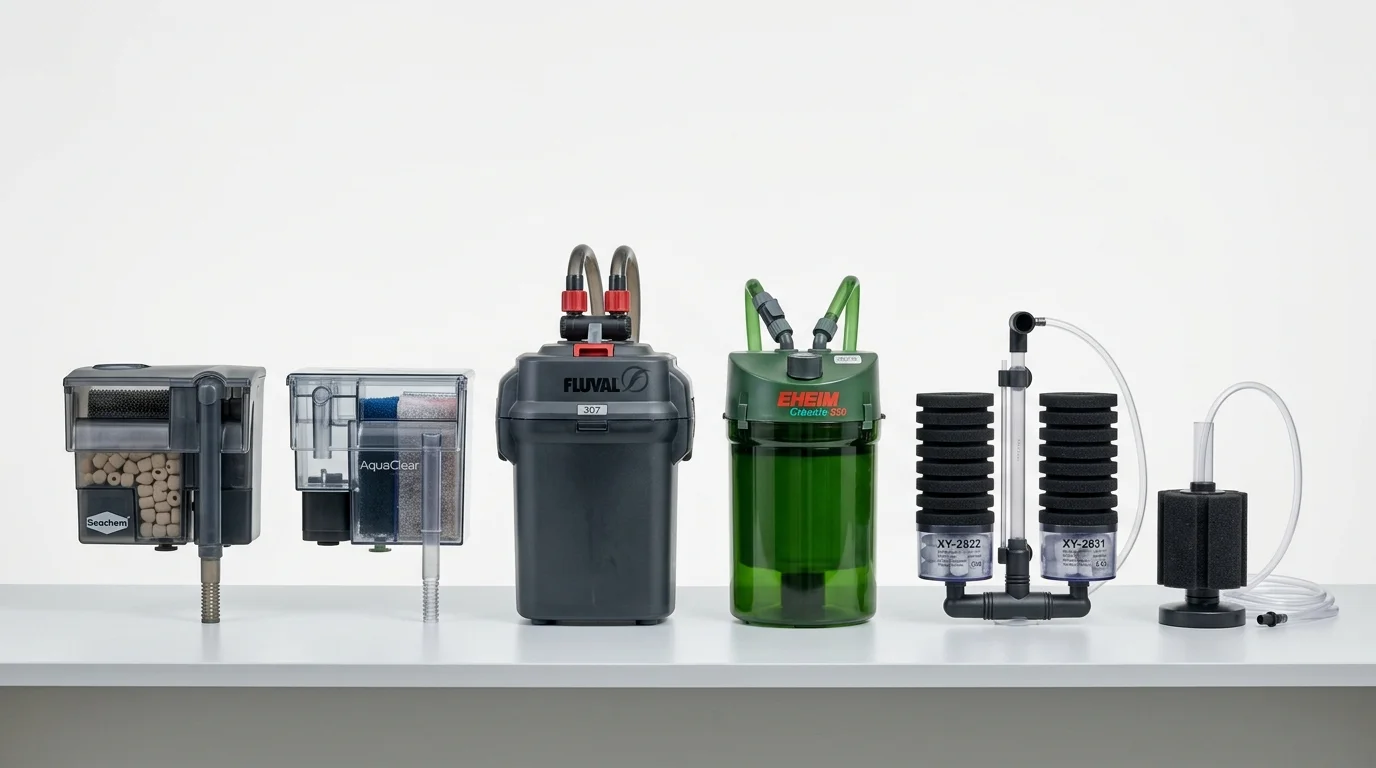
Quick Answer
Aquarium filtration is defined by architecture, not branding. Hang-On-Back (HOB) filters offer accessible mechanical maintenance and surface gas exchange for many standard community tanks. Pressurized canister filters can provide substantial biological media capacity and directional flow, making them useful for many heavy-bioload predator or cichlid systems. Air-driven sponge filters provide gentle flow and low intake risk, making them commonly useful for shrimp and breeding tanks. Sumps expand system water volume and provide space for integrated equipment, which can be useful on larger or higher-bioload systems. Rather than relying only on manufacturer zero-head ratings, evaluate real-world loaded turnover after accounting for head loss, media resistance, livestock needs, and aquarium circulation.
Effective aquatic life support relies on three interdependent stages: mechanical particulate straining, autotrophic biological nitrification, and chemical adsorption. The internal architecture of a filter dictates fluid velocity, contact dwell time across nitrifying biofilms, and hydraulic circulation patterns within the display tank. Selecting filtration requires sizing media volume and real-world pump displacement to metabolic bioload rather than marketing box labels.
1. Pressurized Canister Filters: High-Volume Media and Directional Vectoring
Canister filters operate as closed, external pressure vessels situated below the aquarium. Siphon gravity drives water through an intake strainer down into the canister body, where an electric magnetic impeller drives fluid up through vertically or horizontally stacked media baskets before discharging via return pipes or spray bars.
- Biological Capacity: Exceptional. Canisters can provide substantial internal media volume outside of dedicated sumps, and many models use high-porosity sintered glass or ceramic media. Published specific-surface-area figures vary substantially by media product and test method, so nominal surface-area figures should not be treated as a direct measure of biological performance.
- Hydrodynamic Control: Positioning the intake tube and return outlet at opposing ends of the tank establishes continuous linear cross-flow, sweeping benthic detritus and eliminating circulation dead zones in 4-foot and 6-foot longitudinal tanks.
- Planted & CO2 Tank Utility: Because the loop is hermetically sealed with submerged inputs and outputs, canisters generate zero surface splashing, preserving dissolved carbon dioxide (CO2) for aquatic plant photosynthesis.
- Operational Constraints: Routine servicing is labor-intensive. Canisters must be taken offline, depressurized, drained, and disassembled. If O-rings dry out or clamp alignments shift, they introduce catastrophic leak and siphon-drain flood risks.
2. Hang-On-Back (HOB) Power Filters: Rapid Access and High Gas Exchange
HOB filters seat directly onto the open upper rim of the aquarium perimeter. An internal or external induction motor pulls water up a vertical siphon pipe into an open reservoir, forcing water horizontally through mechanical and chemical media cartridges before spilling back into the display tank over a gravitational waterfall weir.
- Maintenance Accessibility: Highest among motorized systems. Mechanical filter floss, pre-filter sponges, and chemical resins can be inspected, rinsed, or replaced in seconds without taking the unit offline or draining plumbing.
- Surface Oxygenation: The freefall cascade breaks surface tension across a wide boundary layer, driving turbulent gas exchange that strips carbon dioxide and saturates the upper column with dissolved oxygen.
- Optimal Application: Ideal for nano setups, quarantine systems, and standard community tanks up to 55 gallons.
- Hydrodynamic Limitations: Flow is localized around the return spillway. In longitudinal aquariums (such as 36-inch or 48-inch footprints), single HOB filters generate stagnant dead zones at perimeter corners, allowing waste accumulation unless dual filters are deployed at opposite ends.
3. Air-Driven Sponge Filters: Pneumatic Lift and Invertebrate Safety
Sponge filters utilize the buoyant kinetic energy of compressed air rather than motorized impellers. An external diaphragm pump injects air through an airline into the base of a hollow central lift tube. As the bubbles rise, they create localized low-pressure displacement (the airlift pump principle), drawing water radially inward through an open-cell reticulated polyurethane foam sleeve.
- Zero Ingestion Hazard: Fluid face velocity across the sponge surface is exceptionally low (typically < 0.02 m/s). This eliminates suction trauma, making sponge filtration a commonly used low-intake-risk option for Neocaridina and Caridina shrimp colonies, dwarf cichlid fry, and egg-laying breeders.
- Filtration Modality: Exclusively biological and coarse mechanical. The reticulated foam matrix develops dense colonies of autotrophic Nitrosomonas and Nitrospira. Chemical adsorption is absent unless modular carbon cores are fitted.
- Optimal Application: Shrimp hatcheries, quarantine and hospital tanks, shallow fry trays, and low-flow labyrinth fish (such as Betta splendens and wild Gouramis).
- Mechanical Constraints: Incapable of high-volume water polishing or clearing suspended particulate matter in medium-to-large community aquariums. Internal placement also consumes display space.
4. Open Sump Filtration Systems: Unmatched Volume and Hardware Integration
A sump system comprises a secondary, compartmentalized reservoir positioned within the support cabinetry below the primary display tank. Water exits the main display via surface skimming overflow weirs, travels down under gravity through primary drains, traverses modular mechanical filter fleece and fluidized media chambers, and is returned via an external or submersible high-head pressure pump.
- System Water Expansion: A 30-gallon sump connected to a 100-gallon display expands total circulating volume to 130 gallons, substantially increasing chemical buffering capacity and diluting metabolic nitrate accumulation.
- Equipment Concealment: Submersible heaters, automated top-off (ATO) float valves, UV-C sterilizers, pH probes, and chemical dosage lines are housed entirely within the sump chambers, keeping the display footprint clear of clutter.
- Optimal Application: High-bioload setups (such as Lake Malawi Mbuna colonies, large Neotropical predators, and monster fish), systems exceeding 120 gallons, and centralized commercial breeding racks.
- Operational Constraints: Highest equipment and installation cost. Sumps demand drilled glass bulkheads or overflow boxes, balance-tuned drain pipes to suppress cavitation noise, and check-valved returns to prevent back-siphon floods during utility power failures.
Calculating Real-World Turnover: Accounting for Head Loss and Media Compaction
Pump manufacturers calculate Gallons Per Hour (GPH) flow ratings under ideal conditions: zero vertical elevation (zero head pressure) and uninhibited by filtration media. In real-world closed or open loops, pump velocity is substantially reduced by two continuous physical factors:
- Static Head Pressure: The vertical distance from the pump impeller to the display return outlet. In standard canister and sump installations (elevated 3.5 to 5 feet), static gravity resistance reduces rated pump displacement by 25% to 40%.
- Media Friction and Slime-Layer Resistance: Dense mechanical pads, fine micron polishing floss, and thick bacterial biofilms inside porous ceramic media introduce continuous flow resistance. As mechanical stages trap detritus, flow diminishes further.
To maintain water quality and prevent hypoxic dead zones, evaluate your pump sizing using our Filter Turnover Calculator. As a starting framework, evaluate whether real-world flow can provide roughly 5× to 8× hourly turnover for many planted and community tanks and roughly 8× to 10× for some heavy-bioload cichlid and predator systems, then adjust for livestock needs, aquascape, circulation, head loss, and maintenance.
The Problem
Hobbyists often select filtration based on marketed 'tank size ratings' rather than evaluating the required biological media volume and hydrodynamics needed for their specific livestock's waste output.
When to Use This Tool
Consult this guide when designing a new aquarium system, troubleshooting persistent ammonia spikes, or determining the safest flow architecture for sensitive species.
Who is this for?
- Freshwater aquarists seeking an objective, brand-agnostic breakdown of filtration mechanics, flow dynamics, and biological capacity.
Filtration Architectures Compared
| Setup Architecture | Primary Strength | Flow Pattern | Water Movement / Gas Exchange | Bioload Suitability | Typical Complexity |
|---|---|---|---|---|---|
| Pressurized Canister | High-volume enclosed media capacity | Directional return / closed-loop circulation | Low surface disturbance; configurable return flow | Very High | Intermediate |
| Hang-On-Back (HOB) | Accessible mechanical maintenance | Localized return flow with surface cascade | High surface gas exchange | Moderate | Beginner |
| Air-Driven Sponge | Gentle biological filtration | Radial inward flow driven by airlift | High gas exchange with low intake velocity | Low to Moderate | Beginner |
| External Open Sump | Large water volume and equipment integration | Adjustable multi-port return flow | Surface overflow plus open sump gas exchange | Extreme | Advanced |
Troubleshooting Guide
1 HOB Filter motor emits an abrasive grinding sound and ceases pumping water after a power outage.
The pump chamber has lost its water prime, running the magnetic impeller dry against air. Immediately disconnect electrical power, manually fill the main filter reservoir to the brim with dechlorinated aquarium water to submerge the impeller housing, and reconnect power to re-establish siphon suction.
2 Canister filter return flow drops by more than 50% within two to three weeks of maintenance.
Fine particulate matter or bacterial slime has clogged the mechanical polishing floss or intake strainer pre-filter. Disconnect the quick-release valves, open the media stack, and rinse or replace the mechanical pads. Verify that flexible vinyl hoses are free of internal bio-floc accumulation by scrubbing them with an inline tube brush.
3 Air-driven sponge filter produces large, violent eruptive bubbles with negligible water lift.
The integrated porous air stone inside the lift tube core has cracked, fallen off, or calcified. Disassemble the inner lift assembly and install a fresh micro-pore air stone or limewood diffuser to restore dense bubble columns and recover airlift suction efficiency.
4 Water discharges over the top casing or bypass channel of an HOB power filter.
Internal media cartridges or foam pads are saturated with trapped debris, causing hydraulic backpressure that pushes incoming water through the emergency bypass weir. Remove the mechanical sponge pad and rinse it thoroughly in a bucket of removed tank water to clear interstitial flow channels.
Frequently Asked Questions
How often should I discard and replace my filter media?
Is running two smaller filters better than running a single large filter?
Why is my canister filter blowing fine micro-bubbles and making a churning sound?
Which filter type is quietest for an aquarium kept in a bedroom?
Can I use an air-driven sponge filter as the primary filtration on a 55-gallon tank?
Do sumps cause higher evaporation rates than canister filters?
Glossary of Terms
- Static Head Pressure
- The total vertical elevation distance between the pump impeller and the aquarium discharge outlet, which exerts gravitational resistance that decreases nominal pump flow rate.
- Airlift Principle
- A fluid propulsion mechanism where compressed air bubbles introduced at the base of a submerged vertical tube reduce fluid density, creating buoyant upward lift that draws surrounding water through adjacent media.
- Contact Dwell Time
- The duration of time water molecules remain in physical contact with nitrifying bacterial biofilms inside porous filter media, governing the efficiency of ammonia and nitrite oxidation.
- Specific Surface Area (SSA)
- The total available biological colonization surface area per unit of physical volume (expressed in m²/L or ft²/gal) provided by porous media substrates like sintered glass or reticulated polyurethane foam.
- Hydraulic Short-Circuiting
- A filtration defect where incoming water follows the path of least physical resistance around media edges rather than passing through the filtration matrix, preventing complete biological and mechanical processing.
Scientific References
- Biofiltration and Nitrification Kinetics in Closed Recirculating Aquatic Systems
- Hydrodynamics of Airlift Pumps and Oxygen Mass Transfer in Aquaculture Engineering
- Hydraulic Head Loss and Flow Rate Degradation Across Porous Biofilter Media