
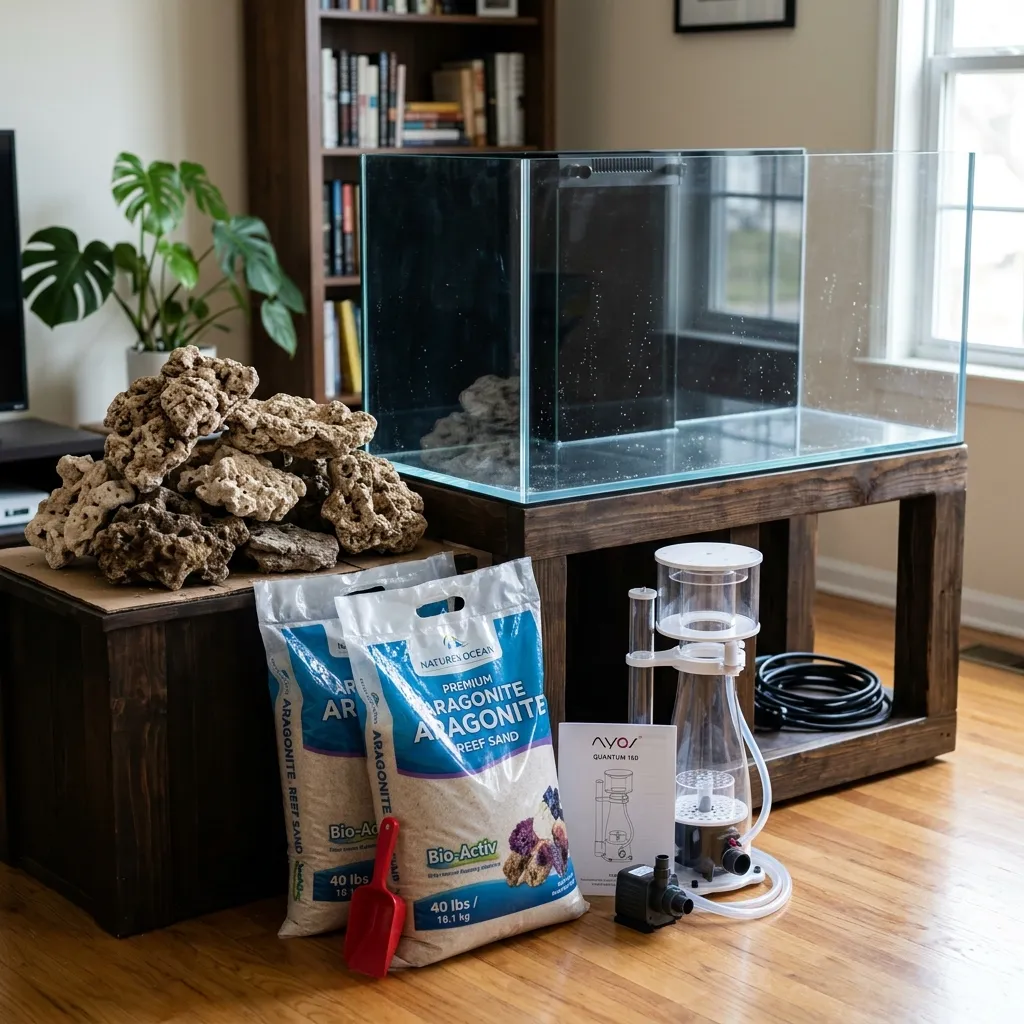
Quick Answer
Setting up a marine aquarium requires specialized equipment including a protein skimmer, powerheads for high flow, and a refractometer to measure salinity. You must mix synthetic sea salt with RO/DI water to reach a specific gravity of 1.020-1.026. The tank is aquascaped with dry or live rock, filled with the saltwater, and cycled over 4 to 8 weeks before any livestock can be added.
Introduction to Marine Aquarium Setup
Transitioning from freshwater to saltwater aquariums is a rewarding challenge. Marine environments are significantly more complex and demand tighter control over water chemistry. The ocean is an incredibly stable environment; marine organisms have not evolved to tolerate the rapid fluctuations common in freshwater habitats.
This guide will walk you through the foundational setup of a marine aquarium, focusing on the specialized equipment and procedures required to establish a thriving saltwater ecosystem.
Core Marine Equipment
A saltwater aquarium requires entirely different life-support systems compared to a freshwater tank.
### 1. Water Purification (RO/DI System) You cannot use tap water to mix synthetic seawater. A Reverse Osmosis De-Ionization (RO/DI) system is mandatory. It strips the water of all impurities, producing 0 TDS (Total Dissolved Solids) pure water. Using tap water will introduce silicates and phosphates, leading to devastating outbreaks of hair algae, cyanobacteria, and diatoms.
### 2. Protein Skimmer Unlike freshwater filters that rely heavily on mechanical and biological media, marine tanks rely on **fractionation**. A protein skimmer creates millions of micro-bubbles inside a reaction chamber. Dissolved organic compounds (fish waste, uneaten food) stick to the bubbles and are pushed into a collection cup, removing them from the system entirely before they can rot and ruin water quality.
### 3. Powerheads (Wavemakers) Marine fish and corals require significantly more flow than freshwater species. In the ocean, they are subjected to tides and currents. You must install powerheads to create a turbulent, random flow pattern. This keeps detritus suspended so the filter can remove it, and ensures oxygen exchange at the water's surface.
### 4. Salinity Measurement To mix saltwater accurately, you need a refractometer (do not rely on cheap plastic hydrometers, as they are notoriously inaccurate). You will also need high-quality synthetic marine salt mix.
Mixing Saltwater
**Never mix salt directly in the aquarium if there is livestock in it.** For the initial setup, however, you can mix it in the empty tank.
1. Fill the tank (or mixing vats) with pure RO/DI water. 2. Turn on a heater and a powerhead to warm and circulate the water. Salt dissolves poorly in cold, stagnant water. 3. Slowly add the synthetic salt mix according to the manufacturer's directions (usually about 1/2 cup per gallon). 4. Wait 24 hours for the salt to fully dissolve and the pH to stabilize. 5. Test the specific gravity with your refractometer. * For a Fish-Only (FOWLR) tank, aim for **1.020 - 1.023**. * For a Reef tank (corals), aim for **1.025 - 1.026**.
Aquascaping: The Foundation of Biological Filtration
In a marine tank, your aquascape is your filter. You will build a structure using porous rock.
* **Dry Rock:** Mined rock that contains no life. It is cheaper and guarantees you won't introduce pests (like Aiptasia anemones or mantis shrimp), but it takes months to establish a strong biological colony. * **Live Rock:** Rock harvested from the ocean or aquaculture facilities, teeming with bacteria and micro-life. It kick-starts the biological filter but is expensive and carries the risk of hitchhikers.
Build a stable structure that allows water to flow through and around it. Avoid building a solid "brick wall" of rock against the back glass; this creates dead spots where detritus accumulates.
### Substrate Use aragonite sand. Unlike freshwater gravel, aragonite is calcium-based and slowly dissolves, buffering the water to maintain the high pH (8.1 - 8.4) required by marine life.
The Marine Cycle
Once the tank is filled, salted, and aquascaped, the cycling process begins.
1. If using live rock, the natural die-off of organisms during transport will provide the ammonia needed to start the cycle. 2. If using dry rock, you must manually dose pure ammonia or add a piece of raw, unseasoned table shrimp to decay and produce ammonia. 3. Monitor Ammonia, Nitrite, and Nitrate using marine-specific test kits. 4. The cycle is complete when Ammonia and Nitrite consistently read 0 ppm, and Nitrate begins to rise.
During the cycle, keep the aquarium lights off to prevent massive algae blooms.
Next Steps: The "Ugly Stage"
Even after the tank cycles, it is not mature. New marine tanks go through a mandatory "ugly stage" for the first 6 to 12 months. You will experience blooms of brown diatoms, green hair algae, and potentially cyanobacteria as the micro-fauna balance themselves out.
Add a "cleanup crew" (snails, hermit crabs, and starfish) before adding your first fish. Proceed slowly, adding only one fish at a time to allow the biological filter to adjust to the new bioload.