
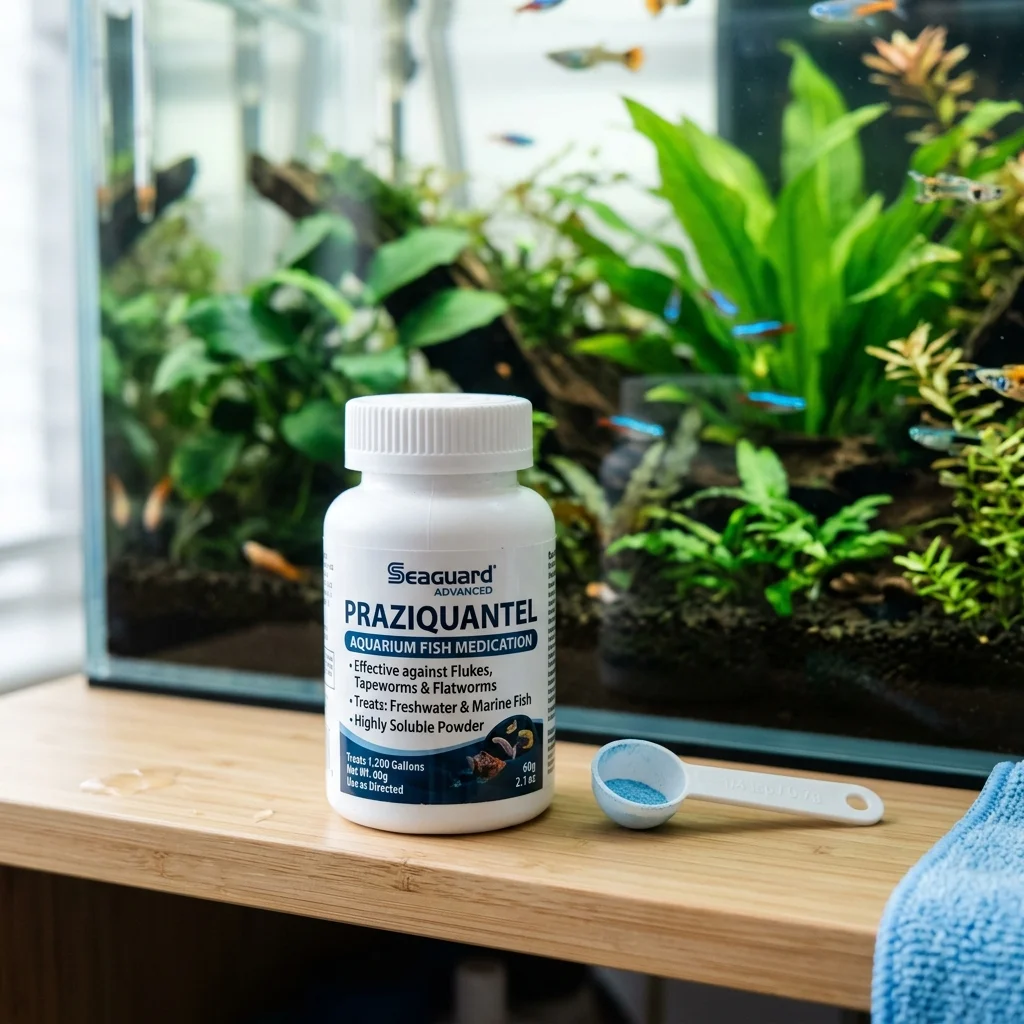
Quick Answer
Praziquantel is an antiparasitic medication used against susceptible flukes and tapeworms in fish. Depending on the parasite and product, it may be administered through aquarium water or as medicated food. Treatment schedules, compatibility, and water-quality effects depend on the exact formulation and aquarium conditions, so follow the product-specific instructions rather than applying a universal dose or repeat-treatment interval.
What Is Praziquantel?
Praziquantel is an antiparasitic drug used against susceptible parasitic flatworms. In aquarium fish, it is particularly associated with many monogenean flukes and cestodes (tapeworms).
The appropriate treatment depends on the suspected parasite, fish species, medication formulation, treatment route, and instructions for the exact product being used.
What Does Praziquantel Treat?
Praziquantel is primarily used against susceptible flatworms, including many monogenean flukes and cestodes. It is not a general-purpose treatment for every fish disease and should not be selected simply because a fish is showing nonspecific symptoms.
Flashing, scratching, respiratory changes, weight loss, abnormal feces, and other signs can have multiple possible causes. For suspected fluke infections, review the relevant Flukes disease profile and consider the complete clinical presentation.
How Does Praziquantel Work?
Praziquantel affects the neuromuscular function and membrane permeability of susceptible parasitic flatworms. This can cause abnormal contraction and paralysis, interfering with the parasite's ability to maintain its normal position on or within the host.
Its activity is directed toward susceptible parasites rather than functioning as a broad antibacterial or antifungal medication.
Water Treatment vs. Medicated Food
Praziquantel can be administered through aquarium water with appropriately formulated products. Oral administration through medicated food may also be useful when the target parasite is accessible through the digestive tract and the fish is eating.
The appropriate route depends on the parasite, its location, the fish's feeding behavior, and the medication product. Water treatment and oral treatment should not be assumed to be interchangeable.
When an internal parasite is suspected and the fish is eating reliably, medicated food can provide an oral route. If the fish is not eating, oral treatment may not provide reliable exposure and another treatment route may need to be considered.
Praziquantel and the Biological Filter
Praziquantel is often considered relatively compatible with biological filtration compared with some aquarium antimicrobials, but it should not be described as guaranteed to have no effect on every biological filter.
The active ingredient, formulation, concentration, exposure time, and other ingredients in a commercial medication can affect aquarium microorganisms differently.
Continue monitoring ammonia and nitrite during treatment, particularly in newly established aquariums, heavily stocked systems, or treatment tanks with limited biological filtration.
Is Praziquantel Safe for Scaleless Fish?
Scaleless fish such as many loaches and catfish should not automatically be assigned a universal reduced dose of praziquantel.
Treatment tolerance can vary with species, health status, formulation, concentration, water conditions, and treatment method. Check the specific product instructions for warnings, species restrictions, and compatibility information.
Do not assume that a recommendation for one praziquantel formulation applies to every product containing the same active ingredient.
Is Praziquantel Safe for Invertebrates?
Compatibility with shrimp, snails, and other aquarium invertebrates should be evaluated using the instructions for the exact medication product.
Different products can contain different inactive ingredients or carry different compatibility warnings. Do not treat praziquantel as universally safe for every aquarium invertebrate.
Praziquantel Treatment Schedules
The required treatment schedule depends on the parasite, medication formulation, concentration, treatment route, and product instructions.
Some aquarium treatment protocols use repeated treatments because parasite life stages can differ in susceptibility and because eggs or other stages may not be affected in the same way as active parasites.
Do not automatically repeat praziquantel after a fixed number of days unless that schedule is supported by the product instructions or appropriate disease-treatment guidance.
Praziquantel Treatment Safety
- Identify the suspected parasite before treatment whenever possible.
- Follow the manufacturer's dosing instructions for the exact product being used.
- Do not automatically increase, reduce, or repeat a dose without appropriate product-specific guidance.
- Monitor fish behavior, respiration, appetite, and other clinical signs during treatment.
- Monitor ammonia and nitrite during treatment.
- Check compatibility with shrimp, snails, plants, and other aquarium inhabitants.
- Use a hospital or quarantine tank when appropriate to control treatment exposure.
- Follow the product's instructions for water changes, filtration, carbon, and other treatment-related equipment.
When Praziquantel Is Not the Right Treatment
Praziquantel is not an all-purpose fish medication. It does not replace appropriate antibacterial, antifungal, or other antiparasitic treatment when those conditions are suspected.
Flashing, scratching, respiratory distress, weight loss, abnormal feces, and other symptoms can result from conditions other than flukes or tapeworms.
Using an ineffective medication can delay appropriate treatment and unnecessarily expose fish and aquarium microorganisms to medication.
Praziquantel and White or Stringy Feces
White or stringy feces are nonspecific and should not be treated as proof of a tapeworm or other flatworm infection.
Fecal appearance can be affected by diet, fasting, intestinal contents, gastrointestinal disease, and several different infectious or noninfectious conditions.
If abnormal feces occur together with weight loss, poor appetite, abdominal changes, or other persistent signs, assess the complete clinical picture before selecting praziquantel.
Using a Medication Dosage Calculator
When a product's dosing instructions require calculating a treatment quantity from aquarium volume, the Medication Dosage Calculator can help with the mathematical part of the calculation.
The calculator does not determine whether praziquantel is appropriate for a particular parasite, fish, or treatment situation. It also does not replace the medication manufacturer's instructions.
Key Takeaway
Praziquantel is an important antiparasitic treatment for susceptible flukes and tapeworms in aquarium fish. Its appropriate use depends on the parasite, fish, medication formulation, treatment route, and aquarium conditions.
Do not apply universal rules about dosing, repeat-treatment intervals, scaleless fish, invertebrate compatibility, or biological filtration. Follow the exact product instructions, monitor the fish and water quality, and reassess the diagnosis if the expected response does not occur.
The Problem
My fish is flashing, scratching, showing respiratory changes, losing weight, or has other signs that may indicate a fluke or tapeworm infection.
When to Use This Tool
Consider when a susceptible fluke or cestode infection is reasonably suspected or identified and praziquantel is appropriate for the fish, parasite, formulation, and treatment situation. Follow the exact product instructions rather than applying a universal treatment schedule.
Who is this for?
- Aquarium hobbyists and advanced aquarists seeking evidence-based information about praziquantel, susceptible parasites, treatment routes, safety considerations, and treatment limitations.
Praziquantel Treatment Approaches
| Approach | Typical Application | Key Consideration | Treatment Limitation |
|---|---|---|---|
| Praziquantel in Water | External flukes and other susceptible parasites accessible through the water | Follow product-specific concentration and exposure instructions | Effectiveness depends on parasite susceptibility and treatment conditions |
| Praziquantel in Medicated Food | Susceptible internal parasites when the fish is eating | Requires reliable food consumption and appropriate preparation | Cannot provide reliable oral exposure when fish are not eating |
Troubleshooting Guide
1 Flukes appear to return after treatment.
Reassess whether the original diagnosis was correct and check the treatment protocol for the suspected fluke. Some parasite life stages may be less susceptible to treatment, so repeated treatment can be part of some protocols. Follow the exact product or disease-treatment guidance rather than automatically repeating the same dose after a fixed interval.
2 Ammonia or nitrite increased during treatment.
Treat the increase as a water-quality or biological-filtration problem rather than assuming that praziquantel always causes a biofilter crash. Test ammonia and nitrite, perform appropriate water changes, maintain adequate aeration, and follow the medication's instructions for treatment and filtration.
3 The fish is not improving during treatment.
Do not automatically increase the dose or extend treatment. Reassess the diagnosis, water quality, likely parasite, treatment route, and medication suitability. If possible, obtain appropriate diagnostic or veterinary guidance.
4 The fish has white or stringy feces.
Do not use fecal appearance alone to diagnose tapeworms or flukes. Review appetite, body condition, diet, water quality, behavior, and other clinical signs before selecting or repeating antiparasitic treatment.
Frequently Asked Questions
Does praziquantel kill beneficial bacteria?
How long does praziquantel stay active in aquarium water?
Does praziquantel require a second dose?
Is praziquantel safe for shrimp and snails?
Is praziquantel safe for scaleless fish?
Glossary of Terms
- Monogenean Flukes
- Parasitic flatworms that commonly attach to the skin or gills of fish. Many monogeneans have direct life cycles involving reproduction on or near the host.
- Cestodes
- Parasitic flatworms commonly known as tapeworms. In fish, some cestodes occur within the digestive tract while others can occupy different tissues or body sites depending on the species.
- Antiparasitic
- A medication or treatment used to control or eliminate susceptible parasitic organisms.
- Medicated Food
- Fish food containing a measured amount of medication so that the drug is delivered orally when the fish consumes the food.