
Quick Answer
Marine quarantine is a mandatory 4-to-6-week isolation period for all incoming saltwater fish. Because marine parasites (like Cryptocaryon irritans and Amyloodinium) are highly lethal and cannot be treated in a reef tank without killing corals, you must quarantine all fish in a bare-bottom tank. Standard protocols often involve prophylactic treatment with chelated copper or hyposalinity to eradicate parasites before the fish enter the main display.
The Necessity of Marine Quarantine
While quarantine is highly recommended for freshwater fish, it is considered **mandatory** for marine aquariums. The stakes in a saltwater setup are exponentially higher.
Marine fish are expensive, and the parasites that afflict them—specifically Marine Ich (*Cryptocaryon irritans*) and Marine Velvet (*Amyloodinium ocellatum*)—are fast-acting and highly lethal. More importantly, it is virtually impossible to treat a sick fish inside a reef tank. The only proven treatments for these parasites involve copper or drastically lowered salinity, both of which will instantly kill corals, shrimp, snails, and the beneficial bacteria living inside your live rock.
If Marine Ich enters a reef display, the only solution is to catch every single fish, move them to a hospital tank for treatment, and leave the main display "fallow" (fishless) for 76 days to starve the parasite out. A proper quarantine protocol prevents this nightmare.
Marine Quarantine Tank Setup
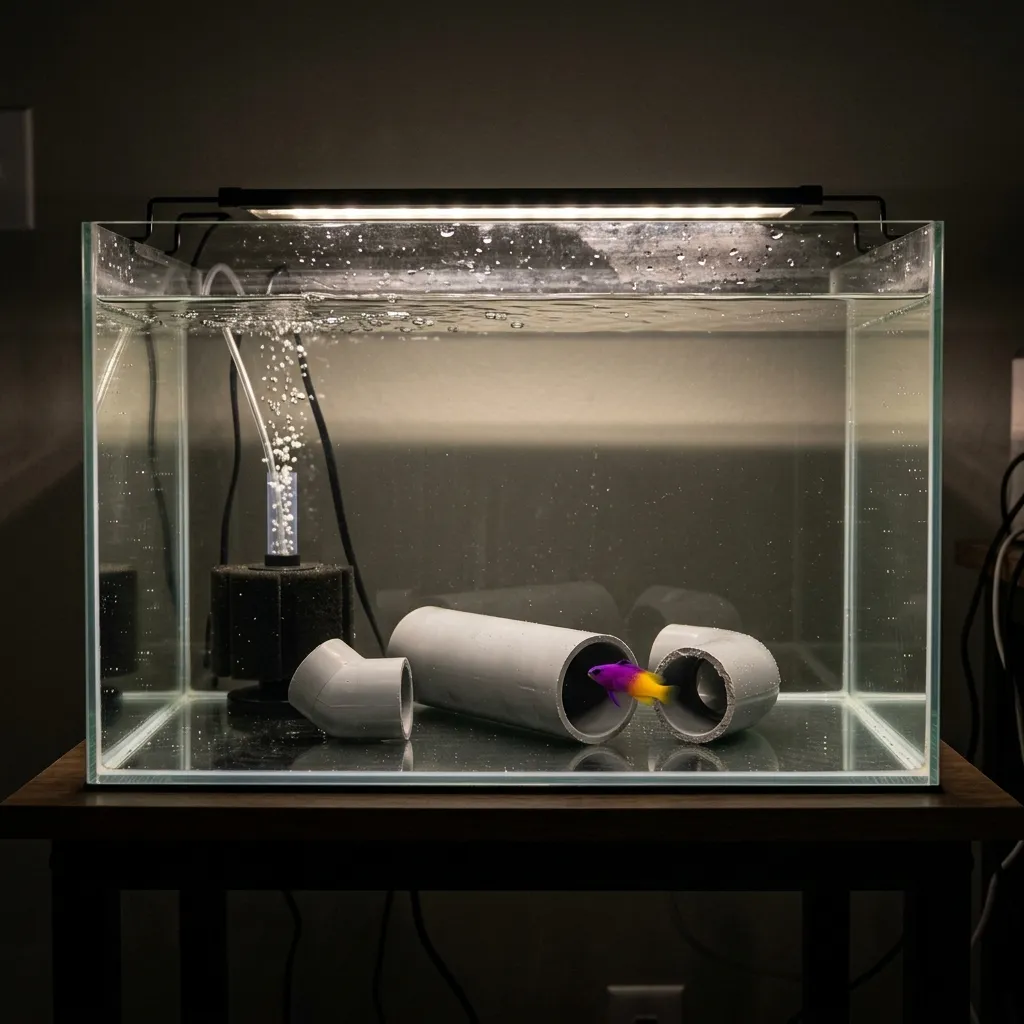
A saltwater quarantine tank must be sterile, easily sterilized, and free of anything that can absorb medication.
* **The Tank:** A standard 20-gallon long or 40-gallon breeder aquarium is ideal, depending on the size of the fish (Tangs require larger quarantine spaces). * **Filtration:** A simple Hang-On-Back (HOB) filter or a large sponge filter. *Do not use live rock or calcareous sand.* They will absorb copper medications, making it impossible to maintain a therapeutic dose. * **Monitoring:** Place an ammonia alert badge inside the tank. Copper can interfere with some liquid ammonia tests, making the badge a critical backup. * **Decor:** Use various sizes of PVC pipe fittings. They provide security for the fish, do not absorb copper, and can be sterilized in a bleach solution later.
The Quarantine Protocols
Unlike freshwater quarantine, which often relies on passive observation, marine quarantine usually involves active, prophylactic treatment.
### 1. The Copper Protocol This is the most common method for eradicating Ich and Velvet.
1. **Acclimation:** Place the new fish in the quarantine tank at normal salinity (1.025 SG). Ensure they are eating. 2. **Ramp Up:** Slowly dose a chelated copper medication (like CopperSafe or Cupramine) over 3 to 5 days until you reach the manufacturer's therapeutic level. Ramping up slowly prevents shocking the fish. 3. **Treatment Period:** Maintain the exact therapeutic copper level for 14 to 30 days. You must test the copper level every single day using a high-quality colorimeter (like a Hanna Checker). If the level drops below the therapeutic threshold for even an hour, the parasite's life cycle resumes, and the 30-day clock restarts. 4. **Observation:** After 30 days, do massive water changes and use activated carbon to remove all copper. Observe the fish in clean water for 2 more weeks to ensure no symptoms return.
### 2. The Hyposalinity Protocol This method uses osmotic shock to kill parasites. It is safer for fish that are sensitive to copper (like Mandarin Gobies or certain Wrasses), but it requires extreme precision.
1. **Acclimation:** Place the fish in the quarantine tank at normal salinity. 2. **Lower Salinity:** Over 48 hours, slowly replace saltwater with pure RO/DI water until the specific gravity hits exactly **1.009**. 3. **Treatment Period:** Maintain 1.009 SG for 30 days. You must use an accurately calibrated refractometer daily. Evaporation will cause salinity to rise; if it hits 1.011, the parasites may survive, and the clock restarts. 4. **Ramp Down:** Slowly raise the salinity back to 1.025 over several days before moving the fish to the main display.
Medicated Foods
While treating the water handles external parasites, new marine fish frequently carry internal parasites (nematodes and tapeworms).
During the observation period (after copper or hyposalinity treatment), feed the fish a specialized diet bound with Praziquantel and Metronidazole for 10-14 days. Binding the medication to the food ensures it enters the fish's digestive tract where the internal parasites reside.
Final Transfer
Once the fish has completed a full chemical treatment and a two-week observation period in clean water without showing any symptoms, it is safe to transfer. Do not transfer any water from the quarantine tank into your display tank.