
Quick Answer
Scaleless and other sensitive fish may respond differently to particular medications, but there is no universal half-dose that applies safely to every species or medication. Check the exact product label for warnings about scaleless or sensitive fish, follow manufacturer-specific dosing instructions, monitor water quality, and use a separate hospital tank when appropriate.
What Are Scaleless Fish Medications?
Scaleless fish medications are treatments used for diseases and parasites affecting fish that lack typical protective scales or are otherwise sensitive to certain medications. Common aquarium examples include many loaches, catfish, and other bottom-dwelling species.
Medication safety depends on the active ingredient, product formulation, concentration, fish species, water conditions, and the manufacturer's instructions. A medication that is appropriate for one sensitive species or formulation should not automatically be assumed to be safe for every scaleless fish.
Why Medication Choice Matters
Some scaleless or otherwise sensitive fish may show greater sensitivity to particular medications or treatment conditions. However, tolerance varies substantially by species, active ingredient, formulation, concentration, and treatment conditions.
For this reason, there is no scientifically reliable universal rule that every scaleless fish should receive half of the standard medication dose. Reducing a manufacturer's dose without appropriate guidance can result in an ineffective treatment and may allow the underlying disease to continue.
How to Treat Scaleless Fish Safely
- Identify the disease. Determine the most likely parasite, bacterial infection, fungal condition, or other cause before selecting a medication whenever possible.
- Check the medication label. Look specifically for warnings concerning scaleless, sensitive, catfish, loaches, or other species restrictions.
- Follow product-specific dosing. Do not automatically halve, increase, or extend a recommended dose unless the manufacturer or qualified treatment guidance specifically instructs you to do so.
- Check the active ingredient. Different medications have different safety profiles, even when they are marketed for similar diseases.
- Consider a hospital tank. A separate treatment aquarium can prevent unnecessary exposure of healthy fish and other aquarium inhabitants.
- Monitor water quality. Check ammonia and nitrite during treatment, particularly when treating a hospital tank or an immature aquarium.
- Observe the fish. Watch for changes in respiration, balance, appetite, activity, and other signs of treatment intolerance.
Copper and Scaleless Fish
Copper-containing medications require particular care with sensitive fish. Copper should not be described as universally safe or universally lethal for every scaleless species because tolerance depends on the fish, product, concentration, water chemistry, and treatment conditions.
Some copper medication labels specifically restrict use with particular fish or aquarium inhabitants. If the product carries a warning for the species being treated, do not override that warning by simply reducing the dose.
Copper can also be dangerous to many aquarium invertebrates. Always check the exact product instructions before using copper in a system containing shrimp, snails, or other sensitive organisms.
Salt and Scaleless Fish
Salt tolerance also varies among fish species. Scaleless fish should not automatically be assigned a particular salt concentration simply because they lack scales.
Before using salt, consider the species, intended purpose, concentration, exposure time, and any other aquarium inhabitants. Follow species-specific treatment guidance where available rather than assuming that a salt treatment is universally appropriate.
Praziquantel and Scaleless Fish
Praziquantel is commonly used against susceptible flukes and tapeworms. However, safety should still be evaluated using the exact product instructions rather than applying a universal reduced-dose rule to all scaleless fish.
When treating suspected flukes or tapeworms, review the Praziquantel topic and the relevant disease information before selecting a treatment.
Metronidazole and Scaleless Fish
Metronidazole may be used in appropriate circumstances for susceptible protozoal or anaerobic infections. There is no universal requirement to halve metronidazole doses solely because a fish is scaleless.
Check the exact formulation and treatment instructions, and consider whether water treatment or oral delivery is appropriate for the suspected infection.
See the Metronidazole topic for information about treatment routes and safety considerations.
Chloramphenicol and Scaleless Fish
Chloramphenicol is a broad-spectrum antibiotic with significant human-handling, veterinary, regulatory, and antimicrobial-stewardship considerations. It should not be treated as a routine aquarium medication simply because a fish may have a bacterial infection.
There is no universal scaleless-fish dose reduction that can safely be applied to chloramphenicol. If its use is appropriate for a susceptible bacterial infection, follow the exact product, veterinary, and regulatory instructions rather than modifying the dose based solely on the absence of scales.
Because antibiotic bath treatments can expose aquarium microorganisms to antimicrobial drugs, a controlled treatment system and close ammonia and nitrite monitoring may be appropriate.
See the Chloramphenicol topic for handling, treatment, and biofilter considerations.
Why a Hospital Tank Can Help
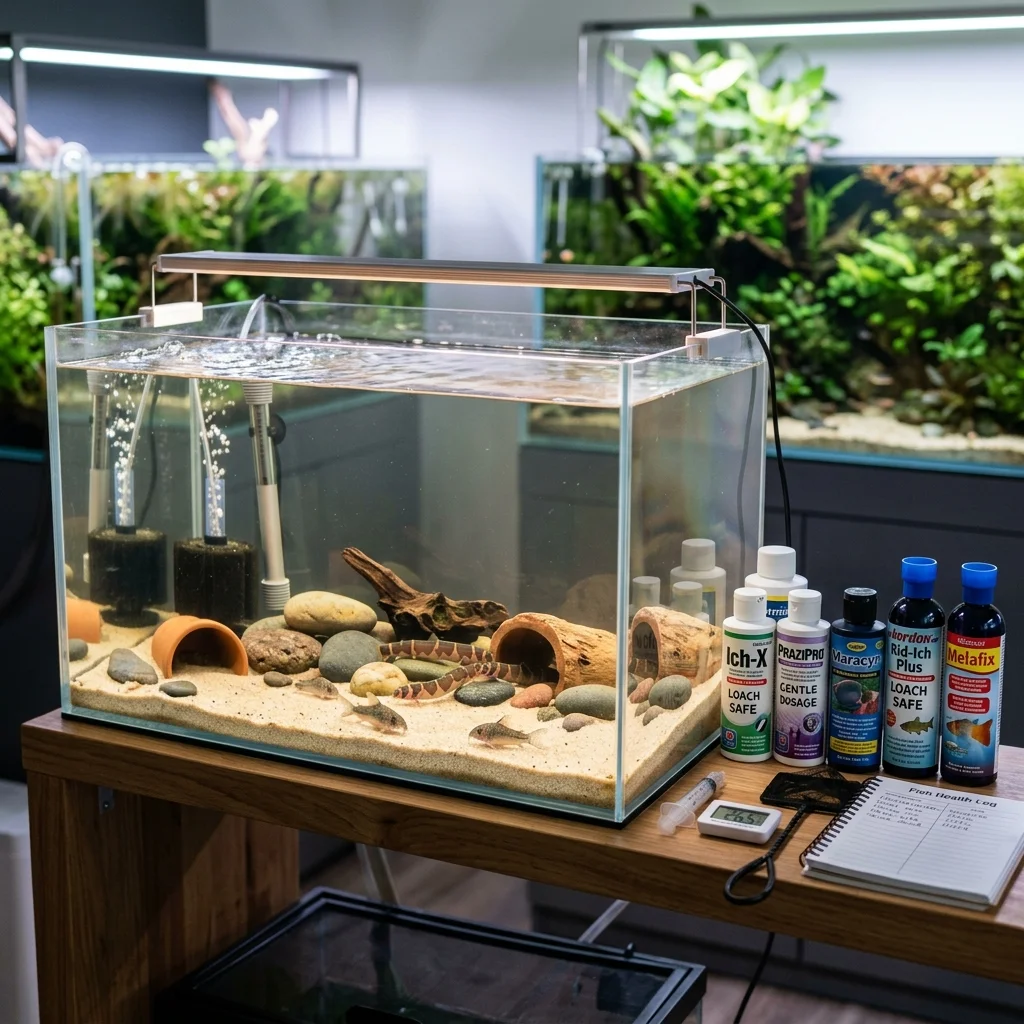
A hospital or quarantine tank provides greater control over medication exposure. It can prevent unnecessary treatment of healthy fish, reduce exposure of sensitive invertebrates, and make it easier to observe the fish during treatment.
Hospital tanks can have limited biological filtration, however. Treating fish separately does not remove the need to monitor ammonia and nitrite. Additional water-quality management may be necessary if biological filtration becomes inadequate.
Medication and the Biological Filter
Not every fish medication has the same effect on beneficial microorganisms. Some treatments may have little measurable effect on established biological filtration, while others can interfere with microbial communities under particular conditions.
Do not assume that a medication is harmless to the nitrogen cycle simply because it is considered safe for fish. Continue monitoring ammonia and nitrite throughout treatment when there is a meaningful risk of biological disruption.
When Not to Reduce a Medication Dose
Automatically reducing a medication dose can be counterproductive. A concentration below the manufacturer's recommended treatment level may fail to control the target organism while still exposing the fish to the medication.
If a medication specifically provides a reduced dose for scaleless or sensitive species, follow that instruction. Otherwise, use the manufacturer's labeled dose and seek species-specific guidance rather than inventing a reduction.
Medication Safety Checklist
- Identify the likely disease or parasite before treatment.
- Read the complete medication label before dosing.
- Check for warnings involving scaleless fish, loaches, catfish, or other sensitive species.
- Verify the active ingredient and concentration.
- Do not assume that two products containing the same active ingredient have identical formulations or instructions.
- Do not automatically halve medication doses.
- Check compatibility with shrimp, snails, plants, and other aquarium inhabitants.
- Use a hospital or quarantine tank when appropriate.
- Monitor ammonia and nitrite during treatment.
- Follow the product's safety instructions and reassess promptly if the fish shows signs of significant treatment intolerance.
Using a Medication Dosage Calculator
When the medication manufacturer's instructions provide a dose based on aquarium volume, a medication dosage calculator can help perform the required volume calculation.
The calculator does not determine whether a medication is appropriate for a particular species, disease, or active ingredient. Product-specific instructions and appropriate disease identification remain the basis for treatment decisions.
Key Takeaway
Scaleless fish should not be treated according to a blanket half-dose rule. Medication tolerance varies by species, active ingredient, formulation, concentration, water conditions, and treatment duration. A controlled approach is to identify the likely disease, check the exact product label, follow species-specific warnings, monitor water quality, and use a hospital tank when appropriate.
The Problem
The aquarist needs to treat a scaleless or otherwise sensitive fish but is unsure whether a medication is appropriate, whether the dose should be reduced, how treatment may affect the biological filter, or whether a hospital tank should be used.
When to Use This Tool
Use this guide when selecting or reviewing medication for scaleless or sensitive aquarium fish, especially when the product label contains species warnings or when the aquarist is considering treatment with copper, salt, praziquantel, metronidazole, or another active ingredient.
Who is this for?
- Aquarium keepers treating scaleless fish
- Aquarium keepers caring for loaches and catfish
- Aquarists researching medication safety
- Aquarium keepers setting up hospital or quarantine tanks
- Fishkeepers troubleshooting medication-related problems
Troubleshooting Guide
1 The fish appears stressed after medication is added.
Review the exact product label, concentration, water conditions, and species warnings. Monitor respiration and behavior closely, and follow the product's safety instructions if significant treatment intolerance occurs.
2 The aquarist wants to halve the medication dose because the fish has no scales.
Do not automatically halve the dose. Check whether the specific product provides a reduced dose or species-specific warning. Otherwise, follow the manufacturer's instructions or obtain appropriate species-specific guidance.
3 The fish does not improve after treatment.
Reassess the diagnosis rather than simply increasing the medication dose. The condition may have a different cause, the organism may not be susceptible to the medication, or the treatment conditions may be inappropriate.
4 Ammonia or nitrite rises during treatment.
Treat the water-quality problem as a priority. Check filtration, feeding, stocking, and treatment conditions, and perform appropriate water-quality management while following the medication's instructions.
5 The aquarium contains shrimp or snails.
Check the exact medication label for invertebrate warnings before treatment. If compatibility is uncertain, a controlled hospital tank can reduce unnecessary exposure of unaffected aquarium inhabitants.
6 A medication is being considered for a fish that is not eating.
Determine whether the product is intended for water treatment, medicated food, or another route. Oral medication cannot be relied upon if the fish will not consume the medicated food.
7 The aquarist is unsure which medication to use.
Identify the most likely disease or parasite first. Selecting an active ingredient based only on a nonspecific symptom can result in unnecessary or ineffective treatment.
Frequently Asked Questions
Do scaleless fish always need half the normal medication dose?
Are all medications safe for scaleless fish?
Can I use copper medication on scaleless fish?
Can I use salt with scaleless fish?
Is praziquantel suitable for scaleless fish?
Is metronidazole suitable for scaleless fish?
Should I use a hospital tank for medicating scaleless fish?
Can fish medication damage the biological filter?
Should I stop medication if a scaleless fish reacts badly?
Glossary of Terms
- Scaleless fish
- Fish that lack the typical external scale covering found in many other aquarium species. Examples commonly kept in aquariums include many loaches and catfish.
- Active ingredient
- The chemical or drug component of a medication responsible for its intended therapeutic effect.
- Hospital tank
- A separate aquarium used to isolate and treat fish, allowing medication exposure and water quality to be controlled independently from the main aquarium.
- Biological filter
- The biological component of aquarium filtration in which microorganisms convert toxic ammonia and nitrite into less toxic nitrogen compounds.
- Copper medication
- A medication containing a copper compound used for certain parasitic fish diseases. Copper requires careful dosing and may be unsuitable for some fish or invertebrates.
- Praziquantel
- An antiparasitic drug used against susceptible flatworm parasites, including many flukes and tapeworms.
- Metronidazole
- An antimicrobial drug used in appropriate circumstances against susceptible anaerobic microorganisms and certain protozoal infections.
- Chloramphenicol
- A broad-spectrum antibiotic with important human-handling, veterinary, regulatory, and antimicrobial-stewardship considerations.
- Treatment intolerance
- An adverse response that occurs when a fish does not tolerate a treatment well, such as marked respiratory distress, abnormal behavior, loss of equilibrium, or other significant deterioration.