African Cichlid Care Guide (Pseudocrenilabrinae (Mbuna, Peacock, Haplochromis))
Quick Answer
African Cichlids are colorful, aggressive fish from the Rift Lakes of East Africa. They require a minimum 55-gallon aquarium with hard, alkaline water (pH 7.8-8.6, GH 10-18 dGH), temperature 75-82°F (24-28°C), and rockwork for territories. Diet is lake-specific: Mbuna are herbivores, Peacocks are omnivores, and Haps are carnivores. Overstocking (12-15+ fish) is essential to disperse aggression.
Quick Facts
| Scientific Name | Pseudocrenilabrinae (Mbuna, Peacock, Haplochromis) |
|---|---|
| Common Names | African Cichlid |
| Family | Cichlidae |
| Genus | Pseudotropheus / Aulonocara / Haplochromis (varies by group) |
| Type | Freshwater |
| Temperament | aggressive |
| Care Difficulty | advanced |
| Lifespan | 8 years |
| Maximum Size | Up to 6 in (15 cm) |
| Diet | Omnivore (lake-specific: Mbuna = herbivore, Peacock/Haps = omnivore/carnivore) |
| Temperature | 75–82°F (24–28°C) |
| pH | 7.8–8.6 |
| Hardness | 10–18 dGH |
| Minimum Size | 55 gallons |
Key Takeaways
- Require hard, alkaline water (pH 7.8-8.6) with aragonite or crushed coral substrate.
- Three main groups: Mbuna (herbivore, rocky), Peacock (omnivore, sandy), Haps (carnivore, open water).
- Overstocking (12-15+ in 75 gal) is the key to managing aggression.
- Maternal mouthbrooders: females incubate eggs in their mouths for 18-24 days.
- Feeding Mbuna meat causes fatal Malawi Bloat—strict herbivorous diet required.
- Minimum tank: 55 gal for Mbuna; 75+ gal for mixed groups; 125+ gal for large Haps.
Overview
African Cichlids are among the most diverse, colorful, and behaviorally fascinating groups of freshwater fish in the aquarium hobby. Native to the African Great Lakes—primarily Lake Malawi, Lake Tanganyika, and Lake Victoria—these fish have undergone explosive adaptive radiation, resulting in hundreds of species with incredible variation in color, shape, and behavior.
They are divided into three main groups: Mbuna (rock-dwelling herbivores), Peacocks (Aulonocara, sandy-bottom omnivores), and Haps (Haplochromis, open-water carnivores). Each group has distinct care requirements, dietary needs, and aggression levels. Their brilliant colors, active personalities, and complex social hierarchies make them a centerpiece of many advanced aquarists’ collections.
Ideal For
- Advanced aquarists with large tanks (55+ gallons) seeking vibrant, active display fish.
- Keepers interested in Rift Lake biotope aquariums with rockwork and hard, alkaline water.
- Breeders fascinated by maternal mouthbrooding behavior and cichlid social dynamics.
Appearance
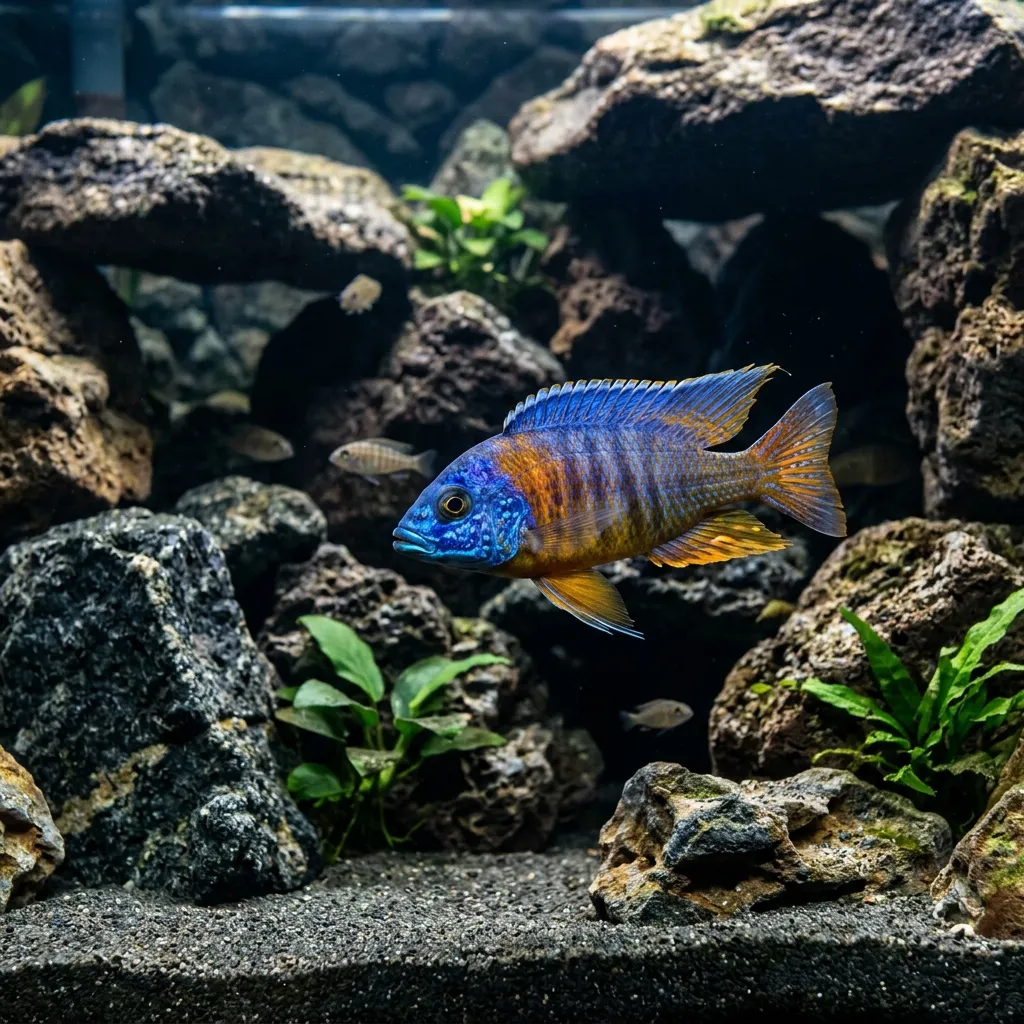
African Cichlids display extraordinary diversity. Mbuna are typically stocky with bold vertical stripes and bright colors (yellow, blue, orange). Peacocks have elongated bodies with iridescent, peacock-like coloration in males. Haps are larger, more streamlined predators. All possess a single nostril on each side (a cichlid hallmark) and specialized pharyngeal jaws for crushing food. Males are generally more colorful and larger than females. Adult sizes range from 4 inches (Mbuna) to 10+ inches (large Haps).
Natural Habitat
Lake Malawi is the ninth-largest lake in the world, with clear, hard, alkaline water (pH 7.8-8.6) and rocky shorelines. Mbuna inhabit the rocky intertidal zones, grazing algae from rocks. Peacocks patrol sandy bottoms near rock outcrops. Haps roam open water. Lake Tanganyika is deeper and older, with even harder water and more specialized species. Lake Victoria cichlids have suffered catastrophic declines due to Nile Perch introduction.
Care
Housing & Pond Requirements
African Cichlid tanks must be designed around territory management rather than aesthetics. The minimum tank size is 55 gallons for a small Mbuna group, but 75+ gallons is strongly recommended. For Peacocks, 50+ gallons; for Haps, 75-125+ gallons.
Key design principles:
- Rockwork: Pile rocks to create caves, crevices, and visual barriers. Each dominant male needs 2-3 caves.
- Substrate: Sand or fine gravel (Mbuna sift substrate; sharp gravel damages mouths).
- Overstocking: Maintain 12-15+ fish in 75 gallons to disperse aggression. Understocking leads to targeted harassment.
- Filtration: Heavy bioload requires canister filters rated for 2x tank volume.
- Lighting: Moderate to bright lighting enhances colors and supports minimal plant growth (Anubias, Java Fern).
Water Parameters
Rift Lake cichlids require hard, alkaline, mineral-rich water that is the opposite of most tropical community fish.
Temperature
Maintain 75–82°F (24–28°C). Stable temperature is critical; fluctuations stress fish and trigger disease.
pH
Maintain 7.8–8.6. This is non-negotiable for long-term health. Use aragonite, crushed coral, or commercial buffers (Seachem Malawi/Victoria Buffer).
Hardness (GH)
10–18 dGH (300+ ppm). In the wild, GH reaches 2000 ppm. Use cichlid salts containing calcium, magnesium, and trace minerals—not table salt.
Carbonate Hardness (KH)
8–15 dKH. This buffers pH and prevents dangerous swings. A KH below 6 leaves no margin for error.
Water Flow
Moderate flow mimics natural lake conditions and improves oxygenation.
Diet
African Cichlid diet is lake-specific and getting it wrong is fatal.
- Mbuna (Herbivores): Require 70%+ plant matter. Feed spirulina flakes, blanched zucchini, nori seaweed, and vegetable-based cichlid pellets. Never feed bloodworms, brine shrimp, or meaty proteins—this causes Malawi Bloat, a fatal intestinal blockage.
- Peacocks (Omnivores): 60% carnivore / 40% herbivore. High-quality cichlid pellets (35-40% protein) plus mysis shrimp, krill, and occasional vegetable matter.
- Haps (Carnivores): Primarily carnivorous. Large pellets, frozen silversides, krill, and occasional vegetable supplements.
Feed 2-3 small portions daily, fasting one day per week. Remove uneaten food promptly to maintain water quality.
Health
African Cichlids are generally hardy when water parameters are correct, but they are susceptible to several serious conditions. Their specialized digestive systems make them particularly vulnerable to dietary mistakes.
Malawi Bloat
A fatal condition caused by feeding meaty proteins to herbivorous Mbuna. The intestines become blocked and distended.
- Severe abdominal swelling.
- Loss of appetite.
- Lethargy and hiding.
- White, stringy feces.
- Rapid breathing and clamped fins.
Feeding protein-rich foods (bloodworms, brine shrimp, beef heart) to herbivorous Mbuna. Poor water quality with high nitrate levels. Internal bacterial infection secondary to intestinal blockage.
Feed Mbuna strictly herbivorous diet: spirulina, vegetables, algae wafers. Maintain pristine water quality with 0 ppm ammonia/nitrite and nitrates <20 ppm. Treat early with Metronidazole and Epsom salt baths.
Ich (White Spot Disease)
Common protozoan parasite causing white salt-like spots on body and fins.
- White salt-like spots on body and fins.
- Rubbing against decorations (flashing).
- Rapid breathing and clamped fins.
Ichthyophthirius multifiliis parasite introduced via new fish. Stress from temperature fluctuations or poor water quality.
Quarantine all new fish for 2-4 weeks. Maintain stable temperature between 75-82°F. Use commercial ich treatments; avoid copper-based medications.
Fin Rot
Bacterial infection causing progressive fin deterioration, common in overstocked or poorly maintained tanks.
- Frayed, disintegrating fins with white or milky edges.
- Reddening at the fin base.
- Lethargy and reduced appetite.
Bacterial infection (Aeromonas or Pseudomonas) from poor water quality. Aggressive tank mates nipping fins during territorial disputes.
Maintain pristine water conditions with regular water changes. Provide adequate rock caves to reduce territorial fighting. Treat with broad-spectrum antibiotics if severe.
Hexamita (Hole in the Head)
A flagellate parasite causing pitting lesions on the head and lateral line, often linked to poor diet and water quality.
- Pitting or holes forming around the head and lateral line.
- White stringy feces.
- Loss of appetite and weight loss.
A flagellate parasite exacerbated by stress, poor diet, and poor water quality. Vitamin deficiency from feeding single-food diets.
Feed a varied, high-quality diet with vitamin supplements. Maintain excellent water chemistry with stable parameters. Treat early with Metronidazole.
Breeding
Most African Cichlids are maternal mouthbrooders, one of the most fascinating reproductive strategies in the aquarium hobby.
Breeding Trigger
Raise temperature to 80-82°F (27-28°C) and perform a 30% water change with slightly cooler (2°F/1°C) hard water. Increase photoperiod to 12 hours of bright light.
Spawning Process
- The male establishes a territory and displays vibrant colors.
- The female lays 10-40 eggs on a flat rock or in a pit in the sand.
- She immediately picks up the eggs in her mouth.
- The male displays ‘egg spots’ (ocelli) on his anal fin; the female tries to add these to her mouth, at which point the male releases sperm, fertilizing the eggs in her mouth.
- The female incubates the eggs for 18-24 days at 78°F (25°C), during which she does not eat.
- She releases 0.2-inch (5 mm) free-swimming fry.
Artificial Stripping
For higher survival rates, strip eggs from the female’s mouth on day 5-7 and incubate in a tumbler. This yields up to 90% survival vs. 30-50% when left with the mother. Fry accept crushed flakes and baby brine shrimp immediately.
Tips
Common Mistakes
The single most fatal mistake is feeding bloodworms, brine shrimp, or beef heart to Mbuna. Their herbivorous digestive systems cannot process animal protein, leading to Malawi Bloat—a condition with very high mortality. Always feed spirulina-based foods and vegetables.
Keeping only 4-6 African Cichlids in a 55-gallon tank is a recipe for disaster. The dominant male will relentlessly harass subordinates to death. Overstocking (12-15+ in 75 gallons) disperses aggression so no single fish becomes a target.
African Cichlids require hard, alkaline water (pH 7.8-8.6, GH 10-18 dGH). Keeping them in soft, acidic community tank water causes chronic stress, immune suppression, and eventually organ failure. Use aragonite substrate and cichlid salts.
Mixing Mbuna, Peacocks, and Haps in the same tank rarely works. Mbuna are too aggressive for Peacocks, and Haps will eat smaller Mbuna. Each group has different dietary needs that are impossible to satisfy in a mixed tank.
Expert Tips
These natural buffers continuously release calcium and carbonate ions, maintaining pH and KH without constant chemical dosing. They also allow Mbuna to engage in natural substrate-sifting behavior.
When introducing new cichlids, completely rearrange the rockwork. This destroys existing territories and forces all fish to re-establish boundaries, reducing aggression toward newcomers.
A weekly fasting day mimics natural conditions and helps clear the digestive system. This is especially important for Mbuna, whose long intestinal tracts benefit from periodic rest.
Compatible Tank Mates
African Cichlid Groups Comparison
| Feature | Mbuna | Peacock Cichlid | Haplochromis (Haps) |
|---|---|---|---|
| Scientific Group | Pseudotropheus, Labidochromis, Melanochromis, etc. | Aulonocara spp. | Haplochromis, Nimbochromis, Copadichromis, etc. |
| Adult Size | 4-5 in (10-13 cm) | 4-6 in (10-15 cm) | 6-10 in (15-25 cm) |
| Minimum Tank Size | 55 gallons (200L) | 50 gallons (190L) | 75-125 gallons (280-470L) |
| Care Difficulty | Advanced | Intermediate-Advanced | Advanced |
| Temperament | Very Aggressive | Moderate | Moderate to Aggressive |
| Diet | Herbivore (70%+ plant matter) | Omnivore (60% carnivore / 40% herbivore) | Carnivore (primarily animal protein) |
| Habitat Preference | Rocky shorelines, caves | Sandy bottoms near rocks | Open water, deeper zones |
| Water pH | 7.8 - 8.6 | 7.8 - 8.6 | 7.8 - 8.6 |
| Water Hardness (dGH) | 10 - 18 | 10 - 18 | 10 - 18 |
| Coloration | Bold vertical stripes; yellow, blue, orange | Iridescent, peacock-like colors (males) | Variable; often silver with patterns |
| Social Structure | Highly territorial harems; 1 male : 3-4 females | Harem groups; 1 male : 3-4 females | Variable; some solitary, some groups |
| Price Range | $5 - $30 | $10 - $50 | $15 - $80 |