
Guppy (Poecilia reticulata)
Quick Answer
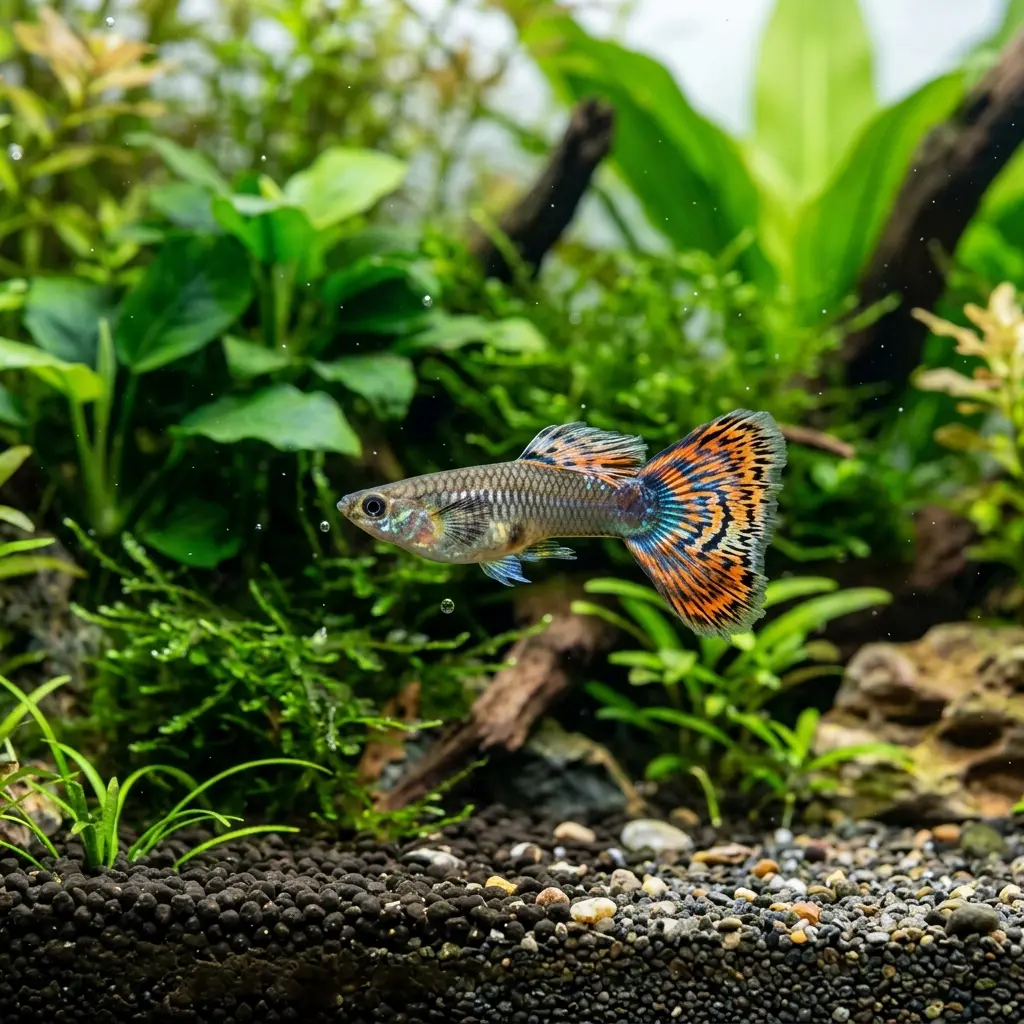
Guppies (Poecilia reticulata), also known as the millionfish, are tiny, colorful freshwater livebearers native to northeast South America. They require a minimum 10-gallon (38-liter) aquarium with hard, alkaline water at pH 7.0 to 8.0, general hardness 8 to 15 dGH, and temperatures of 72 to 82 degrees Fahrenheit (22 to 28 degrees Celsius). These peaceful omnivores are prolific breeders and thrive in densely planted community tanks with compatible tank mates.
Quick Facts
| Scientific Name | Poecilia reticulata |
|---|---|
| Common Names | Guppy |
| Family | Poeciliidae |
| Genus | Poecilia |
| Type | Freshwater |
| Temperament | peaceful |
| Care Difficulty | beginner |
| Lifespan | 2.5 years |
| Maximum Size | Up to 2 in (5 cm) |
| Diet | Omnivore |
| Temperature | 72–82°F (22–28°C) |
| pH | 7–8 |
| Hardness | 8–15 dGH |
| Minimum Size | 10 gallons |
Key Takeaways
- Known for their peaceful temperament and active swimming behavior.
- Requires at least a 10 gallon aquarium with hard, alkaline water.
- Maintain a male-to-female ratio of 1:2 or 1:3 to prevent female exhaustion.
- Prolific livebearers that give birth to 20 to 60 fry every 28 to 30 days.
- Susceptible to Camallanus worms; quarantine and prophylactic treatment are essential.
Overview
Species Overview
Natural History and Distribution
The Guppy (Poecilia reticulata), also known as the millionfish, is a small freshwater livebearer native to northeast South America. Wild populations occur in Venezuela, Guyana, Suriname, and Trinidad and Tobago, where they inhabit slow-moving streams, warm springs, drainage ditches, and brackish estuaries. Their remarkable adaptability has led to introduced populations on every continent except Antarctica, making them one of the most widespread tropical fish in the aquarium trade and in nature.
Physical Characteristics
Adult guppies reach approximately 2 inches (5.1 cm) in total length, with males typically smaller and more slender than females. Males possess a modified anal fin called a gonopodium, which is used for internal fertilization. Selective breeding over the past century has produced an astonishing array of tail shapes, including veil, delta, fan, sword, double sword, lyretail, and roundtail varieties, alongside virtually every color combination imaginable. Wild-type guppies are drab in comparison, displaying olive-gray bodies with iridescent spots.
Conservation and Ecological Impact
The IUCN lists guppies as Not Evaluated. Wild populations remain robust across their native range, and the species is frequently employed in mosquito control programs due to their appetite for mosquito larvae. Their hardiness and reproductive capacity have made them both a blessing and an ecological concern in non-native waters, where they can outcompete native species.
Why Guppies Dominate the Hobby
Guppies are the undisputed gateway fish for new aquarists. They tolerate a wide range of water parameters, breed with abandon, and display constant activity. Their low cost, availability in virtually every pet store, and genetic diversity ensure that both beginners and advanced breeders find endless engagement in their care.
Diet
Feeding and Nutritional Requirements
Dietary Composition
Guppies are omnivores with a metabolism geared toward frequent, small meals. Their ideal dietary composition is approximately 40 percent protein, 10 percent fat, and 50 percent plant matter and fiber. In the wild, they consume algae, detritus, insect larvae, and zooplankton. Captive diets must replicate this balance to prevent obesity, constipation, color fading, and reduced breeding success. Protein sources should be primarily aquatic in origin.
Recommended Foods
- High-quality micro-pellets or crushed flakes formulated for tropical community fish with spirulina inclusion
- Frozen or live foods: baby brine shrimp (Artemia nauplii), daphnia, bloodworms, and mosquito larvae
- Vegetable matter: blanched spinach, zucchini, cucumber, spirulina powder, and algae wafers
- Supplemental grazing: allow controlled natural algae growth on rocks and plant leaves
- Cultured live foods: vinegar eels, microworms, and infusoria for fry and conditioning adults
Feeding Schedule
Feed adult guppies two to three times daily, offering only what they can consume in 2 to 3 minutes. Overfeeding is the leading cause of poor water quality and bloat in guppy tanks. Uneaten food decays into ammonia within hours. Fast the tank one day per week to clear the digestive tract and prevent constipation. Fry require feeding 4 to 6 times daily with powdered fry food, infusoria, vinegar eels, or newly hatched baby brine shrimp. Fry have high metabolisms and will stunt if underfed.
Foods to Avoid
Never feed beef heart, pork, chicken, or other mammalian proteins. Guppies cannot digest the high fat content and connective tissue, leading to intestinal blockages, fatty liver disease, and premature death. Avoid generic low-quality flakes that contain excessive fillers, ash, and artificial dyes. Tubifex worms should be avoided unless from a trusted parasite-free source, as they can carry nematode larvae including Camallanus. Bread, crackers, and human processed foods are toxic to fish and must never enter the aquarium.
Color Enhancement Through Diet
To intensify red, orange, and yellow pigmentation, feed foods rich in carotenoids and astaxanthin, such as krill, spirulina, and specialized color-enhancing flakes. Blue and green iridescence is enhanced by a diet containing blue-green algae and high-quality marine proteins. Avoid color-enhancing foods that rely on artificial dyes, as these provide no biological benefit and may stress the liver.
Health
See sections.health for comprehensive disease profiles and treatment protocols.
Breeding
Breeding and Reproduction
Reproductive Biology
Guppies are livebearers and among the most prolific aquarium fish in existence, earning the well-deserved nickname millionfish. Females possess the remarkable ability to store sperm from a single mating in specialized folds within their reproductive tract and can produce multiple broods over several months without further male contact. This biological trait makes population control challenging but fascinating for dedicated breeders.
Breeding Triggers and Optimal Conditions
No special environmental triggers are required; guppies breed continuously when healthy. To maximize fry survival and female health, maintain the following parameters: temperature at 78 degrees Fahrenheit (25.5 degrees Celsius), pH at 7.4 to 7.6, general hardness at 10 to 12 dGH, and carbonate hardness at 8 to 10 dKH. Dense planting with Java Moss, Guppy Grass, or Water Sprite is essential for fry refuge. Perform weekly 20 percent water changes to maintain water quality in breeding tanks. Brighter lighting and a varied diet rich in protein and spirulina accelerate gonadal development in both sexes.
Gestation and Birth
Gestation lasts 21 to 30 days depending on temperature, water quality, and female age. Females develop a dark gravid spot near the anal fin as pregnancy progresses; the spot enlarges and darkens as birth approaches. A single female can give birth to 20 to 60 live fry, with older, larger females producing up to 100 fry in a single drop. Fry are born fully formed and free-swimming at approximately 0.2 inches (5 mm) in length. The female may appear thinner immediately after birth and can become pregnant again within hours.
Fry Rearing Protocol
Immediately separate fry from adults to prevent cannibalism, or provide dense moss cover that adults cannot penetrate. Feed fry 4 to 6 times daily with powdered fry food, infusoria, vinegar eels, microworms, or baby brine shrimp. Maintain pristine water quality with daily 10 percent water changes or a mature sponge filter. Fry reach sexual maturity at 2 to 3 months of age; separate males and females by 4 weeks of age to prevent early, stunted breeding. At 6 weeks, introduce larger foods such as crushed flakes and small daphnia.
Genetic Management and Culling
Cull deformed fry exhibiting bent spines, missing fins, severe stunting, or gross color abnormalities to maintain genetic health and prevent the spread of recessive defects. Inbreeding depression is common in closed colonies after 3 to 4 generations, resulting in reduced fertility, smaller size, and weakened immune systems. Introduce new bloodlines every 6 to 12 months to preserve vigor, color intensity, and disease resistance. Record breeding pairs and outcomes to track desirable traits.
Population Control Strategies
If you do not wish to breed guppies, keep single-sex groups. Male-only tanks are visually striking but require adequate space to prevent dominance disputes. Alternatively, house guppies with small, peaceful predatory fish such as pea puffers or dwarf cichlids that will consume fry without threatening adults. Do not release unwanted guppies into local waterways, as they are invasive in most climates.
Compatible Tank Mates






Species Comparison
| Feature | Guppy | Platy | Molly | Endler's Livebearer |
|---|---|---|---|---|
| Adult Size | 2 inches (5.1 cm) | 2.5 inches (6.4 cm) | 4 to 5 inches (10 to 13 cm) | 1 inch (2.5 cm) |
| Temperament | Peaceful | Peaceful | Peaceful | Peaceful |
| Minimum Tank Size | 10 gallons (38 L) | 10 gallons (38 L) | 20 gallons (75 L) | 5 gallons (19 L) |
| Diet | Omnivore | Omnivore | Omnivore (herbivore-leaning) | Omnivore |
| pH Range | 7.0 to 8.0 | 7.0 to 8.0 | 7.5 to 8.5 | 6.5 to 8.0 |
| Water Hardness | 8 to 15 dGH | 10 to 20 dGH | 15 to 30 dGH | 6 to 12 dGH |
| Breeding Difficulty | Very Easy (livebearer) | Very Easy (livebearer) | Easy (livebearer) | Very Easy (livebearer) |