
Quick Answer
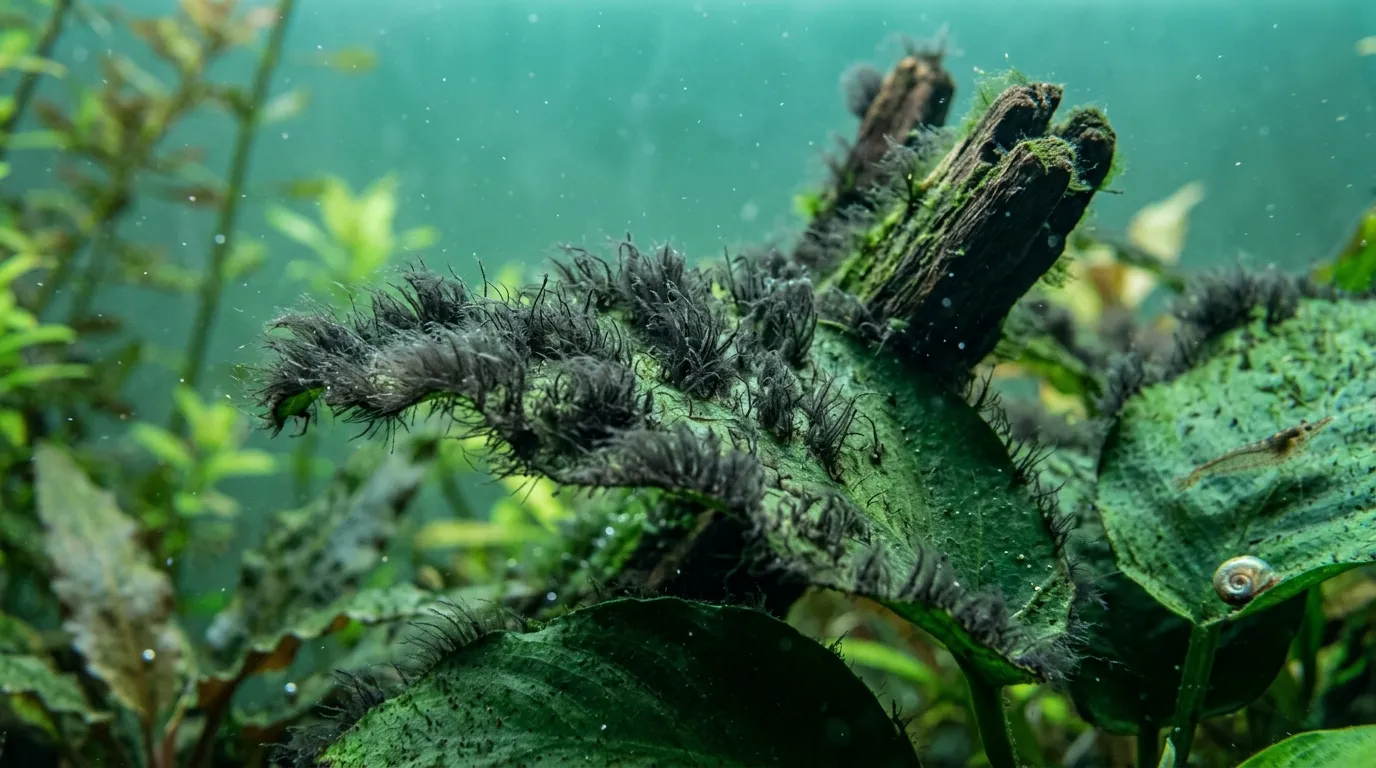
Black beard algae (BBA) is a dark, wiry red alga that grows on leaf edges, driftwood and near filter outlets. It is most often linked to unstable CO₂, inconsistent nutrients, uneven flow and old or dying leaves. Remove it in steps: trim and scrub, then spot treat with 3% hydrogen peroxide, and only then consider liquid carbon or a dip. Treatment only works long term if you fix the cause.
Key Takeaways
- BBA is a dark, wiry red alga on leaf edges, hardscape and near outlets; dying strands turn red, pink or whitish.
- No single cause is proven, but unstable CO₂, inconsistent nutrients, uneven flow and old leaves are the most common triggers.
- Use a treatment ladder: trim and scrub first, then 3% peroxide spot treatment, then liquid carbon or a dip if needed.
- Use only 3% peroxide (never stronger or food-grade), dose by syringe, and take extra care with shrimp, snails and delicate plants.
- Few animals eat mature BBA, so algae eaters are a helper, not a cure.
Black beard algae (BBA), also called black brush algae, is one of the hardest algae to get rid of because it grips tightly and regrows from any fragment left behind. This guide shows you how to identify it, work out why it appeared, and remove it step by step, starting with the safest methods and moving up only when you need to.
Safety first: every chemical method below can harm fish, shrimp, snails or plants if you get the concentration or dose wrong. Use only the concentrations named here, measure with a syringe, and read the livestock and plant cautions before you start. Doses in hobby sources vary, so this guide gives the conservative end of the range.
What is black beard algae? How to identify it
BBA is a red alga, although it looks dark grey, black or greenish-black. It grows as short, coarse, wiry tufts, typically up to a centimetre or two long, that look like a stiff beard or bristle brush. It clings tightly to leaf edges (especially slow-growing plants such as Anubias, Java Fern and Vallisneria), driftwood, rocks, equipment and filter outlets. Unlike green algae, it feels tough and wiry and is very hard to pull off by hand.
A telling sign: when BBA dies it usually turns red, pink or whitish. That colour change means treatment is working.
BBA vs hair algae vs staghorn
- BBA: short, dense, dark tufts that feel coarse. Usually on leaf edges, hardscape and near outlets.
- Green hair (filamentous) algae: softer, longer, bright green strands that can be twirled onto a toothbrush.
- Staghorn algae: grey-green branching tufts that look like tiny antlers, mostly on leaf edges.
If you are unsure, use the table below.
Algae identification table
| Algae | Colour / texture | Where it grows | Usual cause | First fix |
|---|---|---|---|---|
| Black beard algae (BBA) | Dark grey to black, short and wiry tufts | Leaf edges, driftwood, rocks, filter outlets | Unstable CO₂, inconsistent nutrients, flow extremes, dying leaves | Trim affected leaves, stabilise CO₂, spot treat |
| Green spot algae (GSA) | Hard, bright green dots | Glass, old slow-growing leaves | Low phosphate and/or strong light | Scrape glass, check phosphate and photoperiod |
| Green hair / filamentous algae | Soft green strands, can be long | Plants, hardscape, outlets | Excess light, nutrient imbalance, ammonia spikes | Twirl off by hand, shorten lights, keep dosing steady |
| Staghorn algae | Grey-green forked tufts | Leaf edges, older leaves | Poor CO₂ or lots of dissolved organics | Improve CO₂ and water changes |
| Cyanobacteria (blue-green "algae") | Slimy blue-green sheets, musty smell | Substrate, plants, low-flow areas | Poor flow, excess organics, unstable nutrients | Siphon off, improve flow, reduce waste |
| Diatoms | Brown dusty film that wipes off | Glass, substrate, leaves, mostly new tanks | Silicates and immature new tank | Wipe off, wait; it usually fades by itself |
| Green water | Water turns pea-soup green | Free-floating in the water column | Strong light plus excess nutrients or ammonia | Water change, reduce light, check ammonia |
What causes black beard algae?
No single cause has been proven. Experienced hobbyists disagree, and the evidence is mostly experience rather than controlled trials. What most agree on is that BBA thrives where conditions swing, and tends to settle on plant tissue that is old, damaged or growing slowly. Work through these causes in order.
CO₂ instability
In injected tanks, the most commonly reported trigger is CO₂ that rises and falls through the day, not simply "too little". A drop checker that swings between green and blue, or CO₂ that starts late and stops early, are typical culprits. Check this first if you inject CO₂.
Nutrients
Unstable or very low nutrient levels are also linked to BBA. Sporadic fertiliser dosing, skipped doses followed by big ones, and plants that are visibly starved (pale, pitted or yellowing leaves) give algae an opening. Aim for consistent dosing and healthy plant growth. Damaged, dying or old leaves are where BBA usually starts, so trim them promptly.
Flow and dead spots
Reports conflict on flow. BBA is often seen at filter outlets, where flow is strong, and also on leaves and hardscape in slow or dead spots. The practical point is uneven flow: aim for gentle, even circulation reaching every part of the tank, and keep the filter clean so output does not fall away over time. Heavy organic build-up from irregular water changes or a dirty filter makes it worse.
CO₂ stability checklist
- Use a drop checker filled with a 4 dKH reference solution, and remember it lags roughly an hour or two behind real CO₂ changes.
- Read it at the end of the photoperiod, not just in the morning. You want a steady lime-green colour through the lit hours.
- Start CO₂ well before the lights come on so levels are up when photosynthesis starts, and stop it later in the evening.
- Check the needle valve and bubble rate for drift, especially after water changes or if the cylinder is nearly empty.
- Look for leaks at fittings, and check the diffuser or reactor is not clogged.
- Keep surface agitation consistent so CO₂ does not gas off unevenly.
- Change one thing at a time and give it a week or two before judging.
How to remove black beard algae
Treat removal as a ladder. Start at the top and only move down if the step above is not enough. Whatever you use, fix the cause at the same time, or it will come back.
Manual removal and trimming
Cut off and discard heavily affected leaves. For hardscape and equipment, lift the item out at water-change time and scrub it with a stiff toothbrush. It will not remove everything, but it cuts the amount you need to treat with chemicals, and it is completely livestock-safe.
Hydrogen peroxide spot treatment
Concentration matters. Use plain 3% hydrogen peroxide, the common consumer strength. Do not use stronger solutions: food-grade 35% peroxide causes chemical burns and is far too strong for aquarium use. Check the label carefully. In India, some pharmacy and hair-developer bottles are sold as "20 volume", which is roughly 6%, not 3% ("10 volume" is roughly 3%). If your bottle is stronger than 3%, do not use it undiluted. Peroxide also loses strength once opened, so an old bottle may work poorly.
- Turn off filters, powerheads and CO₂ so the peroxide stays where you put it.
- Measure with a syringe. Draw up 1 to 2 ml of 3% peroxide, and apply it directly onto the algae, not into open water.
- Limit the total per session. As a conservative ceiling, keep the total added to the tank at or below about 1 ml of 3% peroxide per US gallon (about 0.25 ml per litre). Published hobby advice for whole-tank doses goes up to roughly 1.5 ml per gallon or higher, but sources disagree and none is peer-reviewed, so the lower figure is safer. Shrimp, snails and other delicate livestock are more sensitive, so remove them first or use a much smaller dose.
- Wait about 10 minutes, then turn the filtration back on and do a partial water change.
- Repeat after a day or two if needed. Stop after a few rounds. If BBA keeps returning, the cause has not been fixed.
Who is sensitive? Fish and shrimp can be stressed or killed by overdoses. Watch for gasping or erratic swimming, and do a large water change if you see it. Delicate, fine-leaved plants and mosses can be burned by direct contact, so keep the dose away from them. Hardy plants such as Anubias and Java Fern tolerate it better. Peroxide can also harm the bacteria in your filter, which is one reason to keep the filter off while it works and to keep doses small. Handle it carefully and keep it away from eyes and skin.
Liquid carbon (glutaraldehyde products)
Products such as Seachem Flourish Excel are widely used against BBA. They are usually applied by syringe directly onto the algae, often with flow paused for a few minutes, and follow-up dosing is common. Follow the manufacturer's label, measure with a syringe rather than a cap, and start with a smaller dose.
Cautions: some plants are reported to be sensitive, notably Vallisneria, mosses and ferns, which can melt if overdosed. Shrimp keepers should be careful, since most complaints about liquid carbon involve shrimp deaths after overdosing. Overdosing can also stress fish. These products are chemical biocides, so avoid skin and eye contact.
Dipping plants and hardscape
Dips are for items you can remove from the tank. Only use them on hardy plants, and never on mosses or delicate plants.
- Bleach dip (hardy plants and hardscape): use plain, unscented household bleach (sodium hypochlorite with no added fragrance or additives). Mix 1 part bleach to 19 parts water. Dip hardy plants such as Anubias and Java Fern for 90 to 120 seconds and no longer. Keep more sensitive plants to about 90 seconds or less. Rinse thoroughly under running water, then soak in dechlorinated water with extra dechlorinator until no bleach smell remains. Set a timer.
- Hardscape: remove driftwood or rock, scrub it, and dip or soak in the same dilution, then rinse and dechlorinate before returning it.
- Peroxide dip (gentler option): some keepers use 3% peroxide on removed items for several minutes, then rinse well. Test on a single leaf first.
Shrimp tanks need extra care, since any chemical residue is dangerous to them. Rinse and soak thoroughly.
What it looks like as it dies
Photo timeline (add your own images at each stage):
- Healthy BBA (before): dark grey-black tufts, wiry and firm.
- Treated (day 1 to 3): tufts start to lose their dark colour.
- Dying (a few days in): strands turn red, pink or whitish.
- Dead (about a week or more): pale, limp strands that detach easily or are picked at by shrimp. Any leftover dark tufts are still alive and will regrow.
Do algae eaters eat black beard algae?
Not reliably, and few animals eat mature BBA. Treat livestock as a helper after treatment, not as a cure.
- True Siamese Algae Eater (Crossocheilus oblongus): the fish most often credited with eating BBA, mainly new, soft growth. It may lose interest in mature growth and prefer other food. Fish sold as "Siamese Algae Eaters" are often Flying Fox or Chinese Algae Eaters, which generally do not eat BBA.
- Amano shrimp: will pick at young or dying BBA, especially after treatment, but usually will not clear healthy mature growth.
- Otocinclus and nerite snails: not dependable BBA eaters, according to keepers' reports.
See our guide to the best algae eaters for stocking advice.
How to prevent black beard algae (checklist)
- Keep CO₂ stable through the photoperiod, using the checklist above.
- Dose fertiliser consistently, and fix visible deficiencies early.
- Do regular water changes (weekly 20 to 30% is a common routine) to control dissolved organics.
- Clean the filter and keep flow even, with no dead spots and no harsh outlet blasts on leaves.
- Trim old, damaged or algae-covered leaves quickly.
- Check your lighting duration and strength against what your plants can use.
- Quarantine new plants and hardscape, and dip hardy plants if BBA is present in another tank.
- Change one variable at a time and give it a week or two.
Black beard algae without CO₂
BBA also appears in low-tech tanks. The usual pattern is slow-growing plants (Anubias, Java Fern), older leaves, strong light for the plants' needs, irregular water changes and dirty filters. Because CO₂ is not injected, natural CO₂ swings can still occur as plants use it during the day.
- Shorten the photoperiod and reduce light intensity.
- Add fast-growing plants or floaters to compete for nutrients.
- Keep water changes and filter cleaning regular.
- Trim affected leaves and scrub hardscape.
- Use spot treatments sparingly, following the peroxide and liquid carbon cautions above.
Liquid carbon is common in low-tech tanks, but check that your plants and any shrimp tolerate it.
Related tools and guides: the CO₂ cylinder calculator, the light duration calculator, our lighting guide and our plant deficiency guide.