
Foxface Rabbitfish (Siganus vulpinus)
Quick Answer
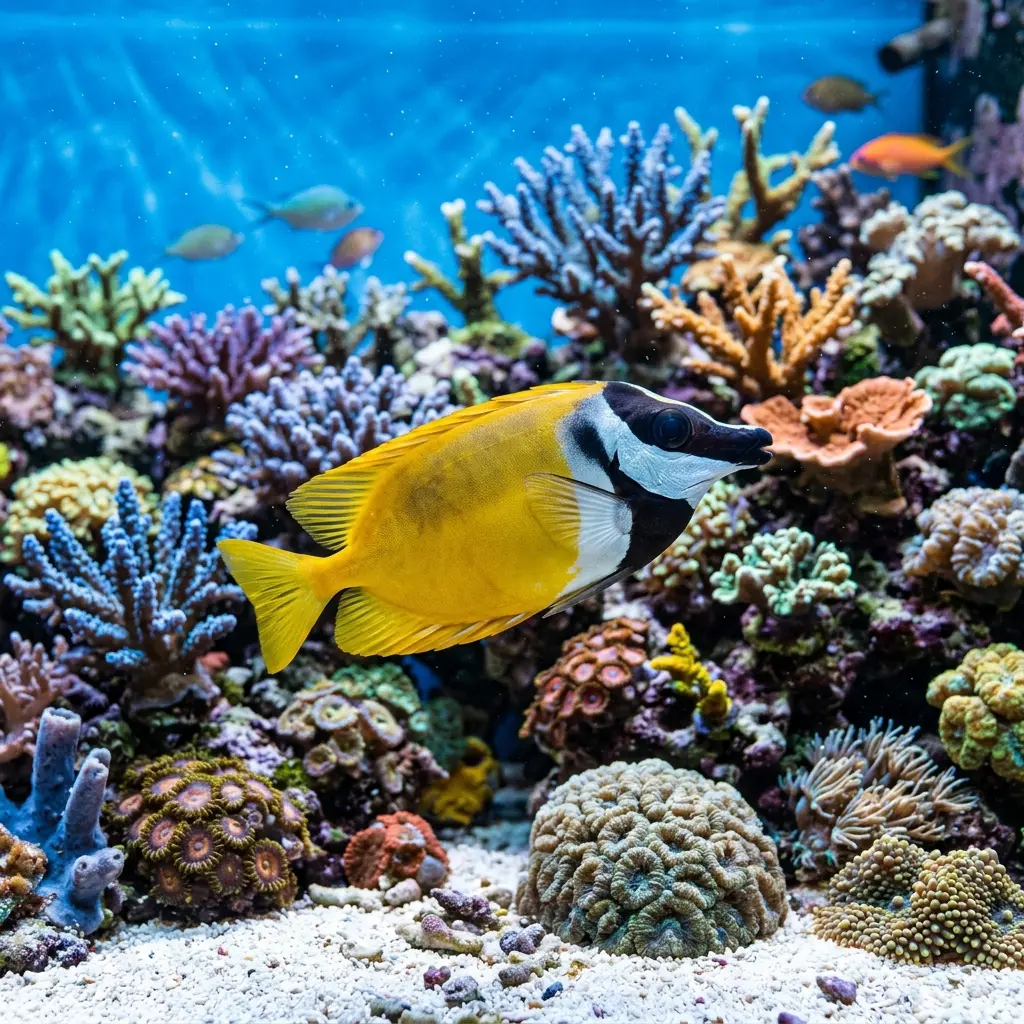
The Foxface Rabbitfish (Siganus vulpinus) is a peaceful, herbivorous marine fish recognizable by its bright yellow body and distinctive black-and-white facial mask. It grows up to 10 inches (25 cm), requires a minimum 75-gallon (284-liter) aquarium, and is valued for controlling nuisance algae. Caution is needed due to venomous spines and potential coral nipping when underfed.
Quick Facts
| Scientific Name | Siganus vulpinus |
|---|---|
| Common Names | Foxface Rabbitfish |
| Type | Saltwater |
| Temperament | Peaceful |
| Care Difficulty | intermediate |
| Lifespan | 5 years |
| Maximum Size | Up to 10 in (25 cm) |
| Diet | Herbivore |
| Temperature | 75–82°F (24–28°C) |
| pH | 8.1–8.4 |
| Hardness | 8–12 dGH |
| Minimum Size | 75 gallons |
Key Takeaways
- Grows to 10 inches (25 cm) and needs 75 or more gallons.
- Primarily herbivorous; excellent nuisance algae control.
- Venomous dorsal spines require careful handling.
- Peaceful with other species but territorial toward conspecifics.
- Reef-safe with caution; may nip soft corals if underfed.
Health
Marine Ich (Cryptocaryon irritans)
- White cysts on skin and fins, rubbing against surfaces, rapid breathing, clamped fins, decreased appetite.
Stress, introduction of infected livestock, poor water quality, or inadequate quarantine.
Quarantine all new fish for 4 or more weeks; maintain stable water parameters and minimize stress.
Lateral Line Erosion (HLLE)
Erosion of sensory pores along the lateral line and head, often associated with nutrition and water quality issues.
- Pitted or eroded areas along the lateral line and head, discoloration around affected areas.
Poor nutrition, carbon dust exposure, stray voltage, or inadequate water changes.
Provide a varied herbivorous diet with vitamin supplementation; perform regular water changes; use high-quality activated carbon.
Venomous Spine Injury
Defensive spines on the dorsal and anal fins contain venom capable of causing severe pain.
- Intense pain, swelling, redness, and possible allergic reaction at the puncture site.
Accidental contact during tank maintenance, netting, or handling.
Wear thick protective gloves during maintenance; use slow, careful netting techniques; avoid cornering or startling the fish.
Breeding
Captive breeding of Siganus vulpinus is extremely challenging and has not been documented in home aquariums. In nature, they form monogamous pairs and are pelagic broadcast spawners, releasing eggs into the water column at dusk. Some related Siganus species have been induced to spawn using hormone injections in research facilities, but commercial captive breeding of foxfaces remains rare. Sexual dimorphism is minimal and not reliably distinguishable in aquarium settings. Attempting breeding requires very large systems, precise environmental conditioning, and specialized larval rearing protocols for pelagic eggs and fry.
Compatible Tank Mates
Species Comparison
| Attribute | Foxface Rabbitfish | One Spot Foxface | Yellow Tang | Lawnmower Blenny |
|---|---|---|---|---|
| Scientific Name | Siganus vulpinus | Siganus unimaculatus | Zebrasoma flavescens | Salarias fasciatus |
| Adult Size | Up to 10 in (25 cm) | Up to 8 in (20 cm) | Up to 8 in (20 cm) | Up to 5 in (13 cm) |
| Temperament | Peaceful | Peaceful | Semi-aggressive | Peaceful |
| Minimum Tank Size | 75 gal (284 L) | 75 gal (284 L) | 100 gal (379 L) | 30 gal (114 L) |
| Diet | Herbivore | Herbivore | Herbivore | Herbivore |
| Reef Safe | With caution | With caution | Yes | Yes |
| Activity Period | Diurnal | Diurnal | Diurnal | Diurnal |
| Care Difficulty | Intermediate | Intermediate | Intermediate | Easy |