African Leaf Fish Care Guide (Ctenopoma acutirostre)
Quick Answer
African Leaf Fish (Ctenopoma acutirostre) is a unique ambush predator from the Congo Basin with remarkable leaf-like camouflage. It requires a minimum 40-gallon aquarium with pH 6.0-7.5, temperature 75-82°F (24-28°C), and soft to moderate water (4-12 dGH). As a strict carnivore with semi-aggressive tendencies, it needs live or frozen food, dense hiding spots, and tank mates too large to swallow. Reaches 4-6 inches and lives 5-8 years.
Quick Facts
| Scientific Name | Ctenopoma acutirostre |
|---|---|
| Common Names | African Leaf Fish |
| Family | Anabantidae |
| Genus | Ctenopoma |
| Type | Freshwater |
| Temperament | semi-aggressive |
| Care Difficulty | intermediate |
| Lifespan | 8 years |
| Maximum Size | Up to 6 in (15 cm) |
| Diet | Carnivore |
| Temperature | 75–82°F (24–28°C) |
| pH | 6–7.5 |
| Hardness | 4–12 dGH |
| Minimum Size | 40 gallons |
Key Takeaways
- Remarkable leaf-like camouflage with mottled brown pattern and motionless hunting posture.
- Strict carnivore requiring live or frozen foods; often refuses dry pellets and flakes.
- Scaleless skin makes it highly sensitive to copper (0.15 ppm lethal) and formalin.
- Best kept singly or as a bonded pair; males fight violently in small tanks.
- Needs gentle water flow, dim lighting, and dense vegetation with hiding spots.
- Member of family Anabantidae (labyrinth fish) with ability to breathe atmospheric air.
Overview
The African Leaf Fish (Ctenopoma acutirostre), also known as the Leopard Bushfish, Spotted Ctenopoma, or Spotted Climbing Perch, is one of the most fascinating ambush predators in the aquarium hobby. Its remarkable leaf-like camouflage—mottled brown coloration, flattened body, and motionless hunting posture—makes it nearly invisible among plants and driftwood. When it strikes, it does so with explosive speed, inhaling prey whole with its enormous, extendable mouth.
Native to the slow-moving waters of the Congo River basin, this fish is a member of the family Anabantidae (labyrinth fish), making it a distant cousin of gouramis and bettas. It possesses a labyrinth organ that allows it to breathe atmospheric air—an adaptation to the oxygen-poor stagnant ponds it often inhabits. Despite its predatory nature, it is relatively peaceful toward fish too large to swallow, making it a unique centerpiece for appropriately planned community tanks.
Ideal For
- Intermediate aquarists seeking a unique ambush predator with extraordinary camouflage.
- Keepers interested in West African or Congo Basin biotope aquariums with driftwood and dense plants.
- Aquarists willing to provide live or frozen foods and maintain gentle water conditions.
Appearance
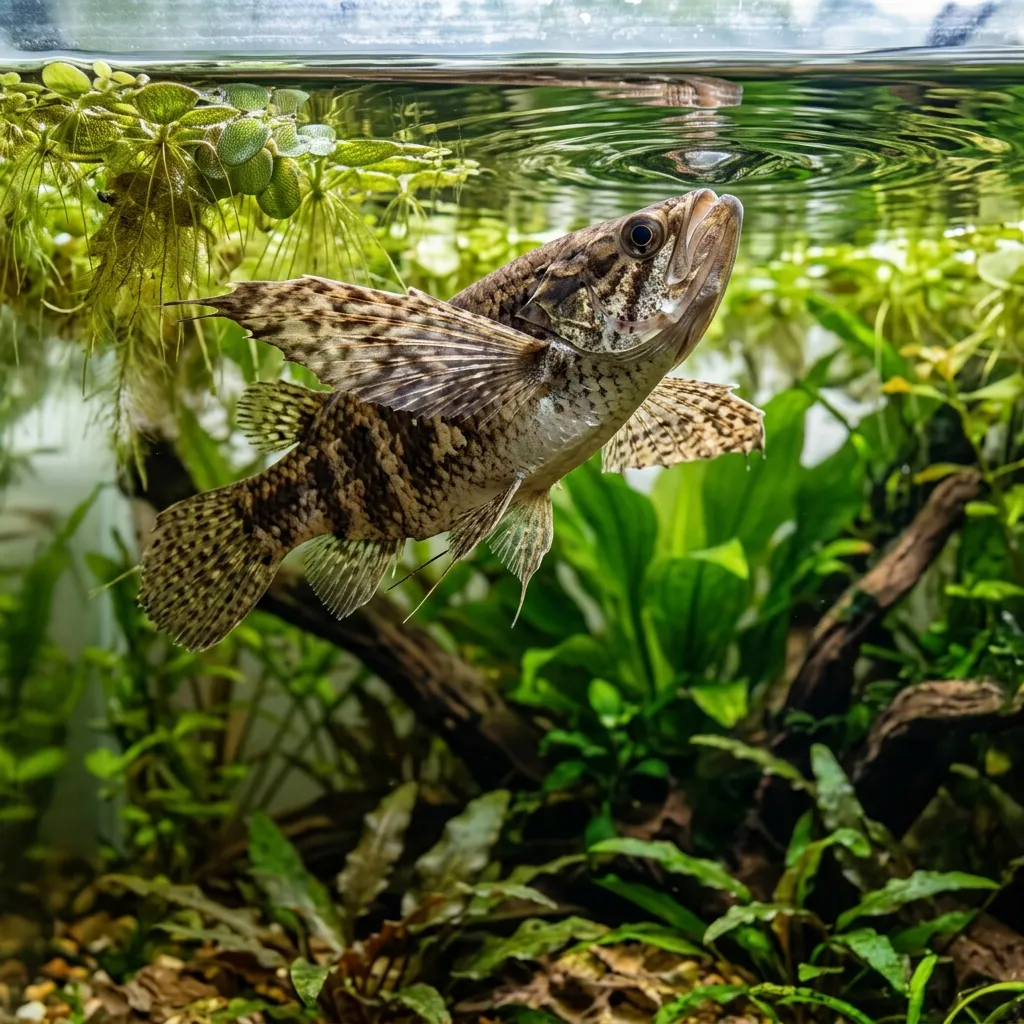
The African Leaf Fish has a rounded, laterally compressed body with a pointed, elongated snout and disproportionately large mouth. Its coloration is a mottled pattern of dark brown spots scattered over a light brown to tan base—resembling a dead leaf floating in the water. The long dorsal fin and rounded caudal fin complete the leaf illusion. Some specimens have a distinctive eye-spot on the tail. The eyes are large and positioned high on the head for spotting prey from below. Males can be distinguished by a rough, textured area at the base of the caudal peduncle (absent in females) and more spines on the gill covers. Adults reach 4-6 inches (10-15 cm) in captivity, though wild specimens can grow to 8 inches (20 cm).
Natural Habitat
In the wild, the African Leaf Fish inhabits the middle Congo River basin across the Republic of the Congo, Democratic Republic of the Congo, and Central African Republic. It is incredibly adaptable, found in fast-flowing streams, slow-moving creeks, and stagnant ponds with dense vegetation. During the wet season, it ventures into flooded forests. The water is typically warm (75-82°F), soft to moderately hard (4-12 dGH), and slightly acidic to neutral (pH 6.0-7.5), often stained with tannins from decaying vegetation.
Care
Housing & Pond Requirements
African Leaf Fish require a tank designed around hiding spots and subdued lighting. The minimum size is 40 gallons for a single fish, with a footprint of at least 36×18 inches (90×45 cm). For a pair or community setup, 55+ gallons is recommended.
Key design principles:
- Plants: Dense vegetation with large-leafed plants (Anubias, Java Fern, Echinodorus) provides hunting cover and security.
- Hardscape: Driftwood, caves, and rock formations create territories and hiding spots. Provide at least 3 distinct hiding zones per fish.
- Substrate: Dark sand or fine gravel mimics the leaf-littered bottom of their natural habitat and reduces skittishness.
- Lighting: Low to moderate intensity with floating plants (Amazon Frogbit, Salvinia) to create dappled shade.
- Filtration: Gentle flow is essential—canister filters with baffled outputs or sponge filters. Strong current stresses these fish.
- Lid: Recommended but not as critical as for jumpers; they occasionally leap during feeding.
Water Parameters
African Leaf Fish are adaptable but thrive in soft, slightly acidic to neutral water that mimics their Congo Basin home.
Temperature
Maintain 75–82°F (24–28°C). Stable temperature is important; avoid fluctuations greater than 2°F per day.
pH
Maintain 6.0–7.5. Wild-caught specimens prefer the acidic end (6.0-6.5), while tank-bred individuals tolerate up to 7.5.
Hardness (GH)
4–12 dGH, with an ideal range of 5-8 dGH. Very soft water is acceptable but not required.
Carbonate Hardness (KH)
2–8 dKH, ideally 3-6 dKH. This provides some pH stability without making the water too hard.
Water Flow
Very gentle. These fish inhabit slow-moving and stagnant waters. Strong currents cause chronic stress and reduce hunting success.
Diet
African Leaf Fish are specialized piscivores and insectivores (obligate carnivores). They are ambush predators that rely on camouflage and patience, striking with lightning speed when prey comes within range. Their enormous mouths can swallow prey nearly half their own body size.
- Live Foods (Best): Live ghost shrimp, guppy fry (quarantined), small earthworms, crickets, and feeder fish. Live prey triggers their strongest feeding response and maintains optimal health.
- Frozen Foods: Frozen silversides, lancefish, bloodworms, and krill. Wiggle the food with tongs to simulate live movement during training.
- Training to Frozen: Many leaf fish can be trained to accept frozen foods by wiggling them with tongs to mimic live prey. This may take several weeks.
- Avoid: Dry pellets and flakes are generally refused. Some individuals never accept prepared foods.
Feed 3-4 times weekly, not daily, as they digest slowly. Overfeeding leads to obesity and water quality issues.
Health
African Leaf Fish are generally hardy when their specialized needs are met, but they are susceptible to several issues related to their scaleless skin, sensitive digestion, and requirement for live foods.
Copper Toxicity / Medication Sensitivity
African Leaf Fish have scaleless skin that absorbs chemicals rapidly. Copper at 0.15 ppm is lethal; formalin is also dangerous.
- Rapid breathing and gasping at the surface.
- Lethargy and loss of appetite.
- Reddening or irritation of the skin.
- Sudden death without warning signs.
Use malachite green at half-dose for external parasites. Use praziquantel at 2 mg/L for internal parasites. Always research medication safety for scaleless fish before treatment.
Bloat / Dropsy
Internal bacterial infection or blockage causing fluid retention and abdominal swelling. Often triggered by overfeeding or poor-quality food.
- Swollen, pinecone-like abdomen (scales sticking out).
- Lethargy and loss of appetite.
- Floating at the surface or sinking to the bottom.
- Clamped fins and rapid breathing.
Overfeeding or feeding inappropriate foods (too large, spoiled). Internal bacterial infection (Aeromonas or Pseudomonas). Poor water quality with high organic load.
Feed appropriately sized prey (no larger than the fish’s eye). Maintain excellent water quality with regular changes. Treat early with broad-spectrum antibiotics and Epsom salt baths.
Ich (White Spot Disease)
Common protozoan parasite. Treatment is complicated by the fish’s sensitivity to copper.
- White salt-like spots on body and fins.
- Rubbing against decorations (flashing).
- Rapid breathing and clamped fins.
Ichthyophthirius multifiliis parasite introduced via new fish or plants. Stress from temperature fluctuations or poor water quality.
Quarantine all new fish and plants for 2-4 weeks. Maintain stable temperature between 75-82°F. Use malachite green or heat treatment instead of copper.
Nutritional Deficiency / Starvation
Chronic condition caused by refusal to accept prepared foods or lack of dietary variety.
- Gradual weight loss and thinning body.
- Dull, faded coloration.
- Lethargy and reduced hunting behavior.
- Refusal to eat despite food being present.
Refusal to accept dry or frozen foods. Lack of live prey variety. Competition from faster tank mates during feeding.
Offer a variety of live and frozen foods. Train to frozen foods using tongs and movement simulation. Feed in a separate container or target-feed to ensure adequate intake.
Breeding
Breeding African Leaf Fish is challenging but achievable with proper conditioning and environmental simulation. They are bubble nest builders with paternal care.
Sexing
Males have a rough, textured area at the base of the caudal peduncle (absent in females) and more spines on the gill covers. Males also tend to be more colorful and slightly smaller than females.
Conditioning
Condition a bonded pair with live foods (earthworms, ghost shrimp) for 2 weeks. Ensure the pair is compatible—forced pairings often result in violence.
Spawning Trigger
Lower water level to 12 inches (30 cm), raise temperature to 82°F (28°C), and perform a 40% water change with soft (4 dGH), slightly acidic (pH 6.5) RO water. Add floating plants (Salvinia) and a PVC pipe as a spawning site.
Spawning Process
- The male builds a bubble nest among floating plants or under a leaf.
- He wraps around the female in a spawning embrace.
- The female releases 500-1000 adhesive eggs that float to the surface.
- The male guards the nest and fry aggressively.
- Eggs hatch in 24-36 hours.
- Fry are tiny (0.1 inch / 2.5 mm) and require infusoria for 5 days, then baby brine shrimp.
Note: Remove the female immediately after spawning to prevent aggression. The male will care for the eggs and fry.
Tips
Common Mistakes
Two male African Leaf Fish in under 75 gallons will fight to severe injury, including eye damage and torn fins. Keep singly or as a single verified male-female pair. In community tanks, ensure only one leaf fish is present unless the tank is 75+ gallons with distinct territories.
African Leaf Fish are obligate carnivores that often refuse dry pellets and flakes entirely. Relying on prepared foods leads to gradual starvation and nutritional deficiency. Always provide live or frozen foods, and use tongs to simulate movement when training to frozen.
These fish come from slow-moving and stagnant waters. Strong filter outputs cause chronic stress, reduce hunting success, and may prevent them from building bubble nests. Use sponge filters or heavily baffle canister filter outputs.
Any fish or invertebrate under 2 inches (5 cm) body depth will eventually be eaten. This includes neon tetras, guppies, shrimp, and small snails. Even if not immediately consumed, their presence triggers constant predatory stress.
Expert Tips
Train your leaf fish to associate a specific stick or tongs with food. This allows precise feeding, ensures the fish gets adequate nutrition, and prevents faster tank mates from stealing food.
Indian almond leaves (Catappa) release tannins that mimic the blackwater conditions of the Congo Basin, reduce stress, boost immune function, and encourage natural hunting behavior. Use 1 leaf per 10 gallons, replaced monthly.
Under bright lights, African Leaf Fish become skittish and hide constantly. Dim lighting with floating plants encourages them to display their natural motionless hunting posture in open view—this is when they are most fascinating to observe.
Compatible Tank Mates
Ambush Predator Fish Comparison
| Feature | African Leaf Fish | Betta Fish | African Butterflyfish | Leopard Bushfish |
|---|---|---|---|---|
| Scientific Name | Ctenopoma acutirostre | Betta splendens | Pantodon buchholzi | Ctenopoma acutirostre (same species) |
| Adult Size | 4-6 in (10-15 cm) | 2.5-3 in (6-8 cm) | 4-5 in (10-12 cm) | 4-6 in (10-15 cm) |
| Minimum Tank Size | 40 gallons | 5 gallons (single) | 30 gallons (long) | 40 gallons |
| Care Difficulty | Intermediate | Beginner | Advanced | Intermediate |
| Temperament | Semi-aggressive (ambush predator) | Aggressive (territorial) | Aggressive (surface territorial) | Semi-aggressive (ambush predator) |
| Diet | Carnivore (live/frozen prey) | Carnivore (pellets, frozen) | Carnivore (surface insects) | Carnivore (live/frozen prey) |
| Water pH | 6.0 - 7.5 | 6.5 - 7.5 | 6.0 - 7.5 | 6.0 - 7.5 |
| Temperature (°F) | 75 - 82 | 76 - 82 | 75 - 86 | 75 - 82 |
| Special Requirements | Hiding spots, live food, dim light | Warm water, lid (jumper), plants | Tight lid, floating plants, live food | Hiding spots, live food, dim light |
| Tank Mate Compatibility | Larger peaceful fish; no small fish/shrimp | Limited; no fin-nippers or other bettas | Mid/bottom dwellers only; no surface fish | Larger peaceful fish; no small fish/shrimp |
| Unique Trait | Leaf-like camouflage, ambush hunting | Labyrinth organ, bubble nests, fin varieties | Can jump and glide, surface predator | Same as African Leaf Fish |
| Price Range | $10 - $25 | $5 - $50 | $15 - $40 | $10 - $25 |