
African Butterflyfish Care Guide (Pantodon buchholzi)
Quick Answer
African Butterflyfish (Pantodon buchholzi) is a unique surface-dwelling predator from West Africa. It requires a minimum 30-gallon long aquarium with pH 6.0-7.5, temperature 75-86°F (24-30°C), and soft water (2-12 dGH). As a strict carnivore with aggressive territorial tendencies, it needs floating plants, live/floating food, and a tight-fitting lid. Reaches 4-5 inches and lives 5-6 years.
Quick Facts
| Scientific Name | Pantodon buchholzi |
|---|---|
| Common Names | African Butterflyfish |
| Family | Pantodontidae |
| Genus | Pantodon |
| Type | Freshwater |
| Temperament | aggressive |
| Care Difficulty | advanced |
| Lifespan | 6 years |
| Maximum Size | Up to 4.8 in (12 cm) |
| Diet | Carnivore |
| Temperature | 75–86°F (24–30°C) |
| pH | 6–7.5 |
| Hardness | 2–12 dGH |
| Minimum Size | 30 gallons |
Key Takeaways
- The only surviving member of the ancient family Pantodontidae (Cretaceous lineage).
- Requires a tight-fitting lid—expert jumper capable of leaping several feet.
- Strict surface feeder; ignores all sinking food. Feed live insects or floating foods only.
- Aggressive territorial behavior at the surface; best kept singly or as a bonded pair.
- Needs very gentle water flow and dense floating vegetation for security.
- Sensitive to copper medications; use malachite green or formalin alternatives.
Overview
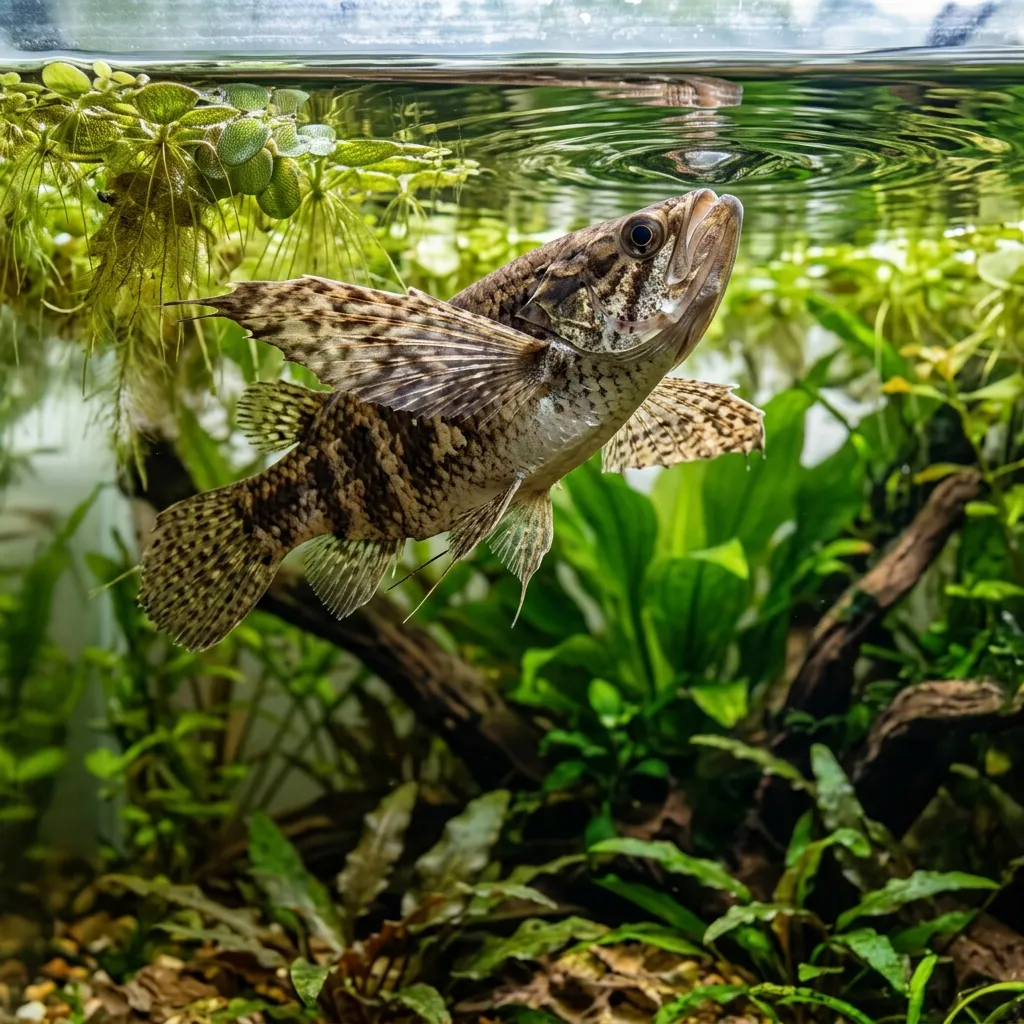
The African Butterflyfish (Pantodon buchholzi) is one of the most unique and visually striking freshwater fish in the aquarium hobby. With its enormous, wing-like pectoral fins, upturned mouth, and prehistoric appearance, it looks like nothing else in the trade. When viewed from above, its spread fins resemble a butterfly in flight—hence the common name.
This species is the sole surviving member of the family Pantodontidae, a lineage that dates back to the Late Cretaceous period. It is a distant relative of arowanas and other bony-tongue fish (Order Osteoglossiformes). Native to the slow-moving, vegetation-choked waters of West and Central Africa, it has evolved into a highly specialized surface predator capable of jumping and gliding short distances to catch flying insects or escape predators.
Ideal For
- Advanced aquarists seeking a unique, prehistoric-looking surface predator.
- Keepers interested in West African biotope aquariums with floating plants and dim lighting.
- Breeders willing to simulate seasonal dry/wet cycles for spawning.
Appearance
African Butterflyfish have a deep, laterally compressed body with a blunt, upward-facing snout. Their most distinctive feature is the pair of massive pectoral fins that extend outward like wings, allowing them to glide short distances above the water surface. The dorsal and anal fins are set far back on the body, and the caudal fin is broad and powerful—together these propel the fish out of the water during jumps. Coloration is a mottled gray-brown camouflage pattern that mimics a dead leaf floating on the surface. The eyes sit high on the head, constantly trained upward to spot prey. Adult size reaches 4-5 inches (10-12 cm) in captivity, up to 5 inches (12 cm) in the wild.
Natural Habitat
In the wild, they inhabit slow-moving and still waters in creeks, lakes, swamps, and quiet backwaters of streams and rivers across West and Central Africa. These habitats are typically ‘blackwater’—tannin-stained, slightly acidic, and soft—with dense floating and overhanging vegetation providing cover. Water movement is minimal, and the fish spend most of their time motionless at the surface, camouflaged among floating debris, waiting to ambush prey. They are crepuscular, becoming most active during dawn and dusk.
Care
Housing & Pond Requirements
The most critical factor in housing African Butterflyfish is surface area and a secure lid. These fish are expert jumpers capable of leaping several feet to catch insects or escape predators. A standard 30-gallon aquarium is the absolute minimum, but a 40-gallon breeder or larger with a footprint of at least 36×12 inches (90×30 cm) is highly recommended. The width of the tank is far more important than the depth—shallow, long tanks are ideal.
A tight-fitting lid with NO gaps is absolutely non-negotiable. Even small openings will be exploited. Use a solid glass canopy or mesh secured with weights. Keep the water level 1-2 inches below the lid to prevent impact injuries during jumps.
Provide dense floating vegetation (Amazon Frogbit, Water Lettuce, Salvinia, Hornwort) to diffuse light, provide security, and replicate their natural habitat. A dark substrate helps them feel less exposed.
Water Parameters
African Butterflyfish are adaptable but thrive best in conditions that mimic their West African blackwater habitats.
Temperature
Maintain 75–86°F (24–30°C), with 77–80°F (25–27°C) being optimal. Stable temperature is more important than the exact number.
pH
Maintain 6.0–7.5. Wild-caught specimens prefer the acidic end (6.0-6.5), while tank-bred individuals tolerate up to 7.5.
Hardness
Soft to moderate: 2–12 dGH. Wild-caught fish require softer water (2-6 dGH). High carbonate hardness (>5 dKH) inhibits their natural mucus coat production, increasing vulnerability to columnaris infections.
Water Flow
Keep it very gentle. Strong currents disrupt their surface feeding and cause chronic stress. Use sponge filters or heavily baffle hang-on-back/canister filter outputs.
Diet
African Butterflyfish are strict surface insectivores and piscivores (obligate carnivores). Their upturned mouth, high-set eyes, and enormous pectoral fins are evolutionary adaptations for snatching prey from the water’s surface tension line. They will completely ignore any food that sinks past the top 1 inch (2.5 cm) of water.
- Staple Diet: High-quality floating carnivore pellets or sticks (large enough to attract attention).
- Live Foods: Live insects are the best food—small crickets, wingless fruit flies (Drosophila), gut-loaded mealworms, spiders, and flies. They will eagerly hunt these across the tank surface.
- Frozen Foods: Frozen bloodworms, brine shrimp, and krill—offered floating.
- Avoid: Standard sinking pellets, dry flakes, and any food that sinks immediately.
Feed small portions 2-4 times daily. Overfeeding fouls the calm surface water they require.
Health
African Butterflyfish are generally hardy when their specialized needs are met, but they are susceptible to several issues related to water quality, diet, and tank conditions. Their sensitivity to copper-based medications requires careful treatment protocols.
Columnaris (Cotton Wool Disease)
Bacterial infection causing white, cotton-like patches on the body and fins, often fatal if untreated.
- White, cotton-like patches on mouth, fins, or body.
- Frayed or disintegrating fins.
- Lethargy and loss of appetite.
- Rapid breathing and clamped fins.
Flavobacterium columnare bacteria, exacerbated by high carbonate hardness (>5 dKH) which inhibits mucus coat production. Poor water quality with high organic load. Stress from incompatible tank mates or strong water flow.
Maintain soft, acidic water (pH 6.0-7.0, dGH 2-6). Keep carbonate hardness below 4 dKH. Perform regular water changes and maintain gentle filtration. Quarantine new fish before introducing to the main tank.
Fin Rot
Bacterial infection causing progressive deterioration of the long pectoral and caudal fins.
- Frayed, disintegrating fins with white or milky edges.
- Reddening at the fin base.
- Reduced activity and appetite.
Bacterial infection (Aeromonas or Pseudomonas) from poor water quality. Fin-nipping by aggressive tank mates targeting their long pectoral fins. Injury from jumping into the tank lid.
Maintain pristine water conditions with 0 ppm ammonia/nitrite. Avoid fin-nipping tank mates like Tiger Barbs or Serpae Tetras. Ensure adequate space between water surface and tank lid to prevent impact injuries.
Ich (White Spot Disease)
Common protozoan parasite. African Butterflyfish are highly sensitive to copper-based treatments.
- White salt-like spots on body and fins.
- Rubbing against decorations (flashing).
- Rapid breathing and clamped fins.
Ichthyophthirius multifiliis parasite introduced via new fish or plants. Stress from temperature fluctuations or poor water quality.
Quarantine all new fish and plants for 2-4 weeks. Maintain stable temperature between 75-82°F. Use malachite green or formalin-based treatments instead of copper.
Nutritional Stunting / Starvation
Chronic condition caused by feeding inappropriate sinking foods that the fish ignores.
- Gradual weight loss and thinning body.
- Lethargy and reduced activity.
- Dull coloration.
- Refusal to eat despite food being present.
Feeding sinking pellets or flakes that pass below the surface feeding zone. Lack of live or frozen insect-based foods. Competition from faster surface feeders.
Feed exclusively floating foods: live insects, floating pellets, freeze-dried bloodworms. Feed 2-4 small meals daily to ensure adequate nutrition. Distract other fish with sinking food while offering live prey near the butterflyfish.
Breeding
Breeding African Butterflyfish is challenging but achievable with careful environmental simulation. They are egg layers that spawn at the water surface among floating plants. Sexing is possible by examining the anal fin: males have a modified anal fin with elongated rays forming a tube-like structure, while females have a rounder, unmodified anal fin and grow slightly larger and heavier.
Breeding Simulation
- Dry Season (14 days): Lower water level to 4-6 inches (10-15 cm) and raise temperature to 84°F (29°C).
- Rainy Season Trigger: Perform a massive 60% water change using cool, soft RO water (pH 6.0, 2 dGH) over 3 hours.
- Add Floating Plants: Introduce dense floating layers of Salvinia or Amazon Frogbit.
- Spawning: Occurs at night under cover. The female deposits 100-200 dark, floating eggs among the plants.
- Egg Care: Eggs hatch in 36-48 hours. Remove parents immediately to prevent egg predation.
- Fry Care: Fry stay at the surface and require tiny live foods that float—infusoria and paramecium for the first 5 days, then newly hatched baby brine shrimp delivered at the surface.
Tips
Common Mistakes
In systems under 40 gallons or with surface area less than 36×12 inches, multiple males engage in violent jaw-locking battles over territory, resulting in severe physical injuries and secondary tail rot. Keep strictly as a single individual or a verified bonded pair.
African Butterflyfish are strict surface feeders. Any food that sinks past the top 1 inch of water is permanently ignored. This leads to gradual starvation and nutritional stunting. Always use floating foods: live insects, floating pellets, or freeze-dried bloodworms.
These fish are expert jumpers capable of leaping several feet. Even small gaps in the tank cover will be exploited, leading to fatal drying out on the floor. Use a solid glass canopy or secured mesh with NO gaps.
Strong currents disrupt their surface feeding behavior and cause chronic stress. Use sponge filters or heavily baffle all filter outputs. The water surface should be nearly still.
Expert Tips
Dense floating plants (Amazon Frogbit, Water Lettuce, Salvinia) are essential for security, light diffusion, and natural behavior. They also harbor microorganisms that fry can feed on.
Live crickets are the ultimate conditioning food for breeding. The normally sedate butterflyfish can sense cricket movement from across the tank and will actively hunt them—this stimulates natural predatory behavior and improves coloration.
African Butterflyfish are less skittish and display more natural behavior when kept over a dark substrate. This mimics the tannin-stained, dark-bottomed waters of their native habitat.
Compatible Tank Mates
Surface-Dwelling Predator Fish Comparison
| Feature | African Butterflyfish | Marbled Hatchetfish | Silver Arowana | African Leaf Fish |
|---|---|---|---|---|
| Scientific Name | Pantodon buchholzi | Carnegiella strigata | Osteoglossum bicirrhosum | Ctenopoma acutirostre |
| Adult Size | 4-5 in (10-12 cm) | 1.5-2 in (3.5-5 cm) | 24-30 in (60-75 cm) | 3-4 in (8-10 cm) |
| Minimum Tank Size | 30-40 gal (long/shallow) | 10-15 gal | 150+ gal | 30 gal |
| Care Difficulty | Advanced | Intermediate | Advanced | Intermediate |
| Temperament | Aggressive (surface territorial) | Peaceful (schooling) | Semi-aggressive | Semi-aggressive |
| Diet | Strict carnivore (surface insects) | Omnivore (surface flakes) | Carnivore (large prey) | Carnivore (ambush predator) |
| Water pH | 6.0 - 7.5 | 6.0 - 7.5 | 6.0 - 7.5 | 6.5 - 7.5 |
| Temperature (°F) | 75 - 86 | 72 - 81 | 75 - 82 | 72 - 82 |
| Special Requirements | Tight lid (jumper), floating plants, live food | Tight lid (jumper), calm surface | Huge tank, tight lid, large prey | Hiding spots, live food preferred |
| Jumping Ability | Expert (can glide short distances) | Moderate (hatchet-like jumps) | High (powerful leaps) | Low |
| Tank Mate Compatibility | Mid/bottom dwellers only; no surface fish | Peaceful community fish | Large, robust fish only | Similar-sized, non-aggressive fish |
| Price Range | $15 - $40 | $5 - $15 | $50 - $200+ | $10 - $25 |