
Chili Rasbora (Boraras brigittae)
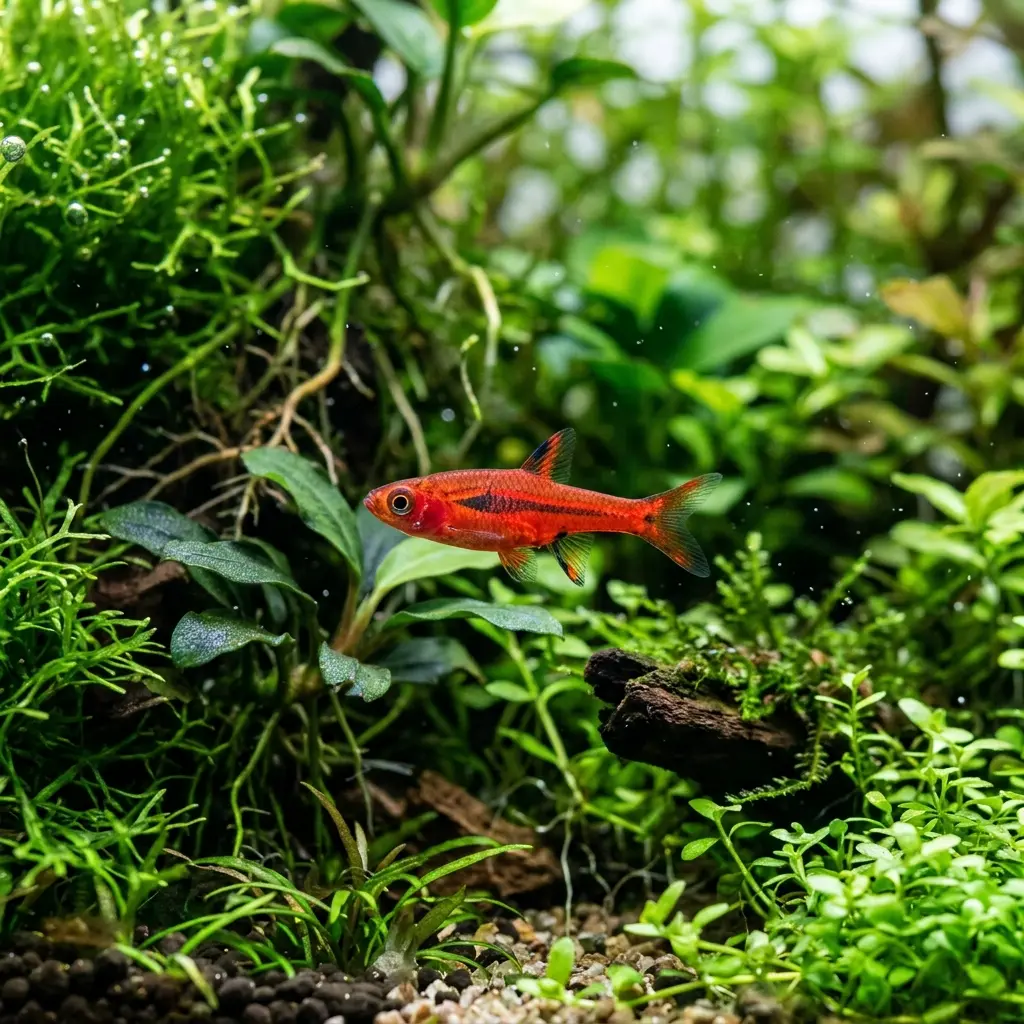
Quick Answer
Chili Rasbora (Boraras brigittae) is a miniature cyprinid endemic to the blackwater peat swamps of southwestern Borneo, Indonesia. It requires a minimum 5-gallon (19 L) heavily planted aquarium with soft, acidic water (pH 5.5-6.5, GH 1-5 dGH), temperature 72-82 degrees Fahrenheit (22-28 degrees Celsius), and schools of 12 or more individuals. This micro-predator occupies the top/middle water column and is compatible with shrimp and other tiny peaceful species under 1.5 inches (3.8 cm).
Quick Facts
| Scientific Name | Boraras brigittae |
|---|---|
| Common Names | Chili Rasbora |
| Family | Cyprinidae (Danionidae in some modern classifications) |
| Genus | Boraras |
| Type | Freshwater |
| Temperament | peaceful |
| Care Difficulty | intermediate |
| Lifespan | 6 years |
| Maximum Size | Up to 0.8 in (2 cm) |
| Diet | Micro-predator / Omnivore |
| Temperature | 72–82°F (22–28°C) |
| pH | 5–7 |
| Hardness | 1–5 dGH |
| Minimum Size | 5 gallons |
Key Takeaways
- Adults reach only 0.6-0.8 inches (1.5-2.0 cm) — one of the smallest aquarium fish available.
- Requires soft, acidic blackwater conditions; hard alkaline water causes chronic stress and shortened lifespan.
- Must be kept in schools of 12 or more to display natural behavior and intense red coloration.
- Highly sensitive to copper (0.1 mg/L lethal), formalin, and aquarium salt; medication doses must be reduced by 50-75%.
- Wild-caught specimens frequently harbor internal parasites and require a 4-6 week quarantine with prophylactic praziquantel treatment.
- Continuous spawners that scatter adhesive eggs on fine-leaved plants; breeding requires dedicated blackwater conditions and infusoria for fry.
- Compatible with adult shrimp and other micro-fish under 1.5 inches (3.8 cm) in blackwater setups.
Overview
Species Overview
The Chili Rasbora (Boraras brigittae) is unequivocally one of the smallest cyprinids in the aquarium trade and represents the pinnacle of nano-aquarium specialization. Endemic to the peat swamp forests and blackwater streams of southwestern Borneo, Indonesia, this species has evolved under extreme selective pressures that demand precise replication in captivity. Adult males display an intense, almost incandescent red coloration that extends into the dorsal, anal, and caudal fin membranes, while females remain slightly larger and more subdued in hue with a continuous lateral stripe.
Natural History and Conservation Status
Wild populations inhabit deeply tannin-stained waters with near-zero mineral content, pH values as low as 4.0, and dense overhead canopy that reduces light penetration to a fraction of surface intensity. The IUCN currently lists B. brigittae as Data Deficient (assessed 2019), though habitat destruction from palm oil plantation conversion and the catastrophic Mega Rice Project drainage has eliminated over 64% of historical peat swamp forest cover. Only 9% of remaining habitat falls within protected reserves. Captive breeding remains limited; most trade specimens are wild-caught or first-generation captive-bred.
Why This Species Demands Expert-Level Care
Do not mistake small size for hardiness. Chili Rasboras possess extremely small mouths (gape width under 1 mm), delicate gill structures adapted to low-oxygen blackwater, and osmoregulatory systems tuned to near-distilled water conditions. Their care is intermediate not because of aggression or space requirements, but because deviation from their narrow environmental tolerance window produces rapid, often irreversible decline. You must provide soft, acidic, stable conditions or select a different species entirely.
Key Identification Features
- Maximum standard length: 0.6-0.8 inches (1.5-2.0 cm)
- Slender, elongated body with a lateral line reduced to 3-5 pored scales
- Males: Intense red body with black markings; red pigment extends into fin membranes; broken or irregular lateral stripe
- Females: Rounder abdomen, slightly paler overall, more pronounced and continuous lateral stripe
- Distinguished from Phoenix Rasbora (B. merah) by more intense uniform red coloration and broken lateral stripe pattern in breeding males
- Distinguished from Strawberry Rasbora (B. naevus) by absence of dark shoulder blotch and more slender body profile
Diet
Dietary Requirements and Feeding Protocol
Feeding Biology
Chili Rasboras are micro-predators with gape widths under 1 mm. They cannot consume standard flake foods without first crushing them against surfaces, which many individuals fail to do. In nature, they feed on micro-crustaceans, insect larvae, rotifers, protozoans, and planktonic organisms suspended in the water column or grazing from biofilm surfaces. You must replicate this diet precisely in captivity to maintain color, immune function, and breeding condition.
Nutritional Targets
- Protein: 40-50% (essential for growth, immune function, and color pigment synthesis)
- Fat: 8-12% (energy reserve; excess fat causes hepatic issues in small cyprinids)
- Plant matter: 30-40% (spirulina, vegetable matter for digestive transit and vitamin intake)
- Carotenoids: Astaxanthin and beta-carotene for red color intensification and immune support
- Fiber: Low to moderate; excessive fiber is not required for this carnivore-leaning omnivore
Recommended Foods
Rotate between these options daily to ensure nutritional completeness:
- Crushed high-quality micro-pellets (0.2-0.5 mm particle size) designed for nano fish or fry
- Powdered fry foods or specialized nano-fish flakes crushed to near-dust consistency
- Live baby brine shrimp (Artemia nauplii) — the gold standard for conditioning and color development
- Live or frozen daphnia, cyclops, and microworms for variety and gut-loading benefits
- Grindal worms for high-protein conditioning prior to breeding attempts
- Spirulina powder or crushed algae wafers (offered weekly) for carotenoid and vitamin supplementation
Feeding Schedule
Feed 2-3 times daily in quantities consumed within 2-3 minutes. These fish have high metabolisms relative to their size but possess tiny stomachs. Uneaten food decays rapidly in soft, acidic water and causes ammonia spikes that are lethal at low concentrations. Use a turkey baster to remove uneaten food immediately after feeding. Fast the tank one day per week to clear digestive tracts and mimic natural feeding variability.
Critical Dietary Warnings
- Never feed beef heart, pork, or other mammalian proteins — cyprinids lack the enzymes to digest mammalian fats, leading to hepatic lipidosis and organ failure
- Avoid large frozen bloodworms; they are too big and can cause intestinal blockages or prolapse
- Do not rely solely on dry foods; coloration fades within 2-3 weeks without live or frozen supplementation
- Old flake foods lose vitamin potency after 6 months of opening; replace opened containers regularly and store in refrigeration
- Avoid overfeeding; obesity in nano fish causes swim bladder disorders and shortened lifespan
Health
Health Management and Disease Protocols
Immunological Vulnerability
Chili Rasboras possess thin epithelial layers and reduced mucus production compared to hardier community fish. Their blackwater-adapted immune systems are not primed for the bacterial loads typical in standard community aquariums. Additionally, the vast majority of specimens in the trade remain wild-caught or only one generation removed from wild stock, carrying protozoan and nematode parasites that activate under the stress of suboptimal captive conditions.
Medication Sensitivity Alert
This is a scaleless-equivalent sensitive species with permeable skin and gill membranes. You must reduce all medication dosages to 25-50% of manufacturer recommendations and observe closely for adverse reactions.
- Copper: Lethal at 0.1 mg/L. Never use copper sulfate, Cupramine, CopperSafe, or any copper-based ich treatments.
- Formalin: Causes severe gill damage and epithelial necrosis at standard doses. Avoid entirely if possible; if unavoidable, use at 25% dose with heavy aeration.
- Malachite Green: Safe at quarter-strength (0.025 mg/L) for external parasites when copper is contraindicated.
- Salt (NaCl): Tolerance below 2 ppt (0.2%). Salt dips, aquarium salt treatments, and elevated salinity will cause fatal osmotic shock.
- Praziquantel: Safe for deworming and internal parasite treatment at standard doses.
- Levamisole: Safe for nematode treatment at half-dose (1.5 mg/L).
- Methylene Blue: Safe for egg prophylaxis and mild fungal treatment at half-dose (3 ppm).
- Kanaplex (Kanamycin): Safe for bacterial infections at standard doses in short courses.
Quarantine Protocol
Quarantine all new specimens for 4-6 weeks minimum. Wild-caught fish frequently harbor intestinal flagellates (Hexamita, Spironucleus), nematodes (Camallanus, Capillaria), and trematodes. During quarantine, treat prophylactically with praziquantel (deworming) and observe for weight loss, stringy white feces, lethargy, or spinal curvature. Do not introduce fish to the display tank until they are feeding aggressively and displaying full red coloration for at least 14 consecutive days.
Ich (White Spot Disease)
Caused by the ciliated protozoan Ichthyophthirius multifiliis. Highly contagious in stressed schools and one of the most common imported diseases in wild-caught specimens.
- White salt-grain spots on body and fins; flashing against decor and substrate; rapid gill movement; clamped fins; lethargy in advanced stages.
Stress from parameter swings (especially temperature), introduction via new livestock, or immune suppression from poor nutrition or prolonged transport.
Quarantine all new fish for 4-6 weeks. Maintain stable temperature within 1 degree Fahrenheit. Treat with gradual temperature elevation to 82-84 degrees Fahrenheit (28-29 degrees Celsius) combined with malachite green at quarter-dose (0.025 mg/L). Never use copper-based ich medications on this species. Continue treatment for 10-14 days after the last visible spot disappears to break the life cycle.
Velvet (Gold Dust Disease)
Caused by the photosynthetic dinoflagellate Oodinium pilularis. Attacks gills first, making early diagnosis difficult. Can kill an entire school within 48 hours of visible symptom onset.
- Fine gold or rust-colored dust on skin visible only under angled flashlight in a dark room; rapid breathing and gill flaring; scratching against objects; lethargy; clamped fins; loss of appetite.
Introduction via new fish, stress from bright lighting, poor water quality, or temperature instability. The parasite requires light to survive and multiply.
Strict quarantine of all new livestock. At first sign, darken the tank completely (blackout with covers on all sides and top for 3-5 days) and treat with low-dose malachite green at 0.025 mg/L. Increase surface agitation and aeration. Remove all invertebrates before treatment. Do not use copper or formalin. Maintain treatment for 14 days minimum.
Columnaris (Saddleback Disease)
Caused by Flavobacterium columnare. A bacterial infection often mistaken for fungus due to cotton-like lesions. Spreads rapidly in warm water above 77 degrees Fahrenheit (25 degrees Celsius).
- White or grayish patches on skin and fins with a mold-like appearance; saddle-shaped lesion behind dorsal fin giving the common name; frayed fin edges; mouth fungus appearance; rapid breathing; lethargy.
Stress, poor water quality, high temperatures, fin damage from rough handling or decor, or introduction via contaminated equipment. Highly contagious through shared nets and siphons.
Maintain pristine water quality with zero ammonia and nitrite. Lower temperature to 72-75 degrees Fahrenheit (22-24 degrees Celsius) if possible to slow bacterial growth. Treat early with Kanaplex (kanamycin sulfate) combined with Furan-2 (nitrofurazone) in a medicated food or bath. Salt is contraindicated for this species; rely on antibiotics and daily 25% water changes. Sterilize all equipment between tanks.
Internal Parasites (Nematodes and Trematodes)
Extremely common in wild-caught specimens. Nematodes including Camallanus and Capillaria, along with trematodes (flukes), colonize the gastrointestinal tract and body cavity, causing chronic wasting.
- Weight loss despite normal or increased appetite; stringy white or clear feces; lethargy and hiding; faded coloration; sunken belly; spinal curvature or bloating in advanced cases; visible red worms protruding from vent (Camallanus).
Wild capture and importation stress. Parasites remain dormant in healthy wild fish but activate when hosts are stressed by suboptimal water conditions, inappropriate diet, or transport trauma.
Mandatory 4-6 week quarantine with prophylactic praziquantel treatment (2.5 mg/L for 3-5 days, repeat in 2 weeks). For nematodes, use levamisole at half-dose (1.5 mg/L) for 24 hours, then perform a 75% water change. Feed high-quality varied diet with live foods to boost immune function. Do not introduce wild-caught fish to display tanks without full quarantine and treatment.
Fin Rot
Bacterial erosion of fin tissue caused by Aeromonas or Pseudomonas species. Almost always secondary to physical damage or water quality failure rather than a primary infection.
- Ragged, fraying fin edges with white, red, or black margins; receding fin tissue progressing toward the body; inflammation and redness at the fin base; difficulty swimming in advanced cases.
Physical damage from rough handling, sharp decor, or fin-nipping tank mates; ammonia or nitrite spikes; chronic nitrate levels above 20 ppm; secondary bacterial invasion through compromised tissue.
Fix water quality first — test ammonia, nitrite, and nitrate immediately. Remove sharp decor and aggressive tank mates. Perform daily 25% water changes for 5-7 days. Treat with API Fin & Body Cure or Kanaplex if infection progresses beyond the fin edge into the fin base or body. Avoid salt treatments entirely. Ensure fish receive vitamin-rich foods to support tissue regeneration.
Breeding
Breeding and Reproduction
Reproductive Biology
Chili Rasboras employ a continuous spawning strategy regulated by the Brain-Pituitary-Gonadal (BPG) axis. Unlike mass spawners, sexually mature females release small batches of 2-5 adhesive eggs daily, scattering them on the undersides of broad leaves and within fine-leaved vegetation. There is zero parental care; adults may consume eggs if not separated or if planting density is insufficient to provide refuge.
Conditioning Protocol
Condition 15-20 adults (mixed sexes in a 2:1 female-to-male ratio) in a mature planted tank for 3-4 weeks prior to spawning attempts. Feed live baby brine shrimp, daphnia, and grindal worms 2-3 times daily. Males will intensify to their deepest red and chase females through moss thickets. Females ready to spawn display noticeably rounded abdomens visible from above, with a distinct gravid spot.
Spawning Triggers
Simulate the rainy season environmental cues that trigger natural reproduction in their native Borneo:
- Perform a 50-75% water change using reverse osmosis water 1-2 degrees Celsius cooler than tank temperature. This mimics rainfall dilution and cooling that stimulates the hypothalamus to release gonadotropin-releasing hormone.
- Gradually raise temperature to 78-82 degrees Fahrenheit (25.5-27.8 degrees Celsius) over 3-4 days to complete hormonal cascade.
- Increase tannin concentration with fresh Indian almond leaves and alder cones to darken water and provide antifungal protection.
- Transfer conditioned fish to a dedicated 5-gallon (19 liter) breeding tank with 3 inches (7.5 cm) water depth, pH 6.0, 1 dGH, and dense java moss or spawning mops on mesh bottoms.
Egg and Fry Development
Spawning typically occurs the morning after introduction, shortly after first light simulates dawn. Males perform vibrating body displays beside females, driving them into moss thickets. Eggs hatch in 24-36 hours at 78-80 degrees Fahrenheit (25.5-26.7 degrees Celsius). Fry are microscopic at approximately 0.05 inches (1.2 mm) at hatch. They require:
- Days 1-7: Green water (Nannochloropsis) or infusoria culture; feed continuously
- Days 7-12: Vinegar eels and micro worms as transition foods
- Days 12-21: Newly hatched baby brine shrimp (Artemia nauplii)
- Week 4 onward: Crushed micro-pellets and powdered fry food
Do not perform water changes for the first 7-10 days after spawning. Top off evaporation only with pre-matched water identical to tank parameters. Mortality is naturally high; expect 10-30% survival to juvenile stage even under optimal conditions. Cover tank sides to reduce light stress on fry.
Common Breeding Failures
- Hard water (dGH greater than 5) prevents proper egg membrane permeability and causes rapid fungal invasion of eggs
- Inadequate tannins — eggs fungus within 12-24 hours without polyphenolic protection
- Removing adults too early — allow 48 hours for 2-3 spawning cycles before removal
- Fry starvation — have multiple live food cultures established and active before attempting breeding
- Poor sex ratio — maintain 2 females per male to prevent male harassment exhaustion
- Excessive light — fry require dim conditions; bright light causes stress and suppresses feeding response
Compatible Tank Mates






Species Comparison
| Feature | Chili Rasbora | Phoenix Rasbora | Celestial Pearl Danio | Ember Tetra |
|---|---|---|---|---|
| Scientific Name | Boraras brigittae | Boraras merah | Danio margaritatus | Hyphessobrycon amandae |
| Adult Size | 0.6 - 0.8 in (1.5 - 2.0 cm) | 0.6 - 0.8 in (1.5 - 2.0 cm) | 0.8 - 1.0 in (2.0 - 2.5 cm) | 0.8 - 1.0 in (2.0 - 2.5 cm) |
| Temperament | Peaceful | Peaceful | Peaceful | Peaceful |
| Minimum Tank Size | 5 gal (19 L) species-only; 10 gal (38 L) community | 5 gal (19 L) species-only; 10 gal (38 L) community | 10 gal (38 L) | 10 gal (38 L) |
| Optimal pH Range | 5.5 - 6.5 | 5.5 - 6.5 | 6.5 - 7.5 | 5.5 - 7.0 |
| General Hardness (GH) | 1 - 5 dGH | 1 - 5 dGH | 3 - 12 dGH | 1 - 10 dGH |
| Diet Type | Micro-predator / Omnivore | Micro-predator / Omnivore | Omnivore | Omnivore |
| Schooling Behavior | Tight shoaling; 12+ required | Tight shoaling; 12+ required | Loose grouping; 6+ acceptable | Loose schooling; 6+ acceptable |
| Color Intensity | Intense red (males) | Deep ruby red (males) | Iridescent spots on dark body | Solid orange-red |
| Difficulty Level | Intermediate | Intermediate | Intermediate | Beginner |