
Celestial Pearl Danio (Danio margaritatus)
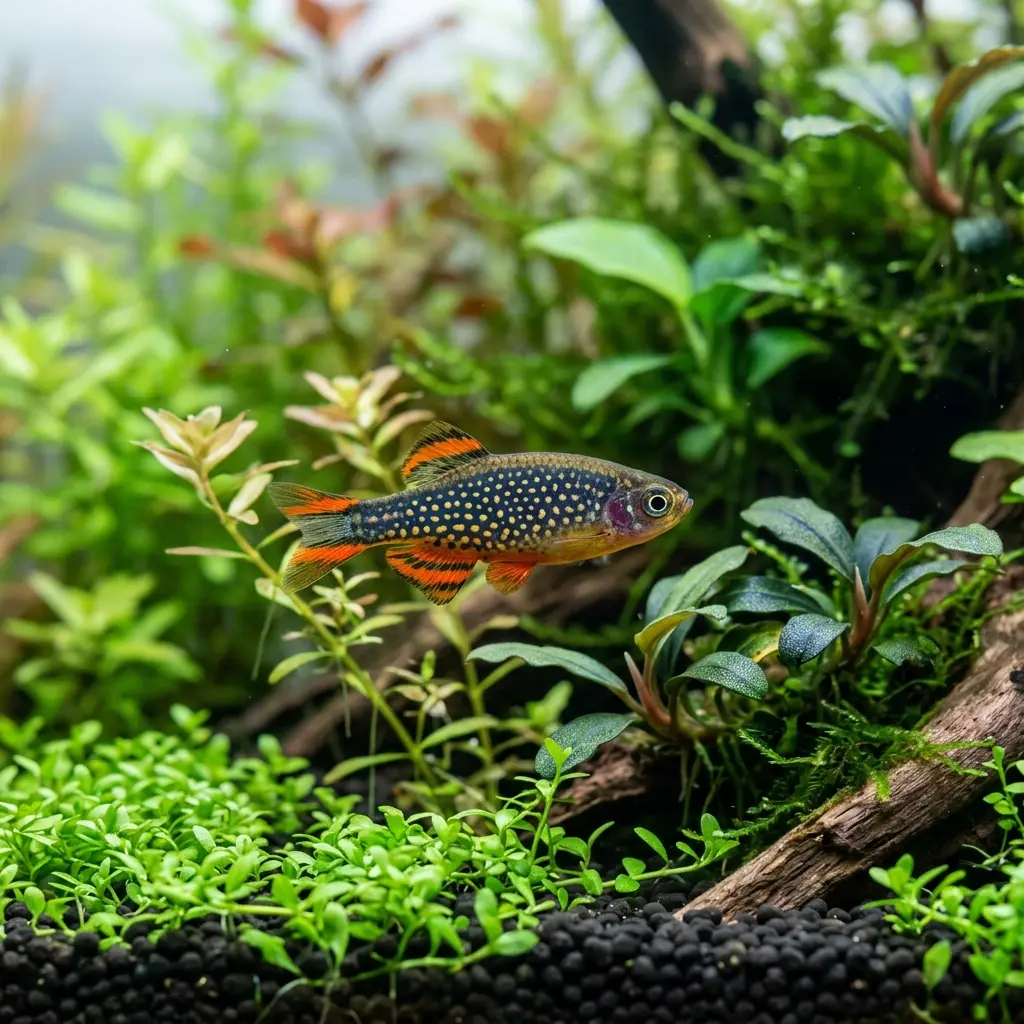
Quick Answer
Celestial Pearl Danio (Danio margaritatus), also known as Galaxy Rasbora, is a small, stunning cyprinid from Myanmar's Shan Plateau. It requires a minimum 10 gallon (38 liter) aquarium with a pH of 6.5 to 7.5, temperature of 68 to 78 degrees Fahrenheit (20 to 26 degrees Celsius), and soft to moderately hard water. This omnivorous micro-predator occupies the middle water column and thrives in heavily planted setups with conspecific groups of 8 or more.
Quick Facts
| Scientific Name | Danio margaritatus |
|---|---|
| Common Names | Celestial Pearl Danio |
| Family | Danionidae |
| Genus | Danio |
| Type | Freshwater |
| Temperament | peaceful |
| Care Difficulty | intermediate |
| Lifespan | 3 years |
| Maximum Size | Up to 1 in (3 cm) |
| Diet | Omnivore (micro-predator preference) |
| Temperature | 68–78°F (20–26°C) |
| pH | 6.5–7.5 |
| Hardness | 5–12 dGH |
| Minimum Size | 10 gallons |
Key Takeaways
- Requires cool water: 72 to 76F (22 to 24C) optimal; avoid temperatures above 78F (25.5C)
- Minimum 10 gallon tank; 15 to 20 gallons recommended for groups of 8 to 12
- Dense planting is mandatory for natural behavior and color display
- Micro-predator diet: requires tiny live, frozen, and crushed prepared foods
- Maintain 1 male to 2 female ratio to reduce territorial aggression
- Quarantine for 4 weeks; commercial stock often suffers inbreeding depression
- Will consume shrimplets; provide dense moss for shrimp refuge
- Not a true beginner fish despite small size
Overview
Species Overview
The Celestial Pearl Danio (Danio margaritatus), widely known in the aquarium trade as the Galaxy Rasbora, is one of the most visually striking nano fish available to aquarists. Discovered in 2006 near Hopong, Myanmar, at elevations exceeding 3,400 feet (1,040 meters), this species exploded in popularity due to its iridescent blue body peppered with pearl-like spots and brilliant red-orange finnage.
Diet
Diet and Feeding Protocol
Celestial Pearl Danios are omnivorous micro-predators with extremely small mouths adapted for consuming tiny invertebrates, insect larvae, and zooplankton. Their dietary requirements are precise; inappropriate food size or nutritional balance leads to malnutrition and wasting.
Health
Health Management and Disease Prevention
Celestial Pearl Danios are generally hardy when maintained in appropriate conditions, but they are particularly vulnerable to diseases associated with inbreeding, poor water quality, and improper temperature. Proactive health management is essential.
Wasting Disease / Sunken Belly Syndrome
A progressive condition characterized by concave belly, lethargy, and refusal to eat, commonly caused by internal parasites or genetic inbreeding depression.
- Concave or sunken belly, visible spine protrusion, lethargy, hiding, refusal to eat despite hunger, gradual weight loss over 2 to 4 weeks, stringy white feces if parasites are present.
Internal parasites (Capillaria, Camallanus, Hexamita), severe inbreeding depression from poor commercial breeding practices, chronic malnutrition, or Mycobacterium infection.
Quarantine new fish for 4 weeks. Purchase from reputable breeders with genetic diversity programs. Maintain optimal water parameters and varied high-protein diet. Treat prophylactically with praziquantel and levamisole during quarantine.
Ichthyophthirius multifiliis (Ich / White Spot Disease)
A protozoan parasite that causes white salt-like spots on fins and body, commonly triggered by temperature fluctuations or introduction of infected tank mates.
- White cysts resembling salt grains on fins, body, and gills; flashing against substrate; rapid breathing; clamped fins; rubbing against decorations.
Introduction of infected fish or plants; temperature drops below 70 degrees Fahrenheit (21 degrees Celsius); stress from poor water quality or inadequate planting.
Quarantine all additions for 4 weeks. Maintain stable temperature between 72 and 76 degrees Fahrenheit (22 to 24 degrees Celsius). Use Ich-X (malachite green and formalin-free formula) at half dose for 14 days. Increase temperature gradually to 78 degrees Fahrenheit (25.5 degrees Celsius) to accelerate parasite life cycle.
Columnaris (Flavobacterium columnare)
A highly contagious bacterial infection that causes white or grayish patches on mouth, fins, and body, often mistaken for fungal growth.
- White cottony patches on mouth, fin edges, or body; frayed fins; lethargy; loss of appetite; rapid mortality within 24 to 48 hours if untreated.
Poor water quality with elevated nitrates above 20 ppm; temperatures above 78 degrees Fahrenheit (25.5 degrees Celsius); stress from overcrowding or inadequate planting; introduction via infected fish.
Maintain nitrates below 15 ppm with weekly water changes. Keep temperature at 72 to 76 degrees Fahrenheit (22 to 24 degrees Celsius). Treat with erythromycin or kanamycin at standard dose immediately upon symptom appearance. Remove carbon filtration during antibiotic treatment.
Velvet Disease (Piscinoodinium pillulare)
A dinoflagellate parasite that causes a gold or rust-colored dusting on the body, often fatal in small cyprinids if not caught early.
- Gold or rust-colored dust on body and fins; clamped fins; rapid breathing; scratching against substrate; lethargy; refusal to eat.
Introduction via infected fish or plants; stress from bright lighting without cover; temperature fluctuations; poor water quality.
Quarantine all additions. Provide shaded areas with floating plants. Treat with copper-based medication at 0.15 mg/L for 10 days (CPDs tolerate this concentration). Alternatively, use aquarium salt at 1 to 2 ppt with increased temperature. Dim lights during treatment.
Mycobacterium Infection (Fish Tuberculosis)
A chronic, incurable bacterial infection causing gradual wasting, spinal deformities, and skin lesions. Highly contagious and zoonotic.
- Progressive wasting despite eating, curved or hunched spine, open sores or lesions, faded coloration, buoyancy problems, gradual decline over weeks to months.
Introduction of asymptomatic carriers; poor water quality; immunosuppression from stress or inbreeding. The bacteria persist in biofilm and substrate.
There is no effective cure. Euthanize affected fish immediately using clove oil. Disinfect the entire aquarium with diluted bleach (10 percent solution) and replace filter media. Always wear gloves when handling fish or aquarium water, as Mycobacterium can cause skin lesions in humans (fish handler’s disease).
Fin Rot (Aeromonas / Pseudomonas)
A bacterial infection causing progressive fin deterioration, often secondary to fin nipping from male aggression or poor water quality.
- Frayed or receding fin edges, redness at fin base, inflammation, in severe cases fin tissue erodes to the body.
Maintain pristine water conditions with 0 ppm ammonia and nitrite. Treat with aquarium salt at 1 ppt and erythromycin. Increase water changes to twice weekly. Add more plants to break male sight lines and reduce aggression.
Breeding
Breeding Celestial Pearl Danios
Celestial Pearl Danios are prolific egg scatterers that breed readily in captivity when conditioned properly. However, achieving high fry survival rates requires precise setup, diligent feeding, and protection from parental predation.
Compatible Tank Mates






Species Comparison
| Feature | Celestial Pearl Danio | Emerald Dwarf Rasbora | Chili Rasbora | Neon Tetra |
|---|---|---|---|---|
| Scientific Name | Danio margaritatus,Danio erythromicron,Boraras brigittae,Paracheirodon innesi | |||
| Adult Size | 1 inch (2.5 cm),0.8 to 1 inch (2 to 2.5 cm),0.8 inch (2 cm),1.5 inches (3.8 cm) | |||
| Temperament | Peaceful; males spar,Peaceful; less sparring,Very peaceful; extremely shy,Peaceful; active schooling | |||
| Minimum Tank Size | 10 gallons (38 L),10 gallons (38 L),5 gallons (19 L),10 gallons (38 L) | |||
| Optimal pH Range | 6.5 to 7.5 (slightly alkaline preferred),7.0 to 8.0 (alkaline),4.0 to 6.5 (acidic),6.0 to 7.0 (slightly acidic) | |||
| Temperature Range | 68 to 78 F (20 to 26 C),68 to 75 F (20 to 24 C),75 to 82 F (24 to 28 C),72 to 78 F (22 to 26 C) | |||
| Diet Preference | Micro-predator; tiny live foods,Omnivore; accepts flakes,Micro-predator; tiny foods,Omnivore; accepts flakes | |||
| Shrimp Safety | Will eat shrimplets; safe with adults,Generally shrimp-safe,Shrimp-safe,May nip adult shrimp antennae |