
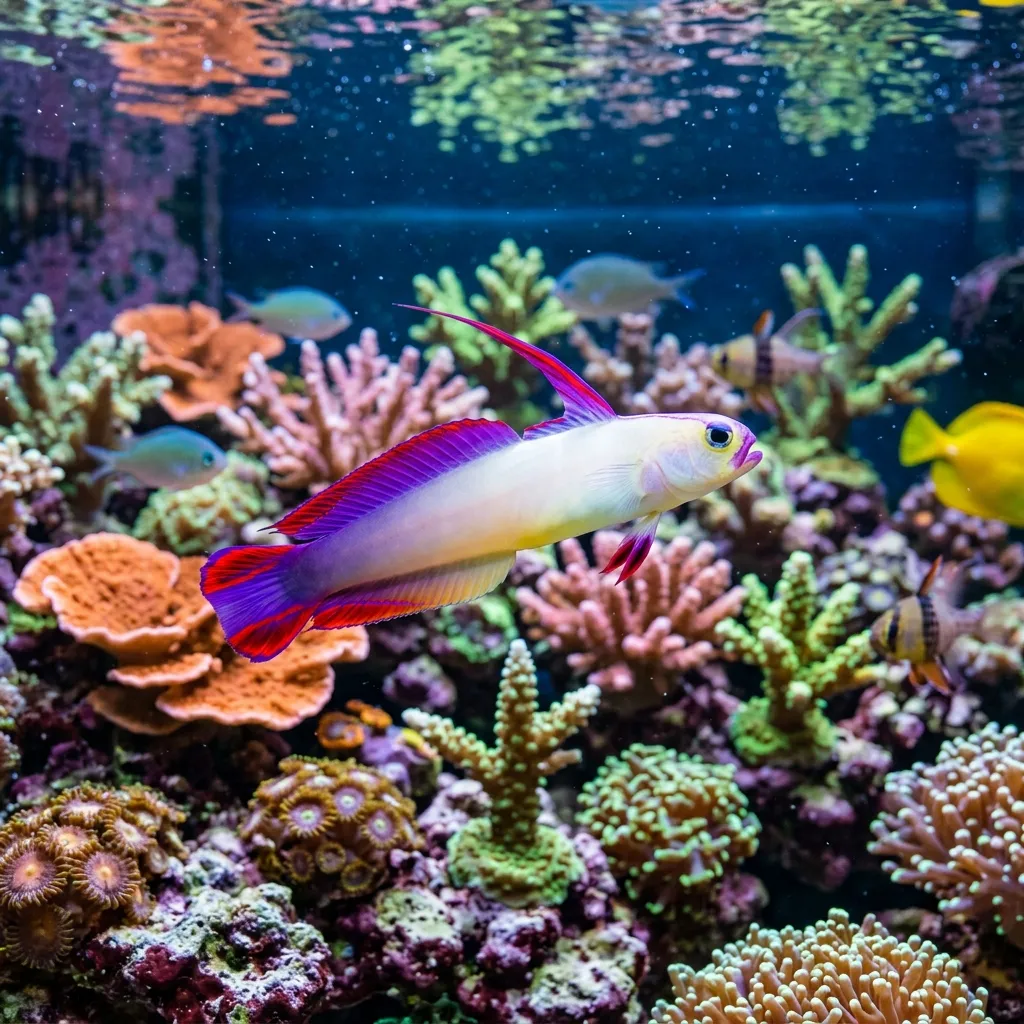
Purple Firefish (Nemateleotris decora)
Quick Answer
The Purple Firefish (Nemateleotris decora) is a striking deep-reef dartfish requiring a minimum 20 gallon (76 liter) aquarium, pH 8.1-8.4, and a temperature of 72-78 degrees F (22-26 degrees C). It is peaceful toward other species but must be kept singly or as a bonded pair due to strong intraspecific aggression, and it demands a tight-fitting lid to prevent jumping.
Quick Facts
| Scientific Name | Nemateleotris decora |
|---|---|
| Common Names | Purple Firefish |
| Family | Microdesmidae (subfamily Ptereleotrinae) |
| Genus | Nemateleotris |
| Type | Saltwater |
| Temperament | peaceful (toward other species); intraspecifically aggressive |
| Care Difficulty | beginner |
| Lifespan | 4 years |
| Maximum Size | Up to 3.5 in (9 cm) |
| Diet | Carnivore (Planktivore) |
| Temperature | 72–78°F (22–26°C) |
| pH | 8.1–8.4 |
| Hardness | 8–12 dGH |
| Minimum Size | 20 gallons |
Key Takeaways
- Peaceful toward other species but must be kept singly or as a bonded pair due to strong intraspecific aggression.
- Requires at least a 20 gallon (76 liter) aquarium with a tight-fitting, gap-free lid.
- Fully reef safe and compatible with corals and most invertebrates.
- An accomplished jumper - lid security is the single most important setup detail.
- Diet must be enriched with HUFA/vitamins to prevent color fading over time.
Diet
What to Feed a Purple Firefish
This species is a carnivorous planktivore in the wild, picking zooplankton continuously from the water column throughout the day. In the aquarium, feed 2-3 small meals daily of enriched frozen mysis shrimp, vitamin-enriched brine shrimp, copepods, and cyclops, supplemented with a high-quality marine pellet or flake formulated for carnivores.
Color-Preserving Enrichment
You must supplement the diet with a HUFA and vitamin enrichment product at least a few times per week. Purple Firefish fed an unenriched diet of plain frozen food will lose vibrancy in their purple and red coloration within a matter of months, an issue that is rarely discussed in mainstream care sheets.
Feeding a Newly Acquired Specimen
Freshly imported individuals are frequently stressed and may refuse prepared foods for the first several days. Live baby brine shrimp or live copepods are the most reliable way to trigger an initial feeding response before transitioning the fish onto frozen and pellet foods.
Breeding
Captive Breeding Difficulty
Breeding the Purple Firefish in a home aquarium is extremely rare and is not a realistic goal for most hobbyists. A genuine bonded male-female pair must be conditioned on enriched frozen foods for several weeks before spawning behavior begins.
Spawning Process
The pair excavates a burrow beneath live rock, where the female deposits 50-150 adhesive eggs. The male guards and fans the clutch for approximately 5-7 days at a stable temperature near 75 degrees F (24 degrees C). Upon hatching, the pelagic larvae require live rotifers followed by phytoplankton cultures for 30-40 days before metamorphosis, a process that requires dedicated larval-rearing systems well beyond standard home aquarium equipment. The vast majority of Purple Firefish sold in the trade are wild-collected rather than captive-bred.
Compatible Tank Mates
Species Comparison
| Feature | Purple Firefish (N. decora) | Common Firefish (N. magnifica) | Helfrich's Firefish (N. helfrichi) | Scissortail Dartfish (P. evides) |
|---|---|---|---|---|
| Max Size | 3-3.5 in (7.6-8.9 cm),3 in (7.6 cm),2 in (5 cm),4.7 in (12 cm) | |||
| Temperament | Peaceful, but the most intraspecifically aggressive dartfish,Peaceful, moderately tolerant of conspecifics in groups,Peaceful, timid, best in pairs,Semi-aggressive, more confident and active | |||
| Minimum Tank Size | 20 gal / 76 L (single); 30 gal / 114 L (pair),10 gal / 38 L,10 gal / 38 L,30 gal / 114 L | |||
| Diet | Carnivore / planktivore,Carnivore / planktivore,Carnivore / planktivore,Carnivore / planktivore | |||
| pH Range | 8.1-8.4,8.1-8.4,8.1-8.4,8.1-8.4 | |||
| Jump Risk | Very high - tight lid mandatory,Very high - tight lid mandatory,High,Moderate to high |