Advanced

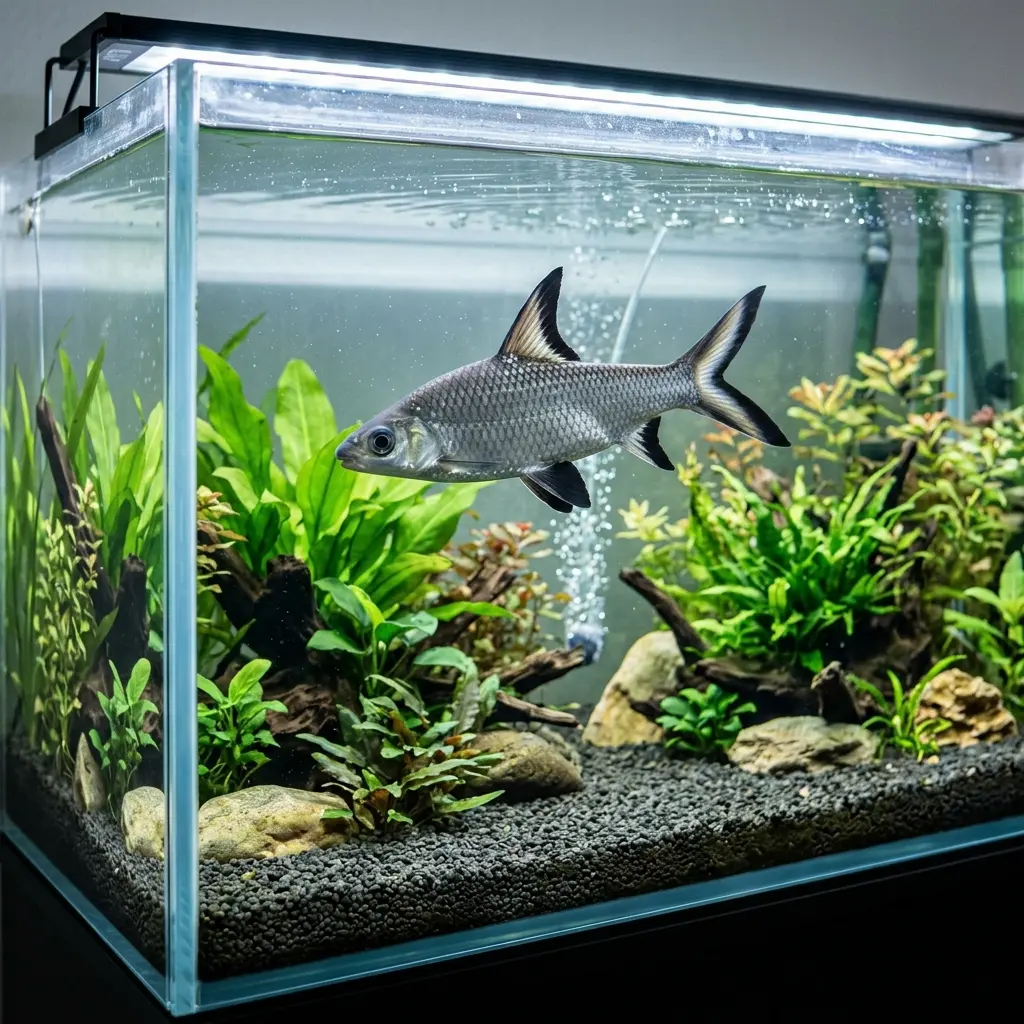
Bala Shark

By The Aquarium Calculators Editorial Team ·

Balantiocheilos melanopterus

Complete Bala Shark care guide covering omnivore diet requirements, peaceful temperament, minimum 125 Gallons tank setup, and compatible freshwater tankmates. Difficulty: Advanced.

Bala Shark

Quick Answer

Bala Shark (Balantiocheilos melanopterus) is a large, silver cyprinid with black-tipped fins. It requires a minimum 125 Gallons aquarium with a pH of 6.5 - 7.5 and temperature range of 24-28°C. This omnivore occupies the middle zone and makes an excellent addition to community setups.

Intro

Bala Shark (Balantiocheilos melanopterus) is a large, silver cyprinid with black-tipped fins. Despite its name, it is not a shark but a close relative of barbs and danios.

Setup

A 125-gallon or larger tank (6+ feet long) with open swimming areas and strong filtration. They are jumpers; use a heavy lid. Smooth substrate and sturdy decorations.

Feeding

Omnivorous; eats flakes, pellets, frozen foods, live foods, and vegetable matter. Large adults need bigger pellets or chunks of seafood.

Compatibility

Peaceful but can eat very small fish. Keep in schools of 4+. Tankmates must be similar size and speed: larger barbs, rainbowfish, loaches, medium-sized cichlids.

Aquarium Tank Volume Calculator

Enter your details below for an instant recommendation.

Recommended Output

Gallons

--

Liters

--

Empty weight

--

Filled weight

--

Tank Position
Middle
Water Temp
24-28°C
Adult Size
See profile
Water pH
6.5 - 7.5

Species Characteristics

Adult Size
Lifespan
Growth Rate
moderate
Tank Compatibility
Community compatible
Indoor Aquarium
Yes

Water Parameters

Water Temperature
Humidity
Water pH

Tank Lighting

Tank Lighting
Standard lighting
Light Hours
N/A
Intensity
moderate

Feeding & Diet

Diet Type
Diet: Omnivore
Feeding Schedule
N/A
Live Food Options
N/A

Frequently Asked Questions

How many Bala Sharks should be kept together?
Maintain a minimum school of 5 to 6 individuals in a tank of at least 125 gallons (473 liters) with a footprint of 72x18 inches (180x45 cm). Bala sharks (Balantiocheilos melanopterus) grow to 12-14 inches (30-35 cm) and require linear swimming space. Groups under 5 cause severe stress, leading to jumping, surface skimming, and stunted growth. Keeping a single or pair results in chronic aggression and fin nipping. Provide a tight-fitting lid with no gaps over 0.5 inches (1 cm). They need high flow (10x turnover) and open swimming lanes.
What are the precise water parameters for Bala Sharks?
Target pH 6.5 - 7.5, General Hardness 5 - 12 dGH, Carbonate Hardness 4 - 10 dKH, Total Dissolved Solids 150 - 300 ppm, Electrical Conductivity 300 - 600 μS/cm, and temperature 72°F - 82°F (22°C - 28°C). They are sensitive to nitrates above 30 ppm; perform 30% weekly water changes. Use a sump or canister filter rated for 500+ gallons per hour. Ammonia must be 0 ppm; any detectable ammonia causes barbel erosion. Provide strong aeration via air stones or venturi. Hardness below 3 dGH leads to osmotic stress and lethargy.
What is the nutritional and medication protocol for Bala Sharks?
They are omnivores with large appetites, requiring 40% protein, 10% fat, 50% vegetable matter. Feed high-quality sinking pellets (Hikari Cichlid Gold) twice daily, supplemented with frozen bloodworms, krill, and blanched zucchini. Offer spirulina wafers and nori sheets once daily. They accept floating flakes but prefer sinking foods. Medication alert: Tolerate copper at 0.2 mg/L but sensitive to formalin; use praziquantel for flukes. Avoid nitrofurazone, which damages gills. Salt baths up to 5 ppt are safe for short periods. Quarantine for 21 days with metronidazole.
How to breed Bala Sharks in a home aquarium?
Breeding is extremely difficult and rarely achieved in home aquariums (requires >300 gallons/1135 liters). To attempt, condition a school of 6 adults with high-protein foods (live bloodworms, krill) for 4 weeks. Simulate rainy season: Lower temperature to 72°F (22°C), perform 50% water change with cool (68°F) RO water over 6 hours, and increase photoperiod to 14 hours. They are egg-scatterers; provide spawning mops or java moss. Females release 500-1000 adhesive eggs. Remove parents immediately. Eggs hatch in 24-36 hours at 78°F (25°C). Fry require green water (Nannochloropsis) for 5 days, then baby brine shrimp.