
Boesemani Rainbowfish (Melanotaenia boesemani)
Quick Answer
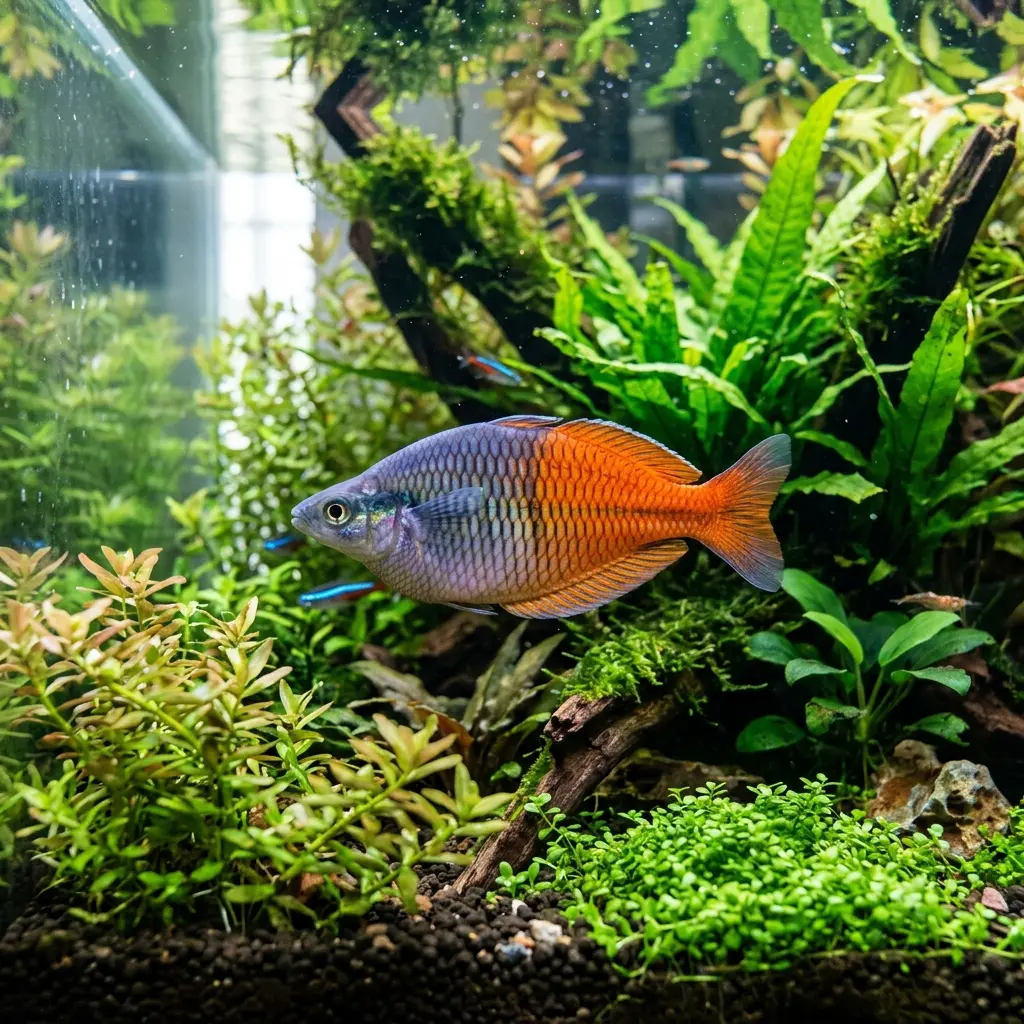
The Boesemani Rainbowfish (Melanotaenia boesemani) is a peaceful, active, fast-swimming shoaling fish known for its split blue-and-orange coloration. It needs a long tank of at least 55 gallons/4 feet, a group of 6 or more, and moderately hard, alkaline water (pH 7.0-8.0).
Quick Facts
| Scientific Name | Melanotaenia boesemani |
|---|---|
| Common Names | Boesemani Rainbowfish |
| Type | Freshwater |
| Temperament | peaceful |
| Care Difficulty | intermediate |
| Lifespan | 4-8 years |
| Maximum Size | Up to 3.9 in (10 cm) |
| Diet | Omnivore |
| Temperature | 75–82°F (24–28°C) |
| pH | 7–8 |
| Hardness | 9–19 dGH |
| Minimum Size | 55 gallons |
Key Takeaways
- Peaceful temperament; fast and constantly swimming.
- Needs a group of 6 or more for best welfare and color.
- Prefers hard, alkaline water (pH 7.0-8.0).
- Best in a long tank of at least 4 feet/55 gallons.
Health
Freshwater Ich (Ichthyophthirius multifiliis)
A common freshwater parasite affecting most aquarium fish, not unique to this species.
- White cyst-like spots on skin and fins, flashing/scratching against decor, clamped fins, lethargy.
Introduction of an infected fish or contaminated water/equipment without quarantine; stress from poor water quality or sudden parameter changes.
Quarantine new arrivals before adding them to the display tank and maintain stable water parameters.
Fin and Body Stress from Fast Tank Mates
Not an infectious disease, but a commonly reported husbandry issue where this species’ own rapid, active swimming can stress slower or more delicate co-habitants.
- Skittish behavior, faded color, and hiding in the affected slower/more delicate tank mates rather than in the rainbowfish itself.
Housing Boesemani Rainbowfish with much slower, more delicate, or long-finned species that cannot keep pace.
Choose tank mates with a similar activity level and size, and provide ample open swimming space.
Breeding
Boesemani Rainbowfish are egg-scatterers, generally reported to spawn among fine-leaved plants or spawning mops, typically in the morning, releasing eggs over several consecutive days rather than in a single event. Breeding success in the aquarium is considered moderate. Reported egg incubation time ranges from about 7 to 12 days depending on temperature, and newly hatched fry are tiny and require infusoria-type foods before graduating to free-swimming foods like baby brine shrimp after roughly a week. Fry stay near the surface, so sinking foods are not well suited to early rearing.
Compatible Tank Mates






Species Comparison
| Species | Adult Size | Temperament | Min. Tank Size | Diet | Social Behavior | |
|---|---|---|---|---|---|---|
| Boesemani Rainbowfish (Melanotaenia boesemani) | 2.75-4 in (7-10 cm) | Peaceful, very active | 55 gal / 4 ft length | Omnivore | Shoaling, 6+ | |
| Dwarf Neon Rainbowfish (Melanotaenia praecox) | Up to 2.4 in (6 cm) | Peaceful, active | 20-30 gal | Omnivore | Shoaling, 6+ | Related, smaller rainbowfish species commonly kept alongside or as an alternative to Boesemani Rainbowfish; not the profiled species. |
| Turquoise Rainbowfish (Melanotaenia lacustris) | Up to 4 in (10 cm) | Peaceful, active | 55 gal / 4 ft length | Omnivore | Shoaling, 6+ | Related, similarly sized rainbowfish species sometimes mixed with Boesemani Rainbowfish in larger tanks; not the profiled species. |