
Rainbowfish (Melanotaeniidae)
Quick Answer
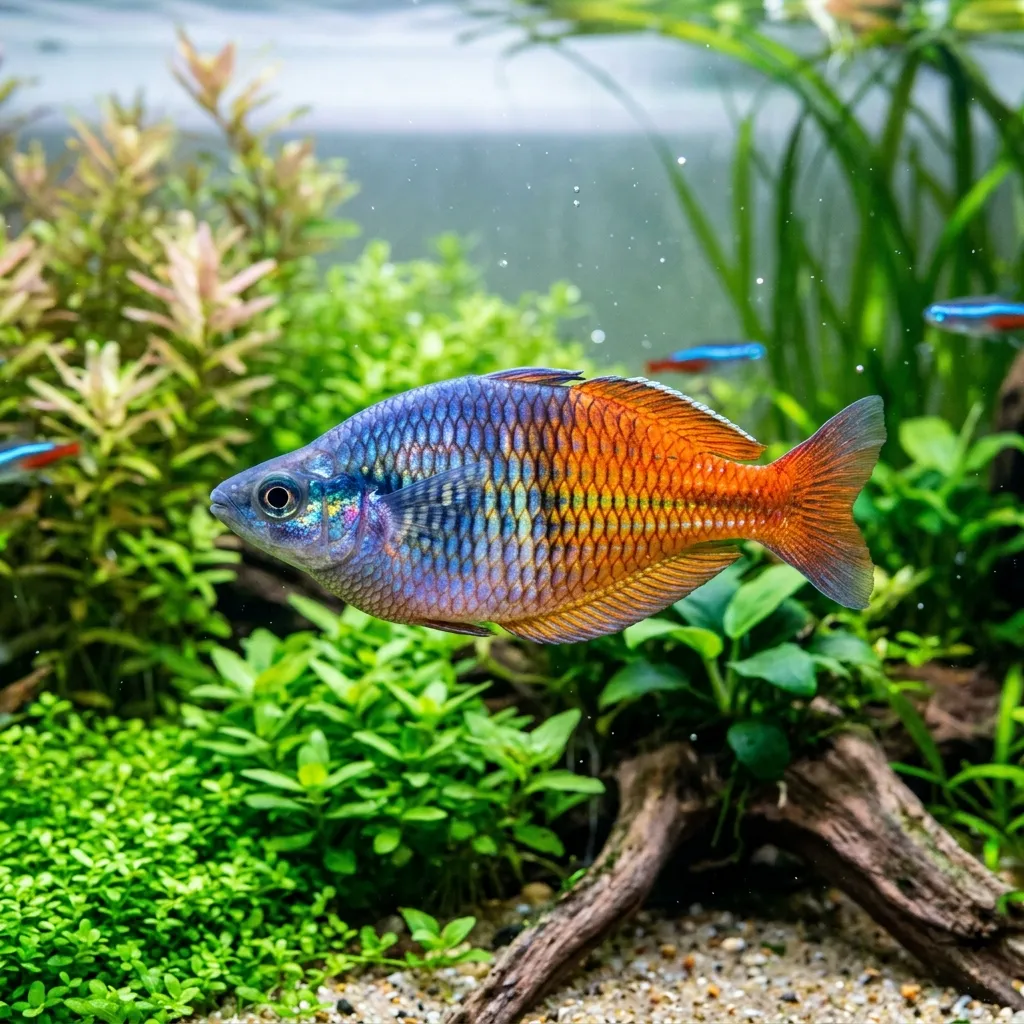
Rainbowfish (Family Melanotaeniidae) are active, peaceful freshwater schooling fish native to Australia and New Guinea. They require a minimum 30-gallon (113 liter) tank for smaller species and 55 gallons (208 liters) for larger species, with water parameters of pH 7.0-8.0 and temperature 74°F-80°F (23°C-27°C). Groups of 6 or more are essential for natural behavior and color development. Omnivorous diet with high vegetable and carotenoid content required.
Quick Facts
| Scientific Name | Melanotaeniidae |
|---|---|
| Common Names | Rainbowfish |
| Family | Melanotaeniidae |
| Genus | Melanotaenia (primary aquarium genus) |
| Type | Freshwater |
| Temperament | peaceful |
| Care Difficulty | beginner |
| Lifespan | 7 years |
| Maximum Size | Up to 6 in (15 cm) |
| Diet | Omnivore |
| Temperature | 72–82°F (22–28°C) |
| pH | 7–8 |
| Hardness | 8–20 dGH |
| Minimum Size | 30 gallons |
Key Takeaways
- Obligate shoalers requiring groups of 6-12+ for health and color display
- Juveniles are drab; full coloration requires 12-24 months and social competition
- Hard alkaline water (pH 7.0-8.0, dGH 8-20) is essential for long-term health
- Notorious jumpers; tight-fitting lid is mandatory equipment
- Sensitive to nitrate accumulation; maintain below 15 ppm with weekly water changes
- Small mouths require appropriately sized food; micro-pellets for smaller species
- Boesemani Rainbowfish (M. boesemani) is Vulnerable in the wild; buy captive-bred only
Overview
Species Overview
Rainbowfish belong to the family Melanotaeniidae and related families Pseudomugilidae, Bedotiidae, and Telmatherinidae, comprising approximately 100 species native to Australia, New Guinea, Indonesia, and Madagascar. These fish represent one of the most visually rewarding groups in freshwater aquaculture, with adult males displaying structural iridescence in electric blues, sunset oranges, crimson reds, and emerald greens that shift with viewing angle and light incidence.
Taxonomy and Natural History
The family Melanotaeniidae was erected by Gill in 1894 and has undergone extensive revision based on molecular phylogenetics. The most commonly available aquarium species include Boesemani Rainbowfish (Melanotaenia boesemani), Turquoise Rainbowfish (M. lacustris), Neon Dwarf Rainbowfish (M. praecox), Australian Rainbowfish (M. splendida), and the Celebes Rainbow (Marosatherina ladegesi). The IUCN lists M. boesemani as Vulnerable due to habitat degradation in its restricted West Papuan range; all specimens in the aquarium trade are now captive-bred.
Physical Characteristics
Melanotaeniid rainbowfish possess a laterally compressed, oval-shaped body with a forked caudal fin and relatively small mouths. A critical characteristic for aquarists to understand is that juvenile rainbowfish of all species appear as drab silver or brownish juveniles for the first 6-12 months of life. Full adult coloration is socially mediated; males develop brilliant hues only when maintained in competitive groups of 6 or more individuals. This display-dependent color development means the pale specimens seen in retail stores are entirely unrepresentative of their adult potential.
Habitat and Distribution
Wild populations inhabit a diverse range of freshwater ecosystems including clear hill streams, slow-moving rivers, densely vegetated lakes, and swamps across northern Australia, Papua New Guinea, and the Maluku Islands. Most Melanotaeniids prefer moderately hard, alkaline waters with abundant vegetation and open swimming areas. Their natural habitats experience seasonal temperature and water level fluctuations, contributing to their adaptability in captivity.
Care
Housing and Environmental Requirements
Tank Size and Dimensions
Tank size requirements vary by species but follow a universal principle: rainbowfish are powerful horizontal swimmers that require length over height. For smaller species such as Neon Dwarf Rainbowfish, the absolute minimum is 30 gallons (113 liters) with a 36-inch (90 cm) length. For medium species such as Australian Rainbowfish, provide 40 gallons (151 liters). For large species including Boesemani and Turquoise Rainbowfish, you must provide 55 gallons (208 liters) minimum with a 4-foot (120 cm) length; a 75-gallon (284 liter) tank is strongly recommended. Tall narrow tanks are unsuitable regardless of volume.
Filtration and Water Flow
Rainbowfish originate from well-oxygenated rivers and lakes with moderate current. Use a canister filter or hang-on-back filter rated for at least 1.5x the tank volume, providing 8-10x turnover per hour. They appreciate gentle to moderate water flow and will position themselves in current lanes, displaying their fins against the flow. Powerheads or wave makers can be used intermittently to simulate natural current patterns. Ensure the filter outflow does not create turbulent surface agitation that prevents the surface feeding behavior characteristic of the family.
Substrate and Hardscape
Use dark fine gravel or sand substrate to maximize color contrast and iridescence. Rainbowfish constantly forage along the bottom for biofilm and fallen food; avoid sharp substrates. Incorporate smooth driftwood, river rocks, and caves to create visual barriers and break lines of sight between rival males. A dark background—black, deep blue, or forest green—dramatically enhances the perception of color.
Plant Recommendations
Provide a planted perimeter with a large open central swimming lane. Use tall background plants such as vallisneria, cryptoryne, and java fern. Fine-leaf plants including java moss, hornwort, and water sprite serve as spawning substrates and fry refuge. Floating plants such as salvinia, frogbit, or red root floaters provide essential shade, reduce jumping behavior, and dampen light intensity. Avoid delicate stem plants that may be uprooted by active swimming.
Cover and Security
A tight-fitting lid is absolutely mandatory. Rainbowfish are prolific jumpers capable of clearing several inches above the waterline. Use glass canopies, mesh screens, or custom covers with zero gaps exceeding 0.25 inches (0.6 cm). Jumping is most prevalent during the first 48 hours after introduction, during male sparring, and when startled by sudden light changes. Implement a ramp-up lighting schedule to prevent dawn-shock jumping.
Diet
Feeding and Nutritional Requirements
Dietary Composition
Rainbowfish are omnivorous surface and mid-water feeders with small mouths relative to their body size. Their diet in captivity must comprise approximately 45% protein, 12% fat, and 43% plant matter and fiber. This balance supports their high activity level, maintains brilliant coloration, and prevents digestive disorders. Unlike many tropical fish, rainbowfish have a relatively fast metabolism and benefit from twice-daily feeding.
Staple Foods
Feed high-quality floating flakes, slow-sinking micro-pellets, or color-enhancing granules as the dietary base. Select products containing spirulina, krill meal, astaxanthin, and marigold extract. For smaller species such as Neon Dwarf or Threadfin rainbows, crush standard flakes to appropriate particle size. Feed portions consumed within 2 minutes, twice daily. Overfeeding degrades the pristine water quality these fish demand.
Protein Supplements
Rotate frozen or live foods including brine shrimp, mysis shrimp, daphnia, bloodworms, and mosquito larvae 3-4 times weekly. Live foods trigger natural surface-hunting behavior and provide essential amino acids for color development. Blackworms are excellent for conditioning breeding stock. Avoid tubifex worms from unreliable sources due to parasite risk.
Vegetable Matter and Color Enhancement
Plant fiber and carotenoid sources are non-negotiable for color development. Offer spirulina flakes, blanched spinach, zucchini, or peas twice weekly. Vegetable matter supports gut flora and supplies the pigments necessary for red and orange color synthesis. You must never feed beef heart, mammalian meat, or bread products; these materials cause fatty liver disease and organ failure in cyprinids and atheriniforms.
Feeding Behavior Notes
Rainbowfish are competitive surface feeders. In community tanks, they may outcompete slower bottom-dwellers such as corydoras during flake feeding. Use target feeding or sinking pellets for bottom-feeding tank mates. Their constant grazing on biofilm and soft algae makes them minor algae consumers, though they will not control established algae outbreaks.
Health
Health Management and Disease Prevention
Rainbowfish are generally hardy in established aquariums but exhibit pronounced sensitivity to poor water quality, particularly nitrate accumulation and sudden parameter shifts. Their hard-water preference actually provides some protection against certain pathogens that thrive in acidic conditions. However, their active metabolism means diseases spread rapidly through the shoal. Quarantine all new specimens for a minimum of 21 days. Maintain nitrates below 15 ppm through disciplined water changes.
General Health Maintenance
Monitor for early warning signs including faded coloration, clamped fins, reduced surface activity, or separation from the shoal. Rainbowfish are stoic and will hide illness until advanced stages; behavioral changes are your primary diagnostic tool. Perform weekly 25-30% water changes with temperature-matched water. Avoid copper-based treatments in tanks with invertebrates; rainbowfish themselves tolerate copper at 0.2 mg/L.
Ichthyophthirius multifiliis (Ich / White Spot Disease)
A protozoan parasite causing white cysts on skin, fins, and gills. Highly contagious in shoaling species and spreads rapidly through rainbowfish groups.
- White salt-like spots across body and fins, flashing against substrate, labored breathing, clamped fins, reduced schooling behavior
Introduction via infected fish or plants, temperature fluctuations, stress from inadequate group size or poor water quality weakening immune response
Quarantine all new additions for 21 days; raise temperature gradually to 82°F-86°F (28°C-30°C) for 4 days to accelerate parasite life cycle; treat with formalin-malachite green combination or half-dose formalin baths; maintain nitrates below 15 ppm
Fin Rot (Aeromonas / Pseudomonas / Flavobacterium infection)
Bacterial degradation of fin tissue, frequently secondary to minor fin damage from male sparring or poor water quality.
- Frayed or receding fin edges, white or red inflamed margins, lethargy, loss of appetite, fins appearing shorter than normal
Fin damage from rough handling or male aggression, elevated nitrates above 20 ppm, ammonia or nitrite spikes, inadequate water change frequency
Maintain pristine water quality with weekly 25-30% changes; treat with broad-spectrum antibiotics such as erythromycin or kanamycin in hospital tank; add 1 teaspoon aquarium salt per gallon to support osmoregulation; remove carbon during medication
Dropsy (Ascites / Bacterial Septicemia)
Clinical manifestation of severe internal bacterial infection causing fluid accumulation. Advanced and difficult to treat in rainbowfish.
- Severe abdominal distension, raised scales giving pinecone appearance, popeye (exophthalmia), lethargy, loss of equilibrium, pale coloration
Chronic poor water quality with elevated nitrates, internal bacterial infection by Aeromonas or Pseudomonas species, immunosuppression from stress or inadequate diet
Epsom salt baths at 1-2 teaspoons per 10 gallons to reduce fluid retention; treat with broad-spectrum antibiotics such as kanamycin or oxytetracycline in feed; prognosis is guarded; euthanasia is often the most humane option for advanced cases
Velvet Disease (Piscinoodinium pillulare)
A parasitic dinoflagellate infection resembling ich but with much smaller gold-dust cysts. Highly contagious and photosynthetic.
- Fine gold or rust-colored dusting on skin and fins, scratching against objects, clamped fins, rapid breathing, lethargy, refusal to eat
Introduction via infected fish or plants, stress from suboptimal parameters, the parasite utilizes photosynthesis making lighted tanks more susceptible
Darken the tank completely for 48 hours to inhibit parasite photosynthesis; treat with copper sulfate at 0.15-0.20 mg/L for 10-14 days; increase aeration during treatment; quarantine all new additions for 21 days
Mycobacteriosis (Fish Tuberculosis)
Chronic wasting disease caused by Mycobacterium marinum. Incurable and zoonotic to humans via open wounds.
- Progressive emaciation despite normal appetite, skin ulcers, popeye, spinal deformities, erratic swimming, pale or patchy coloration
Introduction of asymptomatic carriers, poor quarantine protocols, chronic stress from inadequate tank size or group numbers, immunosuppression
No effective treatment exists; euthanize affected individuals immediately using clove oil; disinfect entire system with diluted bleach solution; always wear waterproof gloves when performing maintenance; immunocompromised individuals should avoid contact with aquarium water
Breeding
Captive Breeding Protocol
Broodstock Selection and Conditioning
Select sexually mature fish aged 12-18 months; juveniles will not breed successfully. Condition 10-12 individuals at a 1 male to 2 female ratio in a 30-gallon conditioning tank for 3 weeks. Feed live blackworms, brine shrimp, and high-protein granules three times daily. Males will intensify coloration and perform continuous courtship displays. Cool water influxes of 2-3°F (1-1.5°C) below tank temperature often trigger spawning readiness.
Spawning Tank Setup
Configure a dedicated 20-gallon (75 liter) breeding aquarium with 8 inches (20 cm) of water depth. Set parameters to pH 7.0, dGH 8, and temperature 76°F (24.5°C). Install multiple spawning mops made of acrylic yarn or dense fine-leaf plants such as java moss and hornwort. Use a gentle sponge filter to prevent egg suction. Add methylene blue at 3 drops per gallon to prevent egg fungus.
Spawning Behavior and Egg Management
Spawning occurs primarily at dawn over a period of several weeks. Males display intensely, erecting all fins and performing lateral shimmies to guide females into vegetation. The female releases 50-200 adhesive eggs daily, which attach to plant leaves and mop fibers. Rainbowfish provide no parental care and will consume eggs voraciously. You must remove parents every 48 hours or collect eggs daily to a separate hatching container.
Incubation and Hatching
Eggs hatch in 7-12 days at 76°F-78°F (24.5°C-25.5°C), with larger species requiring the longer end of the range. Fungused eggs turn opaque white and must be removed immediately with a pipette to prevent spread. Healthy eggs develop visible eyespots after day 4-5.
Fry Rearing
Newly hatched fry are extremely small and remain attached to surfaces for 2-3 days while absorbing the yolk sac. Feed infusoria, paramecia, or commercial liquid fry food for the first 5-7 days. Transition to microworms, vinegar eels, and powdered fry food from day 6. Introduce newly hatched brine shrimp nauplii from day 10-14. Perform daily 10% water changes with aged, temperature-matched water. Grow-out tanks require stable parameters and gentle filtration. Sexual maturity is reached at 9-18 months depending on species and conditions.
Tips
Expert Tips and Common Mistakes
Critical Success Factors
- Patience with Color Development: Do not judge rainbowfish by their juvenile appearance. Full color requires 12-24 months and proper social conditions. This is the single most common source of disappointment among new keepers.
- Social Structure is Everything: Male coloration is driven by social competition. A lone male in a community tank will never display his potential. Always purchase groups, never individuals.
- Water Quality Over Quantity: Rainbowfish are more sensitive to nitrate accumulation than many community fish. Weekly 25-30% water changes are non-negotiable, not optional maintenance.
- Dither Fish Applications: Use active rainbowfish as dither fish for peaceful cichlids such as Blue Acara, Keyhole Cichlids, or Kribensis. Their constant activity signals safety to reclusive species.
Common Mistakes to Avoid
- Undersized Tanks: Housing Boesemani or Turquoise rainbows in 20-gallon (75 liter) tanks causes stunting, suppressed color, and premature death. Their adult size and swimming behavior demand respect.
- Skipping the Lid: Open-top tanks result in dried specimens on the floor. This is entirely preventable and represents the most common cause of rainbowfish mortality in home aquariums.
- Soft Water Maintenance: Attempting to keep Melanotaeniids in soft acidic water (dGH below 5, pH below 6.5) causes chronic stress, poor color, and increased disease susceptibility. These are hard-water fish.
- Impulse Buying of Juveniles: Purchasing a single pale juvenile and expecting immediate brilliance leads to disappointment. Buy established groups of 6-8 juveniles and allow 12 months for development.
- Overfeeding Protein: Diets lacking vegetable matter and spirulina result in constipation, faded coloration, and fatty liver disease. Balance is essential.
Advanced Techniques
- Multi-Species Displays: Large tanks (75+ gallons) can house multiple rainbowfish species simultaneously, creating a multi-layered color display. Ensure all species share similar water parameter requirements.
- Seasonal Temperature Cycling: Simulating natural seasonal temperature fluctuations of 74°F-80°F (23°C-27°C) over the year stimulates more natural behavior and can trigger spawning in established groups.
- Dark Environment Optimization: Black substrate, dark backgrounds, and dimmed perimeter lighting create the optimal environment for iridescence display. Bright environments wash out their colors completely.
- Spawning Mop Rotation: For dedicated breeders, maintain multiple spawning mops and rotate them every 24 hours into a separate hatching tank. This maximizes egg survival without disturbing the adults.
Compatible Tank Mates






Species Comparison
| Feature | Boesemani Rainbowfish | Neon Dwarf Rainbowfish | Turquoise Rainbowfish | Australian Rainbowfish |
|---|---|---|---|---|
| Scientific Name | Melanotaenia boesemani | Melanotaenia praecox | Melanotaenia lacustris | Melanotaenia splendida |
| Adult Size | 4 - 4.5 inches (10 - 11.5 cm) | 2 - 2.5 inches (5 - 6 cm) | 4 - 5 inches (10 - 13 cm) | 3 - 4 inches (7.5 - 10 cm) |
| Minimum Tank Size | 55 gallons (208 L) | 30 gallons (113 L) | 55 gallons (208 L) | 40 gallons (151 L) |
| Temperament | Peaceful / Active | Peaceful / Active | Peaceful / Active | Peaceful / Hardy |
| Color Development | 12-18 months; blue front, orange rear | 6-9 months; electric blue body | 12-18 months; deep blue-green sheen | 8-12 months; silver with red accents |
| Difficulty Level | Intermediate | Beginner | Intermediate | Beginner |
| Special Requirements | Endangered in wild; captive bred only | Small mouth; requires micro-pellets | Needs hard alkaline water for best color | Highly adaptable to varied parameters |