
Corydoras Catfish (Corydoras aeneus)
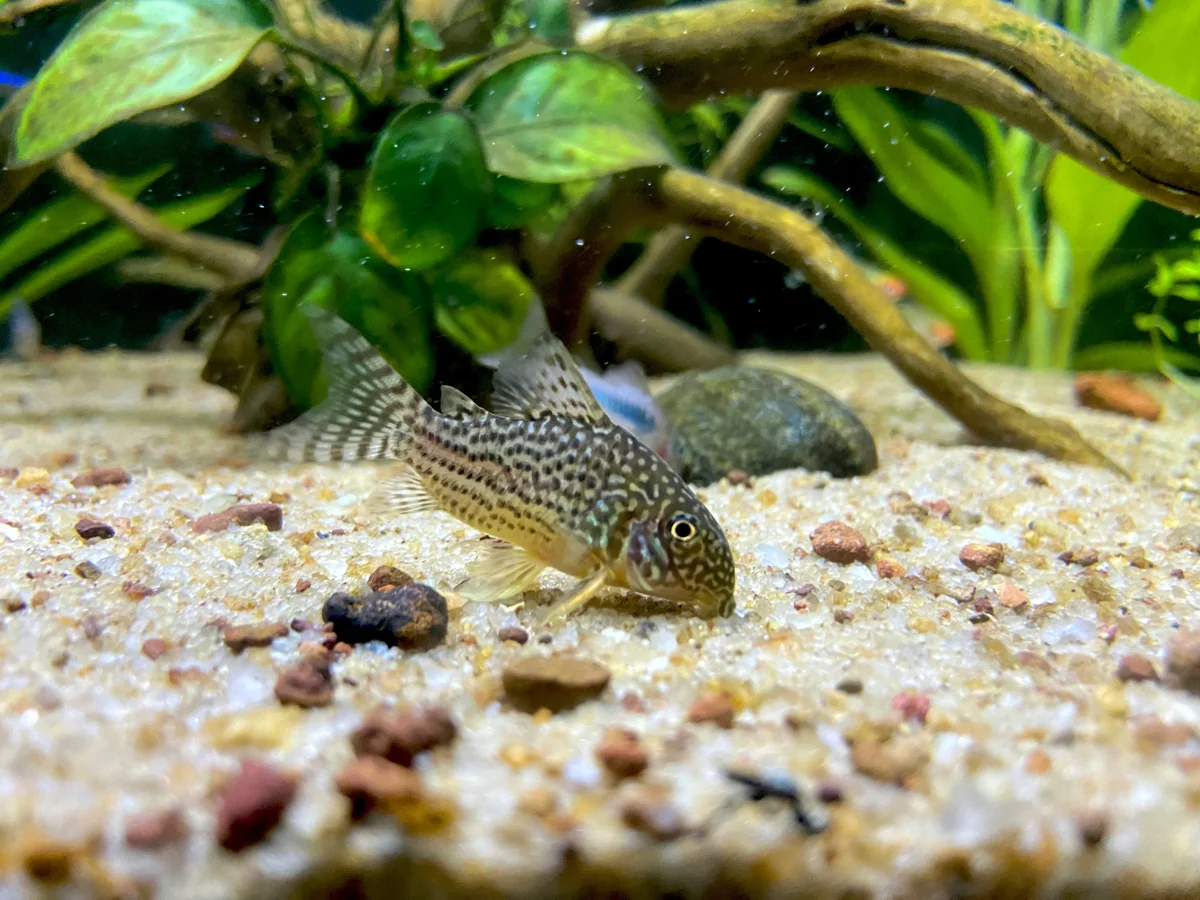
Quick Answer
Corydoras Catfish (this profile covers Corydoras aeneus, the Bronze Corydoras) are small, peaceful, armored South American bottom-dwellers. They need a 15-20 gallon tank with fine sand substrate, a group of 6 or more, and moderate freshwater parameters (pH roughly 6.0-8.0).
Quick Facts
| Scientific Name | Corydoras aeneus |
|---|---|
| Common Names | Corydoras Catfish |
| Type | Freshwater |
| Temperament | peaceful |
| Care Difficulty | beginner |
| Lifespan | 5-10 years |
| Maximum Size | Up to 3 in (8 cm) |
| Diet | Omnivore |
| Temperature | 72–79°F (22–26°C) |
| pH | 6–8 |
| Hardness | 5–19 dGH |
| Minimum Size | 15 gallons |
Key Takeaways
- Peaceful, highly social shoaling bottom-dweller; keep in groups of 6+.
- Needs fine sand or smooth substrate to protect sensitive barbels.
- Tolerant of a fairly wide water-parameter range.
- Can breathe atmospheric air; needs a lid with an air gap.
Health
Barbel Erosion / Damage
A commonly reported issue in Corydoras species linked to sharp or abrasive substrate, not a pathogen-driven disease in itself.
- Shortened, frayed, or missing barbels around the mouth; reduced foraging ability.
Sharp gravel or coarse substrate that abrades the sensitive barbels during normal foraging behavior.
Use fine, smooth sand or well-rounded substrate rather than sharp gravel.
Freshwater Ich (Ichthyophthirius multifiliis)
A common freshwater parasite affecting most aquarium fish; this species’ scaleless skin makes medication choice especially important when treating it.
- White cyst-like spots on skin and fins, flashing/scratching against decor, clamped fins, lethargy.
Introduction of an infected fish or contaminated water/equipment without quarantine.
Quarantine new arrivals and maintain stable water parameters.
Breeding
Corydoras aeneus is a substrate egg-scatterer with no parental care of the eggs after laying. During courtship the female often adopts a characteristic ‘T-position’ with the male, then deposits adhesive eggs, typically on glass, plants, or spawning mops, in small batches over the course of a spawning session; total egg counts across a spawning session are commonly reported up to around 200, though this varies between individuals and conditions. Spawning in the wild is associated with seasonal changes in water chemistry linked to the onset of the rainy season, and hobbyists commonly try to replicate this with a partial water change using cooler, fresh water to encourage spawning, though exact protocols vary by source and are not presented here as a fixed formula. Reported egg hatching time ranges from about 3 days (at warmer temperatures, around 28°C/82°F) to about a week at cooler temperatures.
Compatible Tank Mates






Species Comparison
| Species | Adult Size | Temperament | Min. Tank Size | Diet | Social Behavior | |
|---|---|---|---|---|---|---|
| Bronze Corydoras (Corydoras aeneus) | 2.5-3 in (6.5-7.5 cm) | Peaceful | 15-20 gal | Omnivore | Shoaling, 6+ | |
| Panda Corydoras (Corydoras panda) | Up to 2 in (5 cm) | Peaceful | 15-20 gal | Omnivore | Shoaling, 6+ | Smaller, distinctively patterned relative within the same genus, prefers cooler water than C. aeneus; not the profiled species. |
| Pygmy Corydoras (Corydoras pygmaeus) | Up to 1.2 in (3 cm) | Peaceful | 10 gal | Omnivore | Shoaling, spends more time mid-water than most Corydoras | Much smaller nano species in the same genus, often considered as an alternative for smaller tanks; not the profiled species. |