Koi Fish Care (Cyprinus rubrofuscus)
Quick Answer
Koi are large, colorful, ornamental varieties of domesticated common carp that are kept for decorative purposes in outdoor koi ponds or water gardens. They require a minimum pond size of 1000 gallons, thrive in a temperature range of 59-77°F, and prefer a pH of 7.0-8.5. With proper care, Koi can live for 25 to 35 years or more.
Quick Facts
| Scientific Name | Cyprinus rubrofuscus |
|---|---|
| Common Names | Koi, Nishikigoi, Japanese Carp |
| Family | Cyprinidae |
| Genus | Cyprinus |
| Temperament | peaceful |
| Care Difficulty | advanced |
| Lifespan | 25-35 years |
| Maximum Size | Up to 36 in (91 cm) |
| Diet | omnivore |
| Temperature | 59–77°F (15–25°C) |
| pH | 7–8.5 |
| Hardness | 5–15 dGH |
| Minimum Size | 1000 gallons |
Key Takeaways
- Requires a minimum of 1000 gallons for adults, though 3000+ is highly recommended.
- Pond water stability is critical; deep ponds buffer against rapid temperature swings.
- Heavy filtration and robust aeration are mandatory due to their large bioload.
- Stop feeding entirely when water temperature drops below 50°F (10°C).
- Strictly quarantine all new additions for 3-4 weeks to prevent KHV and parasite outbreaks.
- Best kept with other peaceful pond fish like Goldfish or Hi-Fin Banded Sharks.
- Regular water testing is essential; use a water chemistry calculator to maintain ideal parameters.
- A well-designed predator net or steep pond walls will protect them from herons and raccoons.
Overview
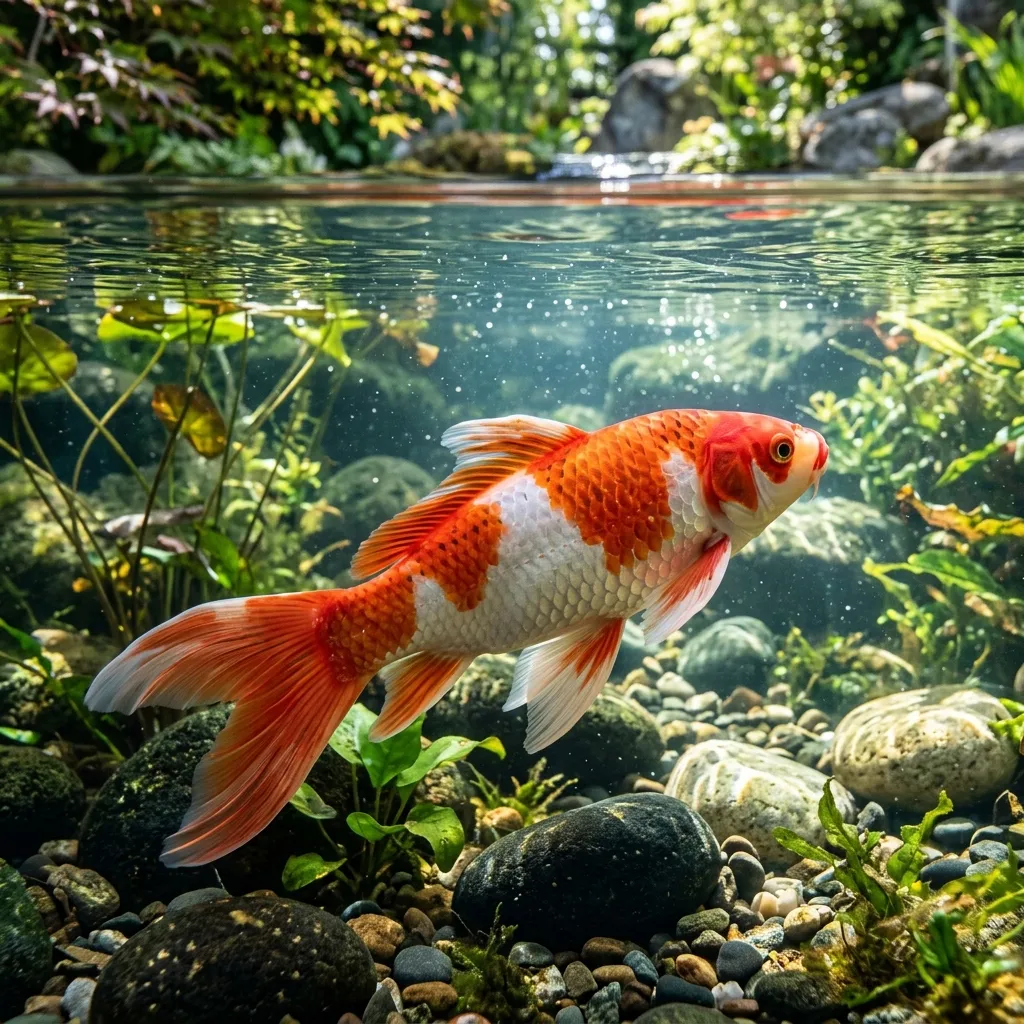
Koi (Cyprinus rubrofuscus) are ornamental freshwater carp bred from the Amur carp and kept primarily in outdoor ponds. They are known for their vibrant colors, peaceful temperament, and exceptional longevity, often living for several decades under proper care.
Originally bred in Japan for their distinct patterns, these fish are often referred to as Nishikigoi. Unlike standard aquarium fish, Koi require specialized setups and massive biological Pond Filtration to manage their size and waste output.
Ideal For
- Koi are best suited for experienced pond keepers with sufficient outdoor space and the resources to maintain large filtration systems. They are not suitable for small aquariums or first-time fish keepers with limited space.
Appearance
Koi are robust, elongated fish characterized by a wide variety of brilliant color morphs and scale patterns. Distinct varieties include Kohaku (white body with red markings), Taisho Sanke (white with red and black markings), and Showa (black body with red and white markings). They feature a terminal mouth with barbels (whisker-like sensory organs) used to forage along the pond bottom.
Natural Habitat
While modern Koi are extensively domesticated, their wild carp ancestors originated in the freshwaters of Eastern Asia. These ancestors thrived in slow-moving rivers, lakes, and muddy ponds, which provided ample foraging opportunities and seasonal temperature variations.
Care
Housing & Pond Requirements
Due to a maximum size of 36 inches (90 cm), Koi are exclusively suited for large outdoor ponds, not indoor aquariums. The absolute minimum volume required is 1,000 gallons (≈3,800 L) per fish, though larger systems of 3,000 to 5,000 gallons (11,300–18,900 L) are strongly recommended for maintaining adult groups. Ponds should have a depth of at least 3 to 4 feet (90–120 cm) to provide stable temperatures during extreme weather and to offer a safe retreat from predators like herons. Proper pond design also demands heavy-duty Pond Filtration (e.g., bottom drains, skimmers) to process the high biological load and complete the Nitrogen Cycle.
Water Parameters
Koi are resilient but thrive best in clean, well-oxygenated water with stable parameters.
Temperature
Maintain 59–77°F (15–25°C). Stable temperatures reduce stress, support immune function, and improve digestion. Koi tolerate lower temperatures by entering a state of torpor during winter.
pH
Maintain 7.0–8.5. Sudden pH swings are more dangerous than maintaining a slightly imperfect but stable value. Perform regular Water Testing to monitor KH (carbonate hardness) which stabilizes pH.
Hardness (GH)
Maintain 5–15 dGH. Adequate mineral content supports healthy bone growth and osmotic regulation.
Diet
Koi are opportunistic omnivores. In a pond setting, their diet varies with the seasons and water temperature:
- Summer (Warm Water): High-protein pellets to support rapid growth and coloration.
- Spring/Fall (Cool Water): Easily digestible wheat-germ-based foods.
- Winter (Below 50°F / 10°C): Feeding should be stopped entirely as their metabolism slows and they cannot digest food properly.
They also readily consume aquatic plants, algae, insects, and occasional treats like watermelon or oranges.
Health
Maintaining excellent water quality and robust Pond Aeration is the best defense. When diseases strike, act quickly. Always use a Pond Volume Calculator before dosing medications.
Koi Herpesvirus (KHV)
- Sunken eyes
- gill necrosis
- lethargy.
A highly contagious viral infection.
Quarantine all new additions for at least 3-4 weeks.
Ich (White Spot Disease)
- White
- salt-like grains on the skin and gills; flashing (scratching against objects).
The parasite Ichthyophthirius multifiliis, often triggered by temperature stress in spring.
Maintain stable water parameters. Treat early using a Salt Dosing Calculator.
Flukes
- Heavy mucus production
- gasping at the surface
- flashing.
Microscopic flatworms (Gyrodactylus or Dactylogyrus).
Maintain pristine water quality and quarantine new fish.
Fin Rot
- Frayed
- white-edged
- or disintegrating fins.
Bacterial infection usually secondary to poor water quality or injury.
Regular water changes and filter maintenance.
Dropsy
- Pinecone-like scales
- bloated body
- bulging eyes.
Internal bacterial infection leading to kidney failure.
Avoid overcrowding and feed a high-quality, fresh diet.
Costia
- A milky film on the skin
- clamped fins
- respiratory distress.
A microscopic flagellate parasite (Ichthyobodo necatrix).
Avoid sudden temperature drops and overcrowding.
Trichodina
- White/grey film
- flashing
- lethargy.
A ciliated protozoan parasite that thrives in high-organic-load ponds.
Improve mechanical filtration to remove organic waste.
Anchor Worm
- Visible thread-like worms attached to the body
- often with red inflammation at the attachment site.
The Lernaea crustacean parasite.
Quarantine plants and new fish.
Fish Lice
- Visible flat
- translucent discs (Argulus) crawling on the fish; erratic swimming.
Parasitic crustaceans introduced from wild sources or unquarantined additions.
Strict quarantine protocols.
Aeromonas Ulcers
- Open red sores
- scale loss.
Aeromonas bacteria entering through parasite bites or physical injuries in poor water conditions.
Maintain excellent water quality and treat parasite outbreaks promptly.
Breeding
Koi breeding is a specialized endeavor typically triggered by the warming waters of late spring. A female will scatter thousands of adhesive eggs on aquatic plants or spawning mops, which are then fertilized by the males. Because Koi will eat their own eggs and fry, breeders usually remove the spawning media to separate rearing tanks.
Tips
Common Mistakes
Buying Koi for indoor aquariums and expecting them not to outgrow the tank.
Failing to install pond-grade filtration systems, leading to ammonia spikes and poor water clarity.
Feeding Koi when water temperatures drop below 50°F (10°C), which can lead to fatal intestinal blockages.
Ignoring the 1,000-gallon (≈3,800 L) minimum requirement per adult fish.
Expert Tips
Always accurately measure your pond volume before dosing any medications to prevent toxic overdoses.
Incorporate a quarantine protocol for all new additions to prevent introducing KHV or aggressive parasites to your established pond.
Use a robust aeration system or waterfall to ensure high dissolved oxygen levels, particularly during hot summer months when warm water holds less oxygen.