
Red Rainbowfish (Glossolepis incisus)
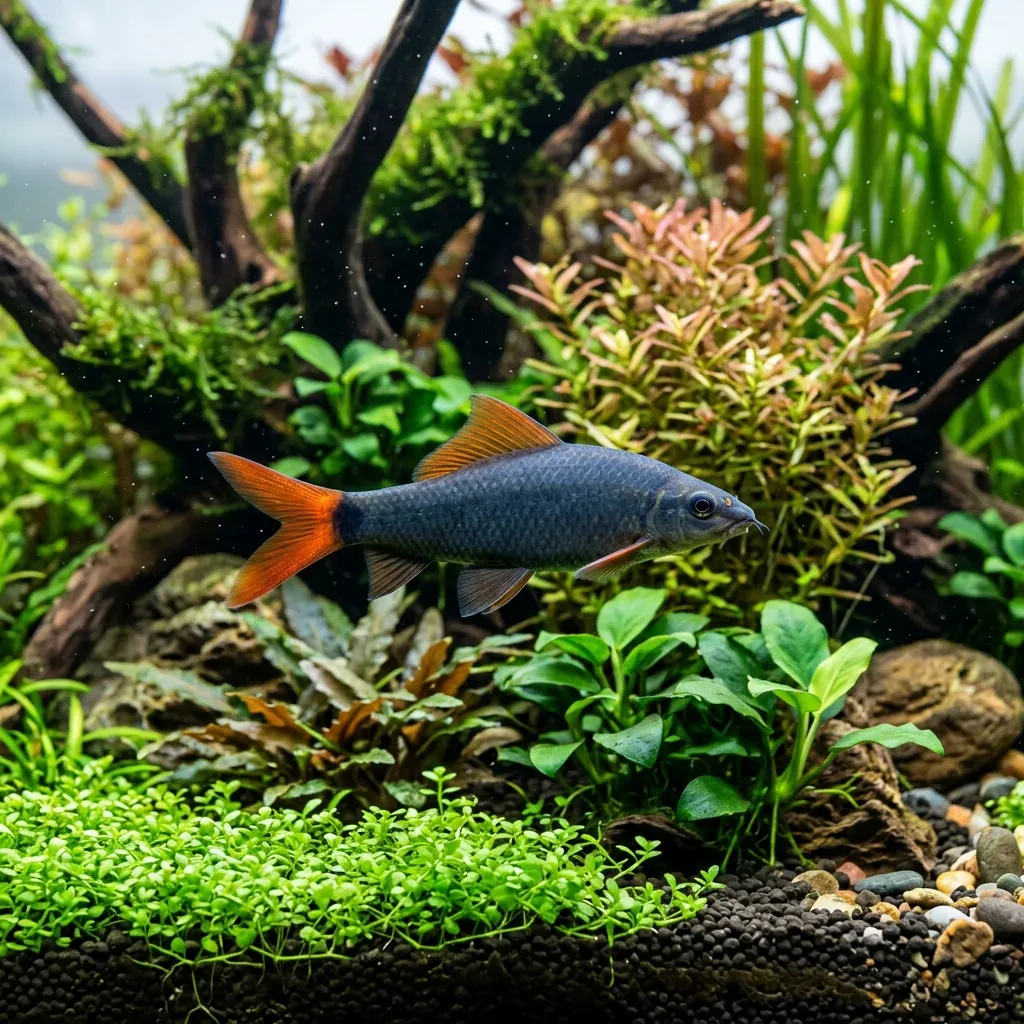
Quick Answer
The Red Rainbowfish (Glossolepis incisus) is a vividly colored, active schooling fish requiring a minimum 55 gallon (208 liter) aquarium at least 48 inches (120 cm) long, a school of 6 or more, pH 7.0-8.0, and a temperature of 72-78 degrees F (22-26 degrees C). It is peaceful but boisterous, and males develop their signature deep red coloration best in a well-fed, properly sized school.
Quick Facts
| Scientific Name | Glossolepis incisus |
|---|---|
| Common Names | Red Rainbowfish |
| Family | Melanotaeniidae |
| Genus | Glossolepis |
| Type | Freshwater |
| Temperament | peaceful, but boisterous and highly active - can intimidate slow or timid tankmates through sheer activity level rather than aggression |
| Care Difficulty | intermediate |
| Lifespan | 7 years |
| Maximum Size | Up to 6 in (15 cm) |
| Diet | Omnivore |
| Temperature | 72–78°F (22–26°C) |
| pH | 7–8 |
| Hardness | 8–20 dGH |
| Minimum Size | 55 gallons |
Key Takeaways
- Peaceful but highly active - can intimidate small or timid tankmates through sheer energy rather than aggression.
- Requires a school of at least 6, ideally 8-10, in a 55 gallon (208 liter) tank at least 48 inches (120 cm) long.
- Male coloration depends on school size, diet, and water hardness - undersized groups and soft water both dull red color.
- Unusually intolerant of ammonia and nitrite - only add to a fully cycled, mature aquarium.
- One of the easier rainbowfish species to breed, using a spawning mop and daily egg collection.
Diet
What to Feed Red Rainbowfish
This is an active, greedy omnivore that should be fed 1-2 times daily. Build the diet around a high-quality flake or slow-sinking granule formulated for community fish, and supplement several times weekly with frozen or live daphnia, brine shrimp, and bloodworms for protein.
Color-Enhancing Nutrition
You must include carotenoid-rich foods such as spirulina flake, krill, and color-enhancing pellets to support the male's full red coloration. A plain, unvaried diet is one of the most common and overlooked reasons a school of Red Rainbowfish never develops the striking color the species is known for.
Plant Matter
Offer blanched peas or spirulina-based foods weekly to round out the roughly 40 percent plant-matter portion of this species' natural diet and support healthy digestion.
Breeding
Breeding Difficulty
Red Rainbowfish are considered one of the more approachable rainbowfish species to breed in a home aquarium. Condition a group of 8-10 mature adults, ideally at a ratio of 1 male to 2 females, on live blackworms and brine shrimp for approximately 3 weeks before introducing spawning material.
Spawning Setup and Process
Provide a spawning mop or a dense clump of java moss, either in the main display or in a dedicated 30 gallon (113 liter) breeding tank set to pH 7.2, roughly 10 dGH, and 74 degrees F (23 degrees C). Spawning typically happens at dawn, with females scattering 100-300 small adhesive eggs across the mop or plants over several consecutive days rather than a single event.
Raising Fry
You must remove the spawning medium with attached eggs every 1-2 days to a separate rearing container, since adults will readily eat their own eggs. Eggs hatch in roughly 7-10 days at 72 degrees F (22 degrees C). Start fry on infusoria for the first few days, then transition to microworms, and finally to newly hatched baby brine shrimp as they grow. Frequent small water changes during grow-out are essential for healthy fry development.
Compatible Tank Mates






Species Comparison
| Feature | Red Rainbowfish (G. incisus) | Boesemani Rainbowfish (M. boesemani) | Dwarf Neon Rainbowfish (M. praecox) | Turquoise Rainbowfish (M. lacustris) |
|---|---|---|---|---|
| Max Size | 6 in (15 cm),4-4.7 in (10-12 cm),2.4 in (6 cm),3.5 in (9 cm) | |||
| Temperament | Peaceful but boisterous / very active,Peaceful, moderately active,Peaceful, calm - suited to smaller tanks,Peaceful, active | |||
| Minimum Tank Size | 55 gal / 208 L, 48 in / 120 cm long,40 gal / 151 L,20 gal / 76 L,40 gal / 151 L | |||
| Diet | Omnivore,Omnivore,Omnivore,Omnivore | |||
| pH Range | 7.0-8.0,7.0-8.0,6.5-7.5,7.5-8.5 | |||
| Schooling Number | 6+ (8-10 ideal),6+,6+,6+ |