
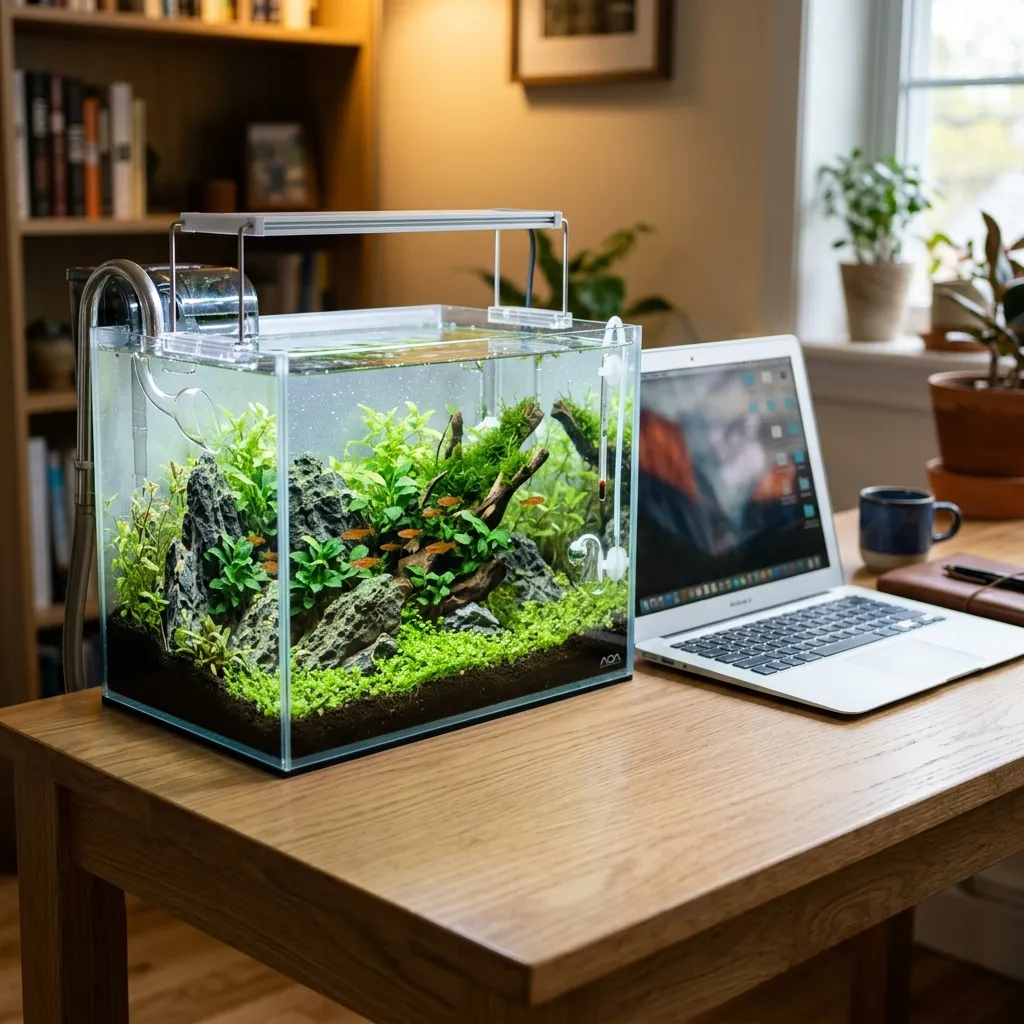
Quick Answer
Setting up a nano aquarium requires specialized miniature equipment and extreme attention to water quality. Because of the small water volume (usually under 10 gallons), toxins like ammonia accumulate rapidly, and temperature fluctuates quickly. You must cycle a nano tank thoroughly, stock it very lightly with micro-species, and commit to strict weekly water changes.
Introduction to Nano Aquariums
Nano aquariums—generally defined as any setup under 10 gallons—have surged in popularity. They are visually stunning, fit perfectly on desks and kitchen counters, and often serve as underwater moving art. However, the nano trend comes with a dangerous misconception: that small tanks are easier to maintain.
In reality, the laws of physics and biology make nano tanks significantly more volatile than large setups. This guide covers the specific constraints of small-volume aquatics and how to establish a stable micro-ecosystem.
The Constraint of Volume
The fundamental challenge of a nano aquarium is **dilution**.
In a 50-gallon aquarium, a dead snail or an extra pinch of fish food decays and releases a small amount of ammonia into a massive body of water. The resulting concentration is barely measurable. In a 5-gallon tank, that exact same dead snail releases the same amount of ammonia into one-tenth the volume, causing a massive, toxic ammonia spike that can kill all inhabitants within hours.
This principle applies to everything in a nano tank: * **Temperature:** A 5-gallon tank heats up and cools down much faster than a large tank. A drafty window or a cheap heater can swing the temperature wildly, stressing livestock. * **Evaporation:** When water evaporates, the minerals and toxins are left behind. In a nano tank, evaporating just half a gallon significantly increases the salinity and hardness of the remaining water. * **Chemistry:** Slight fluctuations in pH or KH (carbonate hardness) are amplified in small volumes.
Equipment Sizing and Selection
You cannot use standard aquarium equipment in a nano setup. Everything must be scaled down to prevent overwhelming the tank.
### Filtration Flow rate is critical. Most nano fish are slow swimmers that originate in stagnant or slow-moving water (like Betta fish in rice paddies). A standard filter will create a whirlpool in a 5-gallon tank, exhausting the fish to death. * **Sponge Filters:** The gold standard for nano tanks. They provide excellent biological filtration with gentle, adjustable flow driven by an air pump. * **Nano HOBs:** Small Hang-On-Back filters designed for 3 to 5-gallon tanks are acceptable, provided you can baffle the output flow if necessary.
### Heating Do not use a high-wattage heater. If a 100W heater gets stuck in the 'on' position, it will boil a 5-gallon tank in minutes. Use a 25W or 50W preset or adjustable nano heater, and always monitor the water with a reliable thermometer.
Aquascaping the Nano Tank
Aquascaping a small tank requires understanding scale and proportion.
1. **Substrate:** Use fine sand or small-grain gravel. Large gravel chunks ruin the sense of scale and trap detritus that is hard to siphon out of a small footprint. 2. **Hardscape:** Choose one 'centerpiece' rock or piece of branching driftwood. Trying to cram multiple large rocks into a 5-gallon tank displaces too much water volume (reducing your 5 gallons of dilution buffer down to 3 gallons). 3. **Plants:** Live plants are highly recommended. Fast-growing plants (like floating Salvinia or stem plants) help absorb excess nutrients, acting as a biological safety net against ammonia spikes.
The Cycling Process
Cycling a nano tank follows the exact same biological rules as cycling a large tank, but requires more precision.
You must perform a **fishless cycle** (using pure liquid ammonia) rather than a 'fish-in' cycle. The margins for error in a small volume are too tight; exposing a fish to the toxic ammonia and nitrite spikes inherent to cycling will almost certainly be fatal in a nano setup.
Dose ammonia to 2 ppm and wait for the bacteria to colonize the filter. This process still takes 4 to 6 weeks. Do not rush it.
Stocking Rules for Nano Tanks
The most common mistake in nano aquariums is overstocking. A 5-gallon tank is not a miniature community tank. It is a single-specimen environment.
**For a 5-Gallon Tank:** * One (1) Betta fish *or* * One (1) Pea Puffer *or* * A colony of Neocaridina shrimp (Cherry shrimp) * *No schooling fish (tetras, rasboras, corydoras).* They need horizontal swimming space that a 5-gallon cannot provide.
**For a 10-Gallon Tank:** * You can keep a small school (6-8) of micro-rasboras (like Chili Rasboras) *or* * A small school of Ember Tetras. * *Do not keep livebearers (guppies, mollies, platies).* They reproduce exponentially and will overwhelm the tank's biological capacity within months.
Long-Term Maintenance
Stability is achieved through strict, unwavering routine. * **Weekly Water Changes:** You must change 25% to 50% of the water every single week. Use a mini-siphon to vacuum the substrate. * **Top-Offs:** Top off evaporated water every few days with pure RO (Reverse Osmosis) or distilled water to prevent mineral buildup. * **Feeding:** Feed very sparingly. The fish's stomach is the size of its eye. A single pellet too many is a massive biological load in a nano tank.