
Congo Tetra (Phenacogrammus interruptus)
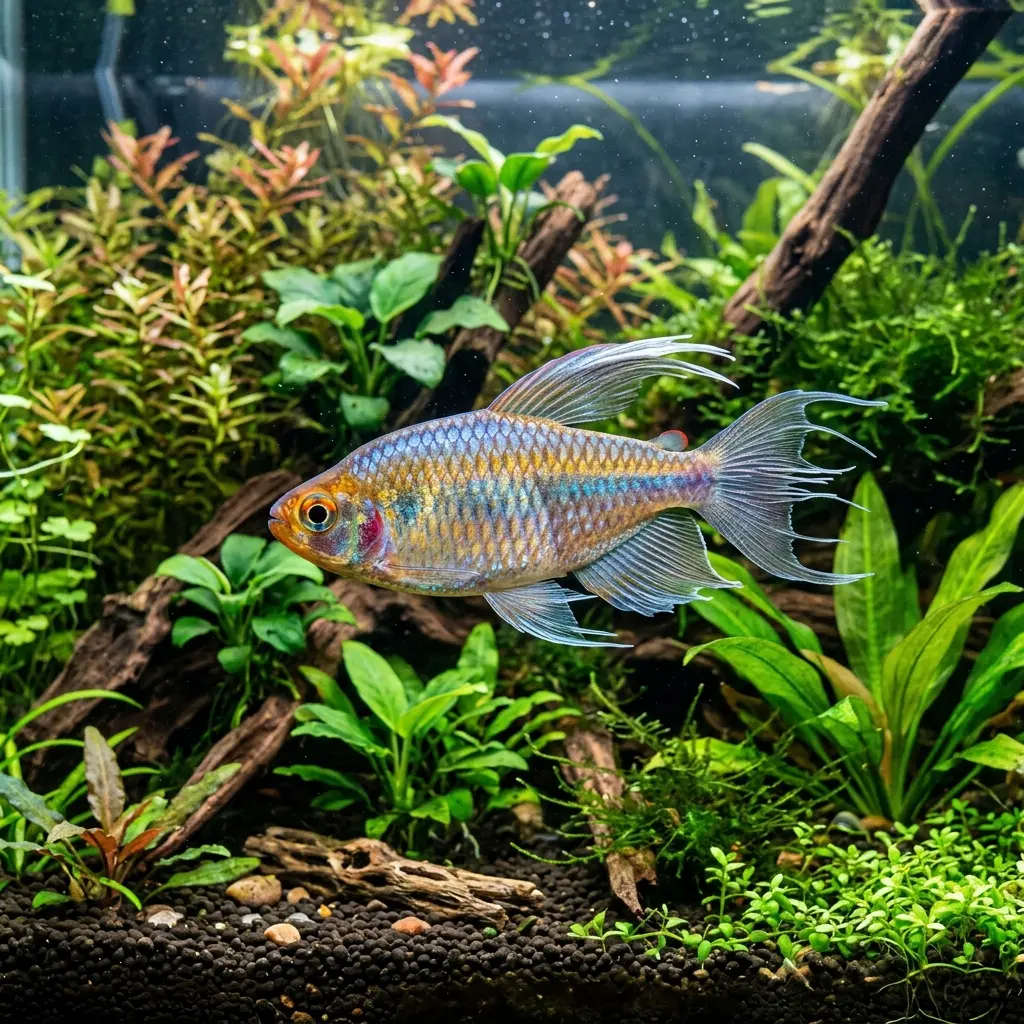
Quick Answer
Congo Tetra (Phenacogrammus interruptus) is a large, iridescent African characin requiring a minimum 30 gallon (114 liter) aquarium for a school of 6-8, with 40-55 gallons (151-208 liters) strongly recommended. This peaceful omnivore occupies the middle and top water column, displays spectacular rainbow coloration under proper lighting, and must be kept in schools to prevent stress and washed-out colors.
Quick Facts
| Scientific Name | Phenacogrammus interruptus |
|---|---|
| Common Names | Congo Tetra |
| Family | Alestidae |
| Genus | Phenacogrammus |
| Type | Freshwater |
| Temperament | peaceful |
| Care Difficulty | intermediate |
| Lifespan | 5 years |
| Maximum Size | Up to 3.5 in (9 cm) |
| Diet | Omnivore |
| Temperature | 73–82°F (23–28°C) |
| pH | 6–7.5 |
| Hardness | 3–18 dGH |
| Minimum Size | 30 gallons |
Key Takeaways
- Requires a minimum school of 6-8 individuals; 10+ strongly recommended for natural behavior and color display.
- Needs a 30 gallon (114 liter) tank minimum; 40-55 gallons (151-208 liters) recommended for optimal fin development and schooling.
- Males develop spectacular elongated dorsal, caudal, and anal fins up to 3.5 inches (8.9 cm) with iridescent blue, green, gold, and red coloration.
- Extremely sensitive to bright light—dim lighting with floating plants is mandatory for color display.
- Susceptible to Neon Tetra Disease (Pleistophora hyphessobryconis) which has no cure; quarantine all new additions for 3-4 weeks.
- Spawns readily in soft, acidic water with peat moss substrate; produces 300-500 eggs per spawning event.
- Fry grow rapidly, reaching 2 inches (5 cm) within 3 months under frequent feeding and clean water conditions.
- Dark substrate is essential—light gravel washes out their iridescent lateral stripe.
Overview
Species Overview
The Congo Tetra (Phenacogrammus interruptus) stands as the largest and most visually spectacular commonly kept tetra species in the aquarium hobby. Native to the Congo River Basin in Central Africa, this African characin displays a remarkable rainbow luminescence that shifts between blue, green, gold, red, and violet depending on lighting angle and water conditions. Males develop extraordinarily long, flowing dorsal, anal, and caudal fins with violet and white edges, creating a centerpiece-quality display that rivals many marine species in sheer visual impact.
First discovered in 1949 and not widely imported until the 1960s, the Congo Tetra benefited from Florida fish farmers who perfected a breeding line in the 1970s. Most specimens available in the trade today descend from these farm-raised lines, which breed true to the vibrant colors and full finnage of their wild counterparts. However, wild-caught specimens may reach up to 4.2 inches (10.7 cm), while captive-bred fish typically max out at 3 to 3.5 inches (7.6 to 8.9 cm).
Visual Identification
Sexual dimorphism is pronounced. Males are larger, more brightly colored, and possess the signature elongated fins. Their bodies shimmer with an iridescent blue-green top, a gold-red mid-lateral stripe, and a blue belly. The caudal fin features a distinct elongated middle lobe. Females are smaller, exhibit golden-olive coloration with silver and green hues, and completely lack the elaborate fin extensions. Mature females carrying eggs display noticeably rounded abdomens.
Behavioral Highlights
Congo Tetras are active, open-water swimmers that occupy the middle and upper water columns. When maintained in proper schools of 6-8 or more, they engage in continuous synchronized swimming and courtship displays. Their behavior is shy and skittish during the first 2-4 weeks after introduction, during which they are prone to dashing into glass and jumping. Once acclimated, they become confident, graceful swimmers that transform a well-planted aquarium into a dynamic display of African river ecology.
Diet
Dietary Requirements
Congo Tetras are true omnivores with a preference for small live or frozen foods. In their natural habitat, they feed on worms, crustaceans, insects, plant matter, and algae. Unlike tiny tetras such as Neons or Cardinals, Congo Tetras possess relatively large mouths and can consume food particles up to 2 mm in diameter. This allows for a broader range of food options, but variety remains the key to unlocking their full color potential.
Nutritional Composition
Target a balanced diet comprising approximately 40% protein, 15% fat, and 45% plant matter. High-quality protein sources maintain the vibrant iridescent colors and fin development in males, while plant matter supports digestive health and provides carotenoids for red and gold pigmentation.
Recommended Foods
- Primary dry foods: High-quality tropical flakes and slow-sinking pellets sized 1-2 mm. Crush flakes slightly for juvenile fish under 2 inches (5 cm).
- Live foods: Brine shrimp, bloodworms, daphnia, and blackworms. These are particularly important for conditioning breeders.
- Frozen options: Frozen brine shrimp, bloodworms, daphnia, and cyclops—thaw and rinse before feeding.
- Freeze-dried: Krill and tubifex worms as occasional treats. Soak before feeding to prevent expansion in the gut.
- Vegetable matter: Spirulina flakes, blanched spinach, zucchini, and peas weekly to support digestion and coloration.
Feeding Schedule
Feed small portions 2-3 times daily. Each feeding should be consumed within 3-4 minutes. Remove uneaten food to prevent ammonia spikes. Congo Tetras can be shy feeders initially—if you do not see them eating, do not worry. They often wait until observers move away. A feeding ring can help concentrate food and make it easier for shy individuals to locate.
Expert Tip: Color-Enhancing Diet
For maximum iridescence, feed a diet rich in carotenoids and astaxanthin. Freeze-dried krill, spirulina-enriched flakes, and foods containing marigold extract significantly enhance the gold-red lateral stripe and blue-violet fin edges. Fish fed exclusively on basic flakes develop noticeably duller coloration within 4-6 weeks.
Health
Health and Disease Management
Congo Tetras are moderately hardy when maintained in stable, mature aquariums with appropriate water parameters. However, their large size relative to other tetras, sensitivity to water quality, and susceptibility to a specific, incurable disease make proactive health management essential. Prevention through quarantine, pristine water quality, and careful food sourcing is vastly more effective than treatment.
Medication Sensitivity and Tolerance
This species exhibits a unique medication profile compared to smaller tetras:
- Copper: Tolerated up to 0.2 mg/L—higher than delicate species but still requires caution. Remove invertebrates before treatment.
- Formalin: Sensitive to standard doses. Use at half-strength maximum to prevent respiratory distress.
- Aquarium Salt: Tolerated up to 5 ppt (parts per thousand) for short-term baths. Standard therapeutic doses of 1 tablespoon per 5 gallons are generally safe for this species.
- Safe Options: Praziquantel for internal parasites and flukes, Methylene Blue for fungal issues, and Kanamycin for bacterial infections.
Quarantine Protocol
Quarantine all new Congo Tetras for a minimum of 3-4 weeks in a separate 20-gallon (76 liter) tank with a mature sponge filter. Observe for feeding response, fin condition, and signs of Neon Tetra Disease. Do not rush acclimation—drip acclimation over 30-45 minutes is recommended, particularly for wild-caught specimens or those from different water parameters.
Neon Tetra Disease (Pleistophora hyphessobryconis)
A microsporidian parasite that infects the skeletal musculature of characins and related species. This is the most serious disease threat to Congo Tetras because it is incurable and highly contagious through cannibalism of infected dead fish.
- Restlessness and breaking away from the school; localized patch of color loss or white discoloration on the body; muscle wasting along the spine; spinal curvature or S-shaped distortion of the lateral line; difficulty swimming with head-down posture; lumpy appearance as cysts deform muscles; eventual complete loss of coloration.
Ingestion of infective spores through consumption of dead infected fish or contaminated live foods such as tubifex worms. The parasite burrows from the intestines into skeletal muscles, producing cysts that destroy tissue from the inside out.
Remove and euthanize any fish showing symptoms immediately. Never leave dead fish in the tank. Quarantine all new additions for 4 weeks. Source live foods only from reputable suppliers. Maintain pristine water quality with heavy filtration to reduce bacterial load and support immune function. Do not reintroduce potentially infected fish to a tank that has housed NTD for at least 6 months.
Ich (White Spot Disease)
A protozoan parasite (Ichthyophthirius multifiliis) that presents as white salt-grain spots on body and fins. Triggered by temperature fluctuations and stress from poor water quality or inadequate schooling.
- White cysts 0.5-1.0 mm in diameter on fins, body, and gill covers; fish flashing against decor; rapid gill movement; clamped fins; reduced appetite; fish breaking from school.
Introduced via infected fish, plants, or equipment; triggered by temperature drops below 73°F (23°C), poor water quality, or stress from inadequate schooling numbers.
Quarantine all new additions for 4 weeks; maintain stable temperature within 73-82°F (23-28°C); avoid temperature swings exceeding 2°F (1.1°C) in 24 hours; ensure school size of 6+ to reduce stress; use a heater with thermostat rated at 3-5 watts per gallon.
Velvet (Gold Dust Disease)
A dinoflagellate parasite (Oodinium pilularis) that appears as a fine gold or rust-colored dust on skin. Photosynthetic and lethal to fish if untreated within 48-72 hours of visible symptoms.
- Gold or rust-colored dust visible under flashlight at sharp angles; rapid breathing; scratching against substrate; lethargy; fin clamping; refusal to eat; fish hiding in dark corners.
Introduced via infected stock; proliferates in warm water with strong lighting. Stress from transport or poor acclimation triggers outbreaks in newly purchased fish.
Quarantine new fish for 4 weeks; dim lighting for 3 days after introducing new stock; maintain pristine water quality with weekly changes; use UV sterilization on quarantine tanks; avoid introducing fish from tanks with visible velvet outbreaks.
Fin Rot (Bacterial)
Bacterial erosion of fin tissue caused by Aeromonas or Pseudomonas species. Male Congo Tetras are particularly susceptible due to their long, flowing fin extensions which provide ample surface area for bacterial colonization.
- Ragged, fraying fin edges with white or translucent margins; receding fin tissue progressing toward the body; red streaks in advanced cases; listlessness; reduced schooling behavior.
House only with peaceful, non-nipping species; remove sharp-edged decorations; maintain nitrates below 15 ppm through weekly water changes; feed fresh, vitamin-rich foods to maintain immune function; treat water with Indian almond leaves for mild antifungal and antibacterial properties.
Columnaris (Mouth Fungus)
A bacterial infection caused by Flavobacterium columnare that spreads rapidly in warm water. Often mistaken for fungal infections due to cotton-like appearance around the mouth and gills.
- White or grayish patches around mouth and gills; saddleback lesion behind dorsal fin; frayed fins; rapid breathing; loss of appetite; lethargy; fish isolating from school.
Stress from temperature fluctuations above 3°F (1.7°C) in 24 hours; overcrowding in tanks under 30 gallons; poor water quality; introduction via infected fish or equipment; low dissolved oxygen levels.
Maintain stable temperature with quality heater; avoid overcrowding (stock no more than 1 inch of fish per 2 gallons in tanks under 40 gallons); sterilize nets and equipment between tanks; ensure adequate aeration and surface agitation; quarantine new arrivals for 3-4 weeks.
Swim Bladder Disorder
A dysfunction of the swim bladder causing buoyancy issues. Common in Congo Tetras when overfed with dry foods that expand in the gut or when startled and gulping air at the surface.
- Fish floating at surface, sinking to bottom, or swimming at odd angles; difficulty maintaining position in water column; bloated abdomen; fish swimming head-down or tail-up.
Overfeeding with dry foods that expand in the gut; constipation from low-fiber diet; physical trauma from jumping or rough handling; bacterial infection secondary to poor water quality.
Feed small portions 2-3 times daily rather than single large meals; soak dry foods before feeding; include vegetable matter and spirulina in diet; maintain pristine water conditions; avoid startling fish with sudden movements or loud noises near the tank.
Breeding
Breeding Congo Tetras
Congo Tetras are egg scatterers capable of producing 300-500 eggs per spawning event. While breeding is achievable in the home aquarium, it requires specific conditions including soft, acidic water, peat moss substrate, and dim lighting. The fry are relatively large compared to other tetras and free-swimming upon hatching, which simplifies initial feeding but demands frequent water changes and ample space for rapid growth.
Conditioning Breeders
Select mature fish at least 1 year old. Condition a group of 8-10 adults with a sex ratio of 2 males per female, or use a single well-conditioned pair. Separate males and females into different tanks for 2 weeks prior to breeding. Feed heavily with live blackworms, brine shrimp, and bloodworms during this period. Well-conditioned females will develop noticeably rounded abdomens filled with eggs, while males will intensify their coloration and extend their fins fully.
Spawning Setup
Prepare a dedicated 15-20 gallon (57-75 liter) long breeding tank with:
- 1 inch (2.5 cm) of loosely packed boiled peat moss covering the entire bottom
- Several thickets of Java moss or nylon spawning mops positioned atop the peat
- Soft, acidic water: pH 6.0-6.5, dGH 1.5-3 (27-54 ppm), temperature 77-84°F (25-29°C)
- Air-powered sponge filter set to minimum bubble output, or no filtration to prevent disturbing peat
- Bright lighting during daytime to simulate natural sunlight and trigger spawning
Fill the tank with reverse osmosis, distilled, or rainwater and allow it to sit for 3 days until the peat moss settles. The water will darken significantly with tannins—this is desirable and mimics their natural blackwater spawning grounds.
Spawning Process
Introduce conditioned breeders in the evening shortly before lights out. Maintain darkness for at least 8 hours. Most pairs spawn the next morning when lights are turned on, simulating dawn. The male performs an elaborate courtship dance around the female, eventually descending to the bottom where both fish swim side-by-side into the Java moss or spawning mops. The female releases 300-500 adhesive eggs, many of which fall into the peat moss substrate where they are hidden from the parents.
Post-Spawning Care
Remove the adult fish immediately after spawning is observed. Unlike many tetras, Congo Tetras do not consume all their eggs because the majority fall into the peat substrate where parents cannot reach them. However, removing adults eliminates any risk of predation. Lower the lighting to protect the light-sensitive eggs. Inspect eggs daily and remove any that develop fluffy fungal growth to prevent spread.
Incubation and Hatching
Eggs hatch in 5-8 days at 75-77°F (24-25°C). This is significantly longer than South American tetras but produces larger, more developed fry. The fry emerge from the peat substrate fully free-swimming and immediately begin searching for food. They are approximately 0.2 inches (5 mm) at hatching.
Fry Rearing
Congo Tetra fry grow remarkably fast compared to other tetra species:
- Days 1-3: Feed infusoria and green water. The fry are large enough to accept baby brine shrimp almost immediately, but infusoria provides insurance for the smallest individuals.
- Days 3-14: Newly hatched baby brine shrimp (Artemia nauplii) and microworms. Feed 3-4 times daily.
- Week 2-4: Gradually introduce powdered dry food and crushed flakes. They accept commercial foods faster than most tetra fry.
- Week 4-12: Continue frequent feedings of live and commercial growth foods. By 3 months, they reach 2 inches (5 cm) and begin showing juvenile coloration.
Perform 20-30% water changes twice weekly. By 6 months, they reach 3 inches (7.6 cm) and sexual maturity. The rapid growth rate necessitates moving fry to progressively larger tanks—do not attempt to raise 300+ fry in a 15-gallon tank beyond 4 weeks.
Tips
Common Mistakes
Expert Tips
Compatible Tank Mates






Species Comparison
| Feature | Congo Tetra | Diamond Tetra | Neon Tetra | Boesemani Rainbowfish |
|---|---|---|---|---|
| Maximum Size | 3.5 inches (8.9 cm) | 2.3 inches (5.8 cm) | 1.5 inches (3.8 cm) | 4.0 inches (10.2 cm) |
| Temperament | Peaceful, skittish initially | Peaceful, active | Peaceful, calm | Peaceful, active |
| Minimum Tank Size | 30 gallons (114 L); 40-55 gal recommended | 20 gallons (76 L) | 10 gallons (38 L) | 55 gallons (208 L) |
| School Size Requirement | 6-8 minimum; 10+ recommended | 6-8 individuals | 6-10 individuals | 6-8 individuals |
| Diet Type | Omnivore (accepts 1-2 mm pellets) | Omnivore (small foods) | Omnivore (microscopic foods) | Omnivore (accepts standard pellets) |
| Ideal pH Range | 6.0 - 7.5 (soft to neutral) | 6.0 - 7.5 (soft to neutral) | 5.5 - 7.0 (soft, acidic) | 7.0 - 8.0 (neutral to alkaline) |
| Lighting Preference | Dim; bright light washes out colors | Moderate; scales sparkle under light | Dim to moderate | Moderate to bright |
| Breeding Difficulty | Intermediate (300-500 eggs, peat substrate) | Intermediate (scatters eggs) | Difficult (requires very soft water) | Difficult (spawning triggers complex) |
| Special Considerations | Dark substrate mandatory; susceptible to Neon Tetra Disease | Needs clean water for scale iridescence | Extremely sensitive to parameter swings | Requires alkaline water; males display intensely |