
Diamond Goby (Valenciennea puellaris)
Quick Answer
The Diamond Goby (Valenciennea puellaris) is a 6-inch (15 cm) sand-sifting marine goby that keeps reef substrate clean by filtering microfauna through its gill rakers. It requires a minimum 40-gallon aquarium with 3 to 4 inches of sugar-fine aragonite sand, stable marine parameters (pH 8.1 to 8.4, SG 1.023 to 1.025, 72 to 78 degrees Fahrenheit), and supplemental target-feeding to prevent starvation. It is peaceful but territorial toward conspecifics and will cover bottom-placed corals with sand.
Quick Facts
| Scientific Name | Valenciennea puellaris |
|---|---|
| Common Names | Diamond Goby |
| Family | Gobiidae |
| Genus | Valenciennea |
| Type | Saltwater |
| Temperament | peaceful |
| Care Difficulty | intermediate |
| Lifespan | 5 years |
| Maximum Size | Up to 6 in (15 cm) |
| Diet | Carnivore |
| Temperature | 72–78°F (22–26°C) |
| pH | 8.1–8.4 |
| Hardness | 7–12 dGH |
| Minimum Size | 40 gallons |
Key Takeaways
- Requires sugar-fine aragonite sand (0.5-1 mm) 3-4 inches deep for gill raker filtration.
- High starvation risk in tanks under 6 months old; supplemental target-feeding is mandatory.
- Will cover corals and clams in the bottom third of the tank with sand during normal sifting.
- Notorious jumper; requires a tight-fitting lid with no gaps.
- Incompatible with deep sand beds (DSB); disrupts anaerobic denitrification layers.
- Generally hardy and disease-resistant with proper quarantine and stable parameters.
Overview
Species Overview
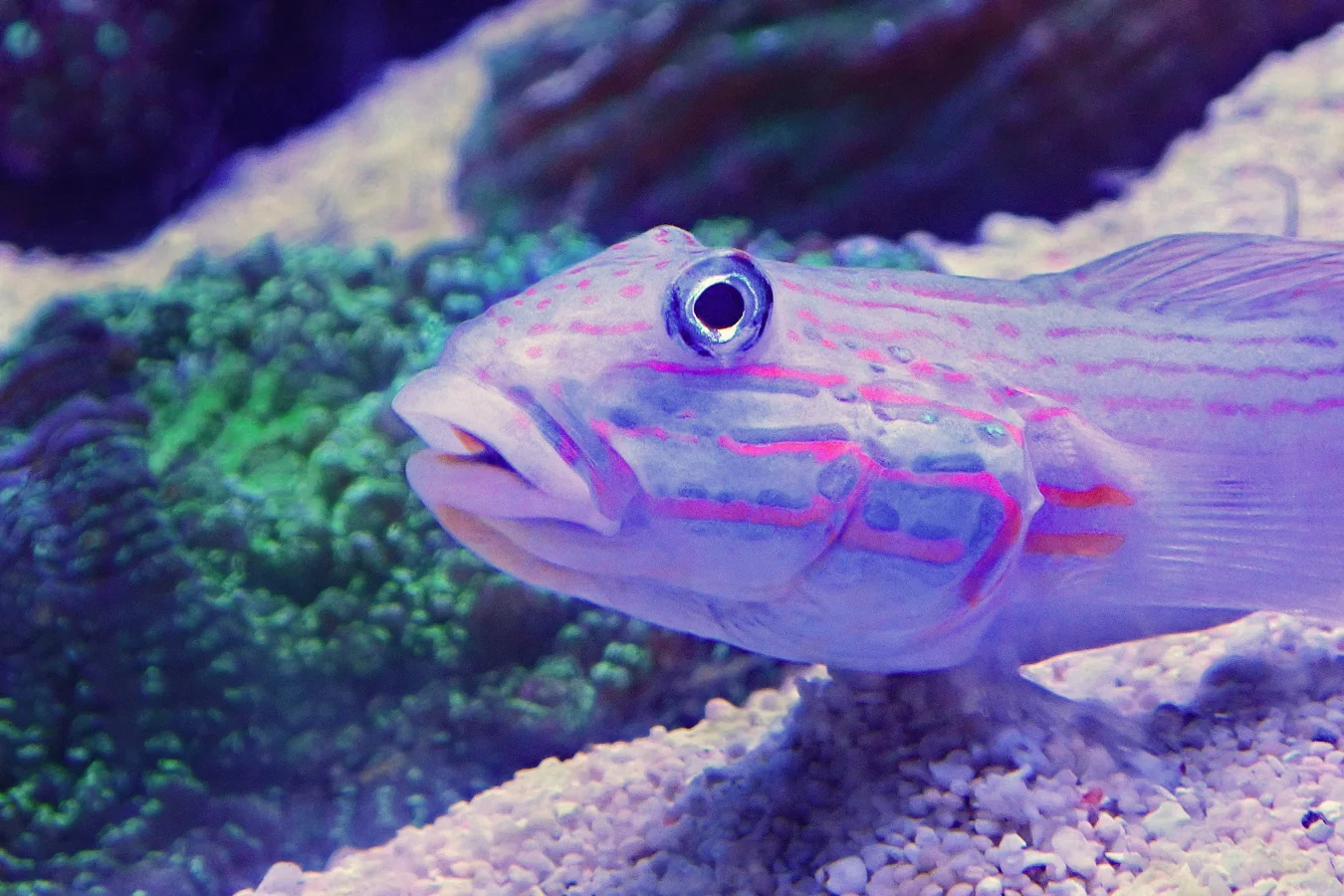
The Diamond Goby (Valenciennea puellaris), also known as the Orange Spotted Sleeper Goby, Maiden Goby, and Pretty Prawn, is one of the most visually striking and functionally valuable fish in the marine aquarium hobby. Adults reach 6 inches (15 cm) and display a brilliant white body dotted with tiny fluorescent orange diamonds, a large head with cyan-colored jaws, and bulbous protruding eyes that give the fish a perpetually inquisitive expression. Their constant sand-sifting behavior keeps reef substrates immaculate while oxygenating the upper sand layers.
Natural History and Distribution
This species is native to the Indo-Pacific region, ranging from the Red Sea and East African coast through the Indian Ocean to Samoa, Fiji, the Great Barrier Reef, and Indonesia. They inhabit sandy bottoms near coral reefs at depths of 6 to 100 feet (2 to 30 meters), where they form monogamous pairs and excavate burrows in the substrate. Wild specimens are found in pairs that are thought to be monogamous, sifting through sand continuously to extract microcrustaceans and organic detritus.
Physical Characteristics
Adults reach 6 inches (15 cm) in total length with a relatively compact, torpedo-shaped body. The head is disproportionately large with powerful jaws adapted for scooping and filtering sand. The body is white to cream-colored with numerous small orange diamond-shaped markings running the length of the flanks. The jaws display a distinctive cyan or turquoise coloration. Sexual dimorphism is minimal and unreliable; some aquarists report females as slightly larger, but this is not scientifically confirmed.
Diet
Dietary Requirements and Feeding Protocol
Diamond Gobies are obligate sand-sifting carnivores with a high metabolic rate. Their survival depends on a combination of natural sand bed microfauna and aggressive supplemental feeding. This is the most commonly misunderstood aspect of their care.
Health
Health Management and Disease Protocol
Diamond Gobies are generally hardy and disease-resistant when provided with appropriate nutrition and stable water parameters. However, their specialized lifestyle creates specific vulnerabilities that proactive management must address.
Cryptocaryon irritans (Marine Ich / White Spot Disease)
A ciliated protozoan parasite that infects the skin and gills of marine fish, producing characteristic white cysts. One of the most common diseases introduced via unquarantined livestock.
- White salt-like granules on fins, body, and gills; flashing against substrate; rapid breathing; clamped fins; loss of appetite; and scratching against rocks or sand.
Introduction via unquarantined fish, invertebrates, or live rock; temperature fluctuations; and stress from poor water quality or aggressive tank mates.
Quarantine all additions for 21 days minimum. Treat with copper at therapeutic levels (0.5 mg/L Cupramine or 2.0 to 2.5 mg/L Copper Power) for 14 days in a bare-bottom quarantine tank, then transfer to an observation tank for 2 to 4 weeks. Maintain temperature at 77 to 80 degrees Fahrenheit (25 to 27 degrees Celsius) to accelerate parasite life cycle. Remove activated carbon during treatment.
Amyloodinium ocellatum (Marine Velvet Disease)
A dinoflagellate parasite that produces a fine golden or rust-colored dust on the skin and gills. Often more lethal than Marine Ich due to rapid gill invasion and ability to kill before visible symptoms appear.
- Fine gold or rust-colored metallic dust on body and fins; excessive mucus production; clamped fins; lethargy; respiratory distress; and sudden death without prior visible symptoms.
Introduction via unquarantined stock; stress; and temperature below 76 degrees Fahrenheit (24 degrees Celsius) that slows immune response.
Quarantine rigorously. The only proven treatments are copper (Cupramine or Copper Power) and chloroquine phosphate. Treat at 77 to 80 degrees Fahrenheit (25 to 27 degrees Celsius). Observe for behavioral symptoms such as rapid breathing and flashing, as visible signs may not appear until it is too late.
Brooklynella hostilis (Brooklynella / Anemonefish Disease)
A ciliated protozoan that causes skin sloughing and rapid mortality. While commonly associated with clownfish, it can infect any marine fish including gobies.
- Skin sloughing or peeling; excessive mucus; rapid breathing; clamped fins; white patches that may resemble Ich or Velvet; and death within 24 to 48 hours of symptom onset.
Introduction via unquarantined fish; stress; and poor water quality. Brooklynella is not responsive to copper treatments.
Quarantine all additions. Treat with formalin baths or acriflavine in a quarantine tank. Metroplex may be used as a secondary treatment. Brooklynella is a fast killer; immediate intervention is required at the first sign of skin sloughing.
Gill Flukes (Monogeneans / Dactylogyrus)
Flatworm parasites that attach to gill filaments, causing respiratory compromise and secondary bacterial infection.
- Rapid breathing; gasping at the surface; flashing against substrate; pale gills; reduced feeding response; and lethargy.
Introduction via unquarantined fish; overcrowding; and poor water circulation.
Quarantine all additions. Treat with praziquantel at labeled dosages for 3 days, followed by a water change. Repeat in 7 days to catch emerging larvae. Praziquantel is safe for Diamond Gobies. Freshwater dips can confirm fluke presence by turning translucent worms opaque.
Bacterial Fin Rot and Septicemia
Secondary bacterial infections typically caused by Aeromonas, Pseudomonas, or Vibrio species following physical damage, parasite infestation, or chronic stress from starvation.
- Frayed or receding fin margins; red streaks at the fin base; ulcerative lesions on the body; bloating; cloudy eyes; and popeye (exophthalmia).
Maintain pristine water parameters with zero ammonia and nitrite. Treat underlying parasites before addressing secondary bacteria. Use broad-spectrum antibiotics such as kanamycin or nitrofurazone in a quarantine tank. Never treat the display tank with antibiotics, as this crashes biological filtration.
Breeding
Breeding Diamond Gobies in Captivity
Breeding Diamond Gobies is rare and exceptionally challenging. While they have reproduced in home aquariums, the difficulty of obtaining a compatible pair, the burrow-spawning behavior, and the pelagic larval stage make this suitable only for advanced marine breeders.
Compatible Tank Mates
Species Comparison
| Feature | Diamond Goby | Sleeper Blue Dot Goby | Yellow Watchman Goby | Orange Spotted Goby |
|---|---|---|---|---|
| Scientific Name | Valenciennea puellaris | Valenciennea sexguttata | Cryptocentrus cinctus | Amblyeleotris guttata |
| Max Size | 6 in (15 cm) | 5 in (13 cm) | 3 in (8 cm) | 3 in (8 cm) |
| Temperament | Peaceful; territorial toward own species | Peaceful; territorial toward own species | Peaceful; forms shrimp symbiosis | Peaceful; forms shrimp symbiosis |
| Minimum Tank Size | 40 gal (151 L); 55 gal recommended | 30 gal (114 L) | 10 gal (38 L) | 10 gal (38 L) |
| Sand Sifting Behavior | Constant; covers corals in bottom third | Constant; swims up to release sand | Minimal; excavates burrow only | Minimal; excavates burrow only |
| Reef Safety | Reef-safe with caveats; covers bottom corals | Reef-safe with caveats; sand storms | Fully reef-safe | Fully reef-safe |
| Starvation Risk | High in new tanks; requires supplemental feeding | High in new tanks; requires supplemental feeding | Low; accepts prepared foods readily | Low; accepts prepared foods readily |
| Sand Requirement | 3-4 in sugar-fine (0.5-1 mm) aragonite | 3-4 in sugar-fine sand | 2-3 in coarse sand acceptable | 2-3 in coarse sand acceptable |
| Unique Trait | Keeps sand bed pristine; constant sifting | Blue spots; active swimmer | Symbiotic with pistol shrimp | Symbiotic with pistol shrimp |