
Flame Hawkfish (Neocirrhites armatus)
Quick Answer
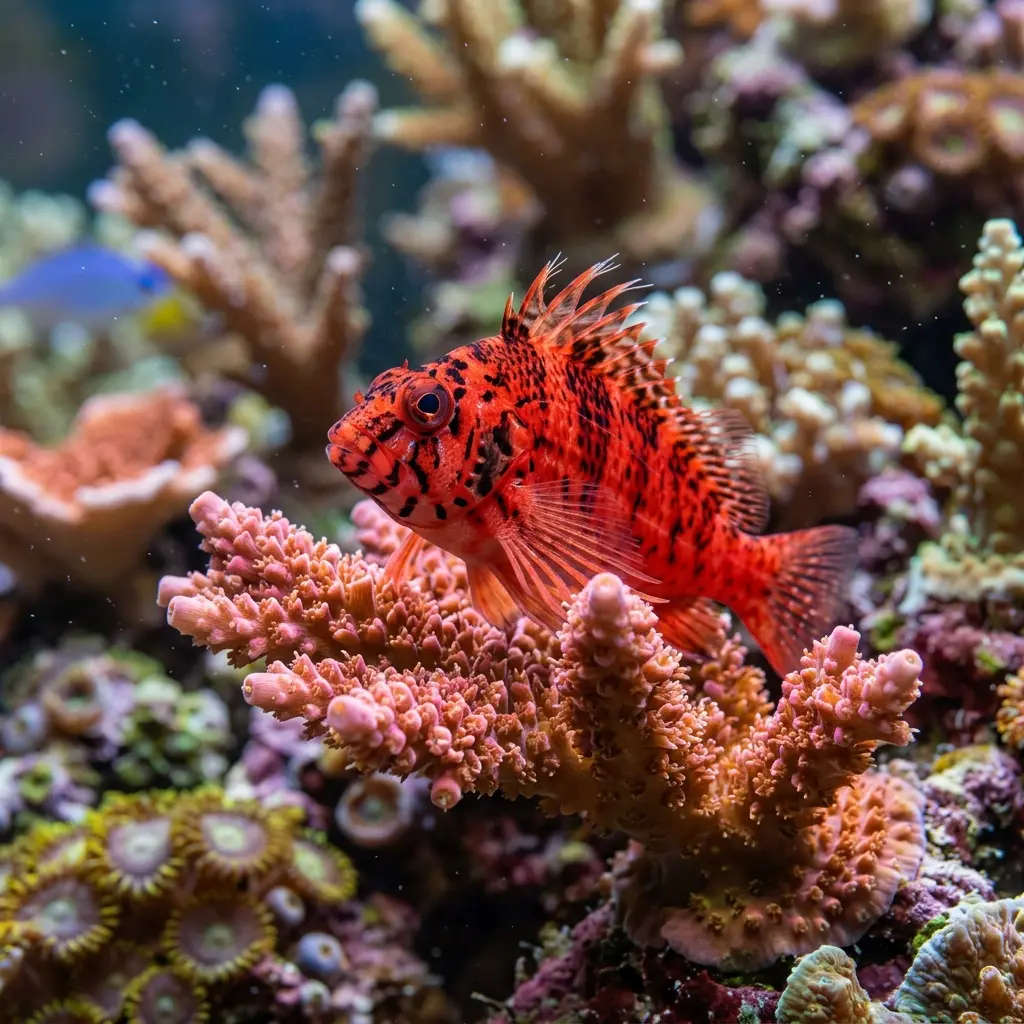
The Flame Hawkfish (Neocirrhites armatus) is a brilliantly red, 4-inch (10 cm) marine fish that lacks a swim bladder and perches on rocks and corals like a bird of prey. It requires a minimum 30-gallon aquarium with stable marine parameters (pH 8.0 to 8.4, SG 1.020 to 1.025, 74 to 80 degrees Fahrenheit), highly oxygenated water, and abundant perching structures. This carnivore is reef-safe with corals but will eat ornamental shrimp, small crustaceans, and tiny fish.
Quick Facts
| Scientific Name | Neocirrhites armatus |
|---|---|
| Common Names | Flame Hawkfish |
| Family | Cirrhitidae |
| Genus | Neocirrhites |
| Type | Saltwater |
| Temperament | semi-aggressive |
| Care Difficulty | beginner |
| Lifespan | 8 years |
| Maximum Size | Up to 4 in (10 cm) |
| Diet | Carnivore |
| Temperature | 74–80°F (23–27°C) |
| pH | 8–8.4 |
| Hardness | 7–12 dGH |
| Minimum Size | 30 gallons |
Key Takeaways
- Lacks a functional swim bladder; hops between perches instead of swimming.
- Brilliant red coloration fades to orange without carotenoid-rich foods.
- Reef-safe with corals but will eat ornamental shrimp and small crustaceans.
- Must be added LAST to the aquarium to prevent territorial aggression.
- Believed to be a protogynous hermaphrodite; males are slightly larger.
- Requires highly oxygenated water due to active metabolism and lack of swim bladder.
Overview
Species Overview
The Flame Hawkfish (Neocirrhites armatus) is one of the most visually arresting and personality-rich fish in the marine aquarium hobby. Adults reach 4 inches (10 cm) and display a brilliant, saturated red body accented by a broad arc-shaped black dorsal band and a distinctive black eye ring that gives the fish its mascara-like appearance. Their most fascinating feature is not their color but their behavior: they lack a functional swim bladder and have evolved to perch motionless on rocks and coral branches, propelling themselves in short bursts between perches like a bird of prey surveying its territory.
Natural History and Distribution
This species is native to the Western and Central Pacific Ocean, ranging from the Ryukyu Islands of Japan south to the Great Barrier Reef of Australia, east to the Line Islands and Mangareva, and throughout Micronesia including the Caroline, Mariana, and Wake islands. They inhabit shallow coral reef environments at depths of 6 to 100 feet (2 to 30 meters), where they are obligate residents of branching coral heads and rocky promontories. Wild specimens are found in monogamous pairs or solitary, perching on Acropora and other branching corals to hunt zooplankton and small crustaceans.
Physical Characteristics
Adults reach 4 inches (10 cm) in total length with a compact, laterally compressed body. The head is large with bulbous, independently rotating eyes that provide nearly 360-degree surveillance. The body is a uniform brilliant red to scarlet, with a broad black band running along the dorsal surface from the snout to the caudal peduncle. A black ring encircles each eye, creating the signature mascara look. The fins are relatively large and rounded, with the pectoral fins adapted for powerful bursts of propulsion rather than sustained swimming. Sexual dimorphism is minimal; males are believed to be slightly larger, consistent with protogynous hermaphroditism.
Diet
Dietary Requirements and Feeding Protocol
Flame Hawkfish are active carnivores with a high metabolism and specific carotenoid requirements. Their brilliant red coloration is entirely diet-dependent and will fade without proper nutrition.
Health
Health Management and Disease Protocol
Flame Hawkfish are generally hardy and disease-resistant, but their high metabolism and active lifestyle create specific vulnerabilities. Proactive quarantine and stable water quality are essential.
Cryptocaryon irritans (Marine Ich / White Spot Disease)
A ciliated protozoan parasite that infects the skin and gills of marine fish, producing characteristic white cysts. One of the most common diseases introduced via unquarantined livestock.
- White salt-like granules on fins, body, and gills; flashing against substrate; rapid breathing; clamped fins; loss of appetite; and scratching against rocks.
Introduction via unquarantined fish, invertebrates, or live rock; temperature fluctuations; and stress from poor water quality or aggressive tank mates.
Quarantine all additions for 21 days minimum. Treat with copper at therapeutic levels (0.35 to 0.5 mg/L Cupramine or 1.5 to 2.0 mg/L Coppersafe) for 14 days in a bare-bottom quarantine tank, then transfer to an observation tank for 2 to 4 weeks. Maintain temperature at 77 to 80 degrees Fahrenheit (25 to 27 degrees Celsius) to accelerate parasite life cycle. Remove activated carbon during treatment.
Amyloodinium ocellatum (Marine Velvet Disease)
A dinoflagellate parasite that produces a fine golden or rust-colored dust on the skin and gills. Often more lethal than Marine Ich due to rapid gill invasion and ability to kill before visible symptoms appear.
- Fine gold or rust-colored metallic dust on body and fins; excessive mucus production; clamped fins; lethargy; respiratory distress; and sudden death without prior visible symptoms.
Introduction via unquarantined stock; stress; and temperature below 74 degrees Fahrenheit (23 degrees Celsius) that slows immune response.
Quarantine rigorously. Treat with copper (Cupramine or Coppersafe) or chloroquine phosphate at 15 mg/L. Maintain temperature at 77 to 80 degrees Fahrenheit (25 to 27 degrees Celsius). Observe for behavioral symptoms such as rapid breathing and flashing, as visible signs may not appear until it is too late.
Brooklynella hostilis (Brooklynella / Anemonefish Disease)
A ciliated protozoan that causes skin sloughing and rapid mortality. While commonly associated with clownfish, it can infect any marine fish including hawkfish. Not responsive to copper treatments.
- Skin sloughing or peeling; excessive mucus; rapid breathing; clamped fins; white patches that may resemble Ich or Velvet; and death within 24 to 48 hours of symptom onset.
Introduction via unquarantined fish; stress; and poor water quality. Brooklynella is not responsive to copper.
Quarantine all additions. Treat with formalin baths or chloroquine phosphate at 15 mg/L. For formalin baths, use 150 ppm in a premixed solution for 30 to 45 minutes with heavy aeration. Repeat baths every other day until symptoms resolve. Immediate intervention is required at the first sign of skin sloughing.
Uronema marinum
A ciliate parasite that causes rapid mortality in marine fish. Often mistaken for Brooklynella or bacterial infection. Not responsive to copper.
- Reddish sores or ulcers on the body; rapid breathing; lethargy; loss of appetite; and death within 24 to 72 hours of symptom onset.
Introduction via unquarantined fish; stress; and poor water quality. Uronema thrives in lower salinity conditions.
Quarantine rigorously. Treat with chloroquine phosphate at 40 to 60 mg/L for active infections, or formalin baths. Uronema is not treatable with copper. Maintain stable salinity above 1.023 to prevent Uronema proliferation.
Bacterial Fin Rot and Septicemia
Secondary bacterial infections typically caused by Vibrio, Aeromonas, or Pseudomonas species following physical damage, parasite infestation, or chronic stress.
- Frayed or receding fin margins; red streaks at the fin base; ulcerative lesions on the body; bloating; cloudy eyes; and popeye (exophthalmia).
Maintain pristine water parameters with zero ammonia and nitrite. Treat underlying parasites before addressing secondary bacteria. Use broad-spectrum antibiotics such as kanamycin or nitrofurazone in a quarantine tank. Never treat the display tank with antibiotics, as this crashes biological filtration.
Breeding
Breeding Flame Hawkfish in Captivity
Breeding Flame Hawkfish is rare and has not yet produced commercially viable offspring. Their protogynous hermaphroditism and extended pelagic larval stage make captive breeding suitable only for advanced marine breeders.
Compatible Tank Mates






Species Comparison
| Feature | Flame Hawkfish | Longnose Hawkfish | Falco Hawkfish | Arc-eye Hawkfish |
|---|---|---|---|---|
| Scientific Name | Neocirrhites armatus | Oxycirrhites typus | Cirrhitichthys falco | Paracirrhites arcatus |
| Max Size | 4 in (10 cm) | 5 in (13 cm) | 2.75 in (7 cm) | 8 in (20 cm) |
| Temperament | Semi-aggressive; territorial over perch | Semi-aggressive; less territorial than Flame | Semi-aggressive; may pester small fish | Aggressive; eats small fish |
| Minimum Tank Size | 30 gal (114 L); 40-55 gal recommended | 30 gal (114 L); 55-75 gal recommended | 10 gal (38 L) | 55 gal (208 L); 75+ gal recommended |
| Reef Safety with Corals | Safe; perches on branching corals | Safe; perches on gorgonians | Safe with corals and clams | Safe with corals and clams |
| Shrimp Safety | High risk; eats small ornamental shrimp | Moderate risk; less likely than Flame | High risk; eats tiny shrimp and crabs | High risk; eats all shrimp and crabs |
| Swim Bladder | Absent; obligate percher | Absent; obligate percher | Absent; some individuals swim more | Absent; obligate percher |
| Coloration | Brilliant red with black dorsal band | White with red checkerboard pattern | Mottled with yellow dorsal tufts | Variable; orange-pink to dark brown |
| Unique Trait | Bug eyes that rotate independently | Extremely elongated snout for probing | Smallest hawkfish; intricate markings | Horseshoe arc behind each eye |