
Green Chromis (Chromis viridis)
Quick Answer
Green Chromis (Chromis viridis) is a peaceful, shoaling damselfish native to Indo-Pacific lagoons. It requires a minimum 30 gallon (114 liter) aquarium for a single specimen or 40+ gallons (150+ liters) for schools of 6+. Water parameters must include pH 8.1-8.4, specific gravity 1.023-1.025, and temperature 72°F-80°F (22°C-27°C). This planktivore is completely reef-safe and thrives on multiple small feedings daily.
Quick Facts
| Scientific Name | Chromis viridis |
|---|---|
| Common Names | Green Chromis |
| Family | Pomacentridae |
| Genus | Chromis |
| Type | Saltwater |
| Temperament | peaceful |
| Care Difficulty | beginner |
| Lifespan | 5 years |
| Maximum Size | Up to 3.5 in (9 cm) |
| Diet | Omnivore (Planktivore) |
| Temperature | 72–80°F (22–27°C) |
| pH | 8.1–8.4 |
| Hardness | 7–12 dGH |
| Minimum Size | 30 gallons |
Key Takeaways
- Requires a school of 6 to 8 minimum; smaller groups experience fatal dominance aggression
- Completely reef-safe with corals and all invertebrates
- Mandatory 4-week quarantine with chloroquine phosphate to prevent Uronema marinum
- Substrate-spawning egg guarder, not a mouthbrooder
- High-metabolism planktivore requiring 3 to 4 small feedings daily
- Sensitive to salinity fluctuations; maintain stable specific gravity at all times
Overview
Natural History and Distribution
Green Chromis (Chromis viridis), also known as the Blue-Green Chromis or Blue-Green Damselfish, is one of the most popular and heavily traded marine aquarium fish globally, with nearly one million specimens imported into the United States annually. Native to the Indo-Pacific region, this species ranges from the east coast of Africa to the Line Islands and Tuamotu Archipelago, north to the Ryukyu Islands, and south to the Great Barrier Reef and New Caledonia.
In the wild, adults form massive aggregations numbering in the thousands above thickets of branching Acropora corals in sheltered lagoons and subtidal reef flats at depths of 1 to 20 meters (3 to 65 feet). Juveniles remain closely tied to individual coral heads, using the complex branching structure as refuge from predators. Their natural habitat is characterized by low to moderate water flow, high light penetration, and stable salinity conditions.
Physical Identification
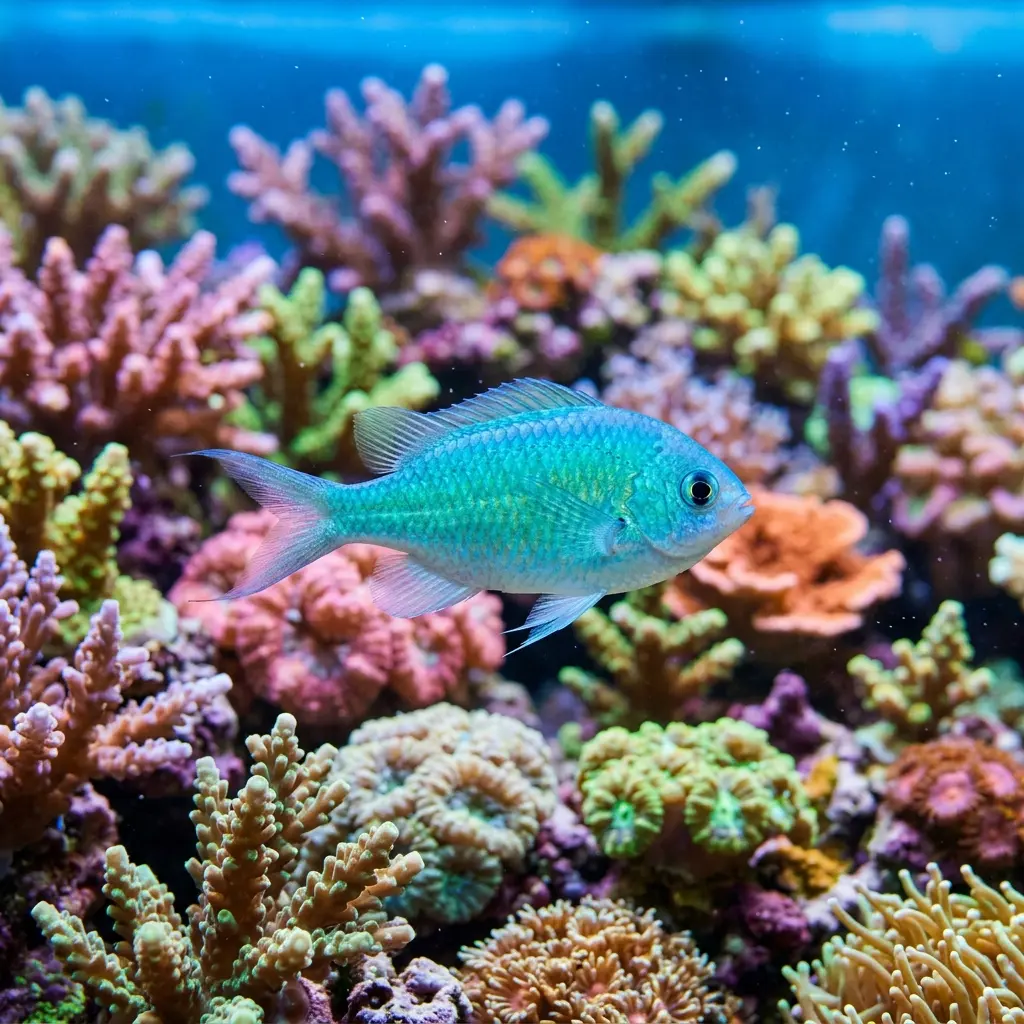
The Green Chromis possesses a deeply forked caudal fin and a laterally compressed, ovate body that reaches a maximum length of 3.5 inches (9 cm) in captivity, though wild specimens may approach 4 inches (10 cm). The base coloration is an iridescent blue-green that shifts between turquoise, emerald, and silvery-white depending on lighting intensity and the fish's mood. During courtship and spawning, males develop a distinct yellowish hue across the head and anterior body, accompanied by a darkening of the dorsal fin. A faint dusky spot may be visible at the upper base of the pectoral fin in some individuals, though this should not be confused with the definitive black axil spot of Chromis atripectoralis.
Conservation and Trade Status
The IUCN lists Chromis viridis as Least Concern due to its vast distribution and enormous wild populations. However, collection and transport mortality through the chain of custody remains significant, with industry estimates suggesting 30 to 50% losses before fish reach retail aquariums. This makes quarantine and prophylactic treatment not merely recommended but absolutely essential for ethical husbandry.
Diet
Nutritional Requirements
Green Chromis are obligate planktivores with a high metabolic rate demanding frequent, varied feedings. Their natural diet consists of zooplankton, phytoplankton, fish eggs, and copepods filtered from the water column. In captivity, you must replicate this nutritional profile with a target macronutrient breakdown of approximately 50% protein, 15% fat, and 35% marine algae and plant matter.
Recommended Foods
- Vitamin-enriched brine shrimp (Artemia) nauplii and adults
- Mysis shrimp (Mysis relicta)
- Live or frozen copepods (Tigriopus, Apocyclops)
- High-quality marine flake and pellet foods with spirulina content
- Frozen cyclops and finely chopped krill
- Spirulina-enriched frozen preparations
- Commercial phytoplankton supplements for filter-feeding behavior
Feeding Schedule
Feed small portions 3 to 4 times daily. Their high activity level and fast metabolism mean single large feedings result in wasted food, water fouling, and malnourished fish. Each feeding should be consumed within 2 to 3 minutes. Soak dry foods in a vitamin supplement containing Vitamin C, Vitamin E, and astaxanthin for 10 minutes before feeding to enhance immune function and coloration. Garlic extract soaks provide additional parasite resistance.
Foods to Avoid
Never offer freshwater feeder fish, beef heart, or terrestrial mammal meats. These foods lack appropriate lipid profiles and contain harmful saturated fats that damage the liver in marine fish. Avoid exclusive flake diets, which lead to nutritional deficiencies and Head and Lateral Line Erosion (HLLE) over time. Do not rely solely on auto-feeders for schools; dominant fish monopolize dispensed food while subordinates starve.
Health
Health Management and Disease Prevention
While Green Chromis are hardy when maintained in optimal conditions, they are susceptible to several specific pathogens that competitors frequently fail to address. Their easily dislodged scales create entry points for bacterial infections, and their unique susceptibility to Uronema marinum makes quarantine absolutely mandatory. A rigorous 4-week quarantine protocol using chloroquine phosphate prophylaxis prevents 95% of common disease introductions.
Quarantine Protocol
All new Green Chromis must undergo a minimum 4-week quarantine in a bare-bottom hospital tank with separate filtration. Observe for 7 days, then treat with chloroquine phosphate at 10 mg/L for 14 days to eliminate Uronema, Brooklynella, and external parasites. Follow with a 7-day observation period before transitioning to the display tank. Never skip quarantine; Uronema introduced to a reef tank forces complete system breakdown and bleaching for eradication.
Uronema marinum (Red Sore Disease)
A free-living scuticociliate parasite that is the leading cause of mortality in captive Chromis populations. It does not require a fish host and survives indefinitely in aquarium substrate and detritus.
- Early: rapid breathing, flashing, color loss. Advanced: distinctive red sores or ulcers on body and lateral line, weight loss, dehydration, lethargy. Mortality exceeds 90% once red sores are visible.
Opportunistic infection by Uronema marinum ciliates that enter through wounds or attack immunocompromised fish. Thrives in tanks with accumulated detritus and poor water quality.
Mandatory 4-week quarantine with chloroquine phosphate prophylaxis (10 mg/L for 14 days). Maintain pristine water quality with minimal detritus accumulation. Avoid overcrowding. Never introduce untested Chromis to display tanks.
Marine Ich (Cryptocaryon irritans)
The most common parasitic infection in marine aquariums, caused by a ciliated protozoan with a complex life cycle involving encysted stages on substrate.
- White salt-like spots on fins, body, and gills; rubbing against rocks and substrate; rapid breathing; clamped fins; clouded eyes in severe cases.
Introduction via infected fish, live rock, or contaminated equipment. Stress from temperature fluctuations, poor nutrition, or aggression triggers outbreaks in carriers.
Quarantine all new livestock for 4 weeks. Maintain stable temperature and salinity. Boost immune function with vitamin-enriched foods. Copper treatment (0.15 mg/L Cupramine) or hyposalinity (1.009 SG for 21 days) in quarantine tanks only.
Marine Velvet (Amyloodinium ocellatum)
A dinoflagellate parasite that infects gills and skin, reproducing rapidly and causing mass mortality within 48 to 72 hours of visible symptoms.
- Dusty gold or velvety gray film on skin; rapid breathing; clamped fins; lethargy; refusal to eat. Often fatal before visible spots appear due to gill damage.
Introduction via infected fish or water. Dinoflagellates attach to skin and gills, causing tissue damage and respiratory failure. Spreads faster than marine ich.
Quarantine all new fish. Chloroquine phosphate at 10 mg/L is highly effective. Copper treatment works but must be monitored precisely. Infected display tanks require 6-week fallow period to break the life cycle.
Bacterial Infections (Fin Rot, Popeye, Septicemia)
Secondary bacterial infections caused by Aeromonas, Vibrio, or Pseudomonas species that exploit stress-weakened immune systems or physical injuries.
- Fin rot: frayed or dissolving fin edges. Popeye: unilateral or bilateral exophthalmia. Septicemia: red streaks under skin, open sores, bloating, abnormal swimming.
Poor water quality with elevated nitrates, physical aggression causing scale loss, improper handling, or introduction via contaminated live foods. Scale loss from dominance fights is a primary entry point.
Head and Lateral Line Erosion (HLLE)
A chronic degenerative condition affecting the sensory lateral line system and head region, resulting in pitting lesions and permanent tissue damage.
- Pitting and erosion along the lateral line canal; small holes around the head and behind the eyes; faded coloration; lethargy in advanced cases. Lesions do not heal without intervention.
Nutritional deficiencies, particularly lack of Vitamin C and essential fatty acids. Activated carbon dust and poor water quality are contributing factors. Exclusive dry flake diets are a primary cause.
Provide a varied diet with fresh and frozen foods. Soak dry foods in vitamin supplements containing Vitamin C and omega-3 fatty acids. Use high-quality carbon in a reactor rather than loose bags. Maintain pristine water conditions.
Breeding
Captive Breeding of Green Chromis
Green Chromis are substrate-spawning egg guarders, not mouthbrooders as incorrectly stated in older aquarium literature. Successful captive breeding has been achieved by research institutions including CMFRI India and the University of Florida Tropical Aquaculture Laboratory, but remains challenging for home aquarists due to larval mortality bottlenecks.
Broodstock Conditioning
Condition a school of 6 to 8 adults in a 75+ gallon (280+ liter) system with excellent water quality and heavy live food supplementation for 4 to 6 weeks. Feed enriched brine shrimp, mysis, and copepods 4 times daily. Maintain temperature at 77°F to 79°F (25°C to 26°C) and provide stable salinity at 1.025. Males will develop a yellowish breeding coloration and darkened dorsal fin when sexually mature.
Spawning Behavior
Males leave the school and establish temporary breeding territories on the substrate. They select flat rocks, dead coral branches, or rubble patches and meticulously clean the surface. The male courts females by passing his body over the nest site; females then deposit adhesive demersal eggs. Multiple females may lay eggs in a single male's nest, with total clutch sizes ranging from 1,300 to 1,500 eggs per night. The male fertilizes eggs externally and guards the nest, ventilating them with caudal fin movements and consuming non-viable eggs to prevent fungal growth.
Egg Incubation and Hatching
Eggs measure approximately 502 micrometers and hatch in 2 to 3 days at 75°F to 77°F (24°C to 25°C). Hatching occurs at night. In captivity without male care, eggs must be artificially aerated with gentle air stones to prevent fungal infection and simulate the male's fanning behavior. Dead eggs turn opaque white and must be removed immediately.
Larval Rearing
Newly hatched larvae are altricial, measuring 2.0 to 2.25 mm with no functional mouth, pigmented eyes, or developed gut. They subsist on yolk reserves for 48 hours. First feeding begins on day 2 to 3 post-hatch using Oithona or Pseudodiaptomus copepod nauplii at a density of 3 per mL. Larvae are highly selective feeders and will not accept rotifers or brine shrimp nauplii initially. Mouth gape at first feeding is approximately 190 micrometers.
The highest mortality bottleneck occurs at flexion around day 15, when larvae undergo dramatic morphological changes and gut reorganization. Supplement with larger copepodites as larvae grow. Metamorphosis begins around day 30 and completes by day 40 to 49, at which point juveniles settle to the bottom, display adult coloration by day 40, and begin schooling behavior. Average survival rate from hatch to juvenile is approximately 5% under optimal conditions.
Juvenile Care
Transfer settled juveniles to a grow-out tank of 20 gallons (75 liters) with gentle flow. Feed freshly hatched Artemia nauplii supplemented with copepods 4 times daily. By 60 days post-hatch, juveniles reach 0.5 to 0.75 inches (1.3 to 1.9 cm) and can accept crushed flake foods. Sexual maturity occurs at 8 to 9 cm total length, approximately 12 to 18 months of age.
Compatible Tank Mates






Species Comparison
| Feature | Green Chromis | Black Axil Chromis | Blue Reef Chromis | Yellowtail Blue Damselfish |
|---|---|---|---|---|
| Scientific Name | Chromis viridis | Chromis atripectoralis | Azurina cyanea | Chrysiptera parasema |
| Max Size | 3.5 in (9 cm) | 4 in (10 cm) | 6 in (15 cm) | 3 in (7.5 cm) |
| Temperament | Peaceful / Shoaling | Peaceful / Shoaling | Peaceful / Semi-shoaling | Semi-aggressive / Territorial |
| Minimum Tank Size | 30 gal (114 L) solo; 40 gal (150 L) school | 30 gal (114 L) solo; 40 gal (150 L) school | 55 gal (208 L) | 20 gal (75 L) |
| Diet | Planktivore / Omnivore | Planktivore / Omnivore | Planktivore / Omnivore | Omnivore / Aggressive feeder |
| pH Range | 8.1 - 8.4 | 8.1 - 8.4 | 8.1 - 8.4 | 8.1 - 8.4 |
| Reef Safety | Completely reef-safe | Completely reef-safe | Completely reef-safe | Reef-safe with caution |
| Schooling Behavior | Dense schooling; needs 6+ | Dense schooling; needs 6+ | Loose groups; 3-4 acceptable | Solitary or pairs; does not school |