
Green Terror (Andinoacara rivulatus)
Quick Answer
The Green Terror (Andinoacara rivulatus) is a large, colorful South American cichlid reaching up to 12 inches (30 cm) in males. It requires a minimum 55-gallon aquarium with pH 6.5 to 8.0, temperature 68 to 80 degrees Fahrenheit (20 to 27 degrees Celsius), and robust filtration. This omnivorous, semi-aggressive fish is known for the male's prominent nuchal hump, intense digging behavior, and dedicated biparental care during breeding.
Quick Facts
| Scientific Name | Andinoacara rivulatus |
|---|---|
| Common Names | Green Terror |
| Family | Cichlidae |
| Genus | Andinoacara |
| Type | Freshwater |
| Temperament | semi-aggressive |
| Care Difficulty | intermediate |
| Lifespan | 10 years |
| Maximum Size | Up to 12 in (30 cm) |
| Diet | Omnivore |
| Temperature | 68–80°F (20–27°C) |
| pH | 6.5–8 |
| Hardness | 5–20 dGH |
| Minimum Size | 55 gallons |
Key Takeaways
- Males reach 12 inches (30 cm) and develop a prominent fatty nuchal hump; females reach 8 inches (20 cm).
- Requires 55 gallons minimum for a single fish; 75+ gallons for a pair; 125+ gallons for community.
- Heavy digger that uproots most plants; use hardy Anubias and Java Fern attached to hardscape.
- Omnivore requiring 50% protein and 35% vegetable matter; fiber prevents Hexamita and bloat.
- Obtain pairs by raising 6-8 juveniles together; forced pairs often result in female death.
- Breeds as substrate spawner with 300-600 eggs; both parents guard eggs and fry aggressively.
Overview
Species Overview
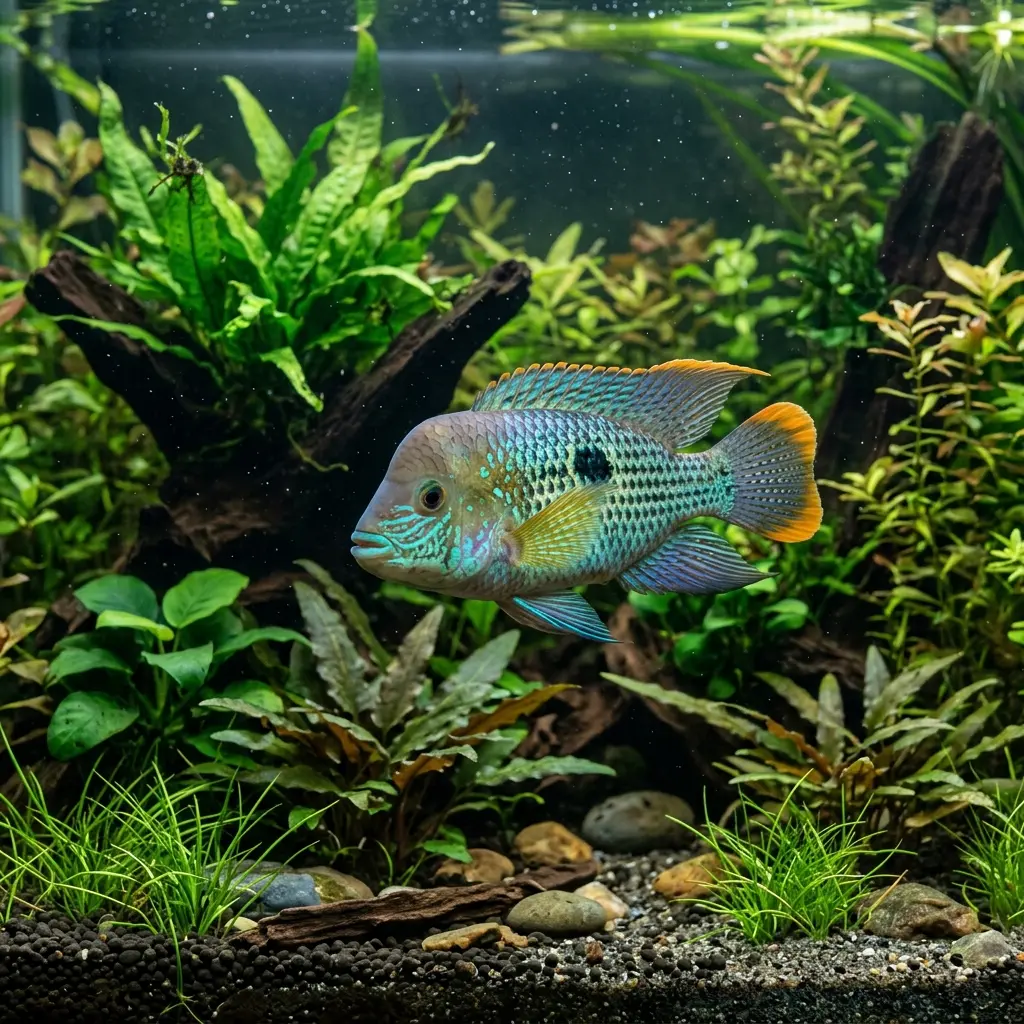
The Green Terror Cichlid (Andinoacara rivulatus), also known as the Gold Saum and formerly classified as Aequidens rivulatus, is one of the most visually striking and behaviorally complex large cichlids available to the aquarium hobby. Despite its intimidating common name, this species is a manageable and rewarding fish for intermediate aquarists who understand its territorial nature and provide appropriate space. Adult males reach up to 12 inches (30 cm) and develop a prominent fatty nuchal hump, brilliant iridescent green and blue speckling, and flowing finnage edged in orange or gold.
Natural History and Distribution
This species is native to the Pacific slope of South America, specifically from the Tumbes River in Peru to the Esmeraldas River in Ecuador. They inhabit large and small coastal streams over varied substrates including mud, sand, gravel, large river rocks, and thickly layered beds of dead leaves. Juveniles are found in shallows and backwater areas, while adults prefer deeper portions of the water column. Wild specimens experience water temperatures of 68 to 80 degrees Fahrenheit (20 to 27 degrees Celsius), pH 6.5 to 8.0, and hardness up to 25 dGH.
Physical Characteristics
Adult males reach 10 to 12 inches (25 to 30 cm), while females mature at 7 to 8 inches (18 to 20 cm). The body is deep and ovoid with a prominent forehead. Mature males develop a pronounced nuchal hump composed of fatty tissue that serves as a visual dominance signal during courtship. The body coloration is a metallic green to olive base with iridescent blue-green speckling across the flanks and electric blue spots on the chin and gill plates. The dorsal and caudal fins are edged in bright orange, gold, or white depending on the morph. A characteristic black spot appears at mid-body. Sexual dimorphism is pronounced: males are larger, more colorful, have elongated fins, and display the nuchal hump, while females are smaller, duller, and lack the hump.
Diet
Dietary Requirements and Feeding Protocol
Green Terrors are omnivores with a strong carnivorous bias. Their large size and active metabolism demand a protein-rich, varied diet with adequate vegetable fiber to prevent intestinal diseases.
Health
Health Management and Disease Protocol
Green Terrors are hardy fish when provided with stable water quality and a balanced diet. However, their large size, high metabolism, and protein-heavy dietary preferences create specific vulnerabilities that proactive management must address.
Hexamitiasis (Hole-in-the-Head Disease / Malawi Bloat)
An internal protozoan infection caused by Spironucleus (formerly Hexamita) that manifests as pitting lesions on the head and lateral line, or as severe abdominal bloating.
- Small pits or erosions along the head and lateral line; stringy white feces; loss of appetite; weight loss despite normal feeding; abdominal bloating; and lethargy.
Chronic poor water quality (nitrates above 20 ppm); nutritional deficiency especially lack of vegetable fiber and spirulina; stress from incompatible tank mates; and introduction via unquarantined live foods.
Maintain nitrates below 20 ppm through weekly 30% to 40% water changes. Feed a balanced diet with vegetable supplementation. Quarantine all new livestock for 21 days. Treat promptly with metronidazole at 50 mg per kg body weight or 10 mg per gram of food for 5 consecutive days. Water-column dosing is scientifically proven ineffective against internal Hexamita.
Ichthyophthirius multifiliis (Ich / White Spot Disease)
A ciliated protozoan parasite that infects the skin and gills, producing characteristic white cysts. Common in large cichlids due to their scale structure.
- White salt-like granules on fins, body, and gills; flashing against decor; rapid breathing; clamped fins; and isolation from the group.
Introduction via unquarantined fish, plants, or decor; temperature fluctuations below 70 degrees Fahrenheit (21 degrees Celsius) that compromise immune function; and stress from poor water quality.
Quarantine all additions for 21 days. Maintain stable temperature between 72 and 77 degrees Fahrenheit (22 and 25 degrees Celsius). Treat with formalin-malachite green combination at standard dose; Green Terrors tolerate this well. Raise temperature to 80 degrees Fahrenheit (27 degrees Celsius) to accelerate the parasite life cycle during treatment.
Bacterial Fin Rot and Septicemia
Secondary bacterial infections typically caused by Aeromonas, Pseudomonas, or Flexibacter species following physical damage from territorial fighting, parasite infestation, or water quality decline.
- Frayed or receding fin margins; red streaks at the fin base; ulcerative lesions on the body; bloating; popeye (exophthalmia); and loss of coloration.
Maintain pristine water parameters with zero ammonia and nitrite. Treat underlying parasites before addressing secondary bacteria. Use broad-spectrum antibiotics such as kanamycin or nitrofurazone in a quarantine tank. Never treat the display tank with antibiotics, as this crashes biological filtration.
Gill Flukes (Dactylogyrus)
Monogenean trematode worms that attach to gill filaments, causing respiratory compromise and secondary bacterial infection in large cichlids.
- Rapid breathing; gasping at the surface; flashing against substrate; pale gills; and reduced feeding response.
Introduction via unquarantined fish; overcrowding; and poor water circulation that allows fluke larvae to concentrate.
Maintain strong surface agitation and avoid overcrowding. Treat with praziquantel at 2.5 mg/L for 3 days, followed by a 25% water change. Repeat in 7 days to catch emerging larvae. Praziquantel is safe for Green Terrors at labeled dosages.
Obesity and Fatty Liver Disease
A chronic nutritional condition caused by overfeeding, excessive protein intake, and lack of dietary fiber. Common in large cichlids fed only pellets and meaty foods.
- Distended abdomen; lethargy; loss of appetite; pale feces; and reduced activity. Advanced cases show liver failure signs including jaundice and fluid accumulation.
Overfeeding; diet lacking vegetable matter and fiber; feeding beef heart or mammalian fats; and insufficient water changes allowing organic waste accumulation.
Feed measured portions twice daily. Include vegetable matter and spirulina in the diet at least twice weekly. Avoid beef heart and mammalian fats entirely. Maintain weekly 30% water changes to reduce organic load.
Breeding
Breeding Green Terrors in Captivity
Breeding Green Terrors is moderately challenging and deeply rewarding. Success depends on obtaining a compatible pair through natural selection, providing the correct environmental triggers, and managing the brood through the free-swimming stage.
Compatible Tank Mates
Species Comparison
| Feature | Green Terror | Blue Acara | Jack Dempsey | Oscar |
|---|---|---|---|---|
| Scientific Name | Andinoacara rivulatus | Andinoacara pulcher | Rocio octofasciata | Astronotus ocellatus |
| Max Size | 12 in (30 cm) male; 8 in (20 cm) female | 6 to 7 in (15 to 18 cm) | 10 in (25 cm) | 14 in (36 cm) |
| Temperament | Semi-aggressive; territorial digger | Semi-aggressive; more manageable | Semi-aggressive; can be shy | Semi-aggressive; personality fish |
| Minimum Tank Size | 55 gal (208 L) single; 75+ gal pair | 30 gal (114 L) | 55 gal (208 L) | 75 gal (284 L) |
| Nuchal Hump | Prominent fatty hump in mature males | Absent or minimal | Minimal in males | Absent |
| Digging Behavior | Heavy; uproots most plants | Moderate; some uprooting | Moderate; burrows in substrate | Moderate; rearranges decor |
| Water pH Range | 6.5 - 8.0 (very adaptable) | 6.5 - 8.0 | 6.5 - 8.0 | 6.5 - 7.5 |
| Breeding Difficulty | Moderate; pair formation challenging | Easy; breeds readily | Moderate; pair formation challenging | Moderate; large spawns |
| Lifespan | 7 to 10 years | 8 to 10 years | 10 to 15 years | 10 to 15 years |