
Hillstream Loach (Sewellia lineolata)
Quick Answer
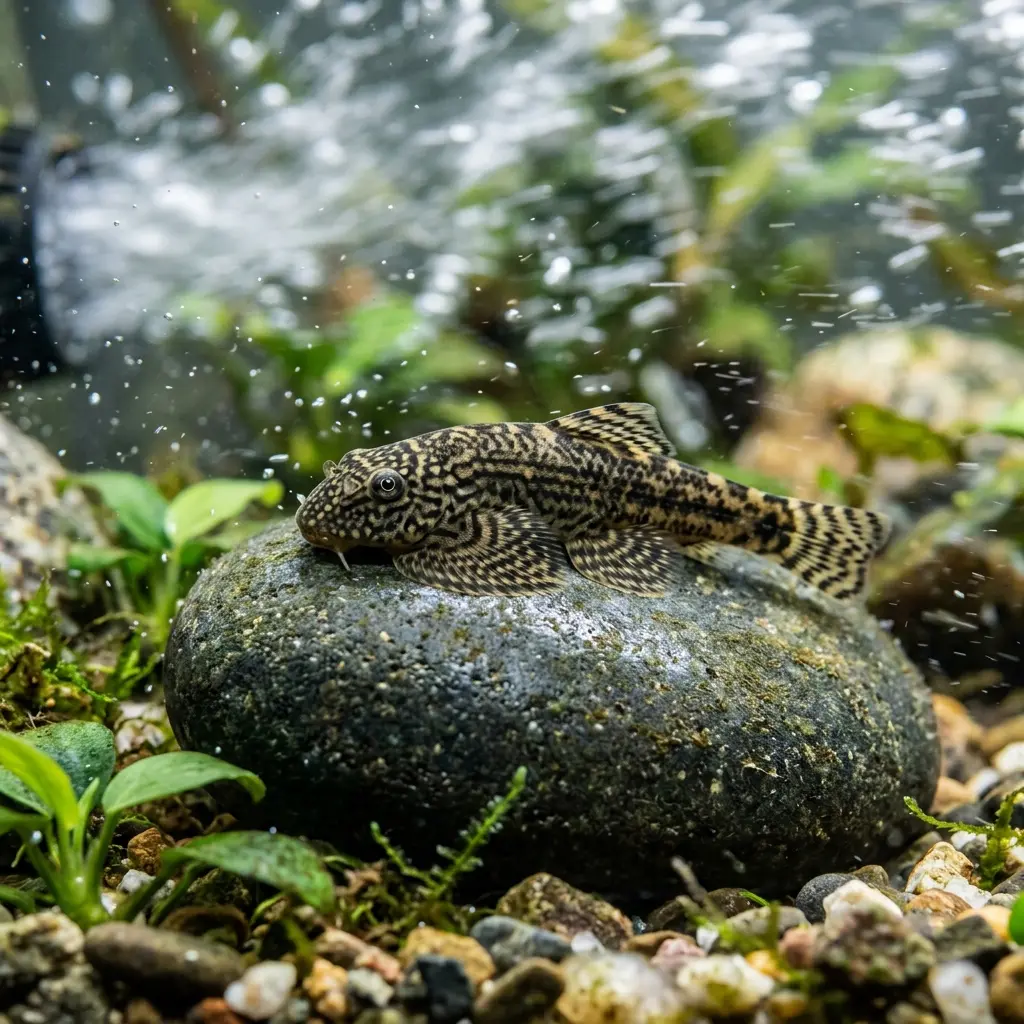
Hillstream Loach (Sewellia lineolata) is a captivating freshwater species native to fast-flowing streams in Vietnam. It requires a minimum 30-gallon (113-liter) aquarium with high water flow (15 to 20 times turnover), cool temperatures of 68 to 75 degrees F (20 to 24 degrees C), and pH 6.5 to 7.5. This peaceful, social bottom-dweller must be kept in groups of 3 to 6 or more and fed a diet primarily of algae, biofilm, and spirulina-based foods.
Quick Facts
| Scientific Name | Sewellia lineolata |
|---|---|
| Common Names | Hillstream Loach |
| Family | Balitoridae |
| Genus | Sewellia |
| Type | Freshwater |
| Temperament | peaceful |
| Care Difficulty | intermediate |
| Lifespan | 8 years |
| Maximum Size | Up to 2.5 in (6 cm) |
| Diet | Omnivore |
| Temperature | 68–75°F (20–24°C) |
| pH | 6.5–7.5 |
| Hardness | 5–12 dGH |
| Minimum Size | 30 gallons |
Key Takeaways
- Requires strong water flow (15 to 20 times turnover) and cool temperatures of 68 to 75 degrees F (20 to 24 degrees C).
- Must be kept in social groups of 3 to 6 or more to prevent stress and encourage natural grazing behavior.
- Primarily herbivorous; relies on algae and biofilm as staple foods. Overcleaning the tank causes starvation.
- Scaleless fish are extremely sensitive to copper, formalin, and aquarium salt. Use scaleless-safe medications only.
- Breeding is triggered by simulated monsoon conditions: cool water changes and increased flow.
Overview
Species Overview
The Hillstream Loach (Sewellia lineolata), also known as the Reticulated Hillstream Loach or Tiger Hillstream Loach, is one of the most visually striking and behaviorally fascinating bottom-dwelling fish in the freshwater aquarium trade. Native exclusively to the fast-flowing, highly oxygenated streams and rivers of Vietnam and Southeast Asia, this species has evolved a remarkable flattened, hydrodynamic body shape and a modified ventral sucker that allows it to cling to smooth rocks in torrential currents.
Natural Habitat
In the wild, Hillstream Loaches inhabit clear, cool mountain streams with substrate composed of smooth river stones, bedrock, and boulders. Water flow is constant and powerful, with dissolved oxygen levels near saturation. The seasonal monsoon cycle triggers breeding through temperature drops and increased flow volume. Replicating these conditions in captivity is non-negotiable for long-term health.
Why Keep Hillstream Loaches?
Aquarists prize this species for its unique disc-shaped body, intricate reticulated patterning, and active diurnal behavior. Unlike many loaches that hide during daylight hours, Hillstream Loaches are constantly visible, grazing across rocks and glass with deliberate, methodical movements. They are excellent algae consumers and add authentic biotope character to river-style aquascapes.
Conservation Status
The conservation status of Sewellia lineolata is currently Not Evaluated by the IUCN. However, habitat degradation from dam construction, deforestation, and pollution in Vietnamese watersheds poses a potential threat to wild populations. Always purchase captive-bred specimens when possible.
Diet
Diet and Nutrition
Hillstream Loaches are specialized herbivorous grazers with digestive systems adapted to process algae, biofilm, and aufwuchs. In captivity, their dietary needs are frequently misunderstood, leading to malnutrition and premature death.
Primary Diet Composition
In a properly established tank, 70 to 80 percent of their nutrition should come from naturally occurring algae and biofilm growing on rocks, glass, and plant leaves. This is not optional. If your tank walls are spotless, your Hillstream Loaches are starving.
Supplemental Foods
- Algae Wafers: High-quality sinking wafers should be offered daily. Place them directly on smooth rocks so the loaches can graze naturally.
- Spirulina Tablets: Provide 2 to 3 times weekly as a concentrated protein and vitamin source.
- Blanched Vegetables: Zucchini, cucumber, spinach, and kale (blanched for 30 seconds) should be available 3 to 4 times weekly. Remove uneaten portions after 12 hours.
- Protein Supplements: Offer frozen bloodworms, daphnia, or brine shrimp no more than once weekly. Excess protein causes bloat and digestive issues in this herbivore-adapted species.
Foods to Avoid
Never feed beef heart, mammalian meat, or fatty foods. These cause severe digestive blockages. Avoid flake foods that float; Hillstream Loaches rarely surface feed and floating flakes will be ignored, fouling the water.
Feeding Schedule
Feed supplemental foods in the evening when tank lights are still on but beginning to dim. This mimics their natural dusk grazing period. If biofilm is abundant, supplemental feeding can be reduced to every other day.
Common Dietary Mistakes
The most fatal mistake aquarists make is maintaining an overly sterile tank. Scrubbing all algae from rocks and glass eliminates their food source. If you must clean viewing glass, leave the back and side walls coated in algae. Second, do not rely solely on algae wafers in a new, uncycled tank; the fish will starve before sufficient biofilm establishes.
Health
Health and Disease Management
Hillstream Loaches are remarkably hardy when provided with cool, oxygen-rich, high-flow conditions. However, they are scaleless fish, making them extraordinarily sensitive to standard aquarium medications, salt, and temperature spikes. Preventative husbandry is vastly superior to treatment.
Scaleless Sensitivity
The absence of scales means their skin directly absorbs chemicals from the water. Copper, formalin, and high-dose malachite green are frequently lethal at standard therapeutic concentrations. Always verify medication compatibility before treatment.
Oxygen and Heat Stress
The most common cause of death is not disease but oxygen deprivation caused by high temperatures, inadequate surface agitation, or filter failure. At 78 degrees F (25.5 degrees C) or above, dissolved oxygen drops below survivable thresholds. Always have backup battery-powered air pumps.
Ich (White Spot Disease)
A protozoan parasite (Ichthyophthirius multifiliis) causing white salt-grain spots on fins and body.
- White cysts on skin and fins, flashing against rocks, rapid breathing, clamped fins.
Stress from temperature fluctuations, poor water quality, or introduction via unquarantined fish.
Quarantine all new fish for 4 weeks. Maintain stable parameters and avoid temperature swings.
Velvet (Gold Dust Disease)
A dinoflagellate parasite (Oodinium pilularis) causing a fine golden or rust-colored dust on the skin.
- Gold or rust-colored film on body, rapid gill movement, lethargy, refusal to eat, scratching against decor.
Stress, introduction via new livestock, poor water quality. The parasite is photosynthetic and thrives in lighted tanks.
Quarantine new fish. Darken the tank during treatment. Avoid copper-based medications with Hillstream Loaches.
Fin Rot
Bacterial erosion of fin tissue caused by Aeromonas or Pseudomonas species.
- Ragged, fraying fin edges with white or red margins. Tissue recedes from the fin edges toward the body.
Poor water quality, fin damage from sharp decor, aggression from tank mates, suppressed immune function.
Columnaris (Saddleback Disease)
A highly contagious bacterial infection caused by Flavobacterium columnare that spreads rapidly in warm water.
- White or gray patches on skin, saddle-shaped lesion behind the dorsal fin, frayed fins, lethargy, rapid breathing.
Stress, high temperatures (above 75 degrees F), poor water quality, and introduction via infected fish.
Keep temperatures at the lower end of their range (68 to 72 degrees F). Quarantine new fish. Maintain excellent water quality.
Patchy Disease (Hillstream Loach Specific)
A rapid-onset bacterial infection particularly deadly to sucker-bodied hillstream loaches, causing patchy color loss.
- Patchy color loss across the body, rapid breathing, lethargy. Death can occur within hours of symptom onset.
Introduction via unquarantined fish. The exact bacterial pathogen is unidentified but responds to broad-spectrum antibiotics.
Strict 4-week quarantine for all new livestock. Use antibiotic treatment with minocycline or erythromycin at reduced initial dosing.
Oxygen Deprivation and Heat Stress
Not a pathogen but a physiological crisis caused by environmental failure, often mistaken for disease.
- Gasping at the surface, hiding in corners, rapid gill movement, loss of suction ability, sudden death.
Temperatures exceeding 76 degrees F (24 degrees C), inadequate surface agitation, filter failure, power outages, overstocking.
Maintain temperatures between 68 and 72 degrees F. Use multiple powerheads and air stones. Install battery backup aeration.
Breeding
Breeding Hillstream Loaches
Breeding Hillstream Loaches in captivity is challenging but achievable with precise environmental manipulation. Success requires simulating the seasonal monsoon triggers that induce spawning in the wild.
Sexual Dimorphism
Mature males are noticeably slimmer and more streamlined than females. During breeding condition, males develop small white tubercles (breeding stars) on their heads and along the leading edges of the pectoral fins. Females become distinctly round-bodied when gravid, with a fuller abdomen.
Conditioning Period
Feed a group of 5 to 6 adults (ideally 2 males and 3 to 4 females) a varied diet of algae wafers, live brine shrimp, and blanched vegetables for 4 weeks prior to triggering. Ensure water parameters are pristine and flow is vigorous.
Spawning Trigger
The critical trigger is a simulated monsoon event:
- Perform a 40 to 50 percent water change using cool water at 64 degrees F (18 degrees C).
- Allow the tank temperature to drop by 3 to 5 degrees F (2 to 3 degrees C) over a 2-hour period.
- Simultaneously increase water flow by adding an additional powerhead or increasing canister filter output.
- Continue feeding heavily with live and frozen foods during this period.
Spawning Behavior
Spawning typically occurs within 24 to 48 hours of the trigger. The male courts the female with a twisting, vibrating display. The pair releases eggs and milt while intertwined over a flat, smooth rock. The female lays 20 to 50 large, adhesive eggs (approximately 2 mm in diameter) on the underside or top of the rock.
Egg Care
The male fertilizes the eggs and guards the site, fanning them with his pectoral fins to prevent fungal growth and ensure oxygenation. Incubation lasts 7 to 10 days at 70 degrees F (21 degrees C). Do not remove the eggs unless fungal infection is visible.
Fry Rearing
Upon hatching, fry measure approximately 0.2 inches (5 mm) and are fully formed. Remove the male after hatching to prevent accidental consumption of fry. The fry immediately begin grazing on biofilm and microscopic algae. Provide a grow-out tank with:
- Mature rocks heavily coated in green algae
- High water flow (10 to 15 times turnover)
- Cool temperatures of 70 to 72 degrees F (21 to 22 degrees C)
- Finely crushed algae wafers and spirulina powder as supplemental food
Fry grow slowly and reach 1 inch (2.5 cm) at approximately 3 to 4 months of age.
Compatible Tank Mates
Species Comparison
| Feature | Hillstream Loach | Bristlenose Pleco | Otocinclus Catfish | Siamese Algae Eater |
|---|---|---|---|---|
| Scientific Name | Sewellia lineolata | Ancistrus sp. | Otocinclus vittatus | Crossocheilus oblongus |
| Max Size | 2.5 in (6.4 cm) | 4 to 5 in (10 to 13 cm) | 2 in (5 cm) | 6 in (15 cm) |
| Temperament | Peaceful | Peaceful | Peaceful | Peaceful to Semi-Aggressive |
| Minimum Tank Size | 30 gal (113 L) for groups | 30 gal (113 L) | 20 gal (76 L) | 30 gal (113 L) |
| Primary Diet | Algae, Biofilm, Aufwuchs | Algae, Wood, Vegetables | Algae, Biofilm | Algae, Vegetables |
| pH Range | 6.5 to 7.5 | 6.5 to 7.5 | 6.0 to 7.5 | 6.5 to 7.5 |
| Flow Requirements | Very High (15 to 20x) | Low to Moderate | Low to Moderate | Moderate |
| Temperature | 68 to 75 degrees F (20 to 24 degrees C) | 72 to 79 degrees F (22 to 26 degrees C) | 72 to 79 degrees F (22 to 26 degrees C) | 75 to 79 degrees F (24 to 26 degrees C) |