
Neon Goby (Elacatinus oceanops)
Quick Answer
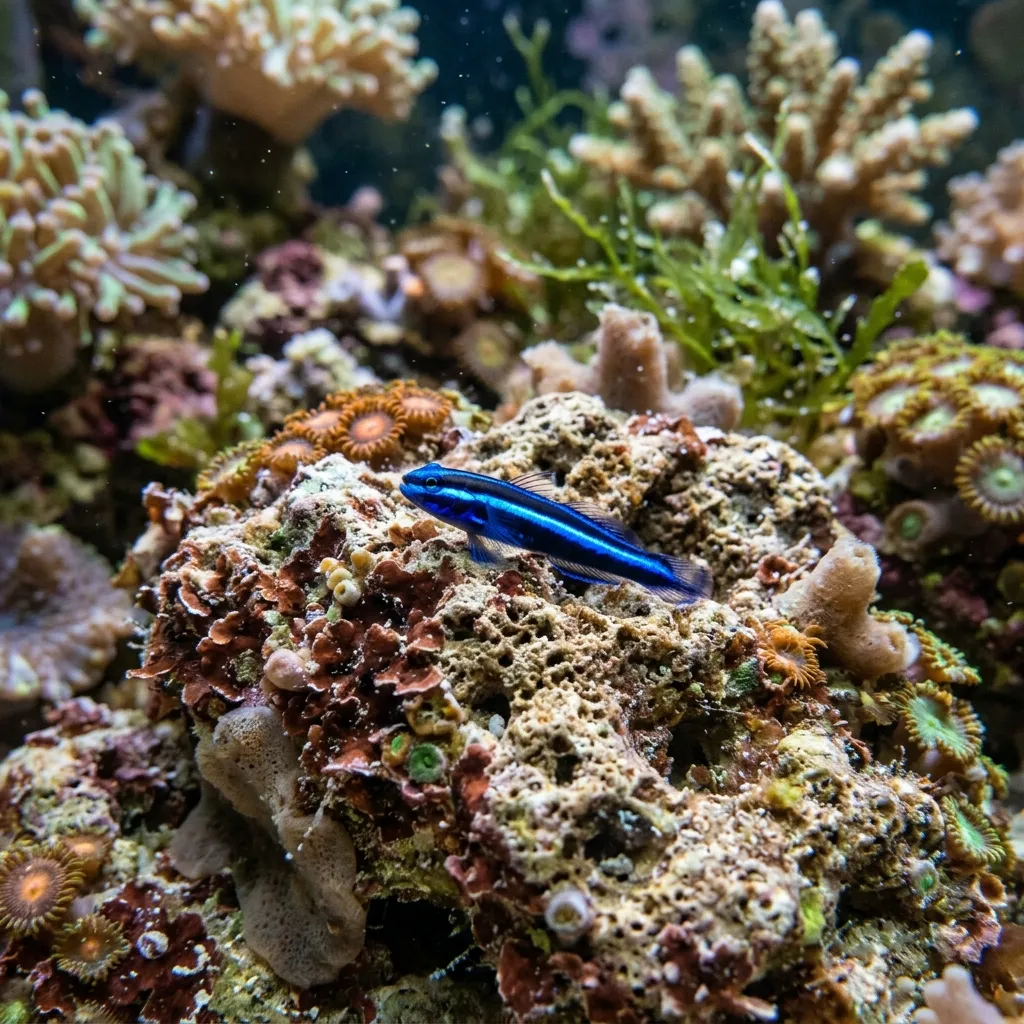
Neon Goby (Elacatinus oceanops) is a small, captive-bred cleaner goby native to the Western Atlantic and Gulf of Mexico. It reaches 2 inches (5 cm) and requires a minimum 10 gallon (38 L) reef aquarium with specific gravity 1.023-1.025, pH 8.1-8.4, and temperature 75-79°F (24-26°C). This carnivorous species establishes cleaning stations to remove parasites from larger fish and is completely reef-safe.
Quick Facts
| Scientific Name | Elacatinus oceanops |
|---|---|
| Common Names | Neon Goby |
| Family | Gobiidae |
| Genus | Elacatinus |
| Type | Saltwater |
| Temperament | peaceful |
| Care Difficulty | beginner |
| Lifespan | 2 years |
| Maximum Size | Up to 2 in (5 cm) |
| Diet | Carnivore |
| Temperature | 75–79°F (24–26°C) |
| pH | 8.1–8.4 |
| Hardness | 7–12 dGH |
| Minimum Size | 10 gallons |
Key Takeaways
- One of the first commercially aquacultured marine ornamental fish
- Requires 10 gallon (38 L) minimum tank; 20 gallons (75 L) for pairs
- Obligate carnivore requiring 55-60% protein diet
- Peaceful with other species but lethal to unpaired conspecifics
- Completely reef-safe with corals and invertebrates
- Prolific jumper requiring tight-fitting mesh lid
- Wild-caught lifespan ~12 months; captive-bred 18-24 months
- Native to Western Atlantic/Gulf of Mexico, NOT the Caribbean
Overview
Species Overview
The Neon Goby (Elacatinus oceanops) is one of the most iconic and historically significant marine ornamental fish in the aquarium hobby. First described by Jordan in 1904, this diminutive cleaner goby was among the very first marine tropical species to be successfully bred in captivity, with commercial aquaculture operations established as early as the 1970s.
Natural History and Distribution
Contrary to popular belief, E. oceanops is not a Caribbean species. Its natural distribution is restricted to the Western Central Atlantic, ranging from southern Georgia and Florida through the Gulf of Mexico to Belize. It is not found in the Bahamas or the broader Caribbean basin, where it is replaced by lookalike species such as Elacatinus lobeli (Caribbean Neon Goby). This restricted range makes aquaculture particularly important for conservation.
Adults inhabit coral heads, rocky substrate, and occasionally the outer surfaces of large sponges at depths of 1-40 meters (3-130 feet). They establish permanent cleaning stations where they remove ectoparasites, dead skin, and debris from the skin, fins, mouth, and gill chambers of larger client fish including groupers, snappers, and moray eels.
Morphology and Identification
The Neon Goby reaches a maximum total length of 2 inches (5.0 cm), though most aquarium specimens remain slightly smaller. Its body is elongated and scaleless, with a distinctive broad, iridescent electric blue stripe running from just before the eye to the base of the caudal fin. The body is otherwise dark blue-black. The mouth is inferior and well under the snout, adapted for picking parasites from host surfaces.
Key identifying features include:
- No markings on the snout (distinguishes it from Sharknose and Cleaning Gobies)
- No pale grey stripe above the blue lateral stripe (distinguishes it from E. lobeli)
- Pelvic fins fused into a complete disc for clinging to substrate
- Dorsal fin VII + I, 11-12 rays; anal fin I, 11-12 rays
There is no reliable external sexual dimorphism. Males and females are identical in coloration; only behavioral cues (territorial defense, nest cleaning) indicate sex.
Diet
Health
Health and Disease Management
Neon Gobies are generally hardy but possess a thin slime coat and reduced scale coverage that makes them vulnerable to specific pathogens. Proactive quarantine and parameter stability are non-negotiable for long-term health.
Brooklynella hostilis (Anemonefish Disease)
A ciliated protozoan that is the leading cause of mortality in wild-caught Neon Gobies. It attacks the skin and gills, causing rapid deterioration.
- Excessive mucus production giving a cloudy or sloughing skin appearance, rapid breathing, clamped fins, lethargy, loss of appetite, flashing against rocks
Direct contact with infected fish or contaminated water. Wild-caught specimens are frequently asymptomatic carriers. Stress from transport or poor water quality triggers outbreaks.
Cryptocaryon irritans (Marine Ich)
The marine equivalent of freshwater Ichthyophthirius multifiliis. Causes white salt-like spots on skin and fins. Can be fatal if untreated, especially in small fish like gobies.
- Small white nodules (0.5-1.0 mm) on skin and fins, flashing against substrate, respiratory distress, rubbing on rocks, secondary bacterial infections at lesion sites
Introduction via contaminated water, live rock, or infected tank mates. The parasite has a complex life cycle with a free-swimming theront stage that seeks hosts.
Quarantine all new livestock for 30 days minimum. Use UV sterilization (1 watt per 10 gallons) to kill free-swimming theronts. Avoid temperature fluctuations that suppress immune function. Copper treatment at 0.15 mg/L (reduced dose for gobies) for 21 days.
Amyloodinium ocellatum (Marine Velvet)
A dinoflagellate parasite that causes Marine Velvet Disease. Highly virulent and often fatal within 48-72 hours of symptom onset in small fish.
- Fine gold, rust, or velvety dusting on skin, lethargy, rapid gill movement, clamped fins, refusal to eat. Respiratory distress is often the first visible sign.
Introduction via infected fish, invertebrates, or live rock. The dinospore stage is motile and seeks fish hosts. Outbreaks are common in tanks with poor gas exchange.
Chloroquine phosphate (15 mg/L) is the treatment of choice and is safe for gobies. Maintain excellent water flow and surface agitation. Quarantine all new arrivals. Avoid hyposalinity; it is ineffective against velvet and stresses gobies.
Internal Parasites and Flagellates
Intestinal worms (nematodes, trematodes) and protozoan flagellates (Hexamita, Spironucleus) commonly affect wild-caught specimens.
- White stringy feces, weight loss despite normal appetite, sunken belly, lethargy, reduced coloration, sporadic appetite
Ingestion of infected prey items in the wild or contaminated live foods. Stress and poor diet exacerbate parasite loads.
Soak all food with API General Cure (Praziquantel + Metronidazole) for 10-14 days. Use Seachem Focus to bind medication to food. Quarantine wild-caught specimens and treat prophylactically. Feed high-quality prepared foods to reduce live food dependency.
Bacterial Septicemia and Fin Rot
Secondary bacterial infections caused by Vibrio, Aeromonas, or Pseudomonas species. Usually follows parasitic infestation, physical injury, or water quality degradation.
- Red patches or ulcers on skin, fin erosion with white margins, cloudy eyes, popeye, abnormal swimming, loss of appetite
Immunosuppression from stress, parasites, or ammonia/nitrite spikes. Physical abrasion from sharp rockwork or aggressive tank mates.
Maintain pristine water parameters with zero ammonia and nitrite. Use smooth-edged rockwork. Treat primary parasitic infections promptly. For active infections, use Kanamycin (5 mg/L) or Nitrofuracin Green bath (25 ppm for 30 minutes) followed by in-tank treatment.
Breeding
Captive Breeding Protocol
The Neon Goby is one of the most successfully aquacultured marine ornamental fish, with commercial breeding operations producing thousands of specimens annually. Home breeding is achievable with dedication to larval rearing protocols.
Compatible Tank Mates






Species Comparison
| Feature | Neon Goby (Elacatinus oceanops) | Sharknose Goby (Elacatinus evelynae) | Yellowline Goby (Elacatinus figaro) | Cleaner Wrasse (Labroides dimidiatus) |
|---|---|---|---|---|
| Maximum Size | 2 inches (5.1 cm) | 1.5 inches (3.8 cm) | 2 inches (5.1 cm) | 5.9 inches (15 cm) |
| Temperament | Peaceful; aggressive only to conspecifics | Peaceful; aggressive only to conspecifics | Peaceful; aggressive only to conspecifics | Peaceful; may harass sensitive fish |
| Minimum Tank Size | 10 gallons (38 L) single; 20 gallons (75 L) pair | 10 gallons (38 L) single; 20 gallons (75 L) pair | 10 gallons (38 L) single; 20 gallons (75 L) pair | 75 gallons (284 L) minimum |
| Diet | Carnivore: parasites, mysis, cyclops, pellets | Carnivore: parasites, mysis, cyclops, pellets | Carnivore: parasites, mysis, cyclops, pellets | Carnivore: parasites, mucus, scales |
| Reef Safety | 100% reef-safe; does not bother corals or inverts | 100% reef-safe; does not bother corals or inverts | 100% reef-safe; does not bother corals or inverts | Reef-safe but may stress sensitive fish |
| Lifespan (Captive) | 18-24 months (captive-bred) | 18-24 months (captive-bred) | 18-24 months (captive-bred) | 4-6 years |
| Availability | Common; widely aquacultured | Common; widely aquacultured | Moderate; aquacultured | Common; mostly wild-caught |