
Yellow Watchman Goby (Cryptocentrus cinctus)
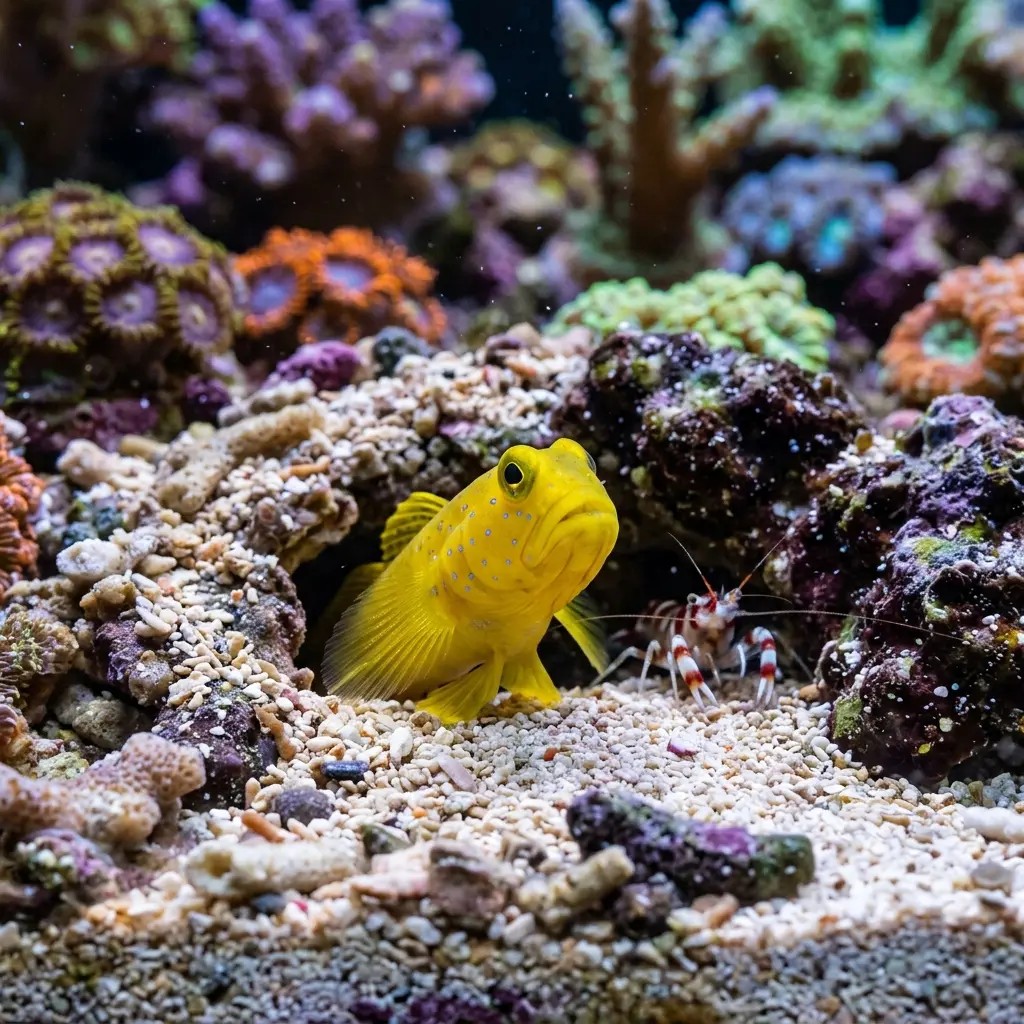
Quick Answer
Yellow Watchman Goby (Cryptocentrus cinctus) is a hardy, reef-safe marine bottom-dweller famous for its symbiotic partnership with pistol shrimp. It requires a 20 gallon (75.7 liter) minimum tank with 3 to 4 inches (7.5 to 10 cm) of mixed sand-rubble substrate and stable salinity maintained with an ATO system.
Quick Facts
| Scientific Name | Cryptocentrus cinctus |
|---|---|
| Common Names | Yellow Watchman Goby |
| Family | Gobiidae |
| Genus | Cryptocentrus |
| Type | Saltwater |
| Temperament | peaceful |
| Care Difficulty | beginner |
| Lifespan | 5 years |
| Maximum Size | Up to 3 in (8 cm) |
| Diet | Carnivore |
| Temperature | 74–80°F (23–27°C) |
| pH | 8.1–8.4 |
| Hardness | 7–12 dGH |
| Minimum Size | 20 gallons |
Key Takeaways
- Famous for mutualistic pistol shrimp symbiosis where the goby acts as sentinel and the shrimp excavates the burrow.
- Requires 3 to 4 inches (7.5 to 10 cm) of mixed aragonite sand and coral rubble for burrow construction.
- Fully reef-safe with corals, clams, and ornamental invertebrates.
- Prolific jumper requiring a glass or acrylic canopy with no gaps exceeding 0.25 inches (6 mm).
- Beginner-friendly but acutely sensitive to salinity fluctuations; an ATO system is mandatory.
- Wild-caught specimens require 4 to 6 week quarantine with chloroquine phosphate prophylaxis.
Overview
The Yellow Watchman Goby (Cryptocentrus cinctus) is one of the most captivating and personality-rich marine aquarium fish available to hobbyists. Despite its small adult size of approximately 3 inches (7.6 cm), this species delivers outsized behavioral complexity through its famous symbiotic relationship with pistol shrimp, its constant vigilance at the burrow entrance, and its striking lemon-yellow coloration punctuated by electric blue spots along the anterior body.
Native to the shallow coastal reefs and protected lagoons of the Indo-Pacific, from Singapore and Indonesia through the Philippines to Micronesia and the Solomon Islands, the Yellow Watchman Goby has adapted to life in mixed sand-and-rubble substrates where it forms burrows with pistol shrimp of the genus Alpheus. In captivity, this species is exceptionally hardy, reef-safe, and suitable for beginners, yet it offers the kind of fascinating natural behavior typically associated with advanced marine species.
Also known as the Yellow Shrimp Goby, Banded Prawn Goby, Gold Shrimp Goby, and Bluespotted Watchman Goby, this species belongs to the family Gobiidae, the largest family of marine fishes with over 2,000 described species. It is frequently confused with the Pinkspotted Shrimp Goby (Cryptocentrus leptocephalus) and Randall's Shrimp Goby (Amblyeleotris randalli), though the Yellow Watchman is distinguished by its uniform yellow base color, anterior blue spotting, and more robust head profile.
Appearance
Appearance and Identification
Yellow Watchman Gobies possess a robust, somewhat elongated body typical of the Gobiidae family, with a maximum standard length of 3 inches (7.6 cm) in well-maintained aquariums. Their body is laterally compressed with a disproportionately large head and mouth relative to body size, an adaptation for their bottom-dwelling, ambush-predator lifestyle.
Key Identification Markings
- Base body color of bright lemon-yellow to golden-yellow, uniform across the body except for the dorsal surface
- Small, iridescent blue spots concentrated on the anterior half of the body, particularly on the cheeks and operculum
- Dorsal fin with a thin black margin and translucent membrane
- Caudal fin rounded with a subtle yellow-to-clear gradient
- Pelvic fins fused into a suction-cup-like disc used for anchoring to substrate and rock surfaces
- Eyes positioned high on the head, providing nearly 360-degree upward and lateral vision while the fish remains at the burrow entrance
Long-Finned Variant
No naturally occurring long-finned variant exists. Any specimens with elongated finnage are likely the result of individual genetic variation or misidentification with other shrimp goby species such as Cryptocentrus leptocephalus, which naturally displays more elaborate finnage.
Natural Habitat
Natural Habitat and Ecology
In the wild, Yellow Watchman Gobies inhabit shallow coastal environments characterized by mixed substrates of coarse coral sand, coral rubble, and fragmented shell beds. They are found at depths ranging from 3 to 75 feet (1 to 23 meters), with highest population densities in protected lagoons and back-reef areas where wave energy is minimal.
Substrate Preferences
Wild populations require substrate with sufficient particle size variation to allow burrow construction. Pure fine sand collapses under excavation; pure rubble lacks cohesion. The ideal wild substrate is 60 percent coarse sand (1 to 3 mm grain size) mixed with 40 percent coral rubble and shell fragments up to 1 inch (2.5 cm) in diameter. This mixture provides structural integrity for burrow walls while allowing the pistol shrimp to excavate effectively.
Symbiotic Partnership
The defining ecological relationship of this species is its mutualism with pistol shrimp. The shrimp, typically Alpheus randalli or closely related species, is nearly blind and relies entirely on the goby for predator detection. The goby maintains constant physical contact with the shrimp via its antennae while both remain at the burrow entrance. When danger approaches, the goby flicks its tail, signaling the shrimp to retreat into the burrow. The shrimp snaps its massive claw in response, creating a defensive shockwave. This partnership reduces predation risk for both species by approximately 70 percent compared to solitary individuals.
Water Chemistry in the Wild
Wild populations experience stable marine parameters with minimal daily fluctuation. Typical conditions include temperatures of 76F to 82F (24.4C to 27.8C), pH of 8.1 to 8.3, and salinity of 1.024 to 1.026. Nutrient levels are extremely low due to oligotrophic reef waters, with nitrates below 1 ppm and phosphates below 0.01 ppm in pristine habitats.
Care
Water Parameters
Water Parameter Management
Yellow Watchman Gobies are adaptable within their preferred marine range but acutely sensitive to salinity fluctuations. Stability is more important than achieving exact wild-type chemistry. Captive specimens tolerate standard reef parameters well.
Critical Parameter Ranges
- Temperature: 74F to 80F (23.3C to 26.7C). Avoid sustained temperatures above 82F (27.8C) as this accelerates metabolism and reduces lifespan.
- pH: 8.1 to 8.4. Marine buffers should maintain this range without manual adjustment.
- Salinity: 1.023 to 1.025 specific gravity (35 to 35.5 ppt). Use a refractometer for daily monitoring. Fluctuations exceeding 0.002 per day cause osmotic stress.
- General Hardness (GH): 7 to 12 dGH.
- Carbonate Hardness (KH): 8 to 12 dKH.
- Calcium: 400 to 450 ppm. Critical for pistol shrimp exoskeleton formation.
- Magnesium: 1250 to 1350 ppm. Maintains calcium and alkalinity stability.
- Alkalinity: 8 to 12 dKH.
- Nitrates: Below 10 ppm.
- Phosphates: Below 0.03 ppm.
Salinity Stability
Salinity is the most critical parameter for this species. Evaporation causes salinity to rise dangerously. Use an automatic top-off (ATO) system with freshwater (RO/DI) to maintain constant water level and salinity. Without an ATO, daily manual top-off is mandatory. Never allow salinity to drop below 1.020 or rise above 1.027.
Diet
Yellow Watchman Gobies are carnivorous ambush predators with a high protein requirement. In nature, they consume small crustaceans, polychaete worms, fish larvae, and planktonic organisms captured at the burrow entrance. In captivity, they require a varied meat-based diet with precise nutritional composition to maintain immune function, coloration, and symbiotic behavior.
Health
Yellow Watchman Gobies are physically hardy and resistant to many common marine pathogens when maintained in stable, clean water. However, their sensitivity to salinity fluctuations, specific medication intolerances, and susceptibility to stress-related outbreaks require proactive health management. Wild-caught specimens may carry internal parasites that manifest months after purchase.
Marine Ich (Cryptocaryon irritans)
The most common parasitic infection in Yellow Watchman Gobies, caused by the ciliated protozoan Cryptocaryon irritans. More persistent and treatment-resistant than freshwater ich.
- Small white cysts resembling grains of salt on fins, body, and gills; rubbing against substrate and rock (flashing); rapid opercular movement; lethargy; refusal to eat; cloudy eyes in advanced stages.
Introduced via infected fish, live foods, or contaminated equipment; triggered by temperature drops, salinity fluctuations, or stress from poor water quality. The parasite has a complex life cycle with a cyst stage that is highly resistant to medication.
Quarantine all new additions for 4 to 6 weeks; maintain stable salinity and temperature; use a UV sterilizer rated for the tank volume; avoid introducing wild-collected live foods without quarantine.
Marine Velvet (Amyloodinium ocellatum)
A dinoflagellate parasite that is significantly more dangerous than marine ich due to rapid gill damage and high mortality rates. Often fatal within 48 hours of symptom onset.
- Fine gold, rust, or velvety dust on the body and fins; rapid breathing; clamped fins; flashing against substrate; lethargy; refusal to eat; death within 24 to 48 hours in severe cases.
Introduced via infected fish or live foods; triggered by stress, temperature fluctuations, and poor water quality. The dinoflagellate feeds on gill tissue, causing rapid respiratory failure.
Strict quarantine of 4 to 6 weeks for all new fish; maintain pristine water quality; use a UV sterilizer; avoid temperature swings exceeding 2F (1C) per day.
Bacterial Fin and Tail Rot
A bacterial infection typically affecting fish with pre-existing fin damage from rock abrasion or conspecific aggression.
- Frayed or receding fin edges with white, red, or black discoloration at the margins; inflammation at the fin base; potential progression to body rot if untreated.
Primary pathogens include Vibrio species, Aeromonas, and Pseudomonas. Exacerbated by elevated nitrates, fin abrasion from sharp rock edges, and organic waste accumulation in the burrow.
Maintain nitrates below 10 ppm; ensure all rock edges are smooth or covered in coraline algae; perform weekly water changes; avoid sharp substrate particles near the burrow entrance.
Internal Parasites (Tapeworms and Nematodes)
Common in wild-caught specimens, these parasites may remain asymptomatic for months before causing visible illness. A leading cause of unexplained mortality in newly acquired gobies.
- Stringy white feces; weight loss despite normal feeding; bloated abdomen; lethargy; faded coloration; refusal to eat in advanced stages.
Ingestion of parasitic larvae from infected live foods, particularly wild-collected polychaetes and crustaceans. Some parasites are transmitted through eggs in the water column.
Quarantine all wild-caught gobies for 6 weeks minimum; feed only cultured or frozen foods from reputable sources; treat prophylactically with Praziquantel during quarantine.
Lateral Line Erosion (HLLE)
Head and Lateral Line Erosion is a degenerative condition affecting the sensory canals of the head and flanks. Common in gobies kept in suboptimal water conditions or fed poor-quality diets.
- Pitting and erosion of the head, cheeks, and lateral line; visible pinhole lesions that deepen over time; faded coloration; lethargy.
Poor water quality (elevated nitrates and phosphates), nutritional deficiencies (lack of marine-derived vitamins A and D), carbon dosing side effects, and stray electrical current (grounding issues).
Maintain nitrates below 10 ppm and phosphates below 0.03 ppm; feed vitamin-enriched foods; use a grounding probe to eliminate stray voltage; avoid excessive carbon dosing.
Breeding
Breeding Yellow Watchman Gobies in captivity is extremely rare and not recommended for home aquarists. The species has a pelagic larval stage lasting 30 to 40 days, requiring specialized rearing systems with live phytoplankton, rotifers, and copepods. Commercial breeding has not been achieved at scale, and the aquarium trade relies entirely on wild-caught specimens.
Tips
Common Mistakes to Avoid
Mistake 1: Inadequate Substrate Depth
Providing 1 to 2 inches (2.5 to 5 cm) of fine sand is the single most common error. This depth is insufficient for burrow construction. The goby will become stressed, lose color, and refuse food. The absolute minimum substrate depth is 3 inches (7.5 cm) of mixed sand and rubble.
Mistake 2: Stacking Rocks on Substrate
Placing live rock directly on top of 3 inches of sand creates a death trap. The goby and shrimp will burrow under the rock, destabilizing it. When the rock shifts or collapses, it crushes the goby. Always place rock on the bare bottom glass, then add substrate around it.
Mistake 3: No Aquarium Lid
Yellow Watchman Gobies are prolific jumpers capable of clearing standard tank rims. A single jump onto a dry surface is fatal due to rapid desiccation. A glass or acrylic canopy is not optional; it is a life-support requirement.
Mistake 4: Housing with Aggressive Feeders
Tanks dominated by chromis, anthias, or damselfish will starve a Yellow Watchman Goby. These fast fish consume all food before it reaches the bottom. The goby's slow, deliberate feeding style cannot compete. Target-feeding is mandatory but may fail if the goby is intimidated by the aggressive surface swarm.
Expert Tips for Advanced Keepers
Symbiosis Enhancement
To maximize the likelihood of successful goby-shrimp pairing, introduce the pistol shrimp first and allow it to establish a burrow for 3 to 5 days before adding the goby. The shrimp's established scent trail and burrow pheromones attract the goby more effectively than an empty tank. Use Alpheus randalli specifically, as this species has the highest documented pairing success with Cryptocentrus cinctus.
Color Maximization
To achieve the brightest yellow coloration, maintain phosphates below 0.02 ppm and feed foods rich in astaxanthin and canthaxanthin, such as mysis shrimp and krill. Elevated phosphates cause algae overgrowth on the goby's skin and faded coloration. Add a small amount of phytoplankton to the display tank twice weekly to provide natural micronutrients that enhance coloration.
Feeding Target Accuracy
Develop a feeding routine where you tap the glass gently at the same spot before each feeding. Within 2 weeks, the goby will associate the tap with food and emerge from the burrow in anticipation. This conditioned response allows precise target-feeding and ensures the goby receives adequate nutrition even in tanks with fast surface feeders.
Burrow Monitoring
Place a small mirror or camera near the burrow entrance to observe nocturnal shrimp activity without disturbing the tank. This allows you to monitor burrow health, shrimp behavior, and potential burrow collapse before it becomes fatal to the goby.
Compatible Tank Mates






Species Comparison
| Feature | Yellow Watchman Goby | Pinkspotted Shrimp Goby | Randall's Shrimp Goby | Yellow Clown Goby |
|---|---|---|---|---|
| Scientific Name | Cryptocentrus cinctus | Cryptocentrus leptocephalus | Amblyeleotris randalli | Gobiodon okinawae |
| Adult Size | 3 inches (7.6 cm) | 3 inches (7.6 cm) | 3.5 inches (8.9 cm) | 1.5 inches (3.8 cm) |
| Temperament | Peaceful; territorial toward conspecifics | Peaceful; more reclusive | Peaceful; very shy | Peaceful; completely non-aggressive |
| Minimum Tank Size | 20 gallons (75.7 L) solo; 30 gallons (113.6 L) with shrimp | 20 gallons (75.7 L) solo; 30 gallons (113.6 L) with shrimp | 30 gallons (113.6 L) minimum | 10 gallons (37.9 L) minimum |
| Pistol Shrimp Symbiosis | Strong; pairs readily with Alpheus randalli | Moderate; less pronounced sentinel behavior | Strong; requires specific Alpheus species | None; does not form shrimp partnerships |
| Diet Type | Carnivore; 55% protein, 15% fat | Carnivore; similar requirements | Carnivore; prefers smaller prey | Carnivore; feeds on coral mucus and small prey |
| pH Range | 8.1 to 8.4 | 8.1 to 8.4 | 8.0 to 8.3 | 8.1 to 8.4 |
| Temperature Range | 74F to 80F (23.3C to 26.7C) | 75F to 80F (23.9C to 26.7C) | 75F to 79F (23.9C to 26.1C) | 75F to 82F (23.9C to 27.8C) |
| Reef Safety | Fully reef-safe; no coral nipping | Fully reef-safe | Fully reef-safe | Reef-safe but may nip SPS polyps |
| Best For | Beginners; symbiosis displays; reef tanks | Intermediate; planted reef displays | Advanced; dedicated species tanks | Beginners; nano reefs; SPS tanks |