
Bolivian Ram (Mikrogeophagus altispinosus)
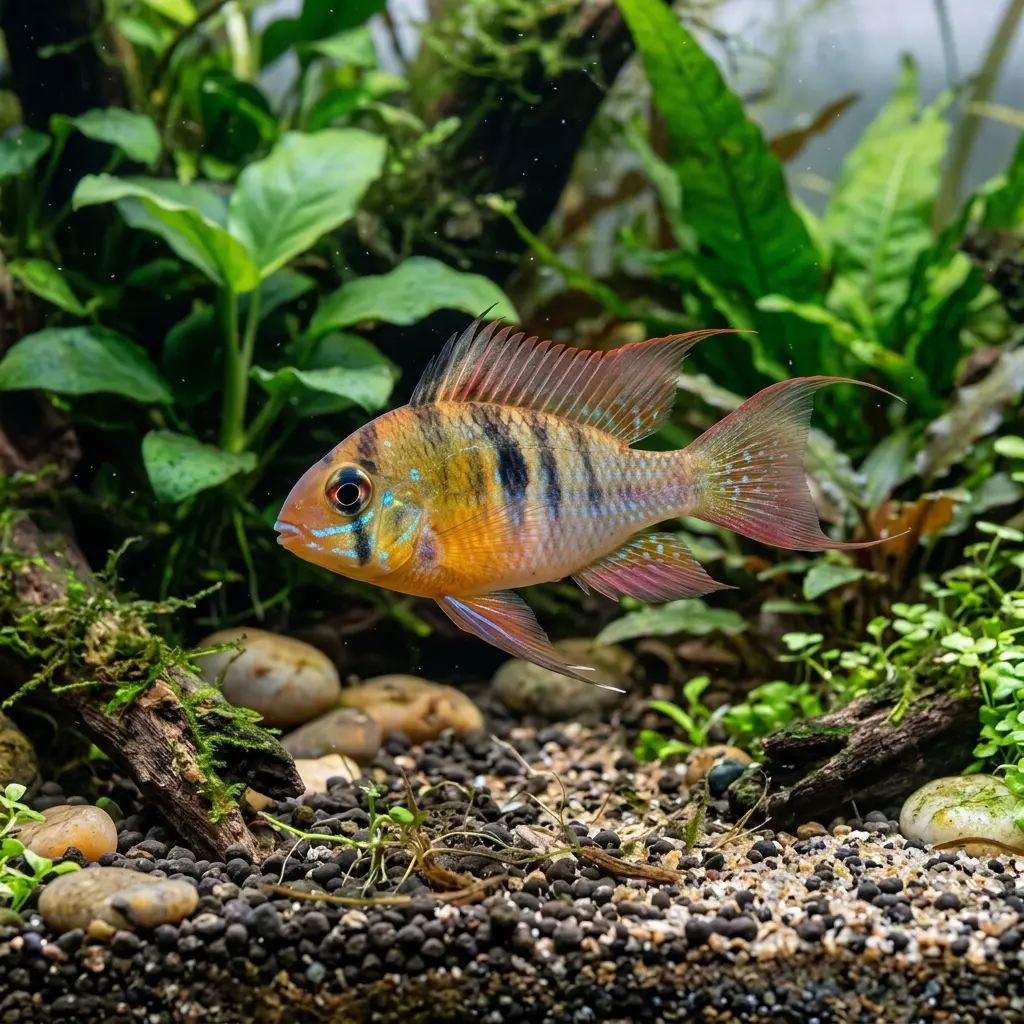
Quick Answer
The Bolivian Ram (Mikrogeophagus altispinosus) is a hardy, peaceful South American dwarf cichlid reaching 3 inches (8 cm). It requires a minimum 20-gallon aquarium with sand substrate, pH 6.5 to 7.5, temperature 74 to 80 degrees Fahrenheit (23 to 27 degrees Celsius), and compatible peaceful community fish. This omnivorous bottom-dweller thrives in planted tanks with moderate water flow.
Quick Facts
| Scientific Name | Mikrogeophagus altispinosus |
|---|---|
| Common Names | Bolivian Ram |
| Family | Cichlidae |
| Genus | Mikrogeophagus |
| Type | Freshwater |
| Temperament | peaceful |
| Care Difficulty | beginner |
| Lifespan | 6 years |
| Maximum Size | Up to 3 in (8 cm) |
| Diet | Omnivore |
| Temperature | 72–80°F (22–27°C) |
| pH | 6–7.5 |
| Hardness | 4–12 dGH |
| Minimum Size | 20 gallons |
Key Takeaways
- Requires sand substrate 1 to 2 inches deep for natural sifting behavior.
- Peaceful temperament suitable for community tanks with tetras, rasboras, and Corydoras.
- Tolerates wider water parameter range than German Blue Rams.
- Breeds readily in captivity with biparental care of eggs and fry.
- Maintain nitrates below 15 ppm to prevent hole-in-the-head disease.
Overview
Species Overview
The Bolivian Ram (Mikrogeophagus altispinosus) is a captivating South American dwarf cichlid that has earned its reputation as one of the most forgiving and visually striking members of the Cichlidae family. Unlike its more delicate cousin, the German Blue Ram, the Bolivian Ram thrives in standard community tank temperatures and tolerates a wider range of water chemistries, making it the superior choice for aquarists who demand both beauty and resilience.
Natural History and Distribution
This species is endemic to the slow-moving tributaries, floodplain lakes, and oxbow pools of the Rio Mamore and middle to lower Rio Guapore basins in Bolivia and Brazil. Wild collection accounts describe habitats with smooth sand or clay substrates, minimal aquatic vegetation, dense shoreline growth, and overhead canopy cover. Water temperatures in native habitats range from 75 to 81 degrees Fahrenheit (24 to 27 degrees Celsius), with pH values between 6.5 and 7.6 and general hardness as low as 4 dGH.
Physical Characteristics
Adult males reach 3 inches (8 cm) in total length, while females typically mature at 2 to 2.4 inches (5 to 6 cm). Sexual dimorphism is subtle but reliable: males possess elongated dorsal and caudal fin rays, more intense red and orange fin margins, and a more pronounced nuchal hump. Females display a rounder abdomen, particularly when gravid, and exhibit a slightly duller base coloration with less elaborate fin extensions. Both sexes display a characteristic dark lateral blotch and iridescent blue spangling across the face and operculum.
Diet
Dietary Requirements and Feeding Protocol
Bolivian Rams are omnivorous substrate sifters with specific macronutrient requirements. A haphazard feeding regimen leads to stunted growth, faded coloration, and increased disease susceptibility.
Health
Health Management and Disease Protocol
Bolivian Rams are hardy but not indestructible. Their small size and specialized gill structure make them susceptible to specific parasitic and bacterial pathogens. Proactive health management is vastly superior to reactive treatment.
Hexamitiasis (Hole-in-the-Head Disease)
An internal protozoan infection caused by Spironucleus (formerly Hexamita) that manifests as pitting lesions on the head and lateral line.
- Small pits or erosions along the head and lateral line, stringy white feces, loss of appetite, weight loss despite normal feeding, and lethargy.
Chronic poor water quality (nitrates above 20 ppm), nutritional deficiency especially lack of vitamin C and spirulina, stress from incompatible tank mates, and introduction via unquarantined live foods.
Maintain nitrates below 15 ppm through weekly 25% water changes. Feed vitamin-enriched, spirulina-supplemented foods. Quarantine all new livestock for 21 days. Treat promptly with metronidazole at 5 mg/L administered in food for 7 days; water-column dosing is ineffective against internal infections.
Ichthyophthirius multifiliis (Ich / White Spot Disease)
A ciliated protozoan parasite that infects the skin and gills, producing characteristic white cysts.
- White salt-like granules on fins, body, and gills; flashing against decor; rapid breathing; clamped fins; and isolation from the group.
Introduction via unquarantined fish, plants, or decor; temperature fluctuations below 72 degrees Fahrenheit (22 degrees Celsius) that compromise immune function; and stress from poor water quality.
Quarantine all additions for 21 days. Maintain stable temperature between 74 and 80 degrees Fahrenheit (23 and 27 degrees Celsius). Use formalin-malachite green combination treatments such as Ich-X at standard dose; Bolivian Rams tolerate this well. Increase temperature to 80 degrees Fahrenheit (27 degrees Celsius) to accelerate the parasite life cycle during treatment.
Piscinoodinium (Velvet Disease)
A dinoflagellate parasite that produces a golden, dust-like coating on the skin and gills. Often more lethal than Ich due to rapid gill invasion.
- Golden or rust-colored metallic dust on the body, excessive mucus production, clamped fins, lethargy, and respiratory distress at the water surface.
Introduction via unquarantined stock, poor lighting management, and stress. The parasite is photosynthetic and thrives under bright, constant illumination.
Quarantine rigorously. Dim lighting during outbreaks to reduce parasite photosynthesis. Treat with copper-based medications at 0.15 mg/L or formalin-malachite green at half dose with increased aeration. Remove activated carbon during all treatments.
Gill Flukes (Dactylogyrus)
Monogenean trematode worms that attach to gill filaments, causing respiratory compromise and secondary bacterial infection.
- Rapid breathing, gasping at the surface, flashing against substrate, pale gills, and reduced feeding response.
Introduction via unquarantined fish, overcrowding, and poor water circulation that allows fluke larvae to concentrate in dead zones.
Maintain strong surface agitation and avoid overcrowding. Treat with praziquantel at 2.5 mg/L for 3 days, followed by a 25% water change. Repeat in 7 days to catch emerging larvae. Praziquantel is safe for Bolivian Rams at labeled dosages.
Bacterial Fin Rot and Septicemia
Secondary bacterial infections typically caused by Aeromonas or Pseudomonas species following physical damage, parasite infestation, or water quality decline.
- Frayed or receding fin margins, red streaks at the fin base, ulcerative lesions on the body, bloating, and popeye (exophthalmia).
Maintain pristine water parameters with zero ammonia and nitrite. Treat underlying parasites before addressing secondary bacteria. Use broad-spectrum antibiotics such as kanamycin or nitrofurazone in a quarantine tank. Never treat the display tank with antibiotics, as this crashes biological filtration.
Breeding
Breeding Bolivian Rams in Captivity
Breeding Bolivian Rams is moderately challenging and deeply rewarding. Success depends on obtaining a compatible pair, providing the correct environmental triggers, and managing the brood through free-swimming stage.
Compatible Tank Mates






Species Comparison
| Feature | Bolivian Ram | German Blue Ram | Electric Blue Ram | Apistogramma cacatuoides |
|---|---|---|---|---|
| Scientific Name | Mikrogeophagus altispinosus | Mikrogeophagus ramirezi | Mikrogeophagus ramirezi (line-bred) | Apistogramma cacatuoides |
| Max Size | 3 in (8 cm) | 2 in (5 cm) | 2 in (5 cm) | 3 in (8 cm) |
| Temperament | Peaceful; minimal spawning aggression | Peaceful; moderate spawning aggression | Peaceful; moderate spawning aggression | Peaceful; highly territorial when breeding |
| Minimum Tank Size | 20 gal (76 L) for pair | 20 gal (76 L) for pair | 20 gal (76 L) for pair | 20 gal (76 L) for harem |
| Temperature Range | 74-80 F (23-27 C) | 82-86 F (28-30 C) | 82-86 F (28-30 C) | 72-82 F (22-28 C) |
| pH Range | 6.5 - 7.5 (tolerant) | 5.5 - 6.5 (strict) | 5.5 - 6.5 (strict) | 6.0 - 7.0 |
| Water Hardness | 4-12 dGH (adaptable) | 1-6 dGH (soft water required) | 1-6 dGH (soft water required) | 2-12 dGH |
| Diet | Omnivore; substrate sifter | Omnivore; mid-water feeder | Omnivore; mid-water feeder | Carnivore/insectivore |
| Care Difficulty | Beginner to Intermediate | Intermediate to Advanced | Intermediate to Advanced | Intermediate |