
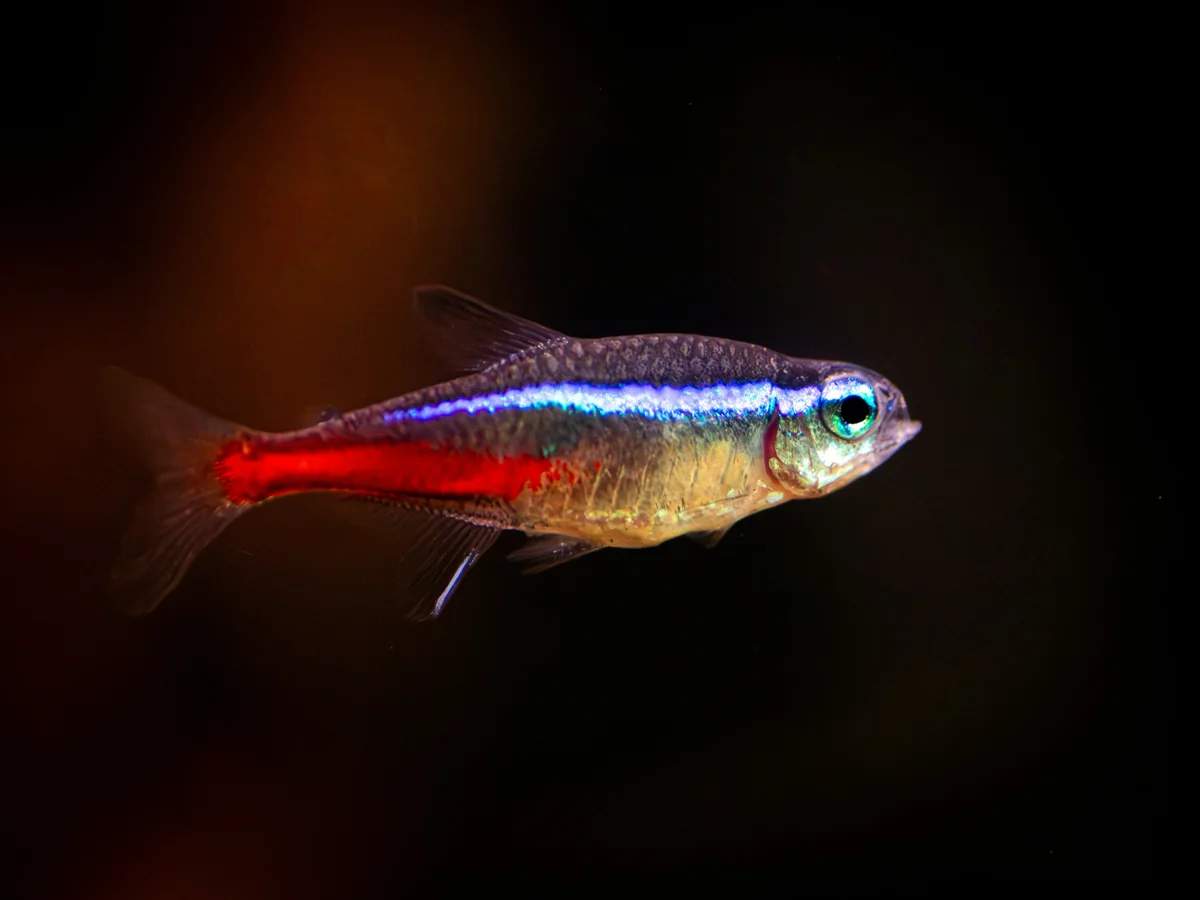
Cardinal Tetra (Paracheirodon axelrodi)
Quick Answer
Cardinal Tetra (Paracheirodon axelrodi) is a stunning freshwater schooling fish from the Rio Negro and Orinoco basins. It requires soft, acidic water (pH 4.0-6.5), temperatures of 73-82°F (23-28°C), and a minimum 20-gallon tank for a school of 10+. This peaceful omnivore is ideal for planted community aquariums.
Quick Facts
| Scientific Name | Paracheirodon axelrodi |
|---|---|
| Common Names | Cardinal Tetra |
| Type | Freshwater |
| Temperament | peaceful |
| Care Difficulty | beginner |
| Lifespan | 5 years |
| Maximum Size | Up to 1.2 in (3 cm) |
| Diet | Omnivore |
| Temperature | 73–82°F (23–28°C) |
| pH | 4–6.5 |
| Hardness | 2–6 dGH |
| Minimum Size | 20 gallons |
Key Takeaways
- Requires soft, acidic blackwater conditions (pH 4.0-6.5)
- Schooling fish needing groups of 10-20+ for natural behavior
- Red stripe extends full body length unlike Neon Tetras
- Sensitive to water parameter fluctuations; acclimate slowly
- Omnivore accepting micro-pellets, flakes, and frozen foods
Health
Neon Tetra Disease (Pleistophora hyphessobryconis)
A microsporidian parasite infection that is particularly devastating to Cardinal Tetras and other small characins.
- Pale or white patches on the body, loss of color, lethargy, difficulty swimming, spinal curvature, emaciation.
Infection by the microsporidian parasite Pleistophora hyphessobryconis, often introduced via infected fish or live foods.
Quarantine all new fish for 2-4 weeks, purchase from reputable sources, avoid feeding wild-caught live foods, maintain excellent water quality.
Ich (Ichthyophthirius multifiliis)
A common protozoan parasite causing white spot disease.
- Small white spots resembling grains of salt on the body and fins, flashing against decor, rapid breathing, lethargy.
Stress, poor water quality, sudden temperature drops, or introduction via new fish or plants.
Quarantine new additions, maintain stable water parameters and temperature, avoid overcrowding.
Fin Rot
Bacterial infection affecting the fins, often secondary to poor water quality or injury.
- Frayed, ragged, or receding fins, redness at the fin base, lethargy.
Bacterial pathogens (Aeromonas, Pseudomonas, Flexibacter) typically following poor water quality, overcrowding, or fin-nipping aggression.
Maintain excellent water quality, avoid overcrowding, remove aggressive tank mates, perform regular water changes.
Breeding
Breeding Cardinal Tetras in captivity is possible but challenging. They are egg-scattering, non-guarding spawners with no parental care. Sexual maturity is reached at approximately 9 months. To breed successfully, set up a dedicated 10-gallon (38-liter) breeding tank with very soft, acidic water: pH 5.5-6.0, general hardness 1-3 dGH, and temperature around 75°F (24°C). Use a spawning mop or fine-leaved plants (e.g., java moss) as a spawning medium. Condition a group of 6-10 mature fish with live foods such as baby brine shrimp and blackworms for 2-4 weeks. Spawning typically occurs at twilight or in dim light. The male embraces the female while swimming, and the female scatters approximately 500 adhesive, light-sensitive eggs. Remove the parents immediately after spawning, as they will eat the eggs. Eggs hatch in 24-30 hours. Fry are extremely light-sensitive; keep the tank covered and lighting minimal. They become free-swimming after 3-4 days. First foods should be infusoria, rotifers, or commercial liquid fry food for the first 5-7 days, followed by microworms, vinegar eels, and then baby brine shrimp.
Compatible Tank Mates






Species Comparison
| Attribute | Cardinal Tetra | Neon Tetra | Green Neon Tetra | Rummy-Nose Tetra |
|---|---|---|---|---|
| Scientific Name | Paracheirodon axelrodi | Paracheirodon innesi | Paracheirodon simulans | Hemigrammus rhodostomus |
| Adult Size | Up to 1.2 in (3 cm) | Up to 1 in (2.5 cm) | Up to 0.8 in (2 cm) | Up to 2 in (5 cm) |
| Temperament | Peaceful | Peaceful | Peaceful | Peaceful |
| Minimum Tank Size | 20 gal (75 L) | 20 gal (75 L) | 10 gal (38 L) | 20 gal (75 L) |
| Temperature | 73-82°F (23-28°C) | 68-77°F (20-25°C) | 73-82°F (23-28°C) | 72-79°F (22-26°C) |
| pH Range | 4.0-6.5 | 5.0-7.0 | 4.0-6.5 | 5.5-7.0 |
| Red Stripe Extent | Full body length | Half body length | Minimal/absent | Head only |
| Lifespan | 3-5 years (up to 10) | 5-8 years | 3-5 years | 5-6 years |
| Difficulty | Beginner | Beginner | Beginner | Beginner |