
Marble Hatchetfish (Carnegiella strigata)
Quick Answer
Marble Hatchetfish (Carnegiella strigata) are small, unique freshwater flying fish native to the Amazon basin in South America. They reach 1.75 inches (4.5 cm) in length and require a minimum 20-gallon (75-liter) aquarium with soft, acidic water at pH 5.5 to 7.0, general hardness 2 to 12 dGH, and temperatures of 75 to 82 degrees Fahrenheit (24 to 28 degrees Celsius). These peaceful, surface-dwelling carnivores must be kept in schools of 8 or more and require a tight-fitting lid with no gaps, as they are among the most accomplished jumpers in the aquarium hobby.
Quick Facts
| Scientific Name | Carnegiella strigata |
|---|---|
| Common Names | Marble Hatchetfish |
| Family | Gasteropelecidae |
| Genus | Carnegiella |
| Type | Freshwater |
| Temperament | peaceful |
| Care Difficulty | intermediate |
| Lifespan | 5 years |
| Maximum Size | Up to 1.75 in (4 cm) |
| Diet | Carnivore |
| Temperature | 75–82°F (24–28°C) |
| pH | 5.5–7 |
| Hardness | 2–12 dGH |
| Minimum Size | 20 gallons |
Key Takeaways
- Known for their unique hatchet-shaped body and ability to actively flap pectoral fins while airborne.
- Requires at least a 20 gallon aquarium with a school of 8 to 12 individuals and abundant floating plants.
- Tight-fitting lid with no gaps exceeding 0.2 inches (5 mm) is absolutely mandatory.
- Extremely susceptible to ich; quarantine for 21 to 30 days is essential due to wild-caught origin.
- Prefers soft, acidic blackwater conditions with dim lighting and gentle surface flow.
Overview
Species Overview
Natural History and Distribution
The Marble Hatchetfish (Carnegiella strigata), originally described as Gasteropelecus strigatus in 1864, is a small freshwater characin native to the Amazon basin and surrounding river systems in South America. Their range includes Brazil, Colombia, Peru, Venezuela, Guyana, Suriname, and Bolivia, specifically within the Rio Orinoco and Amazon River basins. They inhabit slow-moving streams, tributaries, flooded forest areas, marshes, and ditches with dense floating vegetation and overhanging plants. These environments provide both protection from predators and a rich supply of insects that fall or fly near the water surface.
Physical Characteristics
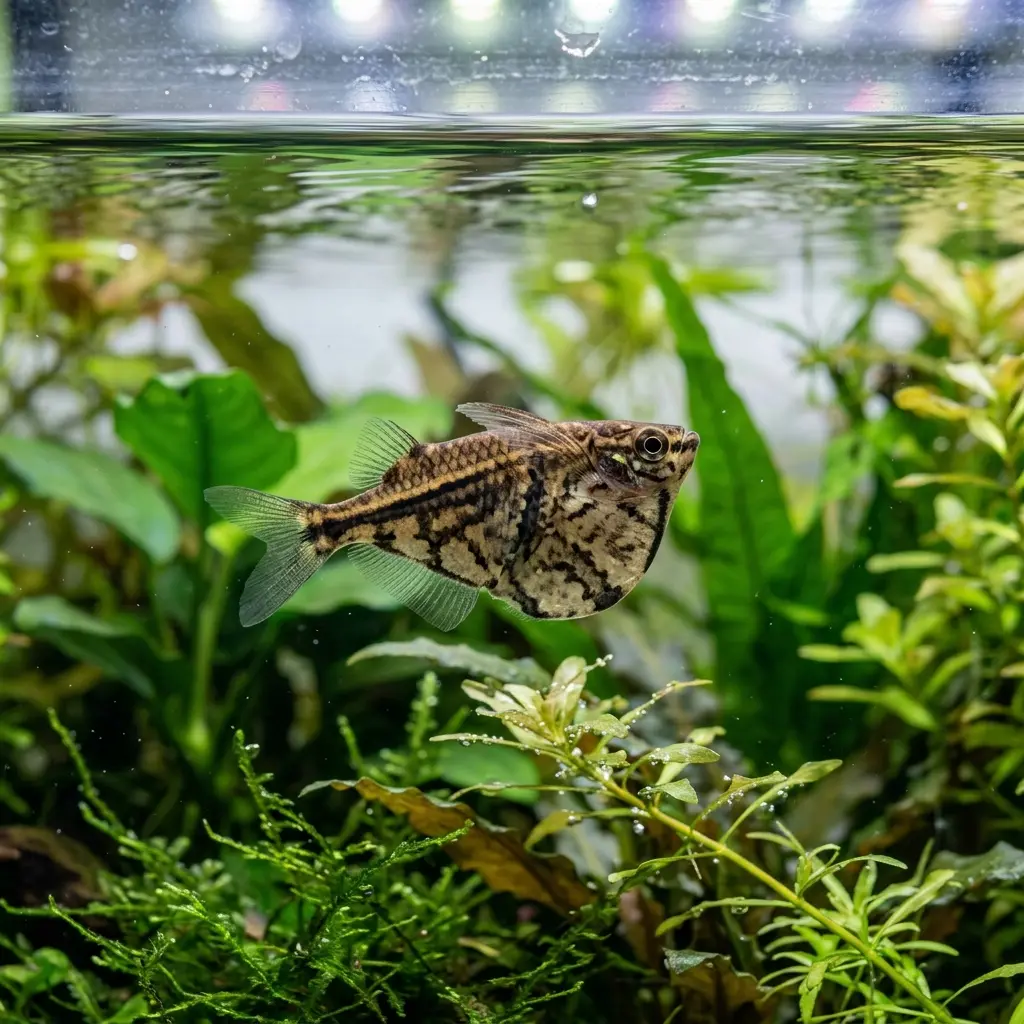
Adult Marble Hatchetfish reach approximately 1.75 inches (4.5 cm) in total length, though some sources report up to 2 inches (5 cm). They possess a distinctive, deeply keeled, triangular body shape that resembles the head of a hatchet or axe, giving them their common name. The body is golden-silver with dark brown to black marbling over the bulbous belly, a light stripe running from head to tail, and a bronze to gold midline stripe edged in black. The dorsum is greenish-bronze. Their eyes are slightly oversized and positioned high on the head, perfectly adapted for spotting aerial prey. The mouth is small and upturned, ideal for snipping insects from the surface. Most remarkably, they possess enormous pectoral muscles that power their wing-like, rigid pectoral fins, enabling them to achieve true flight.
The Only True Flying Fish
Marble Hatchetfish are the only true flying fish in the freshwater aquarium hobby. Unlike most fish that simply leap and glide, hatchetfish can actively flap their pectoral fins while airborne to add forward propulsion and steer. Their pectoral musculature makes up a substantial portion of their total body weight, and evolutionarily, this fish is built around these muscles. In the wild, they stalk clouds of insects hovering low over the water, zero in on a target with their enlarged eyes, leap out of the water, and snap the insect in their upturned jaws before splashing back down. Capable of traveling more than 5 feet (1.5 meters) high or forward, the marbled hatchetfish is one of the most accomplished jumping fish of its size in the world.
Conservation Status
The IUCN lists Marble Hatchetfish as Not Evaluated. Wild populations remain robust across their extensive Amazonian range. However, almost all specimens in the aquarium trade are wild-caught, making proper quarantine an absolute necessity. The species has not been successfully bred on a commercial scale, so farmed stock is virtually unavailable. Their popularity in the hobby has remained consistent for decades due to their unique appearance and behavior.
Why Marble Hatchetfish Captivate Hobbyists
Marble Hatchetfish offer a combination of traits found nowhere else in the aquarium hobby. Their hatchet-shaped bodies, marbled coloration, and surface-dwelling habits make them visually striking. Their ability to fly, their extreme jumping prowess, and their shy, skittish nature create endless fascination. When kept in proper schools with adequate cover, they display charming surface-skimming behavior and occasional short flights above the water. For aquarists seeking a true oddball that occupies the top level of the tank, Marble Hatchetfish are unmatched.
Diet
Feeding and Nutritional Requirements
Dietary Composition
Marble Hatchetfish are strictly surface-dwelling insectivores. Their ideal dietary composition is approximately 50 percent protein, 15 percent fat, and 35 percent chitin and plant fiber. In the wild, they feed exclusively on small insects and invertebrates that fall onto the water surface, as well as insects in flight that they catch by leaping from the water. They are adept predators of aquatic insects and fry, capable of making swift and acutely sharp turns when pursuing prey. In the aquarium, they require food that remains at the surface long enough for them to consume it.
Recommended Foods
- Floating high-quality micro-pellets and flakes formulated for small tropical fish
- Freeze-dried fruit flies (Drosophila) and small flying insects
- Frozen or live mosquito larvae, bloodworms, and daphnia (must float or be offered at the surface)
- Live baby brine shrimp offered at the surface
- Occasional floating vegetable matter such as spirulina flakes for fiber
Feeding Schedule
Feed adult Marble Hatchetfish 2 to 3 times daily in small portions that they consume within 2 to 3 minutes. They are surface feeders and will not chase food that sinks. Use a feeding ring to keep floating food concentrated at the surface and prevent it from drifting into filter outflows or sinking. They may struggle to compete with fast mid-water feeders, so target-feed them directly if housed with active community fish. In community tanks, feed the hatchetfish first with floating food, then offer sinking food for bottom dwellers. A varied diet is crucial; a diet solely consisting of flake food will not suffice for long-term health.
Foods to Avoid
Never feed beef heart, pork, chicken, or other mammalian proteins. These fish cannot digest the high fat content and connective tissue. Avoid generic low-quality flakes containing excessive fillers and artificial dyes. Large pellet foods are unsuitable as these fish have small mouths. Sinking foods such as sinking pellets, wafers, and tablets will be ignored and will foul the water. Foods containing copper or copper sulfate as preservatives must be avoided entirely due to their sensitivity.
Conditioning for Breeding
To condition Marble Hatchetfish for breeding, feed live fruit flies, mosquito larvae, and small flying insects daily for 3 weeks. These protein-rich, natural foods stimulate gonadal development and trigger spawning behavior more effectively than prepared foods. Gut-loaded live foods provide essential nutrients that prepared diets cannot replicate.
Health
See sections.health for comprehensive disease profiles and treatment protocols.
Breeding
Breeding and Reproduction
Reproductive Biology
Marble Hatchetfish are egg-scattering free spawners with no parental care. They reach sexual maturity at approximately 1 year of age. Females carry eggs that are visible through the body wall when gravid, appearing as a greenish mass. The eggs are adhesive and approximately 1 mm in diameter. Spawning occurs among the fine roots of floating plants near the water surface, typically at dawn or during simulated moonlight. In nature, eggs attach to submerged roots and vegetation; in the aquarium, they cling to floating plant roots and spawning mops.
Sexing and Conditioning
Sexing Marble Hatchetfish is challenging but possible with close observation. When viewed from above, females appear plumper, larger, and broader than males. In some instances, you may notice the presence of eggs inside the female, indicating she is preparing to spawn. Males are slimmer and slightly smaller. To condition breeders, feed live fruit flies, mosquito larvae, and small flying insects daily for 3 weeks. These natural foods stimulate gonadal development more effectively than prepared diets.
Breeding Triggers and Spawning Behavior
The key triggers for spawning are soft, acidic blackwater conditions, dim lighting, and dawn simulation. Set up a dedicated 10-gallon (38 liter) breeding tank with reverse osmosis water at pH 6.0, 2 dGH, and 80 degrees Fahrenheit (27 degrees Celsius). Provide abundant floating plants and spawning mops at the surface. Simulate dawn with gradually increasing light over 30 minutes. Spawning occurs at dawn; males perform a fluttering dance parallel to females among the fine shoots of floating plants. The female releases 200 to 400 adhesive eggs that float and cling to plant roots. Remove parents after 4 hours to prevent egg and fry predation.
Breeding Tank Setup
Use a 10-gallon (38 liter) tank with 4 inches (10 cm) of water depth for easier egg collection. Install a small air-powered sponge filter for gentle circulation. Use dim lighting and abundant floating vegetation. A thin layer of gravel mixed with peat helps maintain acidic, soft conditions. Maintain a balanced sex ratio in groups of 4 to 6 specimens to minimize stress and ensure effective pairing. The tank should be biologically mature and well-filtered, but water movement must be kept as gentle as possible.
Egg and Fry Development
Eggs hatch in 24 to 36 hours at 78 degrees Fahrenheit (25.5 degrees Celsius). The fry absorb their yolk sacs for the first day and become free-swimming 1 to 2 days after hatching. Keep the tank covered to maintain humidity and prevent temperature fluctuations. Initial food must be infusoria or liquid fry food for the first 5 to 7 days. Transition to baby brine shrimp and microworms after day 7. Around 20 days post-hatching, the fry begin to develop the distinctive hatchet body shape and will swim in all areas of the aquarium. Regular, small water changes are essential for fry development. Maintaining consistent water quality is paramount for optimal growth and health as the young fish mature.
Compatible Tank Mates






Species Comparison
| Feature | Marble Hatchetfish | Silver Hatchetfish | Common Hatchetfish | Black-Winged Hatchetfish |
|---|---|---|---|---|
| Adult Size | 1.75 inches (4.5 cm) | 2.5 inches (6.5 cm) | 3.5 inches (9 cm) | 1.5 inches (3.8 cm) |
| Temperament | Peaceful | Peaceful | Peaceful | Peaceful |
| Minimum Tank Size | 20 gallons (75 L) | 20 gallons (75 L) | 30 gallons (114 L) | 15 gallons (57 L) |
| Diet | Carnivore (insectivore) | Carnivore (insectivore) | Carnivore (insectivore) | Carnivore (insectivore) |
| pH Range | 5.5 to 7.0 | 6.0 to 7.0 | 6.0 to 7.0 | 5.5 to 6.5 |
| Water Hardness | 2 to 12 dGH | 2 to 12 dGH | 2 to 12 dGH | 2 to 8 dGH |
| Jumping Ability | Extreme (5+ feet) | High | Moderate | High |