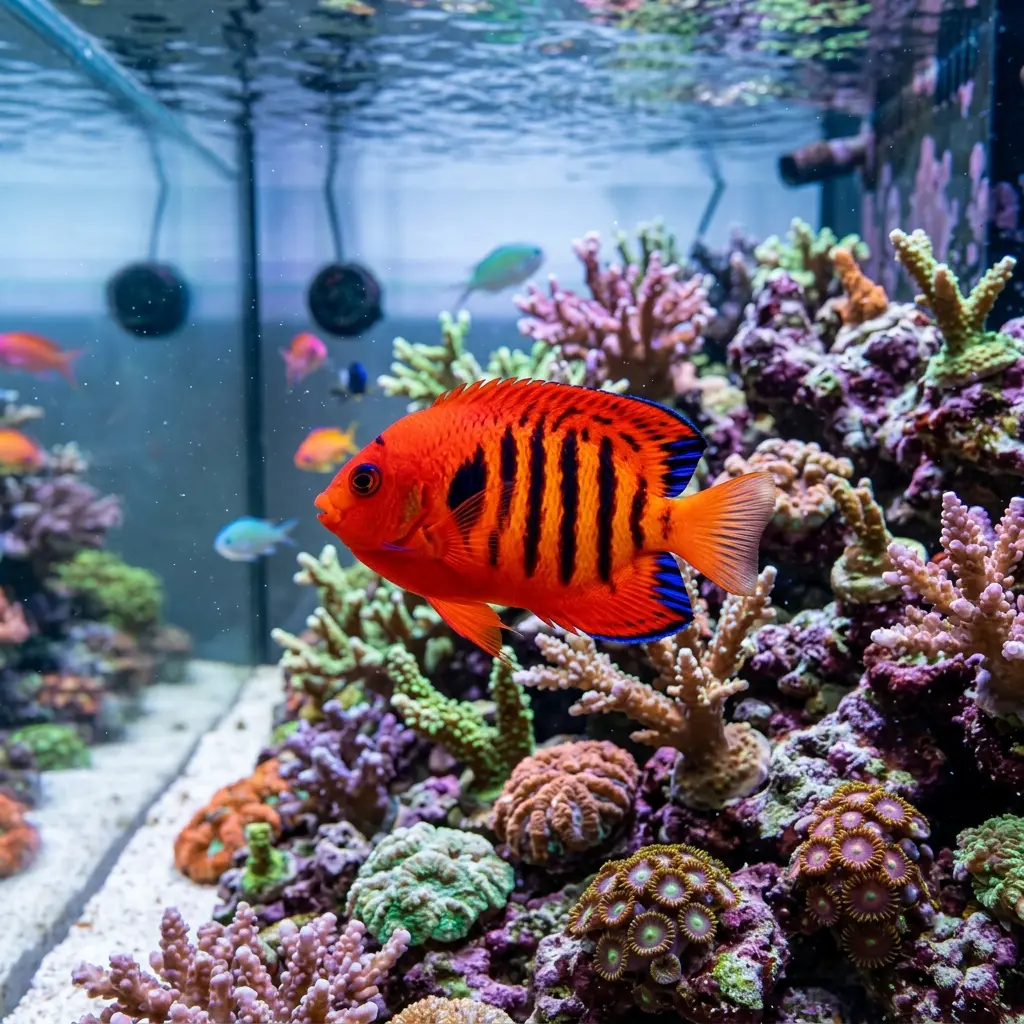
Flame Angelfish (Centropyge loricula)
Quick Answer
Flame Angelfish (Centropyge loricula) is a breathtaking dwarf marine angelfish native to the tropical Pacific. It reaches 4 inches (10 cm) and requires a minimum 55-gallon (208-liter) aquarium with marine water parameters of pH 8.1-8.4, salinity 1.023-1.025 specific gravity, and temperature 75-80 degrees Fahrenheit (24-27 degrees Celsius). This semi-aggressive omnivore is reef-safe with caution, as individual fish may nip at LPS corals, zoanthids, and clam mantles.
Quick Facts
| Scientific Name | Centropyge loricula |
|---|---|
| Common Names | Flame Angelfish |
| Family | Pomacanthidae |
| Genus | Centropyge |
| Type | Saltwater |
| Temperament | semi-aggressive |
| Care Difficulty | intermediate |
| Lifespan | 7 years |
| Maximum Size | Up to 4 in (10 cm) |
| Diet | Omnivore |
| Temperature | 75–82°F (24–28°C) |
| pH | 8.1–8.4 |
| Hardness | 7–12 dGH |
| Minimum Size | 55 gallons |
Key Takeaways
- Requires a minimum 55-gallon (208-liter) aquarium with 1.5-2 pounds of mature live rock per gallon.
- Reef-safe with caution; approximately 18 percent of individuals become problematic coral nippers.
- Only one Flame Angelfish per tank; add last to prevent territorial aggression.
- Wild-caught specimens are standard; captive-bred specimens are rare and expensive (~$275+).
- Quarantine for 21 days is mandatory due to high susceptibility to Marine Ich and Velvet from shipping stress.
- Feed dried nori sheets daily and sponge-based foods to reduce coral-nipping behavior.
- Regional color variations exist, with Hawaiian specimens displaying the deepest red and thickest barring.
Diet
Diet and Feeding Protocol
Flame Angelfish are omnivores with a natural diet consisting primarily of marine algae, sponge tissue, tunicates, and small invertebrates. In captivity, replicating this varied diet is essential for maintaining their brilliant coloration, immune health, and reducing coral-nipping behavior.
Staple Foods
Feed high-quality marine angelfish preparations, spirulina pellets, and marine flakes as the dietary base. The staple should contain a balance of vegetable matter, protein, and ideally some sponge material.
Supplemental Foods
- Frozen: Mysis shrimp, brine shrimp, cyclops, and finely chopped raw seafood (shrimp, scallop, clam). Thaw before feeding.
- Live: Brine shrimp and copepods for conditioning or stimulating appetite in newly acquired fish.
- Vegetable Matter: Dried nori sheets offered daily on a clip. Spirulina wafers and algae-based pellets. These are critical for digestive health and may reduce coral nipping.
- Sponge-Based Foods: Commercial preparations containing natural sponge matter (Angel Formula, Hikari Seaweed Extreme) replicate their wild diet and support long-term health.
Feeding Schedule
Feed 2-3 times daily in portions consumed within 2-3 minutes. A well-fed Flame Angel is significantly less likely to nip corals. Remove uneaten food after 5 minutes to prevent water quality degradation. Target-feed the fish directly if it is shy or competing with faster tank mates.
Vitamin Supplementation
Soak frozen foods in a liquid marine vitamin supplement containing vitamin C and vitamin B complex twice weekly. Vitamin deficiencies contribute to faded coloration and weakened immunity.
Health
Health and Disease Management
Flame Angelfish are moderately hardy once acclimated but are notoriously sensitive to shipping stress and the collection-to-retail pipeline. Wild-caught specimens frequently arrive with parasite loads, bacterial infections, or severe stress that manifests within the first 14 days. Their relatively small size and high metabolism mean that diseases progress rapidly if untreated.
Critical Protocol: You must quarantine all new Flame Angelfish for a minimum of 21 days in a bare hospital tank before introducing them to a display tank. Marine parasites are devastating and difficult to treat in reef tanks, and many medications are toxic to corals and invertebrates. A dedicated quarantine tank is non-negotiable. Ask your retailer to hold the fish for 1-2 weeks before purchase; a fish that has been eating at the store for several weeks has a dramatically higher survival rate than a freshly shipped specimen.
Marine Ich (Cryptocaryon irritans)
A ciliate parasite that presents as white salt-like grains on the fins, body, and gills. It has a complex life cycle with a dormant cyst stage that makes eradication difficult.
- White cysts visible on skin and fins, flashing against substrate, rapid breathing, clamped fins, rubbing against decor, loss of appetite.
Introduced via new fish, invertebrates, or live rock. Triggered by shipping stress and temperature fluctuations. Flame Angelfish are particularly susceptible due to collection and transport stress.
Quarantine all new additions for 21 days. Maintain stable temperatures between 75-78 degrees Fahrenheit (24-25.5 degrees Celsius). Treat with copper (Cupramine at 0.15 mg/L) or hyposalinity (1.009-1.012 SG) in quarantine.
Marine Velvet (Amyloodinium ocellatum)
A dinoflagellate parasite that covers the fish in a fine, velvety, gold-to-brown dust. It is highly contagious and one of the fastest-killing marine fish diseases.
- Fine gold or brown dusting on body, rapid breathing, clamped fins, lethargy, loss of appetite, scratching against decor. Can kill within 48-72 hours.
Introduced via new fish or contaminated water. The parasite attaches to gills and skin, causing severe respiratory distress and osmotic imbalance. Shipping-stressed fish are highly vulnerable.
Quarantine all new fish for 21 days. Treat prophylactically with copper or chloroquine phosphate in quarantine. Marine Velvet is not susceptible to hyposalinity alone.
Brooklynella hostilis (Clownfish Disease)
A ciliate parasite most commonly associated with clownfish but capable of infecting other marine species. It has a direct life cycle and kills rapidly if untreated.
- Excess white mucous sloughing off skin (appearing as peeling), rapid breathing, cloudy eyes, ragged fins, mottled or washed-out coloration, white stringy feces.
Introduced via infected fish or contaminated water. Wild-caught specimens and poorly quarantined livestock are primary vectors.
Quarantine all new fish for 21 days. Purchase from reputable retailers who hold fish before sale. Treat with formalin baths if detected during quarantine.
Vibrio Bacterial Infection
A serious bacterial infection caused by Vibrio species that can kill fish within days. Flame Angelfish are susceptible following shipping stress.
- Popeye (exophthalmia), dropsy (fluid retention and swelling), red streaks or bleeding on the skin, lethargy, loss of appetite, rapid deterioration.
Bacterial infection of the bloodstream and tissues, often secondary to shipping stress, poor water quality, or physical injury. Vibrio thrives in warm, nutrient-rich water.
Head and Lateral Line Erosion (HLLE)
A chronic condition characterized by pits and erosion along the head and lateral line, caused by vitamin deficiencies, poor water quality, and activated carbon dust.
- Pits or craters on the head and face, erosion along the lateral line, faded coloration, lethargy. Progresses slowly over weeks or months.
Vitamin C and B deficiencies, poor diet lacking vegetable matter, use of low-quality activated carbon that releases dust, and osmotic stress from improper salinity.
Feed vitamin-enriched foods including spirulina and nori. Soak frozen foods in liquid vitamins twice weekly. Use high-quality pelletized activated carbon in a media bag. Maintain stable salinity with a refractometer.
Breeding
Breeding Flame Angelfish
Breeding Flame Angelfish in home aquariums is extremely rare and impractical for the average hobbyist. While successful captive breeding has been achieved by specialized aquaculture facilities, the extended larval period and precise environmental requirements make home breeding nearly impossible. The vast majority of Flame Angelfish in the trade remain wild-caught.
Sexual Maturity and Sexing
Flame Angelfish are sequential hermaphrodites, beginning life as females and transitioning to males when they become dominant. Sexual maturity is reached at 12-18 months. Sexing is difficult in juveniles; males are often slightly larger and more intensely colored, with thicker black barring. Definitive sexing is only possible during spawning behavior.
Pair Formation
To obtain a breeding pair, purchase 4-6 juveniles and allow them to form a natural hierarchy. The dominant individual will transition to male. Remove the extras once a pair forms. Alternatively, some aquaculture facilities offer confirmed pairs at premium prices.
Conditioning and Spawning
Condition the pair with high-protein sponge-based foods, mysis shrimp, and enriched frozen foods 2-3 times daily for 4 weeks. Raise the temperature to 80 degrees Fahrenheit (27 degrees Celsius) and perform 20 percent water changes with slightly cooler water (75 degrees Fahrenheit / 24 degrees Celsius) to simulate seasonal changes.
Flame Angelfish are pelagic spawners. At dusk, the pair rises into the water column and releases eggs. The female lays 150-300 eggs nightly during active spawning periods. Fertilization is external. There is no parental care; eggs drift with the current.
Larval Rearing
Eggs hatch in 24-30 hours. Larvae are extremely small and require rotifers enriched with Nannochloropsis phytoplankton. The larval period lasts an extraordinarily long 60-70 days before metamorphosis into juvenile fish at approximately 1 inch (2.5 cm). This extended development makes home breeding impractical. Commercial breeders use specialized larval rearing systems with precise temperature, lighting, and feeding protocols.
Practical Recommendation
For the vast majority of aquarists, focus on providing excellent long-term care for a wild-caught specimen. If you are committed to sustainable practices, seek out captive-bred specimens from Biota Hawaii or similar facilities when available, despite the premium price.
Compatible Tank Mates
Species Comparison
| Feature | Flame Angelfish | Coral Beauty Angelfish | Lemonpeel Angelfish | Bicolor Angelfish |
|---|---|---|---|---|
| Adult Size | 4 in (10 cm) | 4 in (10 cm) | 5.5 in (14 cm) | 6 in (15 cm) |
| Temperament | Semi-aggressive; territorial with own kind | Semi-aggressive; territorial with own kind | Semi-aggressive; territorial | Semi-aggressive; shy when young |
| Minimum Tank Size | 55 gal (208 L) for one | 40 gal (151 L) for one | 55 gal (208 L) for one | 55 gal (208 L) for one |
| Temperature Range | 75-80 degrees F (24-27 degrees C) | 72-78 degrees F (22-25.5 degrees C) | 72-78 degrees F (22-25.5 degrees C) | 72-78 degrees F (22-25.5 degrees C) |
| Diet | Omnivore; algae, sponges, mysis, nori | Omnivore; algae, mysis, pellets | Omnivore; algae-heavy diet | Omnivore; algae, sponges, mysis |
| pH Range | 8.1 - 8.4 | 8.1 - 8.4 | 8.1 - 8.4 | 8.1 - 8.4 |
| Special Requirements | One per tank; add last; reef-safe with caution; quarantine mandatory | One per tank; may nip LPS; hardy | One per tank; notorious coral nipper | One per tank; needs caves; shy |