
Honey Gourami (Trichogaster chuna)
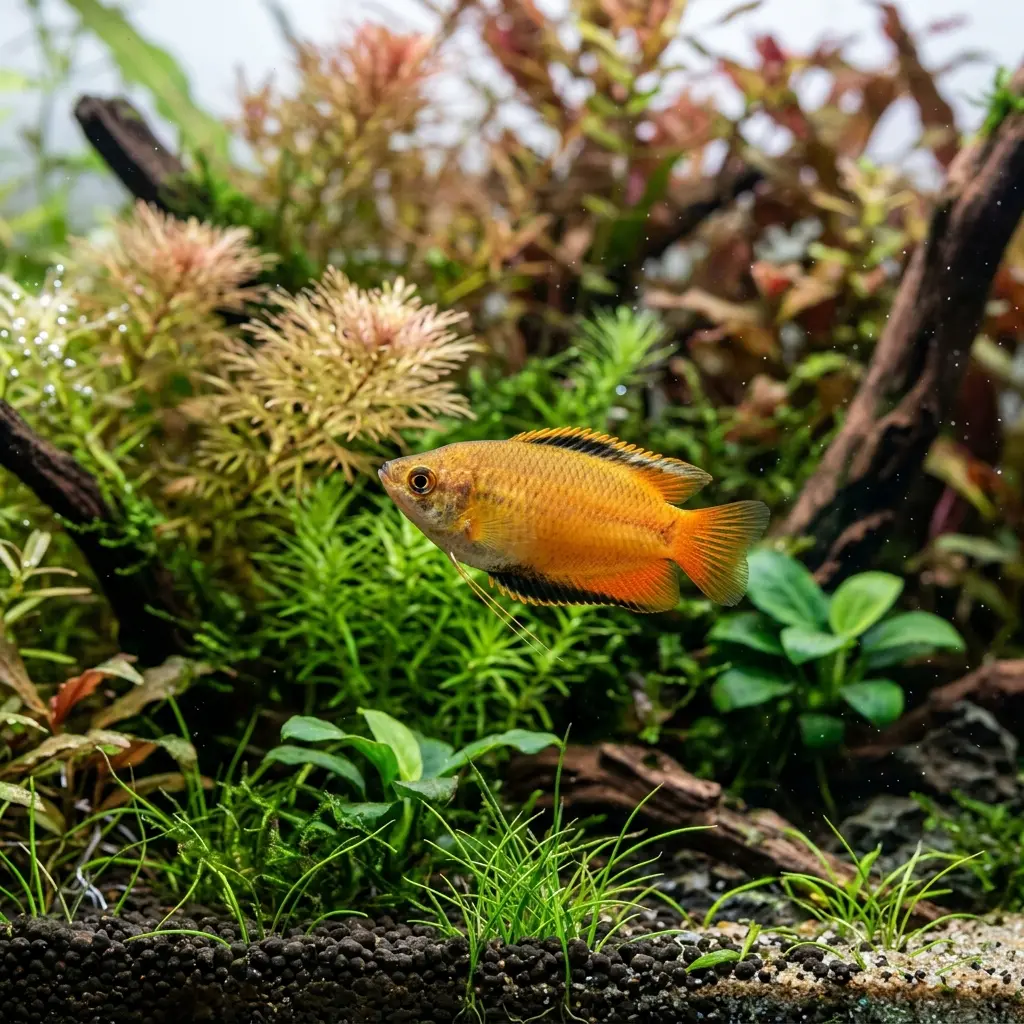
Quick Answer
Honey Gourami (Trichogaster chuna) is a peaceful, small labyrinth fish native to northeast India and Bangladesh. It requires a minimum 10 gallon (38 liter) aquarium for a pair, or 20 gallons (75 liters) for a community setup, with a pH of 6.0 to 7.5 and temperature range of 72 to 82 degrees Fahrenheit (22 to 28 degrees Celsius). This omnivorous, surface-breathing species occupies the top to middle water column and thrives in planted tanks with floating vegetation and gentle water flow.
Quick Facts
| Scientific Name | Trichogaster chuna |
|---|---|
| Common Names | Honey Gourami |
| Family | Osphronemidae |
| Genus | Trichogaster |
| Type | Freshwater |
| Temperament | peaceful |
| Care Difficulty | beginner |
| Lifespan | 6 years |
| Maximum Size | Up to 2.5 in (6 cm) |
| Diet | Omnivore |
| Temperature | 72–82°F (22–28°C) |
| pH | 6–7.5 |
| Hardness | 4–15 dGH |
| Minimum Size | 10 gallons |
Key Takeaways
- Known as the most peaceful gourami species available in the aquarium trade.
- Requires a minimum 10 gallon (38 liter) tank for a pair, 20 gallons (75 liters) for community.
- Does not carry Dwarf Gourami Iridovirus (DGIV), unlike commercially bred Dwarf Gouramis.
- Labyrinth fish that breathes atmospheric air; calm surface is essential.
- Bubble nest builder that breeds readily in home aquariums.
- Floating plants are mandatory, not optional, for security and breeding.
- Only one male per tank; multiple males result in fatal chronic stress.
Diet
Diet and Feeding Protocol
Natural Diet
In the wild, Honey Gouramis are omnivores that lean toward protein, feeding on small insects, insect larvae, and invertebrates at the water surface. They pick at food while hovering, using their threadlike pelvic fins to feel and manipulate items.
Captive Diet Composition
You must provide a balanced omnivorous diet consisting of approximately 40% protein, 10% fat, and 50% plant matter and microorganisms. Feed two to three times daily with portions consumed within 2 to 3 minutes.
- Staple Foods: High-quality insect-based micro-pellets such as Fluval Bug Bites in small granule size. These match their natural insect-heavy diet and produce superior coloration compared to generic flake food.
- Protein Supplements: Frozen or live bloodworms, brine shrimp, daphnia, and cyclops offered 3 to 4 times weekly. Bloodworms are a reliable conditioning trigger for breeding.
- Plant Matter: Spirulina flakes and blanched vegetables such as peas, zucchini, or spinach offered once weekly.
Feeding Behavior
Honey Gouramis are shy feeders. In a community tank, faster or more assertive fish will outcompete them at feeding time if you are not paying attention. Feed small amounts two to three times per day, observe that they are actually eating, and consider target feeding with a turkey baster or pipette if they are consistently losing out to tank mates.
Common Dietary Mistakes
Overfeeding is the primary error; excess food degrades water quality. Do not rely solely on generic flakes; nutritional diversity prevents deficiency diseases. Because they are surface-oriented feeders, sinking pellets may be missed entirely.
Health
Health and Disease Management
Honey Gouramis are hardy but their labyrinth organ makes them sensitive to temperature fluctuations and cold drafts. Their small size and shy nature means illness often progresses before visible symptoms appear. Quarantine all new arrivals for 14 days. Maintain stable parameters; temperature swings are a common trigger for respiratory illness in labyrinth fish.
Preventive Care
Perform weekly 20 to 25% water changes, maintain nitrates below 15 ppm, and keep the tank covered to prevent cold drafts across the surface. Use a UV sterilizer to reduce free-floating pathogens. Test water parameters biweekly using liquid test kits.
Ich (White Spot Disease)
A protozoan infection caused by Ichthyophthirius multifiliis characterized by white salt-like granules on fins and body.
- White cysts on fins, gills, and body; flashing against decor; rapid breathing; clamped fins; lethargy.
Introduced via new fish or plants; triggered by temperature drops below 72 degrees Fahrenheit (22 degrees Celsius) or poor water quality.
Quarantine new stock for 14 days; maintain temperature at 75 to 78 degrees Fahrenheit (24 to 26 degrees Celsius); use a UV sterilizer.
Fin Rot
Bacterial infection typically caused by Aeromonas, Pseudomonas, or Flexibacter species resulting in eroded fin tissue.
- Frayed or receding fin edges; red or inflamed fin bases; tissue discoloration; in advanced cases, body rot.
Maintain pristine water conditions; keep only one male per tank to reduce stress; treat water with conditioner during changes.
Velvet Disease (Oodinium)
A dinoflagellate parasite causing a fine, dusty gold or rust-colored coating over the body, subtler than ich.
- Fine velvety film on body; rapid breathing; scratching against substrate; lethargy; clamped fins; often fatal within days if untreated.
Introduced via contaminated water, fish, or plants; thrives in temperatures above 80 degrees Fahrenheit (27 degrees Celsius).
Strict quarantine protocol; avoid temperature spikes; maintain excellent water quality; use a UV sterilizer.
Fungal Infections (Saprolegnia)
A fungal infection presenting as white or grayish cotton-like patches on the body or fins.
- White fluffy patches on mouth, fins, or body; lethargy; loss of appetite; tissue erosion in advanced cases.
Poor water quality; physical injury from rough handling or decor; stress from inadequate cover or aggressive tank mates.
Maintain clean water conditions; use smooth decor without sharp edges; provide adequate hiding spots; quarantine injured fish.
Dwarf Gourami Iridovirus (DGIV)
An infectious spleen and kidney necrosis virus (ISKNV) that is endemic in commercially bred Dwarf Gouramis but can infect Honey Gouramis through contact with carriers.
- Progressive lethargy; color fading; swelling; bumps or lesions on body; patches of pale or white coloration especially on the head; high mortality rate.
Contact with infected Dwarf Gouramis or contaminated water; the virus can lie dormant for 6 months to a year before breaking out.
Never mix Honey Gouramis with Dwarf Gouramis; quarantine all new fish for 14 days; buy from reputable breeders rather than chain stores; maintain UV sterilization.
Breeding
Breeding Honey Gouramis
Breeding Difficulty
Honey Gouramis are among the easiest labyrinth fish to breed. They are sexually dimorphic, spawn willingly once conditioned, and males are attentive nest builders. Compared to Betta breeding, which involves managing significant male aggression and immediate female removal, Honey Gourami breeding is low-stress and manageable even for beginners.
Conditioning Breeders
Condition a male and female with live or frozen foods such as bloodworms, brine shrimp, and blackworms for 1 to 2 weeks before moving them to the breeding tank. When the male is ready, his coloration shifts dramatically: the body turns bright orange and the throat goes deep blue-black. He begins building a bubble nest among floating plants using mucus-coated bubbles to create a stable structure.
Spawning Tank Setup
Use a dedicated 10-gallon (38 liter) breeding tank. Lower the water level to 6 to 7 inches (15 to 18 cm); shallow water makes bubble nest construction easier and prevents fry from being scattered through too large a water column. Install a gentle sponge filter that will not disturb the surface or suck up fry. Add floating plants throughout but leave gaps for the male to access the top. Maintain pH 7.0, dGH 6 to 8, and raise temperature gradually to 82 to 84 degrees Fahrenheit (28 to 29 degrees Celsius) over several days.
Spawning Behavior
Once the nest is built, the male courts the female in tight circles beneath it. When she is receptive, he wraps around her in a spawning embrace and she releases 100 to 300 eggs, which he catches in his mouth and places in the nest. Remove the female immediately after spawning; the male becomes hostile toward her once spawning is complete.
Egg and Fry Care
Eggs hatch in 24 to 36 hours. The male continues guarding and maintaining the nest for the first 2 to 3 days. Once fry are free-swimming, remove the male. Fry are tiny and need infusoria or commercial liquid fry food for the first week to 10 days. After that, baby brine shrimp and microworms work well. Keep a tight-fitting lid or cover the surface with plastic wrap; young labyrinth fish need warm, moist air above 80 degrees Fahrenheit (27 degrees Celsius) to develop their labyrinth organ properly. Cold drafts through an open top at this stage can be fatal.
Compatible Tank Mates






Species Comparison
| Feature | Honey Gourami | Dwarf Gourami | Pearl Gourami | Betta Fish |
|---|---|---|---|---|
| Scientific Name | Trichogaster chuna | Trichogaster lalius | Trichopodus leerii | Betta splendens |
| Max Size | 2.5 in (6.4 cm) | 3.5 in (8.9 cm) | 4.5 in (11.4 cm) | 3 in (7.6 cm) |
| Temperament | Peaceful | Peaceful to semi-aggressive | Peaceful | Aggressive |
| Minimum Tank Size | 10 gal (38 L) pair | 10 gal (38 L) | 30 gal (113 L) | 5 gal (19 L) |
| Diet | Omnivore (insect-heavy) | Omnivore | Omnivore | Carnivore |
| pH Range | 6.0 - 7.5 | 6.0 - 7.5 | 6.5 - 8.0 | 6.5 - 7.5 |
| DGIV Risk | Low (not a carrier) | High (22% carrier rate) | Low |