
Midas Blenny (Ecsenius midas)
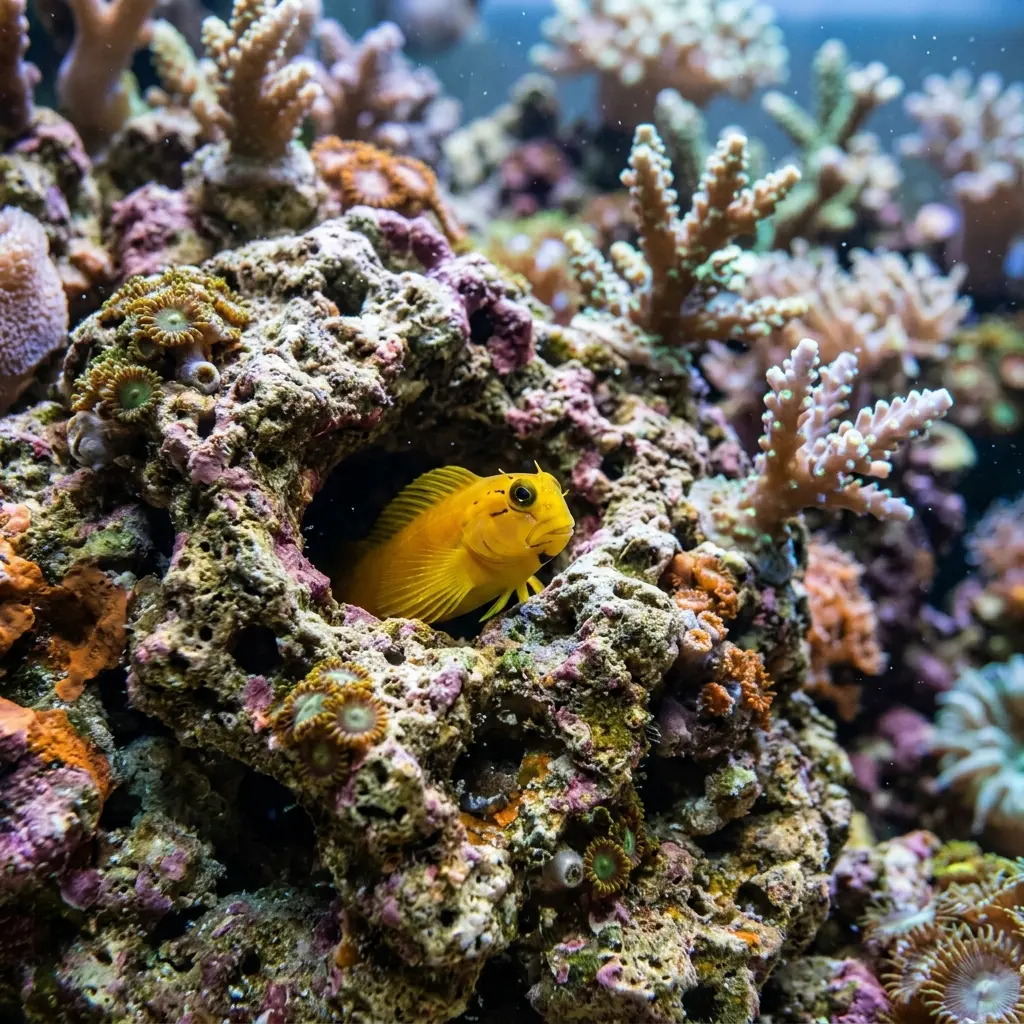
Quick Answer
Midas Blenny (Ecsenius midas) is a stunning golden-yellow blenny that swims actively in the water column, mimicking anthias behavior. It requires a minimum 30 gallon (113 liter) reef aquarium with a pH of 8.1 to 8.4, specific gravity of 1.023 to 1.025, and temperature range of 75 to 82 degrees Fahrenheit (23.9 to 27.8 degrees Celsius). This peaceful, reef-safe omnivore needs live rock with multiple hiding crevices and a tight-fitting lid to prevent jumping.
Quick Facts
| Scientific Name | Ecsenius midas |
|---|---|
| Common Names | Midas Blenny |
| Family | Blenniidae |
| Genus | Ecsenius |
| Type | Saltwater |
| Temperament | peaceful |
| Care Difficulty | beginner |
| Lifespan | 8 years |
| Maximum Size | Up to 5 in (13 cm) |
| Diet | Omnivore |
| Temperature | 75–82°F (24–28°C) |
| pH | 8.1–8.4 |
| Hardness | 7–12 dGH |
| Minimum Size | 30 gallons |
Key Takeaways
- Known for its peaceful temperament and active mid-water swimming behavior.
- Requires at least a 30 gallon (113 liter) aquarium with a tight-fitting lid.
- Completely reef safe with corals, clams, and invertebrates.
- Scaleless fish requiring zero ammonia and careful medication selection.
- Color-changing ability from golden yellow to dark brown or black when stressed.
- Keep only one per tank unless housing a mated pair in 75+ gallons.
Diet
Diet and Feeding Protocol
Natural Diet
In the wild, Midas Blennies are planktivorous omnivores feeding primarily on zooplankton, phytoplankton, and suspended organic matter in the water column. They hover near reef outcroppings and dart after passing food particles, rarely grazing the substrate or rock surfaces.
Captive Diet Composition
You must provide a balanced omnivorous diet consisting of approximately 50% protein, 15% fat, and 35% marine algae and plankton matter. Feed two to three times daily with portions consumed within 1 to 2 minutes.
- Staple Foods: High-quality marine flake foods, small sinking pellets such as New Life Spectrum Thera-A, Hikari Marine S, and Omega One marine formulas.
- Frozen Foods: Mysis shrimp, brine shrimp enriched with spirulina, cyclops, and calanus offered daily.
- Vegetable Matter: Nori sheets attached to a feeding clip, spirulina-enriched pellets, and finely shredded macroalgae offered 3 to 4 times weekly.
- Live Foods: Live brine shrimp or copepods as an occasional treat to stimulate natural hunting behavior.
Feeding Behavior
Midas Blennies are quick, aggressive feeders. They will propel themselves through the water column in an eel-like motion to capture food. In community tanks, ensure slower or more timid tank mates receive adequate nutrition by target feeding with a turkey baster or pipette on the opposite side of the tank.
Common Dietary Mistakes
Overfeeding is the primary error; excess food degrades water quality and fuels nuisance algae. Do not rely solely on flake foods; nutritional diversity prevents deficiency diseases and Head and Lateral Line Erosion (HLLE). Avoid freshwater feeder fish or mammalian meats.
Health
Health and Disease Management
Midas Blennies are hardy but scaleless, making them hypersensitive to ammonia, nitrite, and copper-based medications. Their lack of scales means they absorb chemicals more readily than scaled fish. Maintain pristine water quality with zero ammonia and nitrite at all times. Quarantine all new arrivals for a minimum of 14 days in a separate system.
Preventive Care
Perform weekly 20% water changes, maintain nitrates below 5 ppm, and run a protein skimmer continuously. Use a UV sterilizer to reduce free-floating pathogens. Test water parameters weekly using liquid test kits. Because they are scaleless, even brief exposure to elevated ammonia above 0.25 ppm can cause chemical burns and secondary infections.
Marine Ich (Cryptocaryon irritans)
A ciliated protozoan parasite that encysts on fish skin and gills, causing white salt-like spots.
- Small white cysts on fins, body, and gills; flashing against rockwork; rapid opercular movement; clamped fins; lethargy; loss of appetite.
Introduced via unquarantined fish, invertebrates, or live rock; triggered by temperature drops or stress from poor water quality.
Quarantine all new livestock for 14 days; maintain stable temperature above 75 degrees Fahrenheit (23.9 degrees Celsius); use UV sterilization.
Marine Velvet (Amyloodinium ocellatum)
A dinoflagellate parasite that causes a fine yellowish-brown or rusty dusting on the skin and rapid respiratory distress.
- Fine velvety film on body; rapid breathing; scratching against substrate; lethargy; clamped fins; often fatal within days if untreated.
Introduced via contaminated water, fish, or invertebrates; thrives in temperatures above 78 degrees Fahrenheit (25.5 degrees Celsius).
Strict quarantine protocol; avoid temperature spikes; maintain excellent water quality; use a UV sterilizer.
Brooklynella (Brooklynella hostilis)
A ciliated protozoan that attacks skin and gills, commonly called clownfish disease but affects many marine species.
- Sloughed skin and mucus; cloudy appearance; rapid breathing; loss of appetite; lethargy; death within days in severe cases.
Direct transmission from infected fish; stress from shipping or poor water quality; overcrowding in quarantine.
Quarantine all new fish; avoid overcrowding; maintain stable salinity and temperature during acclimation.
Uronema marinum
A ciliate parasite that infects marine fish, particularly in suboptimal salinity or temperature conditions.
- Reddish sores or ulcers on body; rapid deterioration; lethargy; loss of appetite; death within 24 to 48 hours in acute cases.
Introduced via live foods or contaminated systems; exacerbated by temperatures below 75 degrees Fahrenheit (23.9 degrees Celsius) or salinity below 1.020.
Never use hyposalinity with this species; maintain salinity at 1.023 to 1.025; quarantine live foods before feeding.
Head and Lateral Line Erosion (HLLE)
A degenerative condition affecting the sensory pits along the lateral line and head, resulting in pitted, eroded tissue.
- Pitted lesions along the lateral line and around the eyes; faded coloration; recessed tissue on the head; progressive deterioration if untreated.
Poor nutrition lacking in vitamins C and D; carbon filtration removing trace elements; low-quality food; activated carbon dust; stray voltage.
Feed vitamin-enriched varied diet; use high-quality activated carbon and replace monthly; ground all electrical equipment; supplement with Selcon or similar fatty acid additives.
Breeding
Breeding Midas Blennies
Current Status
Commercial captive breeding of Ecsenius midas has not been achieved at scale as of 2026, though other Ecsenius species have been successfully propagated. This suggests the primary barrier is larval rearing rather than spawning induction. Wild-caught specimens remain the standard in the trade.
Reproductive Biology
Midas Blennies are demersal harem spawners with distinct sexual dimorphism. A single male will court and spawn with multiple females, collecting adhesive egg batches from each inside a single cave or crevice. The male then guards and fans all eggs simultaneously. Because females may spawn on different nights, eggs hatch on staggered schedules, creating a continuous larval production challenge.
Conditioning Breeders
Select a bonded pair or harem group of 1 male and 2 to 3 females. Condition them for 4 weeks in a 75-gallon (284 liter) reef tank with abundant live rock and excellent water quality. Feed live blackworms, enriched brine shrimp, mysis, and high-quality pellets 3 times daily. Maintain temperature at 76 degrees Fahrenheit (24.5 degrees Celsius) and salinity at 1.025.
Spawning and Egg Care
The male selects a cave with a single entrance and clears the interior surface. Spawning typically occurs at dawn. Each female lays 500 to 1,000 tiny adhesive eggs on the cave ceiling or walls. The male fertilizes them and then guards the nest for 5 to 7 days, fanning continuously with his pectoral fins to provide oxygen and prevent fungal growth.
Larval Rearing Challenges
Eggs hatch after 5 to 7 days into pelagic larvae approximately 2.5 mm in length. The primary challenge is the staggered hatch schedule from multiple females, requiring continuous live food production. Larvae require rotifers enriched with phytoplankton for the first 10 days, followed by copepod nauplii and newly hatched brine shrimp. Metamorphosis to juvenile form occurs at approximately 0.5 inches (1.2 cm) after 30 to 40 days. Mortality is high without dedicated larval systems and constant food availability.
Compatible Tank Mates
Species Comparison
| Feature | Midas Blenny | Lawnmower Blenny | Tailspot Blenny | Canary Blenny |
|---|---|---|---|---|
| Scientific Name | Ecsenius midas | Salarias fasciatus | Ecsenius stigmatura | Meiacanthus oualanensis |
| Max Size | 5 in (12.7 cm) | 5 in (12.7 cm) | 2.5 in (6.4 cm) | 4 in (10.2 cm) |
| Temperament | Peaceful (territorial with blennies) | Peaceful | Peaceful | Peaceful |
| Minimum Tank Size | 30 gal (113 L) | 30 gal (113 L) | 10 gal (37 L) | 30 gal (113 L) |
| Diet | Omnivore (planktivore) | Herbivore (algae grazer) | Omnivore | Omnivore |
| Reef Safe | Yes | Yes (may nip some polyps) | Yes | Yes |
| Special Trait | Color-changing golden blenny | Algae control specialist | Small with tail spot marking | Venomous fangs |