
Ocellaris Clownfish (Amphiprion ocellaris)
Quick Answer
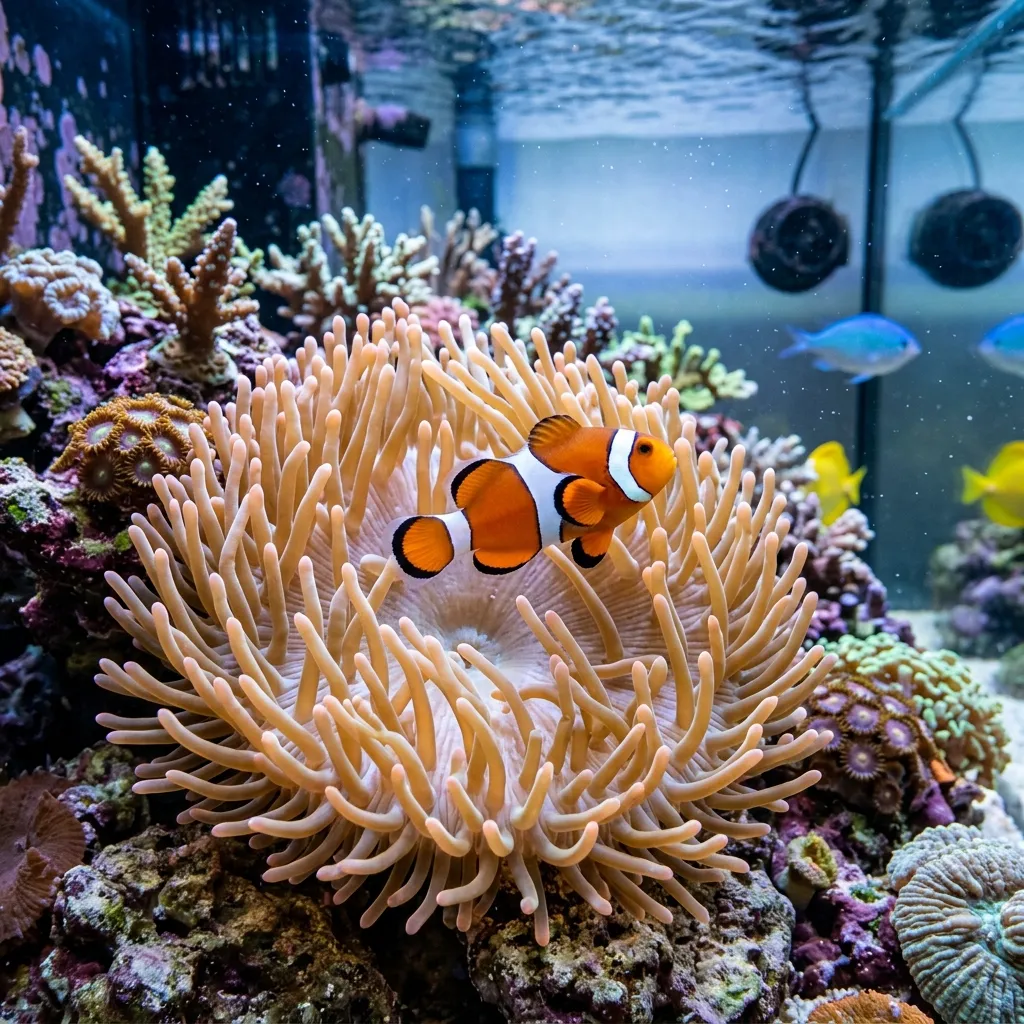
Ocellaris Clownfish (Amphiprion ocellaris) is the most popular marine aquarium fish and an ideal beginner saltwater species. It requires a minimum 20-gallon (75-liter) aquarium for a pair, with marine water parameters of pH 8.1-8.4, salinity 1.023-1.025 specific gravity, and temperature 75-82 degrees Fahrenheit (24-28 degrees Celsius). This omnivorous, semi-aggressive fish forms monogamous pairs through sequential hermaphroditism and does not require an anemone to thrive.
Quick Facts
| Scientific Name | Amphiprion ocellaris |
|---|---|
| Common Names | Ocellaris Clownfish |
| Family | Pomacentridae |
| Genus | Amphiprion |
| Type | Saltwater |
| Temperament | semi-aggressive |
| Care Difficulty | beginner |
| Lifespan | 15 years |
| Maximum Size | Up to 3.5 in (9 cm) |
| Diet | Omnivore |
| Temperature | 75–82°F (24–28°C) |
| pH | 8.1–8.4 |
| Hardness | 7–12 dGH |
| Minimum Size | 20 gallons |
Key Takeaways
- Requires a minimum 20-gallon (75-liter) aquarium for a bonded pair; 10 gallons acceptable for a single specimen.
- All individuals are born male; the dominant fish transforms into female when paired.
- Does not require a sea anemone to survive, though Bubble Tip Anemones (Entacmaea quadricolor) are the best host if desired.
- Captive-bred specimens are hardier, disease-resistant, and ethically superior to wild-caught fish.
- Vulnerable to Brooklynella hostilis; quarantine all new fish for 21 days minimum.
- Marine water parameters must include salinity 1.023-1.025 SG, pH 8.1-8.4, calcium 400-450 ppm, and magnesium 1250-1350 ppm.
- Designer varieties available include Misbar, Caramel, Snowflake, Longfin, and Darwin.
Diet
Diet and Feeding Protocol
Ocellaris Clownfish are opportunistic omnivores. In the wild, they consume zooplankton, algae, leftover food from the anemone's meals, and the anemone's waste products. In captivity, they accept virtually all prepared and frozen marine foods with enthusiasm.
Staple Foods
Feed high-quality marine flakes or pellets as the dietary base. The staple should contain approximately 45% protein, 12% fat, and substantial algae or spirulina content. Pellets are preferred over flakes as they create less mess and preserve water quality.
Supplemental Foods
- Frozen: Mysis shrimp, brine shrimp, cyclops, and finely chopped raw seafood (shrimp, scallop, fish). Thaw before feeding.
- Live: Brine shrimp and copepods for conditioning breeders or enriching fry.
- Vegetable Matter: Spirulina flakes, nori sheets, and algae-based pellets. These provide essential vitamins and prevent Head and Lateral Line Erosion (HLLE).
Feeding Schedule
Feed 2 times daily in portions consumed within 2-3 minutes. Overfeeding degrades water quality rapidly in marine tanks and contributes to nitrate and phosphate accumulation. Remove uneaten food after 5 minutes. If keeping an anemone, target-feed the anemone separately to prevent the clownfish from stealing all the food.
Vitamin Supplementation
Soak frozen foods in a liquid vitamin supplement containing vitamin C and vitamin B complex twice weekly. Vitamin deficiencies are a primary cause of HLLE in clownfish and other marine species.
Health
Health and Disease Management
Captive-bred Ocellaris Clownfish are remarkably hardy and disease-resistant compared to wild-caught marine fish. However, they are not immune to the common pathogens that plague marine aquariums. Their most significant vulnerability is Brooklynella hostilis, a ciliate parasite so commonly associated with clownfish that it is often called clownfish disease. Additionally, poor water quality and vitamin deficiencies can lead to Head and Lateral Line Erosion (HLLE), a chronic condition that disfigures the fish.
Critical Protocol: You must quarantine all new marine fish for a minimum of 21 days before introducing them to a display tank. Marine parasites are far more difficult to treat in a reef tank than in freshwater systems, and many medications are toxic to corals and invertebrates. A dedicated quarantine tank is non-negotiable for responsible marine husbandry.
Brooklynella hostilis (Clownfish Disease)
A ciliate parasite most commonly seen in clownfish. It has a direct life cycle with no encysted stage, making it easier to eliminate than Marine Ich but extremely fast-killing if untreated.
- Excess white mucous sloughing off skin (appearing as peeling), rapid breathing, cloudy eyes, ragged fins, mottled or washed-out coloration, white stringy feces, lethargy.
Introduced via infected fish or contaminated water. Wild-caught clownfish and poorly quarantined livestock are the primary vectors. Brooklynella reproduces directly on the fish.
Quarantine all new fish for 21 days. Purchase captive-bred specimens from reputable breeders. Never introduce wild-caught clownfish directly to a display tank.
Marine Ich (Cryptocaryon irritans)
A ciliate parasite that presents as white salt-like grains on the fins, body, and gills. It has a complex life cycle with a dormant cyst stage that makes eradication difficult.
- White cysts visible on skin and fins, flashing against substrate, rapid breathing, clamped fins, rubbing against decor, loss of appetite.
Introduced via new fish, invertebrates, or live rock. Triggered by temperature fluctuations or stress. The parasite drops off the fish to form cysts on substrate and decor.
Quarantine all new additions for 21 days. Maintain stable temperatures between 75-78 degrees Fahrenheit (24-25.5 degrees Celsius). Use copper (Cupramine) or hyposalinity (1.009-1.012 SG) in quarantine.
Marine Velvet (Amyloodinium ocellatum)
A dinoflagellate parasite that covers the fish in a fine, velvety, gold-to-brown dust. It is highly contagious and one of the fastest-killing marine fish diseases.
- Fine gold or brown dusting on body, rapid breathing, clamped fins, lethargy, loss of appetite, scratching against decor. Can kill within 48-72 hours.
Introduced via new fish or contaminated water. The parasite attaches to gills and skin, causing severe respiratory distress and osmotic imbalance.
Quarantine all new fish for 21 days. Treat prophylactically with copper or chloroquine phosphate in quarantine. Marine Velvet is not susceptible to hyposalinity alone.
Uronema marinum
A ciliate parasite similar to Brooklynella that primarily affects marine fish, particularly clownfish and tangs. It causes rapid deterioration and death.
- Reddish sores or ulcers on the body, rapid breathing, lethargy, loss of appetite, faded coloration. Often mistaken for bacterial infection.
Introduced via new fish or contaminated live foods. Uronema thrives in suboptimal salinity and can exploit fish with weakened immune systems.
Quarantine all new fish for 21 days. Maintain optimal salinity (1.023-1.025 SG). Treat with formalin baths if suspected. Feed metronidazole as a follow-up treatment.
Head and Lateral Line Erosion (HLLE)
A chronic condition characterized by pits and erosion along the head and lateral line, caused by vitamin deficiencies, poor water quality, and activated carbon dust.
- Pits or craters on the head and face, erosion along the lateral line, faded coloration, lethargy. Progresses slowly over weeks or months.
Vitamin C and B deficiencies, poor diet lacking vegetable matter, use of low-quality activated carbon that releases dust, elevated nitrates, and osmotic stress from improper salinity.
Feed vitamin-enriched foods including spirulina and nori. Soak frozen foods in liquid vitamins. Use high-quality activated carbon in a media bag, not loose. Maintain pristine water quality with regular water changes.
Breeding
Breeding Ocellaris Clownfish
Ocellaris Clownfish are the most commonly bred marine fish in captivity and represent the gold standard for home marine breeding projects. Their relatively large larvae, straightforward conditioning requirements, and dedicated paternal care make them far more manageable than most other saltwater species.
Pair Formation
The simplest method is to purchase two juveniles of similar size and allow them to form a natural pair bond. Within weeks to months, the dominant fish will suppress the subordinate and begin the transition to female. You will observe a noticeable size divergence, with the female becoming substantially larger. Alternatively, purchase a confirmed bonded pair from a breeder.
Conditioning Breeders
Condition the pair by feeding enriched frozen mysis shrimp, brine shrimp, and high-quality pellets 2-3 times daily for 4 weeks. Increase the temperature to 80 degrees Fahrenheit (27 degrees Celsius). Well-conditioned females will develop a visibly swollen abdomen, and both fish will intensify in color.
Spawning Tank Setup
Provide a flat spawning site such as a clay pot, ceramic tile, or broad, smooth rock positioned near their host anemone or coral. The pair will clean the surface obsessively for several days before spawning. Ensure the site is in a low-flow area to prevent eggs from being dislodged.
Spawning Process
Spawning typically occurs in the morning. The female swims over the cleaned site, depositing 100-500 bright orange, adhesive eggs in a tight cluster. The male follows immediately, fertilizing the eggs externally. After fertilization, the male assumes sole guard duty. He fans the eggs with his pectoral fins continuously to prevent fungal growth and ensure oxygenation. He also removes dead or fungused eggs with his mouth.
Egg and Fry Development
Eggs hatch 8-10 days after spawning at 78 degrees Fahrenheit (25.5 degrees Celsius), always at night. The male's fanning intensifies dramatically just before hatching. Once hatched, the microscopic larvae must be moved to a dedicated rearing tank, as the parents will consume them.
Larvae require rotifers (Brachionus plicatilis) enriched with Nannochloropsis algae for 8-10 days. Transition to newly hatched brine shrimp (Artemia nauplii) around day 10. Metamorphosis into juvenile clownfish occurs at day 12-14, at which point they begin displaying coloration and behaving like miniature adults.
Raise fry in a bare 10-gallon (38-liter) tank with gentle aeration and green water. Perform 20 percent water changes daily using matched-parameter water. A sponge filter is mandatory once fry are free-swimming. Survival rates range from 10-50 percent depending on feeding consistency, water quality, and the experience of the breeder.
Compatible Tank Mates






Species Comparison
| Feature | Ocellaris Clownfish | Percula Clownfish | Maroon Clownfish | Tomato Clownfish |
|---|---|---|---|---|
| Adult Size | 3-3.5 in (7.5-9 cm) | 3 in (7.5 cm) | 6 in (15 cm) | 5.5 in (14 cm) |
| Temperament | Semi-aggressive; territorial near host | Semi-aggressive; slightly more docile | Aggressive; highly territorial | Aggressive; very territorial |
| Minimum Tank Size | 20 gal (75 L) for a pair | 20 gal (75 L) for a pair | 30 gal (113 L) for a pair | 30 gal (113 L) for a pair |
| Temperature Range | 75-82 degrees F (24-28 degrees C) | 75-82 degrees F (24-28 degrees C) | 74-82 degrees F (23-28 degrees C) | 74-82 degrees F (23-28 degrees C) |
| Diet | Omnivore; flakes, pellets, frozen, algae | Omnivore; flakes, pellets, frozen, algae | Omnivore; larger pellets, frozen foods | Omnivore; accepts all standard marine foods |
| pH Range | 8.1 - 8.4 | 8.1 - 8.4 | 8.1 - 8.4 | 8.1 - 8.4 |
| Special Requirements | Pair only; no third clownfish; anemone optional | Pair only; slightly more sensitive to parameters | Large anemone required; very aggressive to tank mates | Territorial; may attack hands during maintenance |