
Thai Micro Crab (Limnopilos naiyanetri)
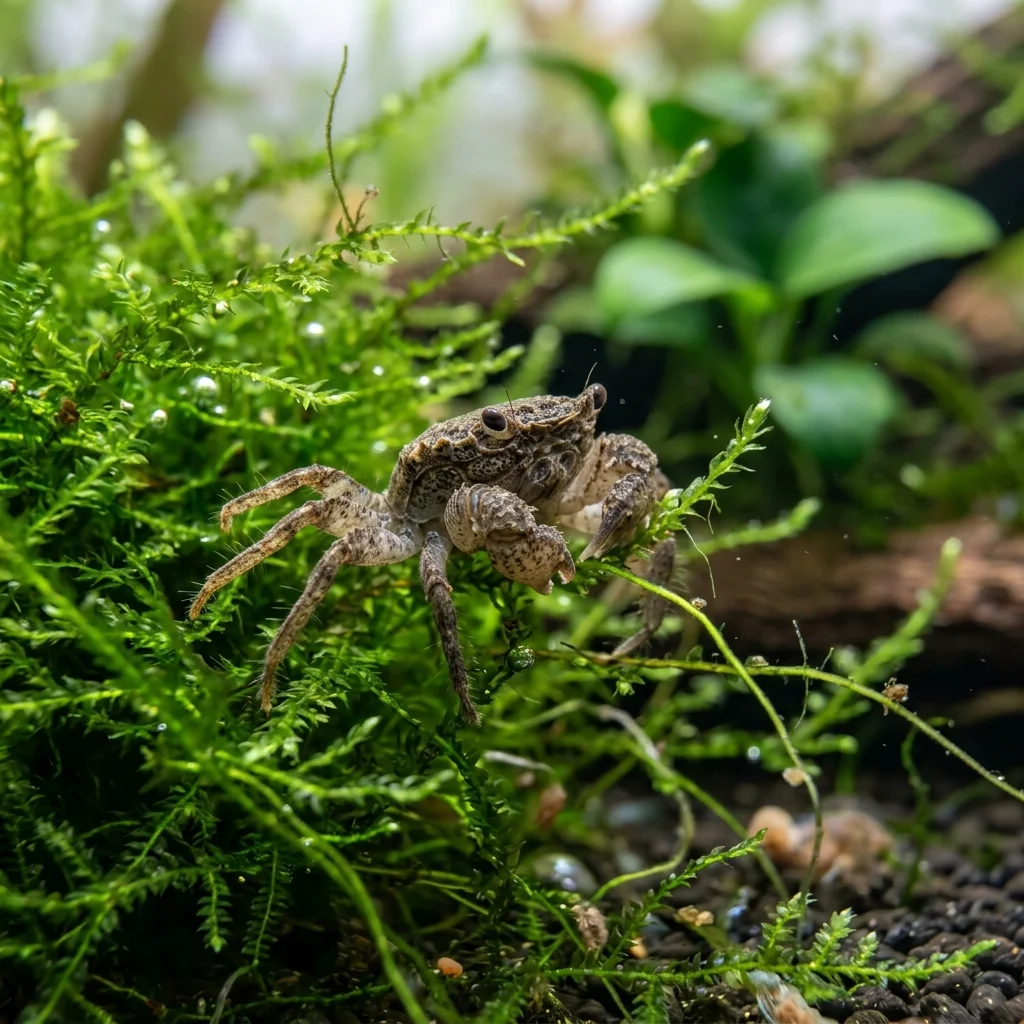
Quick Answer
Thai Micro Crabs (Limnopilos naiyanetri) are tiny, fully aquatic freshwater crabs native to Thailand. They have a carapace width of approximately 0.4 inches (1 cm) and a leg span of about 1 inch (2.5 cm). They require a minimum 5-gallon (19-liter) aquarium with stable water at pH 6.5 to 7.5, general hardness 4 to 15 dGH, and temperatures of 72 to 82 degrees Fahrenheit (22 to 28 degrees Celsius). These peaceful, filter-feeding omnivores are completely harmless to plants and shrimp, making them ideal for nano tanks and invertebrate-only setups.
Quick Facts
| Scientific Name | Limnopilos naiyanetri |
|---|---|
| Common Names | Thai Micro Crab |
| Family | Hymenosomatidae |
| Genus | Limnopilos |
| Type | Freshwater |
| Temperament | peaceful |
| Care Difficulty | intermediate |
| Lifespan | 1.5 years |
| Maximum Size | Up to 1 in (3 cm) |
| Diet | Omnivore |
| Temperature | 72–82°F (22–28°C) |
| pH | 6.5–7.5 |
| Hardness | 4–15 dGH |
| Minimum Size | 5 gallons |
Key Takeaways
- Known for their peaceful temperament and unique filter-feeding behavior using hairy claws.
- Requires at least a 5 gallon aquarium with a group of 5 to 10 individuals.
- Extremely sensitive to copper; lethal at concentrations as low as 0.01 mg/L.
- Fully aquatic and completely harmless to plants, shrimp, and snails.
- Breeding in captivity is extremely rare; larvae require unknown food sources.
Overview
Species Overview
Natural History and Discovery
The Thai Micro Crab (Limnopilos naiyanetri) is a diminutive freshwater crab first described by Chuang and Ng in 1991. It belongs to the family Hymenosomatidae, a group of crabs whose members range from marine to brackish to freshwater habitats. The species was discovered in Thailand by hobby aquarists and introduced to the German aquarium market in 2008. Remarkably, the aquarium hobby is almost ahead of science on this species; detailed information about their biology, ecology, and ethology remains scarce, and much of what is known comes from aquarist observation rather than formal scientific study.
Physical Characteristics
Thai Micro Crabs are among the smallest freshwater crabs available in the aquarium trade. The carapace (shell) measures approximately 0.4 inches (1 cm) in width, roughly the diameter of a pencil eraser. The total leg span reaches about 1 inch (2.5 cm). They possess a flat, pilose (hairy) carapace and chelipeds (legs) covered in fine setae (hairs) that they use for filter-feeding. Coloration ranges from pale transparent to brownish-grey, with some individuals showing slight greenish or yellowish tints depending on diet and environment. Their spider-like appearance and delicate, acrobatic climbing behavior make them visually captivating despite their lack of bright colors.
Natural Habitat
In the wild, Thai Micro Crabs inhabit the roots of water hyacinth and other floating vegetation in slow-moving or stagnant freshwater bodies in Thailand. The water is typically warm, soft to moderately hard, and rich in tannins from decaying plant matter. They are fully aquatic and never leave the water, even for molting or breeding. Their natural habitat provides abundant biofilm, detritus, and microorganisms on which they feed.
Conservation Status
The IUCN has not evaluated Limnopilos naiyanetri. Wild populations are poorly studied, and their exact distribution within Thailand remains unclear. The species is now predominantly commercially farmed for the aquarium trade, though all farmed stock ultimately traces back to wild-collected founders. Their popularity in the hobby has grown rapidly since their introduction, making them one of the most sought-after nano invertebrates.
Why Thai Micro Crabs Captivate Hobbyists
Thai Micro Crabs offer a unique combination of traits that make them irresistible to nano tank enthusiasts and shrimp keepers. They are fully aquatic (no land area needed), completely peaceful, harmless to plants and shrimp, and exhibit fascinating filter-feeding behavior. Their tiny size allows them to thrive in tanks as small as 5 gallons, and their social nature means they are often seen sharing hiding spots in charming clusters. For aquarists who have mastered dwarf shrimp and want a new invertebrate challenge, Thai Micro Crabs represent the next frontier.
Diet
Feeding and Nutritional Requirements
Dietary Composition
Thai Micro Crabs are filter-feeding omnivores that acquire most of their food by using their bristles to filter microorganisms and particulate matter from the water column. They also graze on biofilm, algae, and detritus from surfaces. Their diet consists of approximately 80 percent suspended particles and biofilm, 20 percent protein. In established aquariums with mature biofilm, very little supplemental feeding is needed. However, in newer tanks or sparsely planted setups, regular feeding is essential.
Recommended Foods
- Powdered invertebrate foods: Shrimp King Baby Food, GlasGarten Bacter AE, Golden Pearls, and Nano Bites
- Crushed spirulina tabs and algae wafers
- Blanched spinach, zucchini, and cucumber
- Frozen or live foods: daphnia (water fleas), cyclops, and baby brine shrimp
- Natural grazing: biofilm on moss, driftwood, plant roots, and sponge filters
- Calcium supplementation: cuttlebone, mineral stones, or crushed coral for exoskeleton health
Feeding Schedule
Feed once daily in small amounts that the crabs can consume within 2 to 3 hours. Overfeeding pollutes the water rapidly in small tanks. Distribute food across multiple areas of the tank to ensure all crabs receive adequate nutrition. If kept with dwarf shrimp, feed after lights out when the crabs are most active, as shrimp are faster and bolder feeders. In mature, heavily planted tanks with abundant biofilm, feeding can be reduced to every other day. Remove uneaten food after 4 hours to prevent ammonia spikes.
Foods to Avoid
Never feed beef heart, pork, chicken, or other mammalian proteins. These crabs cannot digest the high fat content and connective tissue. Avoid generic low-quality flakes containing excessive fillers and artificial dyes. Large pellet foods are unsuitable as these crabs cannot grasp or break down large pieces. Foods containing copper or copper sulfate as preservatives must be avoided entirely.
Filter-Feeding Behavior
Thai Micro Crabs are often compared to Bamboo Shrimp (Atyopsis moluccensis) in their feeding strategy. They position themselves in gentle current or still water and extend their hairy claws, capturing passing food particles. They then clean the particles from their claws with their mouthparts. This behavior is most commonly observed at night or in dim lighting. Providing some gentle water movement near their favorite perches encourages this natural feeding behavior and keeps them more active.
Health
See sections.health for comprehensive disease profiles and treatment protocols.
Breeding
Breeding and Reproduction
Reproductive Biology
Thai Micro Crabs are fertilized internally via modified male pleopods called gonopods. After mating, the female carries the egg cluster under her pleon (abdominal flap). The eggs are relatively large at 0.5 to 0.7 mm in diameter and are carried until the larvae (zoea) hatch. The incubation period lasts several weeks. Unlike many freshwater crabs that release miniature adults, Thai Micro Crabs release planktonic larvae that must undergo multiple metamorphoses before becoming crabs. This larval stage is the primary barrier to captive breeding success.
Sexing and Mating Behavior
Sexing requires a magnifying glass. Females have a wider, rounded abdominal flap; males have a narrow, tapered flap. Females carrying eggs show an enlarged abdomen with visible egg clusters. The eggs change color during development: orange at the start, then yellow, and finally grey just before hatching. Mating behavior involves the male climbing onto the female and locking claws. Some observations suggest larger males may be dominant breeders, though the species appears socially monogamous in small groups.
Breeding Challenges
Breeding Thai Micro Crabs in captivity is extremely difficult and remains largely unsolved. While many hobbyists have observed berried females and hatched larvae, the offspring consistently die within days. The larvae are planktonic and require specific, unknown food sources. Various strategies have been attempted without consistent success: feeding larvae with infusoria, green water, powdered foods, and rotifers. Some aquarists speculate the larvae may require an orienting light source, as they are phototactic (attracted to light). Others believe the female may hold the larvae longer than initially thought, releasing them only after partial development. One documented case suggests the female continued holding hatched larvae under her apron, allowing them to develop into young crabs before release.
Breeding Setup Recommendations
If attempting to breed, set up a dedicated 5 to 10-gallon breeding tank with the same parameters as the main tank. Provide abundant Java moss, floating plant roots, and biofilm. Install a fine-pore sponge filter with minimal flow. Ensure the tank is heavily mature with established biofilm before introducing breeders. Feed the female heavily with high-quality powdered foods during egg development. When larvae hatch, provide constant dim lighting as an orienting cue. Remove adult crabs if cannibalism of larvae is observed. Be prepared for repeated failures; successful captive breeding of Thai Micro Crabs would represent a major achievement in the aquarium hobby.
Commercial Availability
All Thai Micro Crabs in the aquarium trade are commercially farmed, as captive breeding by hobbyists has not yet been achieved consistently. The species' popularity has driven demand, and reputable suppliers source from established farms. When purchasing, select active crabs with intact exoskeletons and no visible damage. Avoid crabs that appear lethargic or have discolored shells.
Compatible Tank Mates






Species Comparison
| Feature | Thai Micro Crab | Cherry Shrimp | Amano Shrimp | Dwarf Crayfish |
|---|---|---|---|---|
| Adult Size | 0.4 inches carapace (1 cm) | 1 to 1.5 inches (2.5 to 3.8 cm) | 2 inches (5 cm) | 1.5 to 2 inches (3.8 to 5 cm) |
| Temperament | Peaceful | Peaceful | Peaceful | Semi-aggressive |
| Minimum Tank Size | 5 gallons (19 L) | 5 gallons (19 L) | 10 gallons (38 L) | 10 gallons (38 L) |
| Diet | Filter-feeding omnivore | Omnivore scavenger | Omnivore algae-eater | Omnivore predator |
| pH Range | 6.5 to 7.5 | 6.5 to 8.0 | 6.5 to 7.5 | 6.5 to 8.0 |
| Water Hardness | 4 to 15 dGH | 4 to 15 dGH | 4 to 15 dGH | 6 to 15 dGH |
| Breeding Difficulty | Extremely Difficult (larval stage) | Easy | Very Difficult (brackish larvae) | Moderate |