
Yellow Tang (Zebrasoma flavescens)
Quick Answer
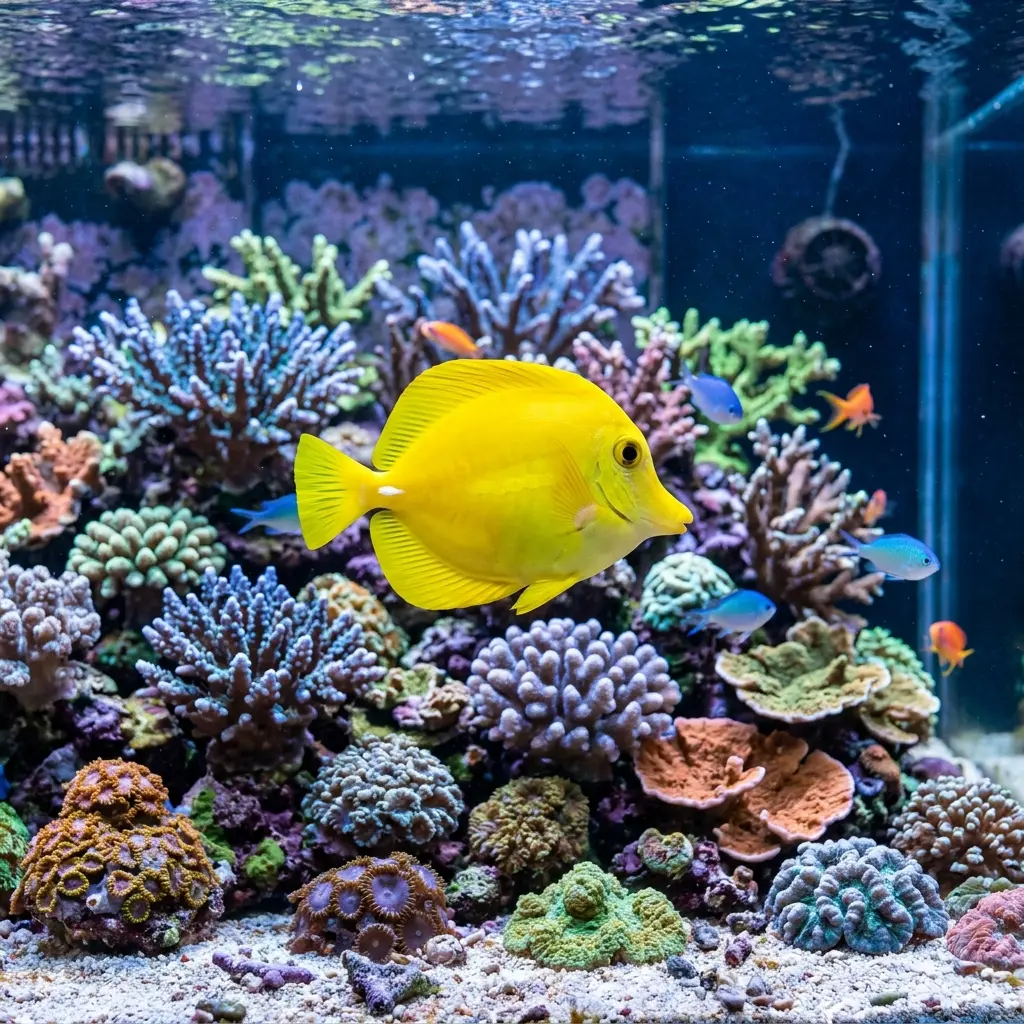
Yellow Tang (Zebrasoma flavescens) is an iconic, bright yellow surgeonfish endemic to the Hawaiian Islands and Pacific Ocean. It requires a minimum 100 gallon (378 liter) aquarium with a pH of 8.1 to 8.4, specific gravity of 1.023 to 1.025, and temperature range of 72 to 80 degrees Fahrenheit (22 to 27 degrees Celsius). This strict herbivore grows to 8 inches (20 cm), needs abundant live rock for grazing, strong water flow, and must be kept singly in all but the largest systems.
Quick Facts
| Scientific Name | Zebrasoma flavescens |
|---|---|
| Common Names | Yellow Tang |
| Family | Acanthuridae |
| Genus | Zebrasoma |
| Type | Saltwater |
| Temperament | semi-aggressive |
| Care Difficulty | intermediate |
| Lifespan | 10 years |
| Maximum Size | Up to 8 in (20 cm) |
| Diet | Herbivore |
| Temperature | 72–80°F (22–27°C) |
| pH | 8.1–8.4 |
| Hardness | 7–12 dGH |
| Minimum Size | 100 gallons |
Key Takeaways
- Known for its brilliant uniform yellow coloration and active grazing behavior.
- Requires at least a 100 gallon (378 liter) aquarium with 4 feet of swimming space.
- Strict herbivore requiring daily nori sheets and constant algae grazing.
- Keep only one per tank unless in 180+ gallons with a group of 5 to 6 juveniles.
- Extremely susceptible to marine ich; 21-day quarantine is mandatory.
- Color changes from bright yellow to greyish-brown at night for camouflage.
- Possesses sharp white tail scalpels; never catch with a net.
- Captive-bred specimens available from Biota and other aquaculture facilities.
Diet
Diet and Feeding Protocol
Natural Diet
In the wild, Yellow Tangs are strict herbivores that graze continuously on filamentous algae, film algae, diatoms, and seaweed growing on coral bases and rock surfaces. Their flexible comb-teeth allow them to pry algae from crevices and scrape it from hard surfaces. They serve an important ecological role by preventing algae from overgrowing and outcompeting corals for space on the reef.
Captive Diet Composition
You must provide a diet consisting of approximately 90% marine algae, 5% vegetable matter, and 5% protein. They require near-constant grazing opportunities. Feed at least twice daily with portions consumed within 2 to 3 minutes, plus constant access to algae on live rock.
- Staple Foods: High-quality dried nori sheets (seaweed) pinned to a feeding clip daily. One full sheet per adult fish is the minimum. Nori is the single most important dietary component for long-term health.
- Pellets and Flakes: Spirulina-based herbivore pellets and marine herbivore flakes offered daily.
- Vegetable Supplements: Blanched romaine lettuce, zucchini, and spinach offered 2 to 3 times weekly.
- Protein Supplements: Frozen mysis shrimp or brine shrimp offered once weekly only. Excessive protein causes digestive issues in strict herbivores.
Grazing Behavior
Yellow Tangs spend their entire day in motion, grazing on every available surface including live rock, aquarium glass, powerhead cords, and coral bases. This constant grazing is not just feeding behavior; it is their natural lifestyle. A tank with insufficient algae growth on rock surfaces requires heavier supplemental feeding.
Common Dietary Mistakes
Underfeeding is the primary error. An underfed Yellow Tang develops a sunken belly, becomes lethargic, and turns more aggressive toward tank mates. Do not rely solely on pellet foods; nori sheets are essential for proper gut function and HLLE prevention. Excessive protein causes intestinal blockages and fatty liver disease in herbivorous surgeonfish.
Health
Health and Disease Management
Yellow Tangs are hardy but extremely susceptible to marine ich (Cryptocaryon irritans) and Head and Lateral Line Erosion (HLLE). Their scaleless bodies make them hypersensitive to poor water quality, particularly elevated nitrates. Quarantine all new arrivals for a minimum of 21 days in a separate system. Maintain pristine water quality with zero ammonia and nitrite and nitrates below 5 ppm.
Preventive Care
Perform weekly 25% water changes, maintain nitrates below 5 ppm, and run a protein skimmer continuously. Use a UV sterilizer at 25 watts per 100 gallons to reduce free-floating pathogens. Test water parameters weekly. A Deep Sand Bed and refugium with macroalgae help control nitrate accumulation. Because they are scaleless, even brief exposure to elevated ammonia causes chemical burns and secondary infections.
Marine Ich (Cryptocaryon irritans)
A ciliated protozoan parasite that encysts on fish skin and gills, causing white salt-like spots. Yellow Tangs are among the most susceptible marine fish to this parasite.
- Small white cysts on fins, body, and gills; flashing against rockwork; rapid opercular movement; clamped fins; lethargy; loss of appetite.
Introduced via unquarantined fish, invertebrates, or live rock; triggered by temperature drops or stress from poor water quality or cramped tanks.
Quarantine all new livestock for 21 days; maintain stable temperature at 75 to 78 degrees Fahrenheit (24 to 26 degrees Celsius); use UV sterilization; avoid temperature fluctuations.
Marine Velvet (Amyloodinium ocellatum)
A dinoflagellate parasite that causes a fine yellowish-brown or rusty dusting on the skin and rapid respiratory distress. Often fatal within days.
- Fine velvety film on body; rapid breathing; scratching against substrate; lethargy; clamped fins; loss of appetite; often fatal within days if untreated.
Introduced via contaminated water, fish, or invertebrates; thrives in temperatures above 80 degrees Fahrenheit (27 degrees Celsius); stress from poor water quality.
Strict 21-day quarantine protocol; avoid temperature spikes; maintain excellent water quality; use a UV sterilizer.
Head and Lateral Line Erosion (HLLE)
A degenerative condition causing pitting and erosion around the eyes, head, and along the lateral line. Extremely common in tangs and directly linked to elevated nitrates.
- Pitted lesions around the eyes and along the lateral line; faded coloration; recessed tissue on the head; progressive deterioration if untreated.
High nitrate levels above 40 ppm; poor water quality; inadequate diet lacking in vitamins and fatty acids; carbon filtration removing trace elements; stray voltage.
Maintain nitrates below 5 ppm through weekly 25% water changes; use a Deep Sand Bed and refugium; feed vitamin-enriched varied diet; replace activated carbon monthly; ground all electrical equipment.
Brooklynella (Brooklynella hostilis)
A ciliated protozoan that attacks skin and gills, commonly called clownfish disease but affects many marine species including tangs.
- Sloughed skin and mucus; cloudy appearance; rapid breathing; loss of appetite; lethargy; death within days in severe cases.
Direct transmission from infected fish; stress from shipping or poor water quality; overcrowding in quarantine.
Quarantine all new fish for 21 days; avoid overcrowding; maintain stable salinity and temperature during acclimation.
Uronema marinum
A ciliate parasite that infects marine fish, particularly in suboptimal salinity or temperature conditions. Can be fatal within 24 to 48 hours.
- Reddish sores or ulcers on body; rapid deterioration; lethargy; loss of appetite; death within 24 to 48 hours in acute cases.
Introduced via live foods or contaminated systems; exacerbated by temperatures below 73 degrees Fahrenheit (23 degrees Celsius) or salinity below 1.020.
Maintain salinity at 1.023 to 1.025; maintain temperature above 75 degrees Fahrenheit (24 degrees Celsius); quarantine live foods before feeding.
Breeding
Breeding Yellow Tangs
Current Status
Commercial captive breeding of Zebrasoma flavescens was first achieved at the Oceanic Institute in Hawaii in 2015, marking a milestone for marine aquaculture. As of 2026, Biota and other hatcheries produce captive-bred Yellow Tangs commercially. This is not feasible for home aquarists and requires massive systems, hormonal induction, and specialized larval rearing.
Reproductive Biology
Yellow Tangs are pelagic spawners with no distinct sexual dimorphism visible to hobbyists. Commercial breeders use human chorionic gonadotropin (HCG) injections to induce spawning. Conditioned pairs rise into the water column at dusk and release 10,000 to 40,000 buoyant eggs in a cloud of milt.
Spawning and Egg Care
Eggs are buoyant and drift in the water column. They hatch in approximately 24 hours into pelagic larvae approximately 2.5 mm in length. Because the eggs and larvae are pelagic, they require specialized systems with gentle circulation that keeps them suspended without damaging them.
Larval Rearing Challenges
Larvae require continuous supplies of enriched rotifers, copepod nauplii, and phytoplankton for 60 to 80 days. Metamorphosis to juvenile form occurs at approximately 1.5 inches (4 cm). Mortality is extremely high without dedicated larval rearing systems, precise water quality control, and constant live food production. This is why home breeding is not recommended.
Captive-Bred vs. Wild-Caught
Captive-bred Yellow Tangs are increasingly available and offer significant advantages: they are not exposed to wild pathogens, they settle into aquariums more readily, they accept prepared foods from a young age, and they support sustainable aquarium practices. Wild-caught adults can be more challenging to acclimate and are more likely to carry parasites.
Compatible Tank Mates






Species Comparison
| Feature | Yellow Tang | Blue Tang | Kole Tang | Sailfin Tang |
|---|---|---|---|---|
| Scientific Name | Zebrasoma flavescens | Paracanthurus hepatus | Ctenochaetus strigosus | Zebrasoma veliferum |
| Max Size | 8 in (20.3 cm) | 12 in (30.5 cm) | 7 in (17.8 cm) | 15 in (38 cm) |
| Temperament | Semi-aggressive | Semi-aggressive | Peaceful | Semi-aggressive |
| Minimum Tank Size | 100 gal (378 L) | 125 gal (473 L) | 70 gal (265 L) | 125 gal (473 L) |
| Diet | Herbivore (90% algae) | Herbivore | Herbivore | Herbivore |
| Reef Safe | Yes (with caution) | Yes (with caution) | Yes | Yes (with caution) |
| Special Trait | Color changes daily; tail scalpels | Famous from Finding Nemo | Yellow eye; excellent algae control | Dramatic fin extension |