
Zebra Loach (Botia striata)
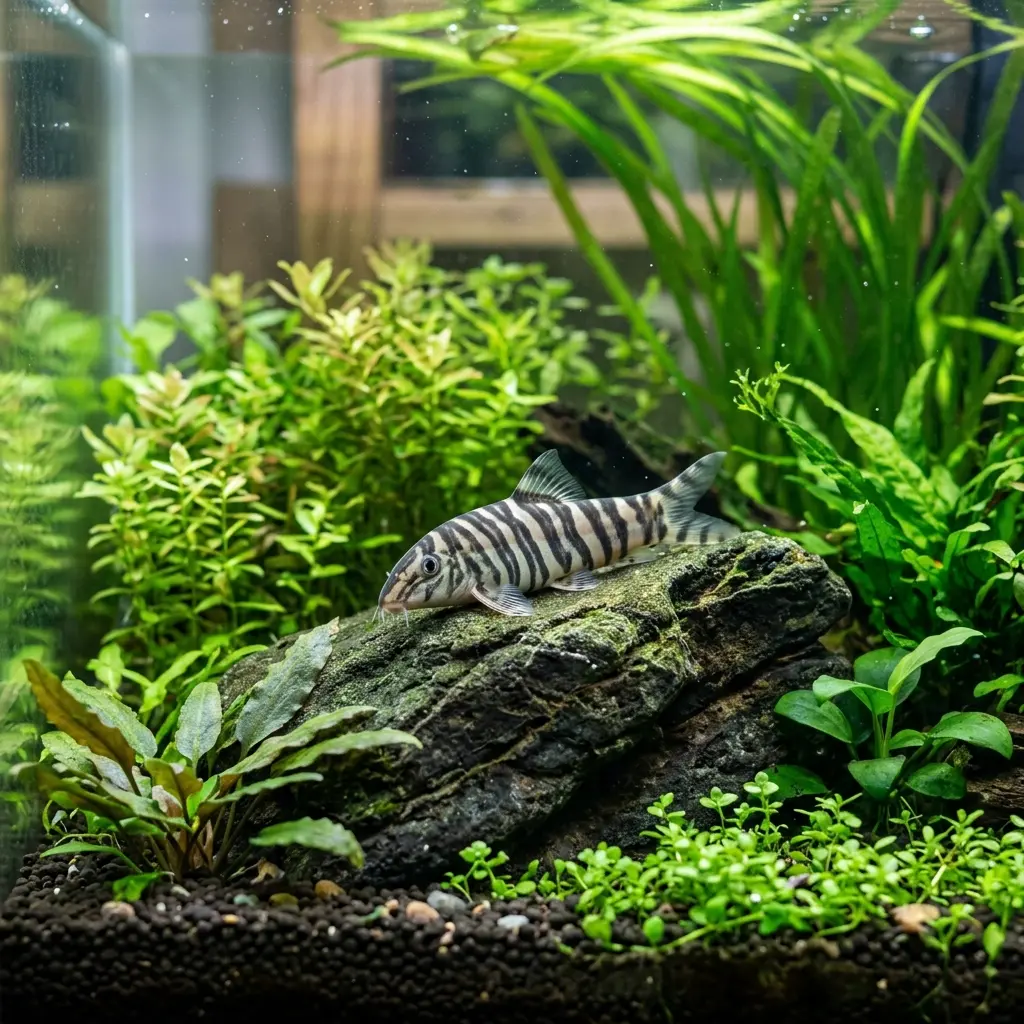
Quick Answer
The Zebra Loach (Botia striata) is an endangered, scaleless loach endemic to the Western Ghats of India. It requires a minimum 30-gallon aquarium with fine sand substrate, a group of 6 or more individuals, stable water parameters (pH 6.5-7.5, 73-79°F), and is highly sensitive to copper-based medications. An excellent snail controller for planted community tanks.
Quick Facts
| Scientific Name | Botia striata |
|---|---|
| Common Names | Zebra Loach |
| Family | Botiidae |
| Genus | Botia |
| Type | Freshwater |
| Temperament | peaceful |
| Care Difficulty | intermediate |
| Lifespan | 12 years |
| Maximum Size | Up to 3.5 in (9 cm) |
| Diet | Omnivore |
| Temperature | 72–79°F (22–26°C) |
| pH | 6.5–7.5 |
| Hardness | 4–12 dGH |
| Minimum Size | 30 gallons |
Key Takeaways
- Endangered species endemic to India's Western Ghats; prefer captive-bred specimens.
- Functionally scaleless — never use copper medications; dose all treatments at half strength.
- Requires groups of 6 or more; smaller groups result in fatal bullying and stress.
- Fine sand substrate is mandatory; gravel causes barbel erosion and starvation.
- Diurnal and highly active — visible during daylight unlike Kuhli Loaches.
- Excellent natural snail control for planted aquariums; will consume all dwarf shrimp.
- Minimum tank size: 30 gallons (113 L) with 36-inch (90 cm) minimum length.
- Lifespan: 8 to 15 years with optimal care and pristine water quality.
Overview
Species Overview
The Zebra Loach (Botia striata) is one of the most visually striking and behaviorally rewarding loaches available to the intermediate aquarist. Endemic to the fast-flowing, shaded streams of India's Western Ghats — a UNESCO biodiversity hotspot — this species carries the unfortunate distinction of being listed as Endangered on the IUCN Red List due to habitat degradation and overcollection for the aquarium trade.
Unlike its larger cousin the Clown Loach or its more reclusive relative the Kuhli Loach, the Zebra Loach occupies a unique niche: it is small enough for a 30-gallon community tank, bold enough to display during daylight hours, and social enough to form fascinating dominance hierarchies within its group. Its alternating vertical black and gold-brown stripes create a dramatic contrast that intensifies dramatically over dark substrate.
Botia striata is a scaleless fish with highly sensitive barbels, making substrate choice and medication protocols absolutely critical to long-term survival. This is not a fish for the unprepared aquarist. Success demands stable water chemistry, appropriate social grouping, and meticulous attention to quarantine protocols.
Diet
Diet & Nutrition
Botia striata is an opportunistic omnivore with a strong preference for animal protein. In the wild, they consume insect larvae, small crustaceans, worms, mollusks, and detritus. In captivity, a varied diet prevents nutritional deficiencies and maintains the vibrant stripe coloration that makes this species desirable.
Health
Health & Disease Management
Botia striata is a hardy fish when provided with optimal conditions, but its scaleless nature and wild-caught origin make it susceptible to specific diseases. Prevention through quarantine, pristine water quality, and proper acclimation is infinitely more effective than treatment. You must understand medication sensitivity before the first sign of illness appears.
Ichthyophthirius multifiliis (Ich / White Spot Disease)
The most common external parasite affecting Zebra Loaches, caused by the ciliated protozoan Ichthyophthirius multifiliis. Triggered by temperature fluctuations, stress from transport, or introduction of infected tank mates.
- White pinhead-sized spots (salt-grain appearance) on body, fins, and gills; rapid gill movement; flashing against decor; clamped fins; loss of appetite; hiding behavior.
Sudden temperature drops below 72°F (22°C); introduction of infected fish without quarantine; stress from poor water quality; overcrowding.
Quarantine all new fish for 4 weeks. Maintain stable temperature between 74°F and 78°F (23°C and 25.5°C). Avoid temperature swings exceeding 2°F (1°C) during water changes.
Skinny Disease (Internal Parasites)
A chronic wasting condition caused by internal protozoan or nematode parasites, extremely common in wild-caught imports. The fish eats normally but loses weight progressively until death occurs.
- Sunken belly with normal or increased appetite; visible spinal column; stringy white or translucent feces; loss of color intensity; lethargy; emaciation despite feeding.
Wild capture and importation without prophylactic treatment; feeding live foods from contaminated sources; introduction of infected fish to the display tank.
Quarantine all new loaches for 4 to 6 weeks. Administer a prophylactic treatment with Praziquantel or Levamisole HCl during week 2 of quarantine. Purchase only from reputable dealers who quarantine imports.
Barbel Erosion & Secondary Bacterial Infection
Mechanical damage to the sensitive barbels from improper substrate, leading to secondary bacterial infections by Aeromonas or Columnaris bacteria. This is a direct consequence of poor husbandry.
- Shortened, frayed, or reddened barbels; redness at the mouth; difficulty foraging; weight loss; white cottony patches around the mouth (Columnaris).
Sharp gravel or coarse substrate; high nitrate levels above 20 ppm; poor water quality; fighting with tank mates.
Use only fine sand substrate. Maintain nitrates below 15 ppm. Perform weekly water changes. Add Vitamin C to the diet to support tissue regeneration.
Fluke Infestation (Dactylogyrus / Gyrodactylus)
Monogenean flatworms that attach to gills and skin, causing respiratory distress and tissue damage. Common in wild-caught specimens and live food sources.
- Excessive mucus production; rapid gilling; flashing against surfaces; clamped fins; reddened or swollen gill tissue; difficulty breathing at the water surface.
Introduction of infected fish; contaminated live foods; poor water quality reducing immune function.
Breeding
Breeding in Captivity
Let us be absolutely clear: there are no verified reports of Botia striata breeding in home aquariums. Commercial breeders rely exclusively on hormone-induced spawning in specialized facilities. The species' reproductive biology remains poorly understood, and hobbyist attempts have been universally unsuccessful.
What follows is a compilation of hypothetical conditions extrapolated from related Botia species and anecdotal observations. Do not purchase this species with the expectation of breeding success.
Tips
Common Mistakes to Avoid
- Keeping fewer than 6 individuals. This is the number one cause of loach mortality in home aquariums. Three loaches means one bully and two victims. Five is barely functional. Six is the absolute minimum.
- Using gravel substrate. Sharp gravel destroys barbels within weeks. The fish cannot forage effectively and starves despite food being present.
- Treating with copper or full-dose medications. Scaleless fish die from standard medication doses. Always verify loach-safety on medication labels.
- Skipping quarantine. Wild-caught loaches almost always carry parasites. Introducing them directly to a display tank infects the entire system.
- Overfeeding to compensate for perceived hunger. Loaches constantly forage and appear hungry. Overfeeding causes obesity, fatty liver disease, and nitrate spikes.
- Housing with shrimp. Dwarf shrimp are expensive live food. Do not expect coexistence.
Expert Tips for Long-Term Success
- Dark substrate is non-negotiable for color display. On black sand, the vertical stripes become jet black against a golden-copper base. On white sand, the fish appear sickly and washed out.
- Feed after lights-out competition subsides. If mid-water fish outcompete loaches at feeding time, turn off the filter and lights for 5 minutes while sinking pellets descend.
- Add leaf litter. Indian Almond leaves or oak leaves provide tannins, lower pH slightly, create grazing surfaces for biofilm, and replicate the natural habitat.
- Monitor barbel length weekly. Barbels should be long, thin, and pinkish-white. Shortened or reddened barbels indicate substrate problems or water quality issues.
- Buy the entire group simultaneously. Adding new loaches to an established group often triggers territorial disputes. Introduce all individuals at once, or rearrange the aquascape when adding new fish.
- Choose captive-bred when possible. Wild-caught specimens carry parasites and stress from collection and transport. Support conservation by demanding captive-bred stock from your retailer.
Compatible Tank Mates






Species Comparison
| Feature | Zebra Loach | Yoyo Loach | Kuhli Loach | Clown Loach |
|---|---|---|---|---|
| Scientific Name | Botia striata | Botia almorhae | Pangio semicincta | Chromobotia macracanthus |
| Maximum Size | 3.5 in (8.9 cm) | 6 in (15 cm) | 4 in (10 cm) | 12 in (30 cm) |
| Minimum Tank Size | 30 gal (113 L) | 55 gal (208 L) | 20 gal (75 L) | 125 gal (473 L) |
| Temperament | Peaceful; hierarchy within group | Semi-aggressive; boisterous | Very peaceful; extremely shy | Peaceful; playful giants |
| Activity Pattern | Diurnal (active during day) | Diurnal; highly active | Nocturnal (hides until dark) | Diurnal; very social |
| Minimum Group Size | 6 individuals | 5 individuals | 6 individuals | 6 individuals |
| Substrate Requirement | Fine sand mandatory | Fine sand preferred | Fine sand mandatory | Fine sand preferred |
| Snail Control Ability | Excellent; small pest snails | Excellent; larger snails too | Poor; too small and passive | Excellent; all snail sizes |