
Kuhli Loach (Pangio kuhlii)
Quick Answer
Kuhli Loaches (Pangio kuhlii), also known as Coolie Loaches, are eel-shaped, scaleless freshwater bottom dwellers native to Southeast Asia. They reach 3 to 4 inches (7.5 to 10 cm) in length and require a minimum 20-gallon (75-liter) aquarium with soft sand substrate, pH 6.0 to 7.5, general hardness 3 to 10 dGH, and temperatures of 75 to 86 degrees Fahrenheit (24 to 30 degrees Celsius). These peaceful, nocturnal omnivores must be kept in groups of 5 or more and are extremely sensitive to copper-based medications due to their scaleless bodies.
Quick Facts
| Scientific Name | Pangio kuhlii |
|---|---|
| Common Names | Kuhli Loach |
| Family | Cobitidae |
| Genus | Pangio |
| Type | Freshwater |
| Temperament | peaceful |
| Care Difficulty | beginner |
| Lifespan | 10 years |
| Maximum Size | Up to 4 in (10 cm) |
| Diet | Omnivore |
| Temperature | 75–86°F (24–30°C) |
| pH | 6–7.5 |
| Hardness | 3–10 dGH |
| Minimum Size | 20 gallons |
Key Takeaways
- Known for their peaceful temperament and eel-like appearance with alternating banded coloration.
- Requires at least a 20 gallon aquarium with a group of 5 to 6 individuals minimum.
- Fine sand substrate is mandatory; gravel causes barbel erosion and skin infections.
- Scaleless fish requiring reduced-dose medication protocols; copper and formalin are lethal.
- Nocturnal feeders that require food after lights out; filter intake guards are mandatory.
Overview
Species Overview
Natural History and Distribution
The Kuhli Loach (Pangio kuhlii), also commonly known as the Coolie Loach, is a fascinating freshwater species native to Southeast Asia, particularly Indonesia, Malaysia, Singapore, Thailand, Java, Sumatra, and Borneo. It belongs to the family Cobitidae and is one of the most popular loach species in the aquarium hobby. This eel-shaped bottom dweller inhabits warm, slow-moving rivers and streams with soft sandy bottoms, dense vegetation, and abundant leaf litter. Their natural habitat provides endless hiding opportunities and a rich supply of microorganisms, detritus, and small invertebrates.
Physical Characteristics
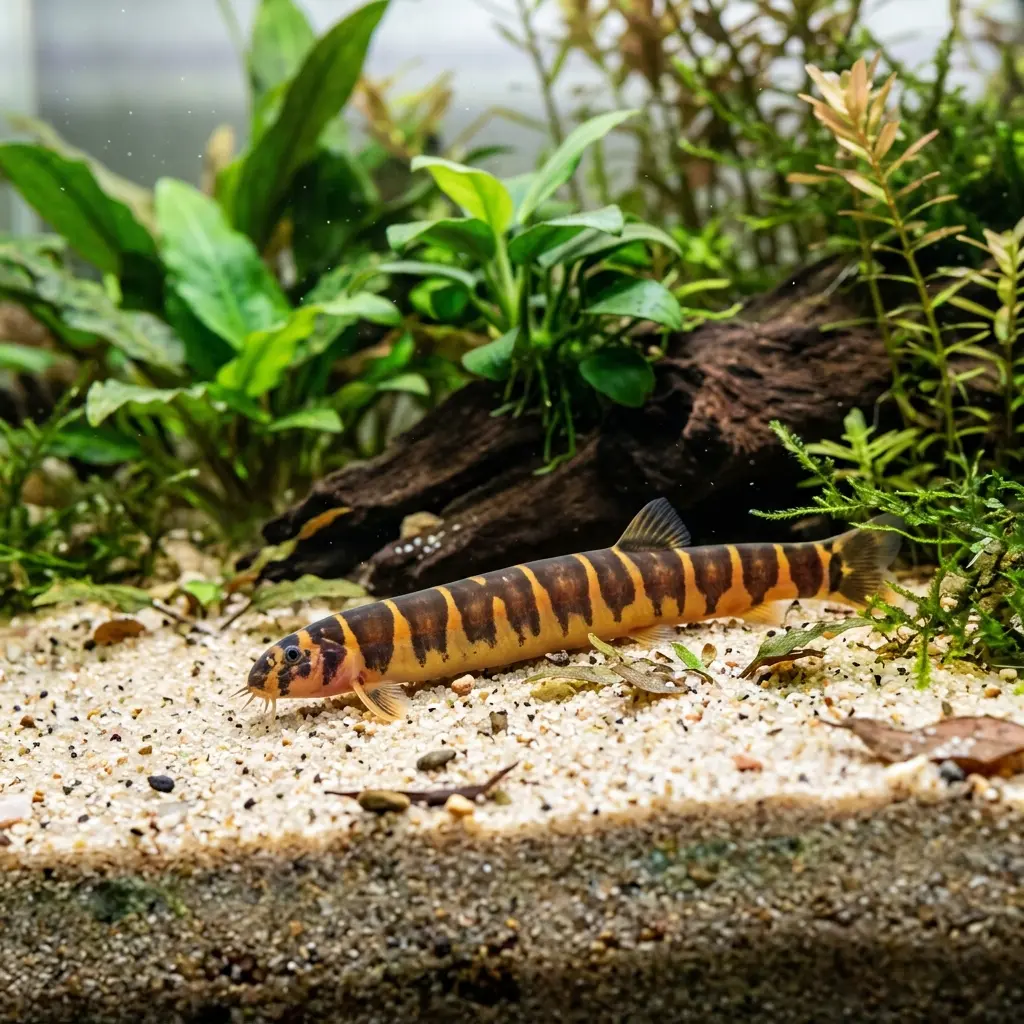
Adult Kuhli Loaches reach approximately 3 to 4 inches (7.5 to 10 cm) in length, with some specimens growing up to 5 inches (12.5 cm) under optimal conditions. They possess a distinctive, slender, eel-like body with alternating pinkish-yellow and dark brown to black bands that half-circle the body. The stomach is whitish, and the eyes are set within one of the dark stripes, making them difficult to see. The mouth is set at a downward angle and adorned with three pairs of bushy barbels, giving them an unmistakable appearance. Their fins are translucent. An albino form with a white body and pinkish markings is occasionally available in the trade. Unlike most aquarium fish, Kuhli Loaches are scaleless, with no scales on their heads and widely spaced scales on their bodies, leaving unprotected gaps.
Conservation Status
The IUCN lists Kuhli Loaches as Not Evaluated. Wild populations remain robust across their native range, and the species is now predominantly commercially farmed for the aquarium trade. Their adaptability to a wide range of water parameters and their small bioload have made them one of the most sustainable and beginner-friendly bottom dwellers available.
Why Kuhli Loaches Captivate Hobbyists
Kuhli Loaches are the quintessential oddball fish. Their eel-like shape, nocturnal antics, and social stacking behavior make them endlessly fascinating. When kept in proper groups with adequate hiding places, they become surprisingly bold, often seen writhing together in a tangled pile or exploring the substrate in a synchronized wave. Their low bioload, peaceful nature, and compatibility with most community fish make them an excellent addition to planted tanks. With a lifespan of up to 10 years, they are a long-term commitment that rewards patience and proper care.
Diet
Feeding and Nutritional Requirements
Dietary Composition
Kuhli Loaches are omnivorous bottom feeders and efficient scavengers. Their ideal dietary composition is approximately 40 percent protein, 10 percent fat, and 50 percent plant matter, detritus, and microorganisms. In the wild, they consume small invertebrates, insect larvae, worms, algae, and organic debris sifted from the substrate. In the aquarium, they will eat leftover food that sinks to the bottom, but supplemental feeding is essential to ensure proper nutrition. Their small mouths are not designed to rip chunks of food; they nibble and sift.
Recommended Foods
- Sinking catfish pellets, shrimp granules, and bottom-dweller formulated micro-pellets
- Frozen or live foods: bloodworms, blackworms, brine shrimp, daphnia, and mysis shrimp
- Vegetable matter: blanched zucchini, spinach, cucumber, and algae wafers
- Supplemental grazing: biofilm, microorganisms, and detritus from sand and leaf litter
- Conditioning foods for breeding: live blackworms and gut-loaded brine shrimp fed daily for 4 weeks
Feeding Schedule
Feed adult Kuhli Loaches once or twice daily, offering only what they can consume within a few minutes. They are nocturnal feeders and often miss out when faster fish eat everything during the day. Feed just before lights out or after the tank has been dark for an hour to ensure they receive adequate nutrition. Use a red flashlight to observe their natural foraging behavior without startling them. Place food in the same spot daily to establish a routine. Remove uneaten food after 4 hours to maintain water quality. In community tanks with fast feeders, target-feed the loaches directly to prevent starvation.
Foods to Avoid
Never feed beef heart, pork, chicken, or other mammalian proteins. Kuhli Loaches cannot digest the high fat content and connective tissue, leading to intestinal blockages and premature death. Avoid generic low-quality flakes containing excessive fillers and artificial dyes. Large pellet foods are unsuitable as these fish have small mouths and cannot grasp large pieces. Foods containing copper or copper sulfate as preservatives must be avoided entirely due to their scaleless sensitivity.
Foraging Enrichment
Scatter or bury small amounts of food in the substrate to encourage natural rooting and sifting behavior. Vary the menu to prevent nutritional deficiencies. A quiet, dimly lit tank with live plants and leaf litter harbors microorganisms that the loaches graze on between feedings, providing natural enrichment and supplemental nutrition.
Health
See sections.health for comprehensive disease profiles and treatment protocols.
Breeding
Breeding and Reproduction
Reproductive Biology
Kuhli Loaches are egg-scattering free spawners with no parental care. They reach sexual maturity at 1 to 1.5 years of age when approximately 3 inches (7.5 cm) in length. Females can carry 500 to 1,000 eggs, though only 50 to 200 are released in a single spawning event. The eggs are bright green, adhesive, and approximately 1 mm in diameter. Fertilization is external. In nature, eggs attach to leaves and roots of plants; in the aquarium, they often fall to the bottom where adults consume them.
Sexing and Conditioning
Sexing Kuhli Loaches requires close observation. Males are generally thinner with more intense coloration, particularly on the ventral side. Females are rounder and fuller, especially when gravid; a female full of eggs is nearly twice as thick as a male and may show a greenish ovary visible through the body wall. Males have a slightly more pointed anal fin, and the first ray of the pectoral fin is thicker. To condition breeders, separate males and females and feed live blackworms, bloodworms, and brine shrimp daily for 4 weeks.
Breeding Triggers and Spawning Behavior
The key trigger for spawning is simulating the rainy season. Lower the water level to 5 inches (12 cm) in the breeding tank. After a week, gradually increase the water level with soft reverse osmosis water infused with oak bark or Indian Almond Leaf decoction. Perform a 40 percent water change with cool water at 68 degrees Fahrenheit (20 degrees Celsius) and pH 6.5 over 2 hours. Raise the temperature to 79 to 82 degrees Fahrenheit (26 to 28 degrees Celsius). Spawning typically occurs at night or in the dim early light. Pairs swim up and down together, intertwine around each other, and splash along the surface where the female releases bright green adhesive eggs that are fertilized by the male. The eggs float briefly, then slowly sink.
Breeding Tank Setup
Set up a dedicated 10 to 20-gallon (38 to 75 liter) breeding tank with dim lighting, no substrate, and a protective mesh net on the bottom to catch falling eggs. Target parameters: pH 6.0 to 6.8, dGH 3 to 6, and temperature 79 to 82 degrees Fahrenheit (26 to 28 degrees Celsius). Use an air-driven sponge filter for gentle filtration and oxygenation. Provide spawning mops, dense Java moss, or floating plant roots as egg deposition sites. Maintain a ratio of 2 females per male. Remove adults immediately after spawning to prevent egg predation.
Egg and Fry Development
Eggs hatch in 24 to 36 hours depending on temperature. The fry consume their yolk sac on the first day and become free-swimming shortly after. Keep the tank dark for the first week. Initial food must be infusoria, microworms, vinegar eels, or rotifers for the first 5 days. Transition to baby brine shrimp, daphnia, or frozen cyclops after day 7. Pigmented spots develop at approximately 2 weeks of age. By 1 month, fry reach 0.6 to 0.8 inches (1.5 to 2 cm). Growth is moderate, and the characteristic banding becomes visible within the first month. Professional breeders sometimes use hormonal injections of chorionic gonadotropin to induce spawning, but this is not recommended for hobbyists due to the risk of fatal infection.
Compatible Tank Mates






Species Comparison
| Feature | Kuhli Loach | Yoyo Loach | Clown Loach | Dojo Loach |
|---|---|---|---|---|
| Adult Size | 3 to 4 inches (7.5 to 10 cm) | 5 to 6 inches (13 to 15 cm) | 12 inches (30 cm) | 6 to 8 inches (15 to 20 cm) |
| Temperament | Peaceful | Peaceful | Peaceful | Peaceful |
| Minimum Tank Size | 20 gallons (75 L) | 40 gallons (151 L) | 75 gallons (284 L) | 55 gallons (208 L) |
| Diet | Omnivore | Omnivore | Omnivore | Omnivore |
| pH Range | 6.0 to 7.5 | 6.5 to 7.5 | 6.0 to 7.5 | 6.5 to 8.0 |
| Water Hardness | 3 to 10 dGH | 5 to 12 dGH | 5 to 12 dGH | 5 to 15 dGH |
| Substrate Requirement | Fine sand mandatory | Fine sand preferred | Fine sand preferred | Fine sand preferred |