Quick Answer
A 2-3 sentence summary that directly answers the main premise of the blog post. This should be highly concise and optimized for AI Overviews and Google featured snippets.
Key Takeaways
- Prevent deadly ammonia spikes and massive algae blooms by avoiding overfeeding, which remains the single most common cause of complete aquarium crashes for beginners.
- Maintain perfect water quality by applying the two-minute rule: strictly feed only the exact amount of food your fish can completely consume within two minutes.
- Keep adult tropical community fish healthy and active by feeding them just once a day, or even every other day, as their energy requirements are surprisingly low.
- Prevent severe bloating and swim bladder disease in betta fish by feeding pre-soaked sinking pellets and strictly fasting them for one full day every week.
- Manage short vacations safely by simply fasting your fish for two to four days instead of using messy vacation feeder blocks that severely pollute the water.
The Biggest Beginner Mistake: Killing with Kindness
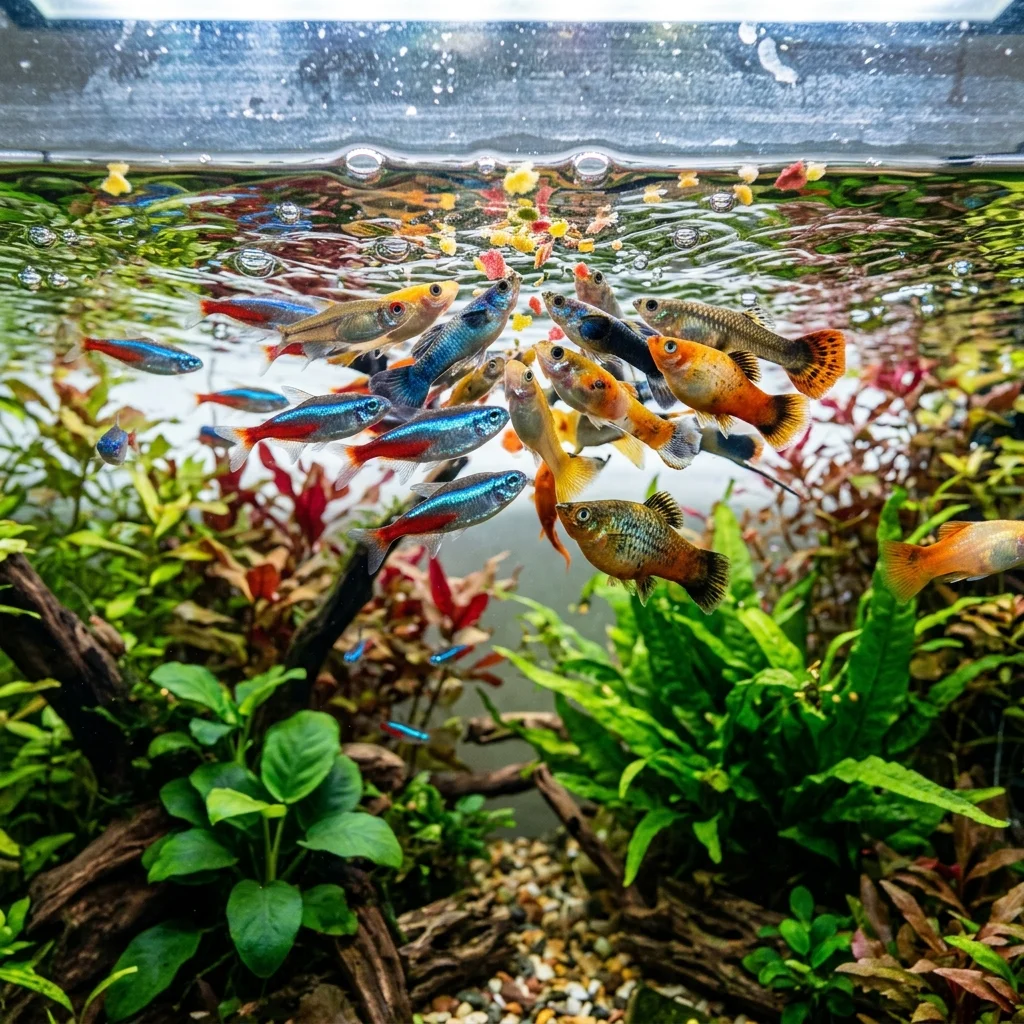
When you walk past your aquarium, your fish will probably rush to the glass, wiggle enthusiastically, and beg for food. It is incredibly tempting to sprinkle a few flakes in every time they do this. Don't. Overfeeding is the single most common cause of aquarium crashes.
Uneaten food falls to the substrate and rots, producing massive amounts of ammonia. Even if your nitrogen cycle converts that ammonia, it leads to rapid nitrate build-up, which causes algae blooms and stunts fish growth.
Should You Feed Your Fish Every Day?
For most adult fish, feeding once a day is perfectly sufficient. In fact, many experienced aquarists feed their adult community fish only every other day without any health issues. Fish are cold-blooded and do not burn calories maintaining body heat, so their energy needs are far lower than most people assume.
If you have a mixed community tank, once-daily feeding is the safest baseline. You can increase to twice daily if your fish are active, healthy, and showing good body condition—but split the total daily portion in half for each feeding.
The "Two Minute Rule" and Pellet Portions
You may have heard the old adage: "A fish's stomach is the size of its eye." While this is anatomically true for many small species, it's a terrible visual guide for portioning food (can you really visualize the volume of a neon tetra's eye in flake food?).
Instead, use the Two-Minute Rule: Feed only what your fish can completely consume in two minutes. If there is food floating at the surface or resting on the gravel after two minutes, you fed too much. Next time, cut the portion in half.
For pellets specifically, a general guideline is 2 to 4 pellets per fish depending on their size. Small fish like neon tetras or guppies may only need 1 to 2 micro-pellets each. Large cichlids or goldfish may need 4 to 6. Always start with fewer pellets and observe—it's far easier to add a little more than to deal with the consequences of overfeeding.
Best Time to Feed Fish
Fish thrive on consistency. The exact hour matters far less than sticking to a regular routine. If you feed once daily, choose a time that works reliably with your schedule—morning before work or evening after dinner both work well.
If you feed twice daily, aim for roughly 12 hours apart (for example, 8 AM and 8 PM). Many tropical fish are naturally most active during dawn and dusk in the wild, so aligning feeding with these periods can encourage more natural foraging behavior and reduce stress.
Try to avoid feeding immediately after turning on the aquarium lights; give your fish 15 to 30 minutes to wake up and become active first.
How to Know If Your Fish Is Hungry
Fish are opportunistic feeders, which means they will act hungry almost constantly. Rushing to the glass, surface-gulping, or searching the substrate when you approach the tank are all normal behaviors—not necessarily cries for help.
True signs of underfeeding are much subtler: thinning bodies (not just a sunken belly, but a narrowing behind the head), lethargy, or aggressive competition at feeding time where some fish never get a bite. If all your fish have rounded, healthy profiles and active behavior, they are getting enough food. Do not let begging trick you into overfeeding.
How Long Can Fish Go Without Food?
This is one of the most common concerns for new aquarists, and the answer is reassuring: healthy adult fish can easily go 3 to 7 days without food. Many hardy species can survive up to two weeks.
This makes short weekend trips a non-issue. Simply feed normally before you leave, and your fish will graze on biofilm, algae, and micro-organisms in the tank until you return. Fry and very small fish are the exception—they should not be left unfed for more than a day or two due to their fast metabolisms.
Feeding Frequency by Life Stage
How often you feed depends heavily on the age and size of the fish:
- Fry (Babies): Fast metabolisms and rapid growth require feeding 3 to 4 times a day in very tiny portions.
- Juveniles: Feed 1 to 2 times daily as they are actively growing.
- Adult Fish: Most adult community fish only need to be fed once a day. Many experienced aquarists only feed every other day.
Feeding by Species Type
Not all fish eat the same way. Understand the feeding style of your specific tank inhabitants:
- Constant Grazers: Fish like Otocinclus and Plecos, as well as shrimp, are designed to graze on biofilm and algae all day long. They need a mature tank and supplementary sinking wafers or blanched vegetables that they can graze on slowly.
- Predators/Gorge Feeders: Bettas, African Cichlids, and predatory fish evolved to gorge on a large meal and then digest it over a long period. Feeding them multiple times a day often leads to severe bloating and swim bladder disease.
How Often to Feed Tropical Fish in a Tank
Tropical community fish—tetras, rasboras, guppies, mollies, and danios—should generally be fed once daily. A varied diet of high-quality flakes, occasional frozen foods like bloodworms or daphnia, and a weekly vegetable-based meal will keep them vibrant and healthy.
If your tank is heavily stocked or contains fast-swimming, high-energy species, you may increase to twice daily. Just remember: the total daily amount should remain the same, simply split into two smaller portions.
How to Feed Small Fish in an Aquarium
Small fish have tiny mouths and even tinier stomachs. Standard flakes may be too large for species like chili rasboras, ember tetras, or endlers. Crush flakes into a fine powder between your fingers before feeding, or use specialized micro-pellets and fry powder.
Because small fish are often outcompeted by larger tankmates, target-feed them using a turkey baster or pipette to deliver food directly to their swimming zone. Alternatively, use a feeding ring to contain floating food in one area so bolder fish don't monopolize it.
How Often to Feed Fish in a Planted Tank
Feeding frequency in a planted tank is similar to a non-planted tank—once or twice daily for most adult fish. However, in heavily planted tanks with algae and biofilm, some fish (like otocinclus, shrimp, or certain livebearers) may graze naturally between feedings.
Still provide supplemental food regularly, but you may reduce portions slightly if natural food sources are abundant. Be extra vigilant about leftover food in planted tanks, as it can easily hide among leaves and roots, rotting unnoticed and causing ammonia spikes.
How Often to Feed Betta Fish
Betta fish should be fed once or twice daily, with each feeding consisting of 2 to 4 pellets or an amount they can eat in about 2 minutes. Their stomachs are roughly the size of their eye, so overfeeding is easy.
It's recommended to skip one day per week to allow their digestive system to rest and reduce the risk of constipation and bloating. Bettas are also prone to swim bladder issues, so never feed them floating pellets that encourage gulping air at the surface—pre-soak pellets or use sinking varieties.
How Often to Feed Fish in a Pond
During warm months (above 50°F or 10°C), feed pond fish once or twice daily. As temperatures drop in fall, reduce feeding to once every other day. When water temperature falls below 50°F, stop feeding entirely as fish enter a state of torpor and cannot digest food properly. Resume feeding in spring when temperatures consistently rise above 50°F.
Koi and goldfish are particularly sensitive to temperature changes. In peak summer, they may eat aggressively, but resist the urge to overfeed—uneaten pellets in a pond decompose quickly and can trigger massive algae blooms.
Using an Automatic Fish Feeder
Automatic fish feeders are excellent tools for maintaining consistency, especially if you travel frequently or have an irregular schedule. A reliable drum-style feeder can dispense precise portions of flakes or pellets once or twice daily.
Before relying on one for a vacation, test it for at least a week to ensure the portion size is correct and the mechanism doesn't jam. Place the feeder directly over an area of strong water flow so food disperses evenly rather than clumping. Never use automatic feeders as an excuse to overfeed—they should deliver the same modest portions you would by hand.
Signs You Are Overfeeding
Your tank will tell you if you are feeding too much long before your water tests do. Look for these warning signs:
- Cloudy Water: A milky white haze usually indicates a bacterial bloom feeding on excess dissolved organics from rotting food.
- Detritus Worms & Planaria: If you suddenly see hundreds of tiny white worms crawling on the glass or swimming in the water, they are multiplying to eat the excess food in the gravel.
- Algae Outbreaks: High phosphates and nitrates from overfeeding are the primary fuel for algae.
Fasting: Why Skipping a Day is Healthy
In the wild, fish do not find a consistent meal every single day. Fasting your aquarium for one day a week is highly recommended. It allows their digestive tracts to clear completely, preventing constipation and bloating, and gives your biological filter a 24-hour break to catch up on processing waste.
Vacation Feeding: Short vs. Long Trips
Going out of town? Do not use the white chalky "vacation feeder blocks." They dissolve poorly, foul the water, and most fish won't eat them anyway.
- Short Trips (2 to 4 days): Do nothing. Simply feed them normally before you leave, and let them fast while you are gone. They will be perfectly healthy and will graze on micro-organisms in the tank.
- Long Trips (5+ days): Fasting for a week or more isn't realistic for most community tanks. Invest in a reliable automatic drum feeder, or use a daily pill organizer to pre-portion exact meals for a pet sitter. (Never let a pet sitter eyeball the food amount!). Make sure to schedule a water change right before you leave.