
Endler's Livebearer (Poecilia wingei)
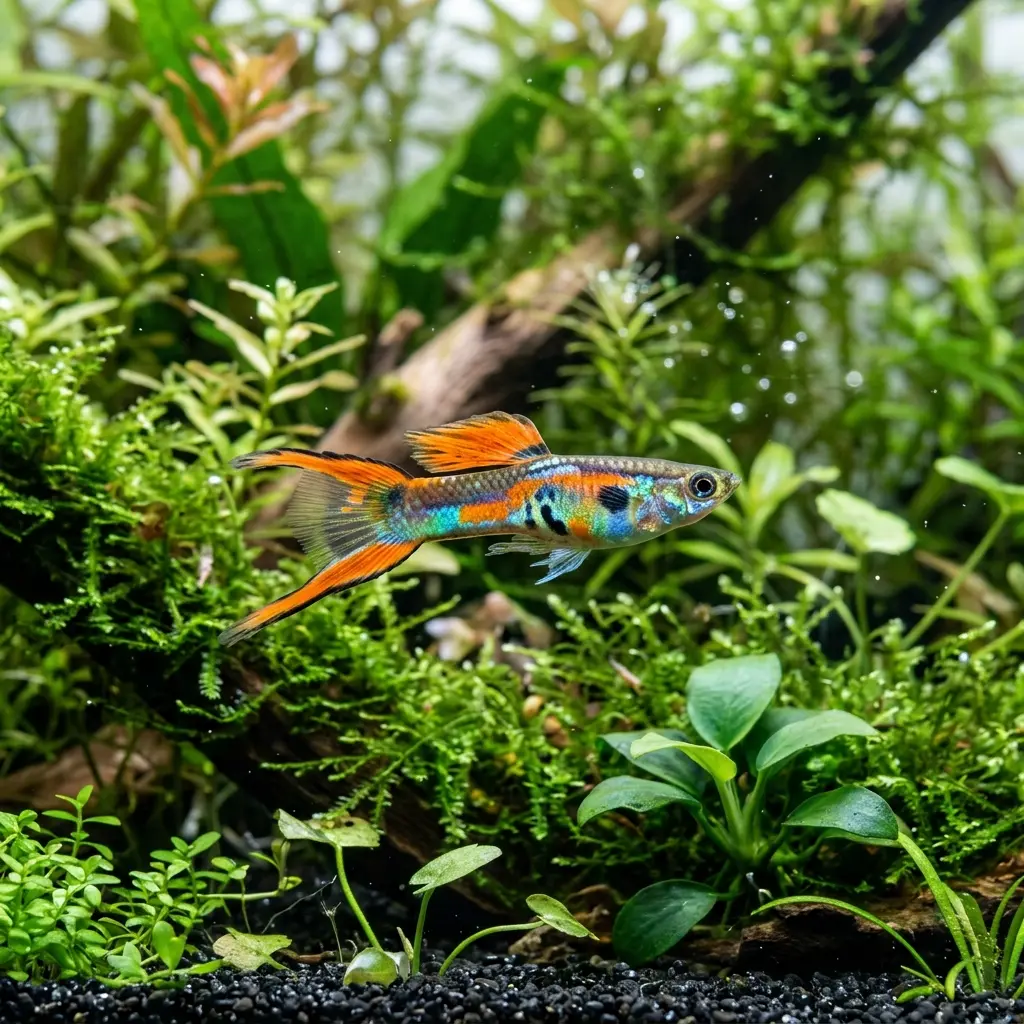
Quick Answer
Endler's Livebearer (Poecilia wingei) is a tiny, brilliantly colored freshwater livebearer reaching 1.5 inches (3.8 cm) for males and 2 inches (5 cm) for females. It requires a minimum 10 gallon (38 liter) aquarium with a pH of 7.0 to 8.0 and temperature range of 72 to 82 degrees Fahrenheit (22 to 28 degrees Celsius). This peaceful omnivore occupies the top and middle zones and breeds prolifically without intervention.
Quick Facts
| Scientific Name | Poecilia wingei |
|---|---|
| Common Names | Endler's Livebearer |
| Family | Poeciliidae |
| Genus | Poecilia |
| Type | Freshwater |
| Temperament | peaceful |
| Care Difficulty | beginner |
| Lifespan | 3 years |
| Maximum Size | Up to 2 in (5 cm) |
| Diet | Omnivore |
| Temperature | 72–82°F (22–28°C) |
| pH | 7–8 |
| Hardness | 8–20 dGH |
| Minimum Size | 10 gallons |
Key Takeaways
- Males reach 1.5 inches (3.8 cm); females reach 2 inches (5 cm). Lifespan is 2 to 3 years.
- Requires a minimum 10 gallon (38 liter) tank with a tight-fitting lid.
- Peaceful and curious; significantly bolder and less skittish than fancy guppies.
- Breeds prolifically; females produce 5 to 30 fry every 23 to 24 days.
- Maintain 2 to 3 females per male to prevent harassment and female death.
- Population control is mandatory; plan male-only groups or predator tank mates.
- N Class (pure wild), P Class (undocumented wild-type), and K Class (hybrid) strains exist.
- Never keep with common guppies; they will hybridize and dilute pure genetics.
- Camallanus worms are the most dangerous parasite; treat with levamisole immediately.
- Hard water (8 to 20 dGH) and alkaline pH (7.0 to 8.0) are essential for long-term health.
Overview
Species Overview
Endler's Livebearer (Poecilia wingei) is one of the most captivating and rewarding fish in the nano aquarium hobby. Native to the warm, shallow waters of Laguna de Patos in northeastern Venezuela, this tiny livebearer packs an extraordinary amount of color and personality into a body barely larger than a thumbnail. Discovered in 1937 by Franklyn F. Bond and brought to aquarium prominence by John Endler in the 1970s, this species has become a favorite among beginner and expert aquarists alike.
The Guppy Confusion
Endler's Livebearers are frequently mislabeled as Endler's Guppies, but this is taxonomically incorrect. Since 2005, the species has been formally recognized as Poecilia wingei, distinct from the common guppy (Poecilia reticulata). While they share the same genus and can hybridize, they differ in size, color intensity, hardiness, and behavior. The name Endler's Guppy is outdated and should be avoided in favor of the correct scientific and common names.
Conservation Status and Wild Populations
The wild population of Endler's Livebearers is critically threatened and may already be extinct in the wild. Their sole natural habitat, Laguna de Patos, has been severely impacted by a garbage dump constructed on its shores, which has significantly polluted the waters. This makes captive breeding programs and the preservation of pure N Class strains essential for the species' survival. Most fish sold in pet stores are K Class hybrids, not pure Endlers.
Diet
Diet and Nutrition
Endler's Livebearers are enthusiastic, non-picky omnivores that naturally graze on biofilm, algae, and small invertebrates. Their small size requires appropriately sized food, but their appetite is voracious. A varied diet is essential for coloration, breeding success, and immune health.
Health
Health and Disease Management
Endler's Livebearers are extremely hardy and disease-resistant when kept in proper conditions. Their wild genetics make them significantly more resilient than inbred fancy guppies. However, they are still susceptible to common aquarium diseases, particularly camallanus worms and ich.
Ich (White Spot Disease)
The most common external parasite affecting Endler’s Livebearers, caused by Ichthyophthirius multifiliis.
- White salt-like spots on body and fins, rubbing against decor, rapid breathing, lethargy, clamped fins, loss of appetite.
Introduced via new fish or plants; triggered by temperature drops below 70 degrees Fahrenheit (21 degrees Celsius), poor water quality, transport stress, or inadequate acclimation.
Quarantine all new additions for 2 to 4 weeks. Maintain temperature at 76 to 80 degrees Fahrenheit (24 to 26.7 degrees Celsius). Avoid sudden temperature fluctuations. Use a UV sterilizer for prevention in display tanks.
Camallanus Worms (Red Worms)
A devastating nematode parasite that protrudes from the fish’s anus, causing wasting and death if untreated.
- Red, thread-like worms protruding from the anus, weight loss despite normal appetite, lethargy, bloating, stringy feces.
Introduced via contaminated live foods (especially tubifex worms) or new fish. The parasite lives in the fish’s intestines and reproduces rapidly.
Avoid tubifex worms and other potentially contaminated live foods. Freeze all live foods for 48 hours before feeding. Quarantine all new fish for 4 weeks. Treat the entire tank if one fish is infected, as the parasite spreads through feces.
Fin Rot
Bacterial infection of the fins causing progressive erosion and tissue death.
- Frayed, ragged, or receding fin edges, redness at fin base, white or blackened fin edges, lethargy.
Aeromonas, Pseudomonas, or Flavobacterium columnare bacteria. Triggered by poor water quality, fin nipping from tank mates, or physical damage from sharp decor.
Maintain nitrates below 20 ppm with regular water changes. Avoid sharp-edged decor. Treat with aquarium-safe antibiotics (kanamycin, nitrofurazone) at first sign.
Fungal Infections
Cotton-like fungal growth on body, fins, or mouth, often secondary to injury or stress.
- White, cottony patches on body or fins, frayed fins, lethargy, loss of appetite.
Saprolegnia and other water molds. Triggered by physical injury, poor water quality, or stress from inadequate plant cover.
Maintain pristine water quality. Avoid rough handling and sharp decor. Quarantine new fish. Treat with methylene blue or aquarium antifungal medications at first sign.
Internal Parasites (Nematodes, Tapeworms)
Roundworms and flatworms that compromise nutrient absorption and cause chronic wasting.
- Gradual weight loss despite normal appetite, bloating, visible worms in feces, stringy white feces, reduced activity.
Introduced via live foods (especially wild-caught invertebrates) or contaminated substrate. More common in wild-caught specimens.
Avoid wild-caught live foods. Freeze all live foods for 48 hours before feeding to kill parasites. Prophylactic deworming with praziquantel during quarantine.
Breeding
Breeding and Reproduction
Endler's Livebearers are livebearers that breed prolifically without any special effort from the aquarist. Females give birth to free-swimming fry rather than laying eggs. This makes them ideal for beginners interested in breeding, but it also creates the challenge of population management.
Tips
Common Mistakes to Avoid
- No population plan: Buying a mixed group without a strategy leads to overstocking, poor water quality, and fish deaths within months.
- Keeping with guppies: They will hybridize. Pure Endler genetics are lost forever after one generation of hybridization.
- Skipping the lid: Finding dried Endlers on the floor is heartbreaking and entirely preventable.
- Overfeeding: The number one cause of water quality crashes in Endler tanks. Their tiny stomachs and your enthusiasm are a dangerous combination.
- Insufficient planting: Bare tanks result in zero fry survival and stressed fish. Dense vegetation is not optional.
- Wrong sex ratio: One male with one female results in a dead female within weeks. Maintain 2 to 3 females per male minimum.
- Assuming store-bought fish are pure: Almost all commercial Endlers are hybrids. If you want pure strains, buy from documented breeders.
- Ignoring camallanus worms: Red worms protruding from the anus are a death sentence if untreated. Levamisole is your first line of defense.
Expert Tips for Success
- Plan for population growth before buying: Decide your population control strategy before purchasing fish. A 10-gallon mixed tank will be overstocked in 3 months without intervention.
- Buy from specialized breeders for pure strains: Most chain pet store Endlers are K Class hybrids. N Class pure Endlers cost 5 to 10 times more but are worth it for color intensity and hardiness.
- Use sponge filters exclusively: They provide filtration, aeration, and biofilm grazing in one device. Fry cannot be sucked in.
- Feed live foods weekly: Even a small amount of daphnia or baby brine shrimp weekly dramatically improves male coloration and triggers breeding.
- Keep a breeding journal: Track birth dates, brood sizes, and female health. This helps predict births and manage population.
- Invest in dense planting: Java moss and guppy grass are non-negotiable. They are cheap, fast-growing, and essential for fry survival.
- Never skip the lid: Even a 0.25-inch gap is enough. Check filter openings and cord cutouts weekly.
- Separate strains: If keeping N or P Class fish, maintain them in species-only tanks. One guppy will destroy pure genetics forever.
Compatible Tank Mates






Endler's Livebearer vs. Similar Livebearer Species
| Feature | Endler's Livebearer | Common Guppy | Platy | Swordtail |
|---|---|---|---|---|
| Scientific Name | Poecilia wingei | Poecilia reticulata | Xiphophorus maculatus | Xiphophorus hellerii |
| Max Size (Male / Female) | 1.5 in / 2 in (3.8 cm / 5 cm) | 2.5 in / 2.5 in (6.4 cm / 6.4 cm) | 2 in / 2.5 in (5 cm / 6.4 cm) | 3 in / 4.5 in (7.6 cm / 11.4 cm) |
| Temperament | Peaceful, active, curious | Peaceful, can be nippy | Peaceful, active | Peaceful, males can spar |
| Minimum Tank Size | 10 gallons (38 L) | 10 gallons (38 L) | 10 gallons (38 L) | 20 gallons (76 L) |
| Breeding Difficulty | Extremely easy; no triggers needed | Extremely easy; no triggers needed | Easy; livebearer | Easy; livebearer |
| Diet | Omnivore; grazes biofilm | Omnivore | Omnivore; algae-heavy | Omnivore |
| pH Range | 7.0 to 8.0 | 6.8 to 7.8 | 7.0 to 8.3 | 7.0 to 8.4 |
| Temperature Range | 72 to 82 degrees F (22 to 28 degrees C) | 72 to 82 degrees F (22 to 28 degrees C) | 72 to 78 degrees F (22 to 25.5 degrees C) | 72 to 82 degrees F (22 to 28 degrees C) |
| Hardiness | Extremely hardy; less inbred than fancy guppies | Moderate; fancy strains fragile | Very hardy | Very hardy |
| Fry Predation by Parents | Rarely eat their own fry | Frequently eat their own fry | May eat fry | May eat fry |