
Swordtail (Xiphophorus hellerii)
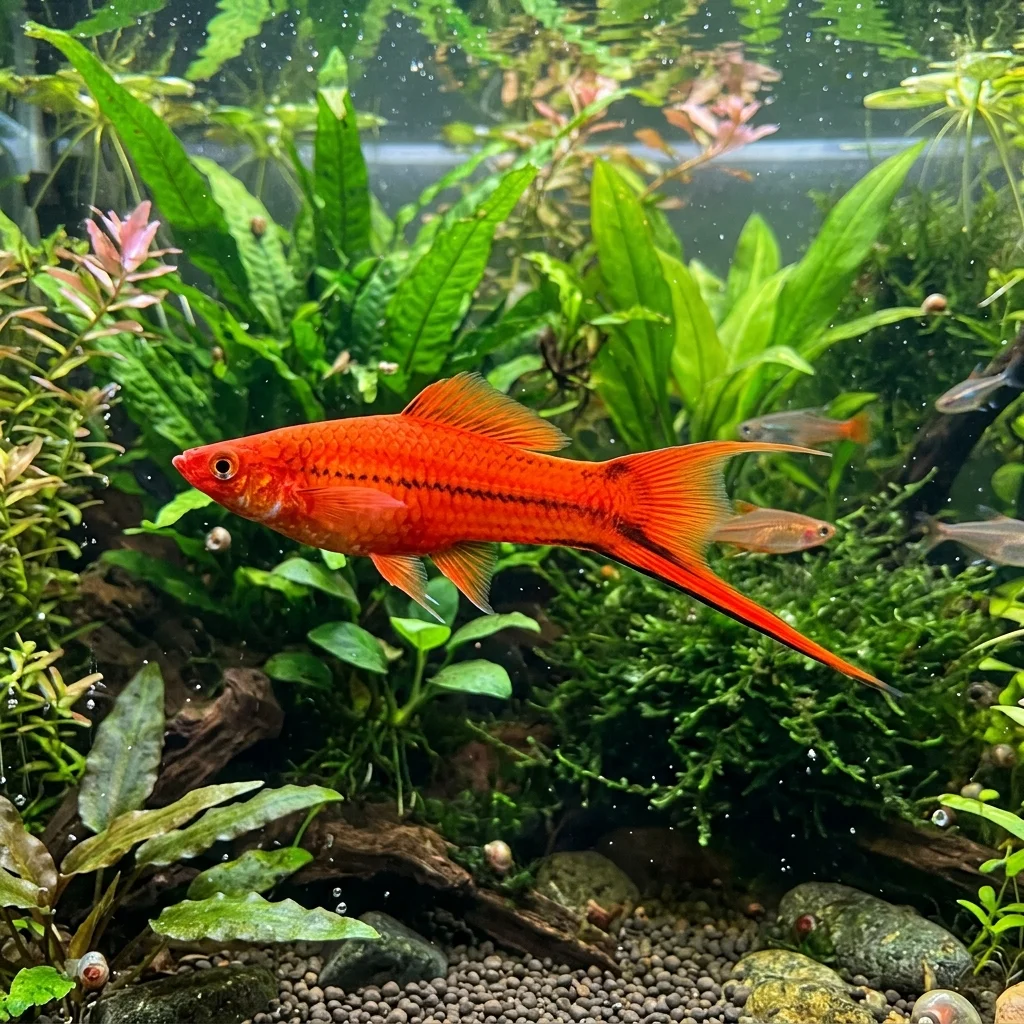
Quick Answer
Swordtail (Xiphophorus hellerii) is a hardy, active livebearing freshwater fish ideal for beginner aquarists with hard, alkaline water. It requires a minimum 20-gallon (76 liter) long aquarium with a group of 4 to 6 fish at a ratio of 2 to 3 females per male, pH 7.0 to 8.4, temperature 70F to 78F (21C to 26C), and dGH 8 to 25. This omnivore occupies the middle water column and thrives in planted community setups.
Quick Facts
| Scientific Name | Xiphophorus hellerii |
|---|---|
| Common Names | Swordtail |
| Family | Poeciliidae |
| Genus | Xiphophorus |
| Type | Freshwater |
| Temperament | peaceful |
| Care Difficulty | beginner |
| Lifespan | 5 years |
| Maximum Size | Up to 5.5 in (14 cm) |
| Diet | Omnivore |
| Temperature | 70–78°F (21–26°C) |
| pH | 7–8.4 |
| Hardness | 8–25 dGH |
| Minimum Size | 20 gallons |
Key Takeaways
- Requires a minimum 20-gallon (76 liter) long tank with 30 inches (76 cm) of horizontal swimming space.
- Must maintain a ratio of 2 to 3 females per male to prevent female harassment and premature death.
- Requires hard alkaline water: dGH 8 to 25, dKH 6 to 12, pH 7.0 to 8.4; add crushed coral to soft water.
- Livebearer producing 20 to 100 fry every 28 to 30 days; females store sperm for 5 to 9 consecutive broods.
- Omnivore with strong herbivorous leaning; 55% plant matter essential to prevent constipation and swim bladder disorder.
- Do not breed with platies; hybrid offspring carry documented risk of malignant melanoma from the xmrk oncogene.
- Quarantine all new fish for 4 weeks; prophylactic methylene blue treatment recommended.
Diet
Nutritional Requirements
Swordtails are omnivores with a strong herbivorous leaning. In the wild, they consume algae, detritus, insect larvae, and small crustaceans. In captivity, their diet must replicate this plant-heavy intake to prevent the digestive disorders common in livebearers.
Macronutrient Profile
Target a dietary composition of approximately 35% protein, 10% fat, and 55% plant matter and fiber. Juveniles benefit from elevated protein at 40% to 45% for growth. Excess fat above 12% causes hepatic lipidosis, particularly in ornamental high-finned strains that are already genetically compromised.
Recommended Foods
- Staple: High-quality tropical flake or slow-sinking pellet food formulated for livebearers. Select brands listing spirulina, algae meal, and fish meal among the first three ingredients.
- Protein supplement (3 to 4 times weekly): Frozen or live bloodworms, brine shrimp, daphnia, and mosquito larvae. These provide essential amino acids and carotenoids for color enhancement.
- Plant matter (daily): Spirulina flakes, algae wafers, blanched spinach, zucchini, cucumber, or peas. Plant fiber is absolutely essential for intestinal motility and preventing constipation and swim bladder disorders.
- Color enhancers: Foods containing astaxanthin, beta-carotene, and canthaxanthin intensify red, orange, and golden coloration. These are particularly valuable for red velvet and pineapple strains.
Feeding Schedule
Feed twice daily in portions consumed within 2 to 3 minutes. Fast the tank for 24 hours once weekly to clear the digestive tract. Overfeeding is the primary cause of water quality degradation and obesity in livebearers; swordtails will beg continuously but require only what they can consume rapidly.
Critical Dietary Restrictions
Never feed beef heart, chicken, pork, or any mammalian protein. Livebearers and all cyprinids lack the specific proteases required to digest mammalian muscle tissue. These foods cause intestinal blockages, bloat, and premature organ failure. Avoid tubifex worms sourced from polluted waters, as they are vectors for internal parasites including Camallanus and Capillaria.
Breeding
Breeding Swordtails in Captivity
Swordtails are prolific livebearers that require no special triggers to breed beyond stable water, adequate nutrition, and the presence of both sexes. They are among the easiest aquarium fish to breed, making them ideal for first-time livebearer breeders. Success depends on managing the male-to-female ratio, providing fry cover, and controlling population explosion.
Sexual Maturity and Gonopodium
Both sexes reach sexual maturity at 10 to 12 weeks under optimal conditions. Males develop the gonopodium, a rod-like modified anal fin formed by the fusion of anal fin rays 3, 4, and 5. This structure delivers sperm packets (spermatophores) directly into the female's reproductive tract. Males also develop the signature sword extension on the lower caudal fin lobe, which is entirely absent in females. Females develop a dark gravid spot near the anal fin that enlarges and darkens from orange-brown to nearly black as pregnancy progresses.
Sperm Storage and Multiple Broods
Critical fact for population control: Females can store viable sperm for 5 to 9 consecutive broods after a single mating. This means removing the male will not immediately stop births. The gestation period is 28 to 30 days at 75F to 78F (24C to 26C) but can extend to 63 days at cooler temperatures. Females produce 20 to 100 fry per brood; larger females over 2.5 inches (6.4 cm) standard length produce the most. A single female can deliver over 500 fry in her lifetime if sperm storage is active.
Breeding Tank Setup
No special breeding tank is required; swordtails breed readily in community tanks. If you wish to raise fry, you have three approaches:
- Dense planting method (recommended): Plant 40% of the tank with java moss, guppy grass, hornwort, or floating water sprite. Fry hide in the vegetation and a percentage survives to adulthood. This is the most natural and lowest-stress method.
- Breeding box method: Transfer a visibly gravid female to a floating breeding box when the gravid spot is large and dark. Remove her immediately after birth. Never leave a female in a breeding box for more than 24 hours; ammonia buildup kills fry rapidly. This method has high fry mortality due to stress and poor water quality in the confined space.
- Separate breeding tank: Set up a 10-gallon (38 liter) planted tank with a sponge filter. Transfer the gravid female 24 hours before expected birth. Remove her immediately after delivery. Raise fry in the tank with daily 10% water changes.
Fry Rearing
Newborn swordtail fry are relatively large at 0.3 inches (8 mm) and can accept crushed flake food, powdered fry food, or newly hatched brine shrimp immediately. Feed 3 to 4 times daily in small portions. Perform 10% daily water changes with matched-temperature water to prevent growth stunting. Sexual maturity is reached at 10 to 12 weeks. Separate males and females by 8 weeks if you wish to prevent uncontrolled breeding.
Population Control
To prevent tank overpopulation, choose one of the following strategies: maintain a male-only tank (4 to 5 males display fascinating hierarchy behavior without reproduction), remove all fry and donate them to local fish stores, or house swordtails with small predatory fish such as dwarf gouramis that consume fry without threatening adults. Never release swordtails into local waterways; they are invasive in many warm-climate regions.
Hybrid Warning
Do not breed swordtails with platies. They are closely related and will freely hybridize, but the offspring carry a documented risk of malignant melanoma caused by the xmrk oncogene. Cull any accidental hybrid offspring and do not distribute them.
Compatible Tank Mates






Species Comparison
| Feature | Swordtail | Platy | Molly | Guppy | Endler |
|---|---|---|---|---|---|
| Scientific Name | Xiphophorus hellerii | Xiphophorus maculatus / variatus | Poecilia sphenops / latipinna | Poecilia reticulata | Poecilia wingei |
| Adult Size | 4 to 5.5 inches (10 to 14 cm) | 2 to 3 inches (5 to 7.6 cm) | 3 to 5 inches (7.6 to 13 cm) | 1.5 to 2.5 inches (3.8 to 6.4 cm) | 1 to 1.8 inches (2.5 to 4.6 cm) |
| Temperament | Peaceful; males spar for dominance | Peaceful; males occasionally chase | Peaceful; can be mildly nippy | Peaceful; males display constantly | Peaceful; extremely active |
| Minimum Tank Size | 20 gallons (76 L) long | 10 gallons (38 L) | 20 gallons (76 L) long | 10 gallons (38 L) | 10 gallons (38 L) |
| Temperature Range | 70F to 78F (21C to 26C) | 70F to 78F (21C to 26C) | 72F to 82F (22C to 28C) | 72F to 82F (22C to 28C) | 72F to 82F (22C to 28C) |
| Water Hardness (dGH) | 8 to 25 dGH | 8 to 25 dGH | 10 to 30 dGH; tolerates brackish | 8 to 20 dGH | 8 to 20 dGH |
| Breeding Method | Livebearer; 20 to 100 fry every 28 to 30 days | Livebearer; 20 to 80 fry every 28 to 30 days | Livebearer; 20 to 100 fry every 30 to 40 days | Livebearer; 10 to 50 fry every 28 to 30 days | Livebearer; 5 to 25 fry every 23 to 28 days |