
Gold Laser Corydoras (Corydoras aeneus 'Gold Laser' / Corydoras sp. CW010)
Quick Answer
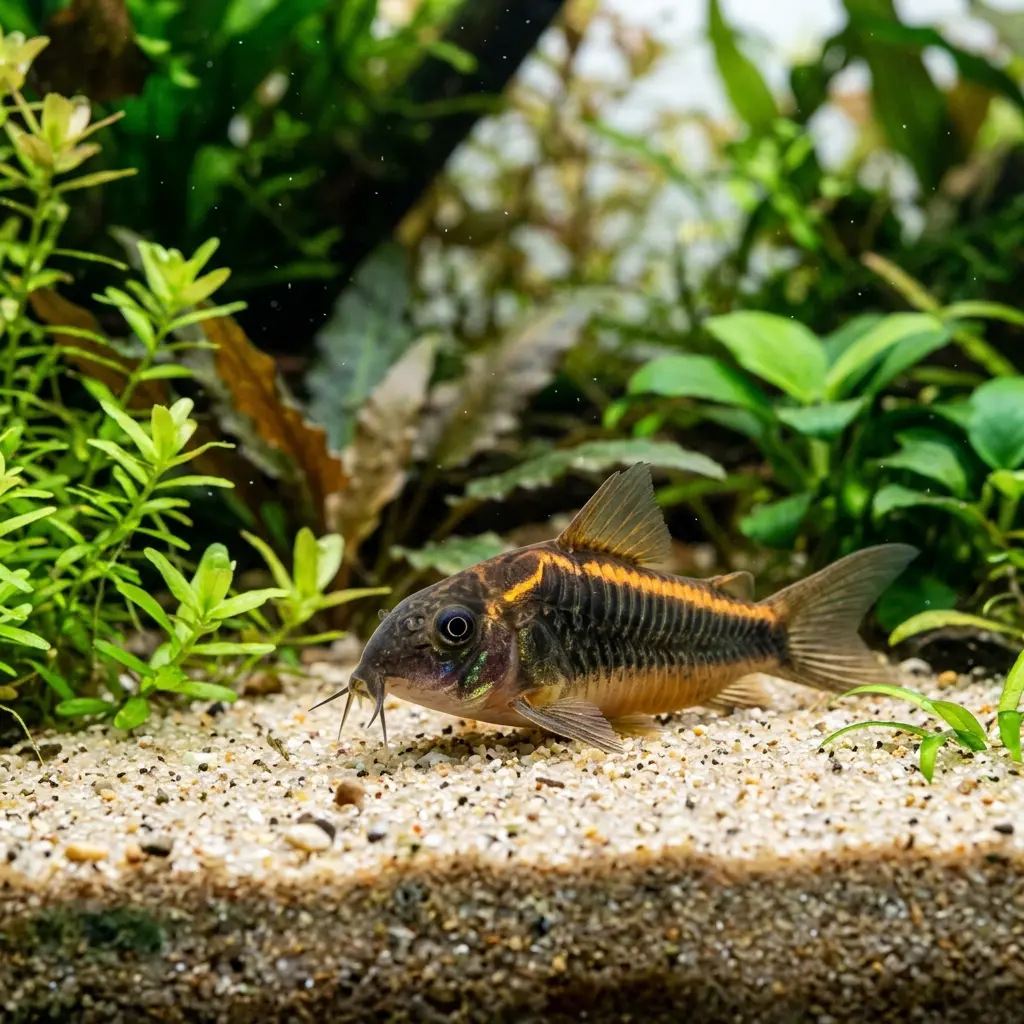
Gold Laser Corydoras is a selectively bred color morph closely related to the Bronze Cory group, often cataloged as Corydoras sp. CW010. It requires a minimum 20 gallon long aquarium with a pH of 6.0 - 7.5 and a temperature range of 72-78 degrees F (22-26 degrees C). This peaceful, schooling omnivore occupies the bottom zone and makes an exceptional addition to community and planted aquariums.
Quick Facts
| Scientific Name | Corydoras aeneus 'Gold Laser' / Corydoras sp. CW010 |
|---|---|
| Common Names | Gold Laser Corydoras |
| Family | Callichthyidae |
| Genus | Corydoras |
| Type | Freshwater |
| Temperament | peaceful |
| Care Difficulty | beginner |
| Lifespan | 10 years |
| Maximum Size | Up to 2.5 in (6 cm) |
| Diet | Omnivore |
| Temperature | 72–78°F (22–26°C) |
| pH | 6–7.5 |
| Hardness | 2–12 dGH |
| Minimum Size | 20 gallons |
Key Takeaways
- Requires a minimum group of 6-8 individuals for natural behavior and stress reduction.
- Needs a minimum 20 gallon long aquarium with fine sand substrate to protect barbels.
- Extremely sensitive to copper and full-strength medications due to scaleless skin.
- Omnivorous diet requiring sinking pellets, live or frozen protein, and vegetable matter.
- Spawns readily in home aquariums when triggered with cool water changes.
Overview
Species Overview
The Gold Laser Corydoras, scientifically cataloged as Corydoras sp. CW010 and commonly associated with the Corydoras aeneus group, is one of the most visually striking bottom-dwelling catfish in the aquarium trade. Native to the upper Amazonian rainforest streams and tributaries of eastern Peru, this species commands attention with a brilliant metallic gold-orange lateral stripe that runs from the gill plate to the caudal peduncle, set against a warm bronze body.
Despite its exotic appearance, the Gold Laser Corydoras is exceptionally hardy and forgiving, making it an ideal choice for beginner aquarists while still offering enough nuance to satisfy advanced hobbyists. It is a true schooling species that thrives in groups of 6 or more, where it displays constant bottom-foraging behavior, social interaction, and the characteristic corydoras wiggle that endears these fish to enthusiasts worldwide.
Natural History and Origin
This species originates from the calm, shallow waters of the Ucayali, Marañon, and Upper Amazon River systems in Peru. Its natural habitat consists of soft, acidic blackwater environments rich in leaf litter, driftwood, and submerged roots. The water is typically stained with tannins, low in minerals, and warm year-round. Replicating these conditions in captivity unlocks the fish's full color potential and encourages natural behaviors including surface air-gulping and substrate sifting.
Why This Species Stands Out
Unlike many color-morph fish that suffer from weakened genetics, the Gold Laser Corydoras retains the robust constitution of its wild-type relatives. It is shrimp-safe, plant-safe, and completely peaceful. Its moderate size of 2.5 inches (6.4 cm) and bottom-dwelling nature make it compatible with nearly any peaceful community fish that occupies the middle and upper water columns.
Diet
Diet and Feeding Requirements
Gold Laser Corydoras are opportunistic omnivores with a dietary split of approximately 35% protein, 10% fat, and 55% plant and detrital matter. In the wild, they consume insect larvae, microcrustaceans, worms, plant debris, and biofilm. In captivity, you must replicate this diversity to maintain immune function, color vibrancy, and digestive health.
Staple Foods
The foundation of their diet should be high-quality sinking pellets or wafers. Recommended products include Hikari Sinking Wafers, Fluval Bug Bites Bottom Feeder Formula, Omega One Shrimp Pellets, and New Life Spectrum Thera-A. These foods are formulated to sink rapidly and retain integrity on the substrate, allowing corydoras to locate and consume them before they dissolve.
Protein Supplementation
Offer live or frozen foods 3-4 times per week. The best options are live blackworms, frozen bloodworms, frozen daphnia, frozen brine shrimp, and grindal worms. These foods provide essential amino acids and natural enzymes that prepared foods lack. Avoid beef heart and terrestrial mammal meats entirely; corydoras cannot digest mammalian fats and proteins, which cause fatty liver disease and organ failure.
Vegetable and Algae Components
Feed blanched vegetables weekly. Zucchini, cucumber, spinach, and peas (shelled) are excellent choices. Supplement with spirulina-based wafers or tabs to provide carotenoids that enhance the gold stripe coloration. Vegetable matter also provides fiber that prevents constipation and buoyancy disorders common in overfed corydoras.
Feeding Schedule and Technique
Feed once daily in the evening, as corydoras are crepuscular. Drop food directly over their foraging area. If you keep surface-feeding or midwater fish in the same tank, feed the corydoras after lights out or use a feeding dish to ensure they receive adequate nutrition. Competition from faster fish is the leading cause of chronic malnutrition in community corydoras tanks.
Common Dietary Mistakes
- Relying solely on algae wafers intended for plecos, which are too high in cellulose and low in protein.
- Overfeeding, which causes obesity, fatty liver, and water quality degradation.
- Feeding only flake food, which rarely reaches the bottom intact and lacks the nutrient density corydoras require.
- Ignoring vegetable matter, which leads to constipation and buoyancy issues.
Health
Health, Disease, and Treatment Protocols
Gold Laser Corydoras are generally hardy, but their scaleless bodies and bottom-dwelling lifestyle create specific vulnerabilities that generalist aquarium guides often miss. Understanding these vulnerabilities allows you to prevent, identify, and treat disease with precision.
Critical Medication Sensitivity
Because corydoras are scaleless, their skin absorbs medications at much higher rates than scaled fish. This is the single most important health consideration for this species. Always begin treatment at half the manufacturer-recommended dose and observe for 24 hours before adjusting. Copper-based medications are lethal at concentrations above 0.1 mg/L. Formalin causes severe respiratory distress. Malachite green must be used at quarter strength. Melafix contains tea tree oil that irritates catfish respiratory tissue; if used, dilute to half dose.
Preventive Healthcare
The majority of corydoras health issues are preventable through substrate choice, water change discipline, and quarantine. Use fine sand, perform weekly 25-30% water changes, and quarantine all new livestock for 2-4 weeks before introduction. Test water parameters weekly; nitrates above 20 ppm suppress immune function in bottom-dwellers.
Ich (White Spot Disease)
A protozoan parasite infection caused by Ichthyophthirius multifiliis, characterized by tiny white salt-like granules on fins and body.
- Small white cysts resembling salt grains on fins, body, and gills; rubbing against decor; rapid breathing; clamped fins; lethargy.
Introduced via new livestock, contaminated equipment, or stress-weakened immunity. The parasite has a complex life cycle involving free-swimming theronts.
Quarantine all new fish for 2-4 weeks. Maintain stable temperature and water quality. Use Ich-X at labeled scaleless-fish dosage. Raise temperature gradually to 82-84 degrees F (28-29 degrees C) to accelerate the parasite life cycle. Avoid copper-based treatments.
Barbel Erosion
A bacterial infection of the sensory barbels caused by physical abrasion followed by opportunistic bacterial invasion, most commonly Aeromonas or Pseudomonas species.
- Shortened, frayed, or completely missing barbels; reddened barbel bases; difficulty locating food; weight loss despite apparent feeding.
Sharp or dirty gravel substrate; accumulated detritus in substrate; poor water quality with elevated nitrates; secondary bacterial infection after physical trauma.
Use fine sand substrate exclusively. Vacuum substrate weekly during water changes. Maintain nitrates below 15 ppm. Treat early-stage erosion with Kanamycin at half dose in a hospital tank with pristine water.
Red Blotch Disease
A severe bacterial infection producing hemorrhagic patches on the ventral surface, flanks, or base of the fins. Progresses rapidly and is often fatal without immediate intervention.
- Reddish-brown or bloody patches on the belly and lower flanks; ulceration; fin deterioration; lethargy; loss of appetite; rapid mortality in advanced cases.
Chronic poor water quality, especially nitrate accumulation above 20 ppm; overcrowding; stress from inadequate group size; compromised immune function.
Perform a 50% water change immediately upon detection. Treat with Kanamycin (KanaPlex) at half dose or Furan-2 at half dose. Improve water change schedule to twice weekly until resolved. Address root causes: group size, stocking density, and filtration.
Fin Rot
A bacterial infection causing progressive degradation of fin tissue, often beginning at the edges and moving inward toward the body.
- Frayed, ragged, or receding fin edges; white or translucent fin margins; redness at the fin base; in advanced cases, erosion reaching the body wall.
Test water immediately and correct any ammonia or nitrite presence. Remove aggressive tank mates. Treat with broad-spectrum antibiotics safe for scaleless fish at half dose. Ensure filter intakes are covered with sponge guards.
Internal Parasites (Hexamita / Camallanus)
Protozoan or nematode infections of the gastrointestinal tract that cause chronic wasting, malnutrition, and eventual organ failure.
- Chronic weight loss despite normal appetite; white, stringy feces; visible worms protruding from the anus (Camallanus); lethargy; sunken belly.
Introduction via contaminated live foods, particularly tubifex worms or blackworms from unreliable sources; poor quarantine protocols.
Quarantine all new fish and treat prophylactically with Praziquantel, which is safe for corydoras at standard dosage. Purchase live foods only from reputable sources. For active infections, use Praziquantel for tapeworms and flukes, or Metronidazole at half dose for Hexamita.
Breeding
Breeding Gold Laser Corydoras
Breeding Gold Laser Corydoras in the home aquarium is straightforward once you understand the environmental triggers that simulate their natural reproductive cycle. Unlike many egg-layers that require complex chemistry manipulation, corydoras respond primarily to temperature drops and water changes that mimic seasonal rainfall.
Pre-Breeding Conditioning
Select a group of 6-8 mature fish with a ratio of 2 females per male. Condition them for 14 days with high-protein live and frozen foods including live blackworms, frozen bloodworms, and brine shrimp. Increase feeding frequency to twice daily during this period. Well-conditioned females will become visibly round and gravid.
Spawning Triggers
The most reliable trigger is a large water change with cool water. Lower the tank water level to 5 inches (12 cm) for 7 days while maintaining filtration. Then perform a 50% water change using water that is 8-10 degrees F (4-6 degrees C) cooler than the tank temperature, ideally reverse osmosis water adjusted to pH 6.5 and 2 dGH. Pour the new water in over 2 hours to simulate heavy rainfall. Simultaneously increase aeration. These combined stimuli typically trigger spawning within 12-24 hours.
Spawning Behavior
The male initiates by pursuing the female and nudging her flanks. When receptive, the female adopts the classic T-position, pressing her head against the male's ventral surface. The male releases milt, and the female catches it in her pelvic fins to fertilize the eggs she holds there. She then deposits adhesive eggs onto cleaned surfaces such as aquarium glass, plant leaves, or spawning mops. A single female can lay 100-200 eggs across multiple surfaces during one spawning event.
Egg and Fry Rearing
Remove the adults immediately after spawning to prevent egg predation. Eggs hatch in 3-5 days at 75 degrees F (24 degrees C). Newly hatched fry absorb their yolk sacs for 2-3 days and remain on the substrate. Once free-swimming, feed infusoria or commercial liquid fry food for the first 3 days. Transition to microworms or vinegar eels on day 4, and introduce newly hatched brine shrimp by day 7. Maintain pristine water quality with daily 10% water changes using aged, temperature-matched water. Fry grow rapidly and reach sellable size within 8-10 weeks.
Common Breeding Mistakes
- Using too-small a breeding group, which prevents pair formation and reduces spawning frequency.
- Failing to remove adults, resulting in near-total egg loss within hours.
- Feeding fry only brine shrimp from day one, which is too large and causes starvation.
- Allowing fungal outbreaks on eggs; treat with methylene blue at quarter dose or remove fungused eggs with a pipette.
Compatible Tank Mates






Species Comparison
| Feature | Gold Laser Corydoras | Bronze Corydoras | Sterbai Corydoras | Julii Corydoras |
|---|---|---|---|---|
| Scientific Name | Corydoras aeneus 'Gold Laser' / sp. CW010 | Corydoras aeneus | Corydoras sterbai | Hoplisoma julii |
| Adult Size | 2.5 in (6.4 cm) | 2.5 in (6.4 cm) | 2.75 in (7.0 cm) | 2 in (5.1 cm) |
| Temperament | Peaceful | Peaceful | Peaceful | Peaceful |
| Minimum Tank Size | 20 gal long (75.7 L) | 20 gal long (75.7 L) | 20 gal long (75.7 L) | 10 gal (37.9 L) |
| Temperature Range | 72-78 degrees F (22-26 degrees C) | 72-79 degrees F (22-26 degrees C) | 73-79 degrees F (23-26 degrees C) | 72-79 degrees F (22-26 degrees C) |
| Diet | Omnivore; sinking pellets, live/frozen worms, vegetables | Omnivore; sinking pellets, live/frozen worms, vegetables | Omnivore; prefers higher protein, frozen foods | Omnivore; micropredator, small live foods |
| Distinctive Trait | Metallic gold-orange lateral stripe on bronze body | Bronze-green iridescent body with dark mask | Orange fins with black spotting, warm-water specialist | Fine reticulated pattern, false eye spot at caudal peduncle |
| Difficulty Level | Beginner | Beginner | Beginner-Intermediate | Beginner |