
Peacock Cichlid (Aulonocara spp.)
Quick Answer
Peacock Cichlids (Aulonocara spp.) are stunning haplochromine cichlids native to Lake Malawi in East Africa. They require a minimum 55 gallon (208 liter) aquarium with a pH of 7.8 to 8.6, hard water (10 to 18 dGH), and temperature range of 76 to 82 degrees Fahrenheit (24 to 28 degrees Celsius). As maternal mouthbrooders and sand-sifting omnivores, they demand a fine sand substrate, open swimming areas, and careful dietary management to prevent Malawi bloat.
Quick Facts
| Scientific Name | Aulonocara spp. |
|---|---|
| Common Names | Peacock Cichlid |
| Family | Cichlidae |
| Genus | Aulonocara |
| Type | Freshwater |
| Temperament | semi-aggressive |
| Care Difficulty | intermediate |
| Lifespan | 8 years |
| Maximum Size | Up to 6 in (15 cm) |
| Diet | Omnivore |
| Temperature | 76–82°F (24–28°C) |
| pH | 7.8–8.6 |
| Hardness | 10–18 dGH |
| Minimum Size | 55 gallons |
Key Takeaways
- Requires a minimum 55 gallon (208 liter) aquarium; 75 gallons (284 liters) strongly recommended for groups
- Maternal mouthbrooders; females carry fertilized eggs for 18 to 24 days
- Possess specialized sensory pits on the head for detecting prey buried in sand
- Highly susceptible to Malawi bloat from low-quality protein or excessive mammalian meat
- Males display egg-spots on anal fin to trigger female spawning response
- Fine sand substrate is mandatory; coarse gravel damages delicate sensory mouth structures
Overview
Species Overview
Natural History and Origin
The Peacock Cichlid (genus Aulonocara) is one of the most visually striking and behaviorally fascinating groups of African cichlids in the aquarium hobby. Endemic to Lake Malawi in East Africa, these fish inhabit the sandy transition zones between rocky shorelines and open water. The genus comprises over 22 recognized natural species, with countless color variants, line-bred strains, and hybrid forms developed by aquarists. Lake Malawi is one of the largest and deepest lakes in the world, and its endemic cichlid fauna represents one of the most rapid adaptive radiation events known in vertebrate evolution, with an estimated 1,000 species evolving from a common ancestor over the past 2 to 3 million years.
Physical Description
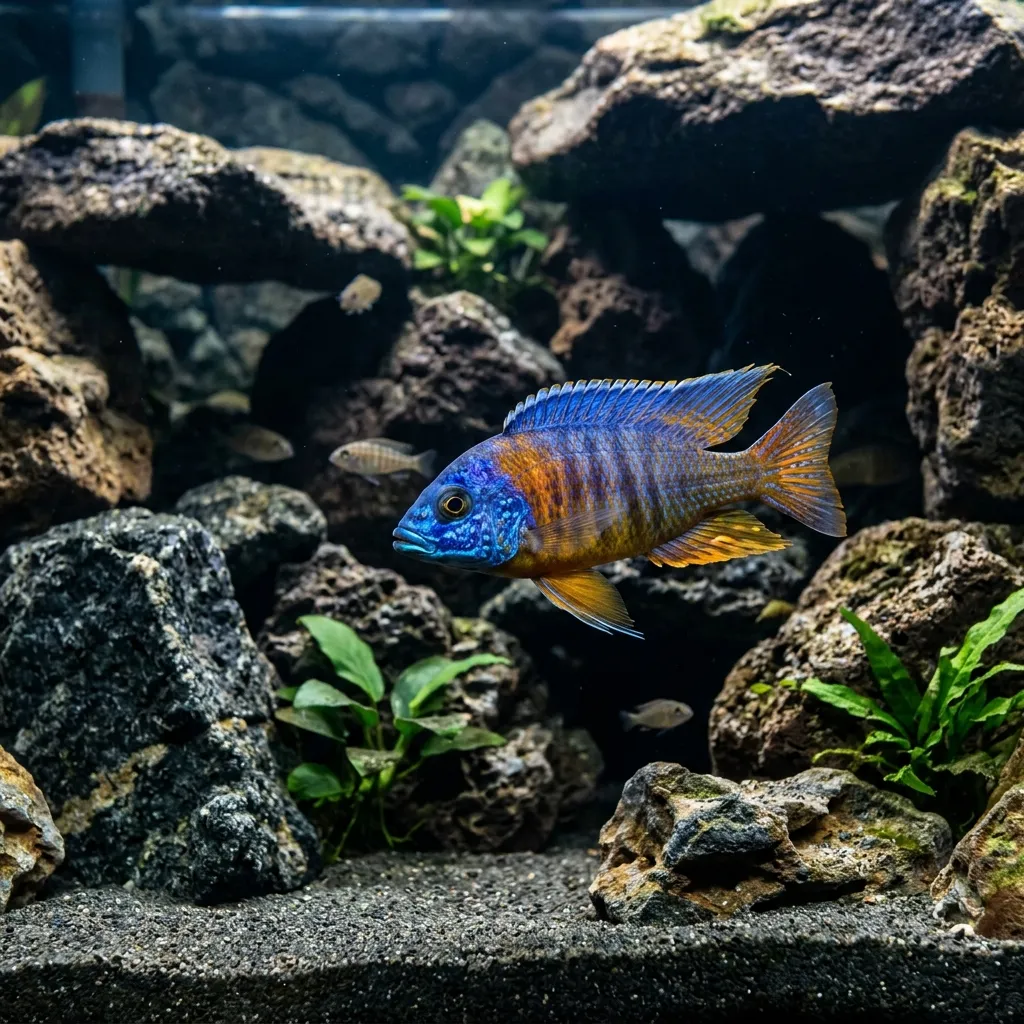
Adult Peacock Cichlids reach 4 to 6 inches (10 to 15 cm) in length, with males typically growing larger and more vibrantly colored than females. Males display brilliant metallic shades of blue, red, orange, yellow, and white depending on the species and variety. Females are generally drab silver-gray with faint vertical barring, a cryptic coloration that provides camouflage during mouthbrooding. The body is moderately deep and laterally compressed with a continuous dorsal fin. A defining feature of the genus is the presence of enlarged cephalic lateral line pores on the head, which function as pressure-wave detectors for locating prey buried in sand. Males also display characteristic egg-spots on the anal fin, yellow-to-red oval markings that play a critical role in spawning behavior.
The Sensory Pit Adaptation
Peacock Cichlids possess one of the most remarkable feeding adaptations in the aquarium hobby. Rows of enlarged sensory pores on the head are connected to an expanded lateral line system. These pores detect minute pressure waves and vibrations produced by small invertebrates buried in the sand. The fish hovers just above the substrate, sifts sand through its gill rakers, and uses these sensory pits to pinpoint prey location with extraordinary precision. This adaptation makes fine sand substrate not merely a preference but a biological necessity. Deprived of sand, they cannot perform their natural feeding behavior, leading to chronic stress, nutritional deficiencies, and suppressed immune function.
Conservation and Trade
Wild populations are listed as Not Evaluated by the IUCN. The aquarium trade relies almost entirely on captive-bred specimens from fish farms in Southeast Asia, Eastern Europe, and Florida. Wild collection does occur but represents a small fraction of the market. Many commercially available color variants, including the popular Dragon Blood, OB (Orange Blotch), and Strawberry Peacock strains, are the result of selective breeding and hybridization rather than naturally occurring forms. Serious breeders should be aware that hybrid peacocks can produce fertile offspring that complicate conservation efforts and strain identification.
Care
Aquarium Care Requirements
Tank Size and Dimensions
The absolute minimum tank size for a single male Peacock Cichlid is 55 gallons (208 liters) with a footprint of at least 48 by 13 inches (122 by 33 cm). For a harem group or community setup, you must provide 75 gallons (284 liters) or larger with a footprint of 48 by 18 inches (122 by 46 cm). A 90-gallon (341 liter) or 125-gallon (473 liter) tank is strongly recommended for groups of 8 or more. These are active, roaming fish that patrol territories and engage in constant social interaction. Inadequate space triggers severe aggression, stunted growth, and chronic stress. Tank length is far more important than height; a 48-inch (122 cm) long tank is the absolute minimum for natural behavior.
Filtration and Water Flow
Use a canister filter rated for at least twice the actual tank volume or a sump filtration system. African cichlids are heavy waste producers, and Peacock Cichlids are no exception. The filter must turn over the tank volume at least 10 times per hour. Use two external canister filters on tanks 75 gallons (284 liters) and larger to distribute flow evenly and provide redundancy. Clean filter sponges monthly; the high detritus load in African cichlid tanks causes rapid clogging. Add powerheads or circulation pumps to create moderate water movement, but avoid creating dead zones where waste accumulates. UV sterilization is highly recommended to control free-floating pathogens and algae.
Substrate Requirements
Fine sand is mandatory. Use pool filter sand, play sand (rinsed thoroughly until water runs clear), or specialized aquarium sand with grain size of 0.5 to 2 mm. Maintain a depth of 2 to 3 inches (5 to 8 cm) to allow natural burrowing and sifting behavior. Never use coarse gravel or crushed coral as the primary substrate. While crushed coral effectively buffers pH and raises hardness, its sharp, coarse texture abrades the delicate mouth structures and gill rakers of sand-sifting cichlids. If you need pH buffering, place crushed coral or aragonite in a mesh bag inside the filter, not on the tank bottom. The fish will rearrange sand to their preference; accept this as normal behavior.
Hardscape and Rockwork
Create rock piles and caves using smooth, rounded rocks such as sandstone, slate, or river rock. Avoid rough, jagged rocks like lava rock, as chasing fish will scrape themselves severely. Build rock formations before adding substrate, and place a thin layer of polystyrene or smooth pebbles under rock piles to distribute weight and prevent landslides. Peacock Cichlids burrow under rocks, and unsupported formations can collapse, crushing fish or cracking the tank glass. Provide at least 1 cave or hiding spot per fish. Arrange rocks to create visual barriers that break lines of sight across the tank; this is critical for reducing territorial aggression. PVC pipes buried in the sand with silicone-coated sand or crushed coral exteriors provide excellent, safe hiding tunnels.
Plant Considerations
Peacock Cichlids are not suitable for planted tanks. They will uproot, consume, or destroy almost all aquatic plants. If you insist on plant decoration, use hard-leaved species such as Anubias and Java fern attached to rocks above the substrate where fish cannot reach the roots. Even these will likely be nibbled. Fake plants can provide visual barriers and color accents without the destruction. Focus your aquascape on rockwork, sand, and open swimming areas rather than vegetation.
Lighting
Maintain bright lighting for 10 to 12 hours daily. Bright light enhances male coloration and stimulates natural territorial displays. It also promotes algae growth on rocks, which some peacocks and mbunas will graze. Use full-spectrum LED fixtures. Avoid dim lighting, which suppresses color display and can reduce spawning activity.
Common Care Mistakes
- Using gravel or crushed coral substrate: Damages sensory mouth structures and prevents natural feeding.
- Insufficient filtration: African cichlids produce massive waste loads; inadequate filtration causes rapid water quality deterioration.
- Soft water without modification: pH below 7.5 causes osmotic stress, organ damage, and suppressed immune function.
- Keeping two males in small tanks: Results in severe fighting, injury, and death.
- Skipping quarantine: Commercial African cichlids frequently carry subclinical bloat and internal parasites.
- Feeding low-quality protein: The leading cause of Malawi bloat, a fatal digestive disorder.
Diet
Diet and Feeding Protocol
Nutritional Requirements
Peacock Cichlids are primarily carnivorous omnivores with a dietary composition targeting 45 percent high-quality protein, 12 percent fat, and 43 percent plant matter and fiber. In the wild, they use their sensory pits to detect and consume small invertebrates, insect larvae, and zooplankton buried in the sand. In captivity, their nutritional needs must be met with high-quality prepared foods; low-quality protein is the primary trigger for Malawi bloat, a fatal digestive disorder.
Recommended Foods
- Staple: Premium cichlid pellets such as New Life Spectrum, Hikari Cichlid Gold, or NorthFin Cichlid Formula. Look for fish meal, krill meal, and spirulina as primary ingredients. Pellet size should match the fish's mouth; 2 to 3 mm pellets for adults, 1 mm for juveniles.
- Protein supplement (3 to 4 times weekly): Frozen or freeze-dried mysis shrimp, krill, brine shrimp, and bloodworms. These provide essential fatty acids and carotenoids that enhance coloration.
- Vegetable matter (weekly): Spirulina flakes, blanched peas (shelled), spinach, and zucchini. Plant fiber supports digestive health and prevents constipation.
- Live foods (occasional): Live brine shrimp, blackworms, and white worms stimulate hunting behavior and are excellent conditioning foods for breeding pairs.
Feeding Schedule
Feed small portions twice daily, offering only what the fish can consume within 2 to 3 minutes. Their large appetites and competitive feeding behavior lead to overeating if portions are excessive. Fast the tank one day per week to clear digestive tracts and reduce waste accumulation. Spread food across multiple zones to allow subordinate fish access; dominant males will monopolize a single feeding area.
Malawi Bloat Prevention
Malawi bloat is the single greatest dietary threat to Peacock Cichlids. It is caused by feeding low-quality protein, excessive mammalian meat, or overfeeding. Prevention is the only reliable strategy. Never feed beef heart, pork, chicken, or other mammalian proteins. Avoid generic flakes with excessive fillers (wheat, soy). Limit tubifex worms, which are strongly linked to bloat outbreaks. Maintain nitrates below 20 ppm and perform weekly 30 percent water changes. If a fish shows early bloat symptoms (loss of appetite, stringy white feces), immediately stop feeding for 48 hours and perform a 50 percent water change.
Foods to Avoid
- Beef heart and mammalian proteins: Cichlids lack the enzymes to digest mammalian lipids, leading to intestinal blockage and bloat.
- Generic low-quality flakes: Excessive fillers and low-quality protein sources cause nutritional deficiencies and bloat.
- Excessive tubifex worms: Strongly linked to Malawi bloat outbreaks; feed sparingly if at all.
- Large pellets for juveniles: Food particles exceeding mouth size cause choking and water fouling.
- Feeding once daily in large portions: Causes digestive overload and rapid water quality degradation.
Expert Tip: Color Enhancement
To maximize metallic coloration, provide foods rich in astaxanthin and canthaxanthin, such as krill-based pellets, color-enhancing cichlid formulas, and mysis shrimp. Maintain stable hard water parameters and bright lighting; stress and poor water chemistry cause rapid color fading regardless of diet quality.
Health
Health, Disease, and Treatment Protocols
General Health Considerations
Peacock Cichlids are moderately hardy but suffer from several health issues specific to African cichlids. Their hardwater evolutionary history makes them sensitive to acidic conditions and soft water. Their carnivorous-leaning diet makes them highly susceptible to Malawi bloat if fed low-quality protein. Their active, territorial lifestyle makes them prone to physical injuries from rockwork and fighting. Preventive care through pristine water quality, proper diet, and quarantine is far more effective than any treatment once disease manifests.
Medication Sensitivity
Peacock Cichlids tolerate copper-based medications up to 0.2 mg per liter, making them more resilient than tetras or scaleless fish. However, they are sensitive to formalin, which should be avoided or used at half-dose. Praziquantel is safe for internal parasites. Salt baths up to 5 ppt effectively treat ich and external parasites. Metronidazole at 5 mg per liter is the treatment of choice for internal flagellates, hexamita, and early-stage Malawi bloat. Always prefer medicated foods over water-borne treatments for freshwater fish, as they do not drink and absorb dissolved medications poorly through the skin and gills. African cichlid lake salts can be used prophylactically to support osmotic balance and immune function.
Preventive Health Measures
- Quarantine all new fish for 21 days minimum.
- Maintain nitrates below 20 ppm through weekly 30 percent water changes.
- Use a UV sterilizer to reduce free-floating pathogens.
- Feed high-quality pellets with digestible protein; avoid mammalian meats and generic flakes.
- Maintain pH above 7.8 at all times; acidic conditions cause rapid health decline.
- Source fish from reputable breeders to avoid inbred or diseased stock.
- Monitor for early bloat symptoms daily; early intervention is the only chance for recovery.
Malawi Bloat (Digestive Disorder)
A fatal digestive disorder caused by feeding low-quality protein, excessive mammalian meat, or overfeeding, often complicated by secondary bacterial infection.
- Severe abdominal swelling and distension; loss of appetite; rapid breathing; lethargy; darkened coloration; stringy white or clear feces; clamped fins; fish may hide in corners. In advanced stages, scales may protrude (pineconing) indicating organ failure.
Feeding low-quality protein sources, beef heart, pork, excessive tubifex worms, or generic flakes with high filler content. Overfeeding causes intestinal flora imbalance. Poor water quality with elevated nitrates exacerbates the condition. Secondary bacterial infection often follows the initial digestive upset.
Feed premium cichlid pellets with high-quality fish and krill protein. Never feed mammalian meat. Limit tubifex worms. Feed small portions twice daily rather than one large feeding. Maintain nitrates below 20 ppm with weekly 30 percent water changes. Fast the tank one day per week.
Ichthyophthirius multifiliis (Ich or White Spot Disease)
A common protozoan parasite causing white salt-grain-like spots on the body and fins.
- Small white cysts covering body, fins, and gills; rubbing against decor (flashing); rapid breathing; clamped fins; lethargy in advanced stages.
Introduction via new fish, plants, or equipment. Triggered by temperature fluctuations and stress-induced immunosuppression.
Quarantine all additions. Maintain stable temperature between 78 and 80 degrees Fahrenheit (25.5 to 26.5 degrees Celsius). Treat with gradual temperature increase to 82 to 84 degrees Fahrenheit (28 to 29 degrees Celsius) combined with a salt bath at 3 to 5 ppt for 10 to 14 days.
Hexamita (Hole-in-the-Head Disease)
A protozoan infection affecting the intestinal tract and head region, common in cichlids kept in poor water conditions or fed inadequate diets.
- Small pits or lesions on the head and lateral line; white, stringy feces; loss of appetite; weight loss; lethargy; darkening coloration.
Protozoan parasite Hexamita sp. Triggered by poor water quality, inadequate diet lacking vegetable matter, and stress. Often associated with high nitrate levels.
Maintain pristine water quality with nitrates below 20 ppm. Provide a varied diet including spirulina and vegetable matter. Treat with metronidazole in food at 1 percent by weight for 10 days. Perform daily 15 percent water changes during treatment.
Fin Rot (Aeromonas, Pseudomonas species)
Bacterial degradation of fin tissue, typically beginning at the edges and progressing toward the body.
- Frayed, ragged, or receding fin edges with white, red, or black discoloration. In severe cases, fin tissue erodes to the fin base and may progress to body rot.
Poor water quality, especially elevated nitrates and organic waste. Often triggered by fighting, rough rockwork, or sharp decor causing physical damage that becomes infected.
Perform weekly 30 percent water changes. Remove rough or jagged rockwork. Treat with antibiotic food (kanamycin or erythromycin) for 14 days. Ensure all decor is smooth and rounded.
Velvet Disease (Piscinoodinium pillulare)
A dinoflagellate parasite causing a fine yellow-gold dusting on the skin, often more dangerous than ich due to rapid progression.
- Fine yellow or gold dust covering the body, giving a velvety appearance; scratching against objects; rapid gill movement; clamped fins; lethargy. Often harder to see than ich on brightly colored fish.
Introduction via new fish or plants. Thrives in temperatures below 76 degrees Fahrenheit (24 degrees Celsius) and poor water quality.
Quarantine all additions. Raise temperature to 82 degrees Fahrenheit (28 degrees Celsius) and treat with copper-free anti-parasitic medication. Increase aeration during treatment. Dim lights, as the parasite contains photosynthetic pigments.
Dropsy (Edema / Fluid Retention)
A symptom of severe internal organ failure rather than a specific disease, characterized by fluid accumulation in the body cavity.
- Severe bloating with scales protruding like a pinecone (pineconing); bulging eyes; pale gills; lethargy; and loss of appetite. Scales may detach easily.
Bacterial infection (typically gram-negative Aeromonas), kidney failure, liver disease, or advanced Malawi bloat compromising organ function.
Dropsy is extremely difficult to treat once external symptoms appear. Focus on prevention through pristine water quality, proper diet, and early removal of sick fish. Euthanasia is often the most humane option for advanced cases.
Breeding
Breeding Peacock Cichlids
Breeding Overview
Peacock Cichlids are maternal mouthbrooders and relatively easy to breed in captivity compared to many other cichlids. Their breeding behavior is fascinating, involving egg-spot mimicry, external fertilization, and extended maternal care. Success requires proper conditioning, appropriate water parameters, and careful management of the female during her fasting mouthbrooding period. Artificial egg stripping is an advanced technique that significantly increases fry survival rates.
Parent Selection and Conditioning
Select sexually mature fish at least 6 to 8 months old, measuring 3 inches (7.6 cm) or larger. Males display intense coloration, longer fins, and prominent egg-spots on the anal fin. Females are drab silver-gray with rounded fins and a fuller body. Maintain a harem ratio of 1 male to 3 to 4 females; this distributes male attention and prevents a single female from being harassed to exhaustion. Condition the group for 2 to 3 weeks with high-quality pellets, live or frozen brine shrimp, mysis shrimp, and bloodworms. Feed heavily 3 times daily. Maintain water temperature at 78 to 80 degrees Fahrenheit (25.5 to 26.5 degrees Celsius) during conditioning.
Spawning Triggers
In the wild, Peacock Cichlids breed during the warm, rainy season when lake levels rise and fresh water enters the system. Simulate this by performing a 30 to 40 percent water change with fresh, temperature-matched hard water and raising the temperature to 80 degrees Fahrenheit (27 degrees Celsius). The influx of fresh, slightly cooler water often triggers spawning within 24 to 48 hours. Ensure the tank has open sand areas for spawning and flat rocks or slate for egg deposition.
Spawning Behavior
The male selects a territory and intensifies his color display, flaring fins and swimming in tight circles to attract females. When a receptive female approaches, the male leads her to a flat rock or open sand area. The female lays 20 to 60 eggs, immediately picks them up in her mouth, and then nips at the male's anal fin egg-spots. The male releases sperm as she nips, fertilizing the eggs already held in her buccal cavity. This process may repeat 3 to 5 times over 30 to 60 minutes. The female then retreats to a cave or hiding spot to begin incubation.
Mouthbrooding Timeline
- Days 1 to 5: Female holds eggs in her buccal cavity. She does not eat and becomes increasingly dark in coloration. Eggs are visible as a bulge in her throat. She may spit and re-collect eggs to rearrange them.
- Days 6 to 12: Eggs develop eyes and begin hatching inside the female's mouth. She continues to hold the hatchlings, occasionally chewing gently to circulate water over them.
- Days 13 to 18: Fry are fully formed with yolk sacs absorbed. The female becomes visibly thin and stressed from fasting. She may begin spitting and re-collecting fry more frequently.
- Days 18 to 24: Female releases free-swimming fry, typically 0.3 inches (8 mm) in length. She may continue to protect them for 2 to 5 days, scooping them into her mouth at signs of danger.
Natural Rearing vs Artificial Egg Stripping
In a community tank, most fry will be eaten by tank mates within hours of release. For dedicated breeding, you have two options:
Option 1: Separate Brooding Tank - Move the female to a dedicated 10 to 20 gallon (38 to 75 liter) brooding tank on day 1 of mouthbrooding. Provide a cave, sponge filter, and dim lighting. Do not feed her during incubation. After fry release, remove the female to a recovery tank and feed her high-protein foods to rebuild her strength. Raise fry on crushed high-quality flakes and baby brine shrimp.
Option 2: Artificial Egg Stripping (Advanced) - On day 5 to 7 of mouthbrooding, gently net the female and carefully open her mouth using a blunt, wet toothpick or plastic spoon. The eggs or early-stage fry will fall into a prepared container of tank water. Place the eggs in a tumbler or egg tumbler device that gently circulates water to simulate the female's buccal cavity movements. Maintain temperature at 78 to 80 degrees Fahrenheit (25.5 to 26.5 degrees Celsius) and add methylene blue at half-strength to prevent fungal infection. Eggs hatch in 18 to 24 days total. This technique significantly increases survival rates but requires experience and gentle handling to avoid damaging the female's mouth.
Fry Care
Newly released fry are approximately 0.3 inches (8 mm) and immediately free-swimming. They accept crushed high-quality cichlid flakes, powdered fry food, and baby brine shrimp from day one. Feed 4 to 5 times daily in small portions. Perform daily 10 percent water changes with aged, temperature-matched hard water. Maintain pristine water quality; fry are highly sensitive to ammonia and nitrite. Growth rates vary significantly between individuals; this is normal. Sexual differentiation begins at 3 to 4 months, with males beginning to show color traces by 4 to 5 months. Full adult coloration may take 8 to 12 months.
Tips
Expert Tips and Advanced Care
The Sand vs Crushed Coral Debate
Many competitors recommend crushed coral substrate for African cichlids to buffer pH and raise hardness. This advice is dangerous for Peacock Cichlids. Crushed coral is too coarse and sharp for their delicate sand-sifting mouths and gill rakers, causing chronic abrasion, infection, and inability to feed naturally. Instead, use fine sand as the substrate and place crushed coral or aragonite in a mesh bag inside your canister filter. This provides pH buffering without damaging your fish. If your tap water is soft, add cichlid lake salts and sodium bicarbonate (baking soda) gradually to achieve target parameters.
Rockwork Landslide Prevention
Peacock Cichlids are enthusiastic burrowers. They will dig under rock piles, creating tunnels and caves. This natural behavior can destabilize rock formations, causing dangerous landslides that crush fish or crack tank glass. Always place a thin layer of polystyrene foam or smooth pebbles under rock piles before adding substrate. This distributes weight evenly and prevents rocks from settling directly onto the glass. Use aquarium-safe epoxy putty (such as milliput) to bond rocks together into stable structures. Never stack heavy rocks in a tower without support; they will eventually topple.
Overstocking as Aggression Management
The most effective aggression management technique for African cichlid tanks is controlled overstocking. By maintaining 15 to 20 fish in a 75-gallon (284 liter) tank, no single male can establish a large enough territory to exclude rivals. This technique, while counterintuitive, is well-established in the African cichlid community and dramatically reduces lethal fighting. The trade-off is exceptional filtration requirement: use canister filters rated for at least double the tank volume, and perform 30 percent water changes weekly without fail. This technique does not apply to community tanks with non-cichlid species.
Dither Fish Strategy
Adding fast-moving dither fish such as giant danios or zebra danios to an African cichlid tank reduces aggression by distracting territorial males. The dither fish draw the male's attention away from subordinate cichlids, spreading aggression across multiple targets that can easily escape. This technique is particularly effective when introducing new cichlids to an established tank. Ensure dither fish are large enough (over 2 inches or 5 cm) to avoid being eaten.
Rearranging Decor to Reset Territories
When introducing new fish or when aggression escalates, completely rearrange all rockwork and hardscape. This forces all tank inhabitants to re-establish territories simultaneously, reducing the advantage held by established dominant males. Combine this with the addition of new visual barriers. This technique must be repeated every 2 to 3 months in tanks with multiple males.
OB (Orange Blotch) Genetics
The Orange Blotch (OB) phenotype is a Mendelian trait common in female Peacock Cichlids, characterized by irregular dark blotches on an orange or yellow background. Research has linked this trait to regulatory variation in the pax7a gene and aberrant melanophore migration. The trait is sex-linked because females benefit from cryptic coloration during mouthbrooding, while males with OB patterning are disadvantaged in mate competition. Serious breeders should understand that OB strains are the result of selective breeding and may not represent natural wild-type coloration. Hybrid OB peacocks can produce fertile offspring, complicating strain purity.
Quarantine for African Cichlids
Quarantine tanks for Peacock Cichlids must maintain hard, alkaline water matching their display tank parameters. Sudden shifts from hard to soft water during quarantine cause severe osmotic stress. Use a sponge filter, heater, and aragonite or crushed coral in the quarantine tank to maintain pH above 7.8. Quarantine for 21 days, feeding high-quality foods and observing for Malawi bloat symptoms, ich, and internal parasites. Treat prophylactically with metronidazole if fish appear stressed or show stringy feces.
Water Parameter Stability
Peacock Cichlids are far more sensitive to parameter swings than to absolute parameter values. A stable pH of 7.6 is healthier than a pH that swings between 7.8 and 8.4. Use aragonite or crushed coral in the filter to provide stable buffering. Test pH and KH weekly. If KH drops below 6 dKH, add sodium bicarbonate gradually (1 teaspoon per 10 gallons or 38 liters) until KH reaches 8 to 12 dKH. Never make large chemical adjustments in a single day.
Common Expert Mistakes to Avoid
- Using crushed coral substrate: Damages sensory mouth structures; use fine sand instead.
- Feeding beef heart or mammalian meat: Causes Malawi bloat, a fatal digestive disorder.
- Insufficient rockwork: Inadequate hiding spots cause chronic stress and aggression.
- Skipping quarantine: Commercial African cichlids frequently carry subclinical disease.
- Soft water without modification: pH below 7.5 causes osmotic shock and organ failure.
- Keeping two males in under 90 gallons: Results in severe fighting and death.
- Ignoring female weight loss during mouthbrooding: Extended fasting weakens females; remove and feed after fry release.
Compatible Tank Mates






Peacock Cichlid vs Similar African Cichlid Species Comparison
| Feature | Peacock Cichlid | Yellow Lab (Mbuna) | Electric Blue Hap | Frontosa |
|---|---|---|---|---|
| Scientific Name | Aulonocara spp. | Labidochromis caeruleus | Sciaenochromis fryeri | Cyphotilapia frontosa |
| Adult Size | 4.0-6.0 in (10-15 cm) | 3.5-4.0 in (9-10 cm) | 6.0-8.0 in (15-20 cm) | 10.0-12.0 in (25-30 cm) |
| Temperament | Semi-aggressive; territorial males | Semi-aggressive; active and hardy | Semi-aggressive to aggressive | Peaceful but predatory |
| Minimum Tank Size | 55 gal (208 L) | 30 gal (114 L) | 75 gal (284 L) | 125 gal (473 L) |
| Temperature Range | 76-82 F (24-28 C) | 75-82 F (24-28 C) | 76-82 F (24-28 C) | 75-80 F (24-27 C) |
| pH Range | 7.8-8.6 | 7.8-8.5 | 7.8-8.6 | 8.0-9.0 |
| Diet | Omnivore; pellets, mysis, krill, spirulina | Herbivore; algae, spirulina, vegetable matter | Carnivore; fish, shrimp, high-protein pellets | Carnivore; fish, shrimp, pellets |
| Hardiness | Moderate; susceptible to Malawi bloat | Very hardy; forgiving of parameters | Moderate; needs pristine water | Hardy; long-lived with proper care |
| Breeding Behavior | Maternal mouthbrooder; egg-spot fertilization | Maternal mouthbrooder; rock spawner | Maternal mouthbrooder; open water spawner | Maternal mouthbrooder; colony breeder |
| Special Notes | Sand-sifting sensory pits; brilliant male coloration | Best beginner African cichlid; algae grazer | Stunning blue color; larger and more aggressive | Deep-water species; needs caves and dim light |