
Quick Answer
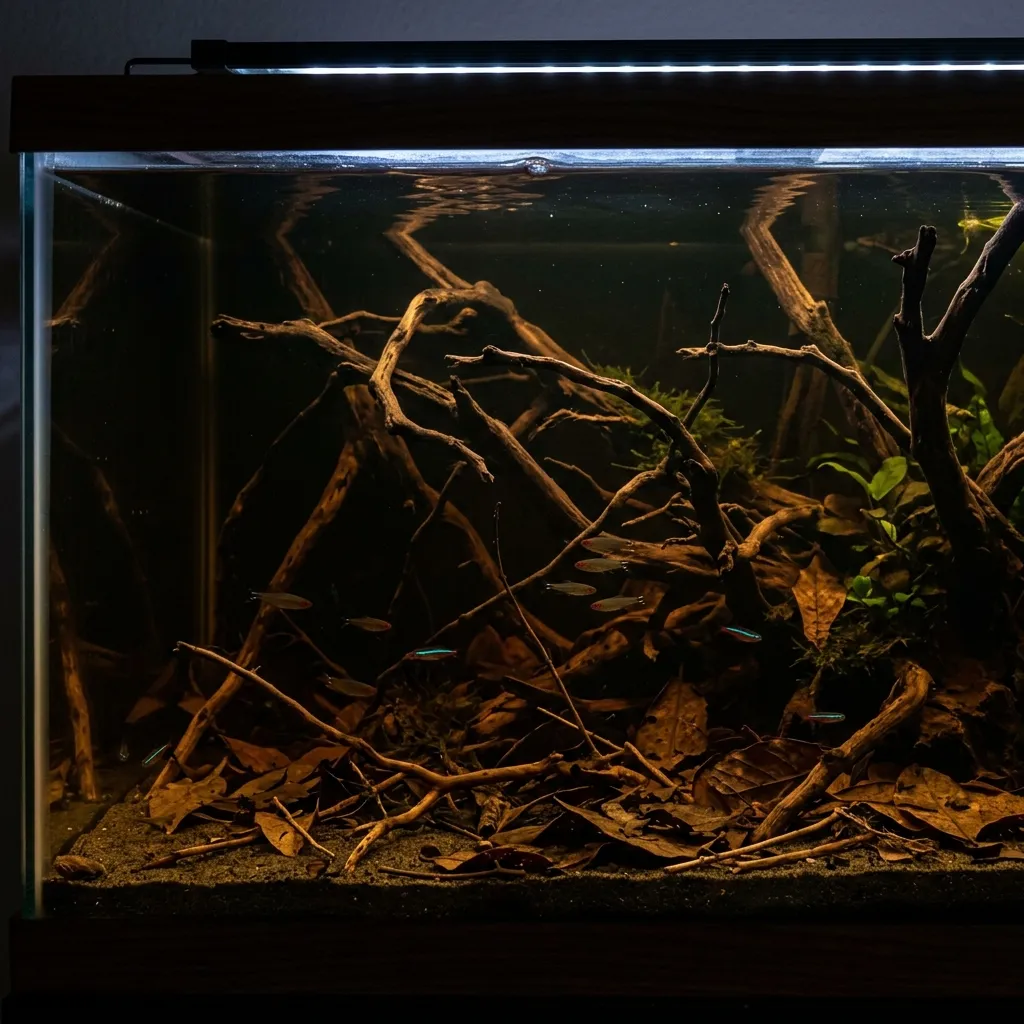
A blackwater aquarium replicates the dark, acidic rivers of the Amazon or Southeast Asia. It uses natural botanicals—like Indian Almond leaves, alder cones, and driftwood—to release humic substances and tannins into the water. This stains the water a deep tea color, naturally lowers the pH (often between 4.5 and 6.0), and provides antibacterial properties that boost the immune systems of soft-water fish like Discus, Betta fish, and tetras.
What is a Blackwater Aquarium?
A blackwater aquarium is a specialized setup designed to mimic the ecological conditions of tannin-stained rivers and swamps, most notably the Rio Negro in the Amazon basin or the peat swamps of Southeast Asia.
In nature, these waterways flow slowly through dense jungles. Leaves, branches, and seed pods fall into the water and decay. As they break down, they release humic acids and tannins, dyeing the water a rich amber or dark brown. This creates an environment that is incredibly soft (low GH/KH) and highly acidic (low pH), yet teeming with life.
The Benefits of Botanicals
The core of a blackwater setup is the use of botanicals. These are dried, natural plant materials added directly to the aquarium.
**Common Botanicals:** * **Indian Almond Leaves (Catappa):** The gold standard. They release a large amount of tannins and break down slowly, providing a food source for shrimp and micro-fauna. * **Alder Cones:** Small cones that pack a massive punch of tannins and lower pH rapidly. * **Driftwood:** Mopani and Malaysian driftwood release significant tannins over many months. * **Seed Pods:** Lotus pods, monkey pots, and oak leaves add structural complexity to the substrate.
**Health Benefits:** Tannins act as a mild astringent. They naturally inhibit the growth of harmful bacteria and fungi in the water column. Fish kept in blackwater are significantly less likely to develop fin rot or fungal infections.
Water Chemistry Constraints
Maintaining a blackwater aquarium is a balancing act of water chemistry.
### The KH and pH Relationship To achieve the low pH of a true blackwater biotope, you must have soft water. If your tap water has high Carbonate Hardness (KH), the buffers in the water will neutralize the humic acids, preventing the pH from dropping.
To build a true blackwater tank in a hard-water area, you must use RO (Reverse Osmosis) water and remineralize it slightly to achieve a KH of 0-2 dKH. This allows the botanicals to push the pH down to 5.5 - 6.5.
### The Danger of pH Crashes When operating with a KH of near zero, your tank has no buffer against pH swings. If you add too many botanicals at once, the pH can plummet to 4.0, which can shock and kill your livestock. Botanicals must be added gradually, and water parameters must be monitored weekly.
Aquascaping and Lighting
Blackwater tanks look completely different from standard planted aquariums.
* **Lighting:** Use dim lighting. The dark water naturally blocks light penetration, which mimics the dense jungle canopy. Bright light ruins the aesthetic and encourages algae. * **Plants:** Because of the dim light and low pH, most high-tech aquarium plants will die in a blackwater tank. Stick to bulletproof, low-light plants like Anubias, Java Fern, Amazon Swords, and Cryptocoryne. * **Substrate:** Fine sand or organic soil topped with a thick layer of leaf litter is the most authentic aquascape. The leaf litter provides hiding spaces and a foraging ground for bottom dwellers.
Choosing the Right Fish
You cannot put hard-water fish (like African Cichlids or Livebearers) into a blackwater tank; the acidic water will cause severe physiological stress and eventual death.
Select species that evolved in these exact conditions. When placed in a blackwater biotope, these fish exhibit behaviors and vibrant coloration rarely seen in crystal-clear water.
**Ideal Blackwater Fish:** * **South American:** Discus, Angelfish, Cardinal Tetras, Neon Tetras, Apistogrammas (Dwarf Cichlids), and Corydoras catfish. * **Southeast Asian:** Betta fish, Gouramis, Harlequin Rasboras, and Kuhli Loaches.
Maintenance Routine
Blackwater maintenance differs slightly from standard tanks. 1. **Do not vacuum the leaf litter.** As the leaves break down, they form a detritus layer called "mulm." While unsightly to some, this mulm is the biological engine of the tank and the primary food source for fry and shrimp. 2. **Replenish botanicals.** As leaves disintegrate, you must add new ones to maintain the tannin levels. 3. **Consistent Water Changes.** Perform regular water changes using water that has been pre-conditioned and matched to the tank's pH and temperature to avoid shocking the delicate fish.