
Harlequin Rasbora (Trigonostigma heteromorpha)
Quick Answer
Harlequin Rasbora (Trigonostigma heteromorpha) is a captivating, peaceful freshwater schooling species native to Southeast Asia. It requires a minimum 10 gallon (38 liter) aquarium for a small group, with 20 gallons (76 liters) recommended for optimal schooling behavior. Water parameters should be pH 6.0-7.5, temperature 72-82°F (22-28°C), and dGH 2-10. This omnivore occupies the middle water column and thrives in planted community setups with dim lighting and dark substrate.
Quick Facts
| Scientific Name | Trigonostigma heteromorpha |
|---|---|
| Common Names | Harlequin Rasbora |
| Family | Cyprinidae |
| Genus | Trigonostigma |
| Type | Freshwater |
| Temperament | peaceful |
| Care Difficulty | beginner |
| Lifespan | 6 years |
| Maximum Size | Up to 2 in (5 cm) |
| Diet | Omnivore |
| Temperature | 72–82°F (22–28°C) |
| pH | 6–7.5 |
| Hardness | 2–10 dGH |
| Minimum Size | 10 gallons |
Key Takeaways
- Peaceful schooling fish requiring groups of 8-12 minimum for natural behavior.
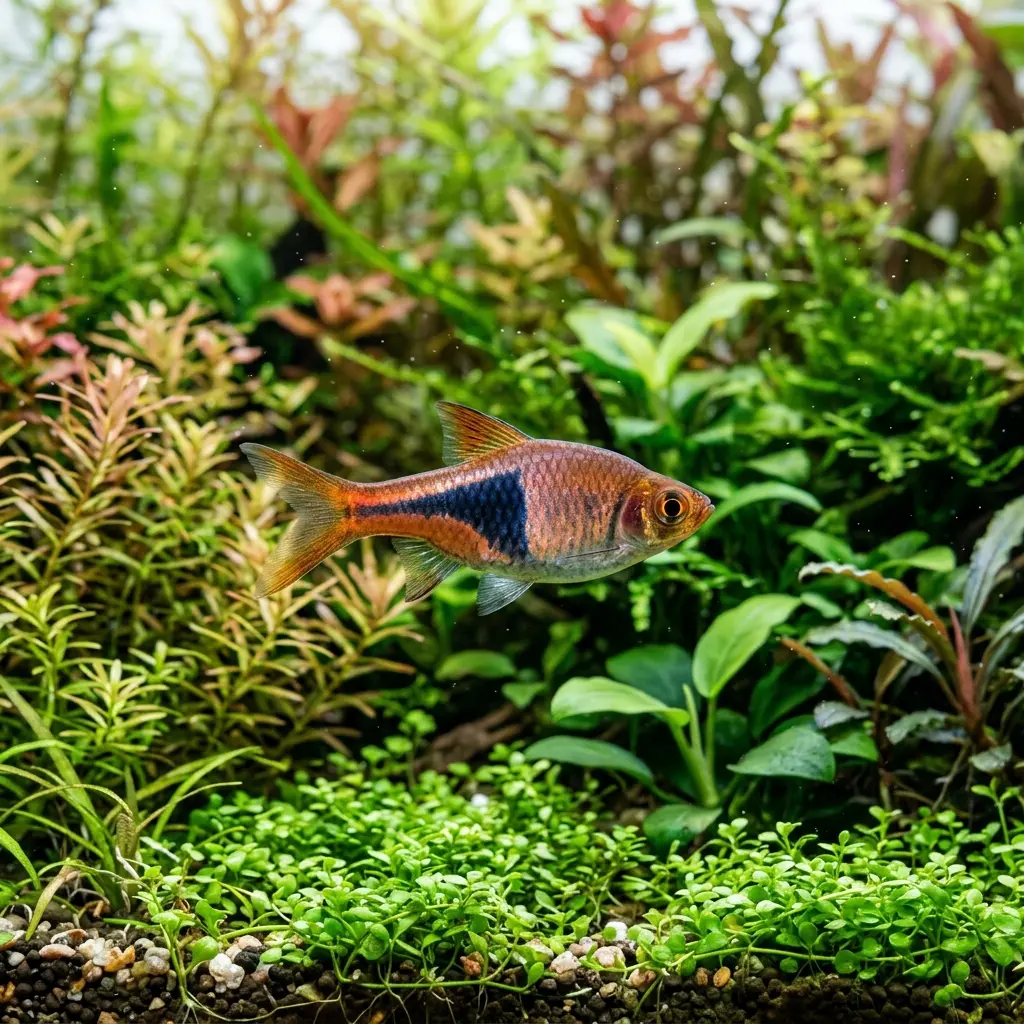
- Distinguished by copper-orange body with large black triangular wedge on rear flank.
- Requires soft to moderately hard water: pH 6.0-7.5, dGH 2-10, temperature 72-82°F.
- Minimum 10 gallon tank for small group; 20 gallon long recommended for display school.
- Omnivore diet: high-quality flakes, frozen daphnia, brine shrimp, and spirulina supplements.
- Breeds by depositing adhesive eggs on underside of broad leaves like Cryptocoryne.
- Sensitive to formalin and full-strength copper; quarantine all new fish for 14 days.
- Dark substrate and floating plants essential for color intensity and stress reduction.
Overview
Species Overview
The Harlequin Rasbora (Trigonostigma heteromorpha) is one of the most iconic and enduringly popular freshwater aquarium fish in the hobby, having been a staple since the early 1900s. Native to the slow-moving, tannin-stained forest streams and peat swamps of the Malay Peninsula, southern Thailand, and Sumatra, this small cyprinid is instantly recognizable by its copper-orange to rose-pink body adorned with a sharply defined black triangular wedge spanning the rear half of the flank.
What separates the Harlequin Rasbora from other small community fish is its unique combination of visual impact, behavioral complexity, and genuine hardiness. A properly maintained school of 10 to 15 individuals moving in tight, synchronized formation through a planted aquarium represents one of the classic displays of the aquascaping hobby. They are not merely decorative; their social dynamics, spawning rituals, and environmental sensitivity make them a genuinely engaging species for observant aquarists.
Despite their forgiving nature, Harlequin Rasboras are not bulletproof. Their color intensity, lifespan, and breeding success depend on specific environmental factors that general community-tank guides often overlook. This guide provides the exact parameters, dietary protocols, and tank mate strategies required to maintain this species at its full potential.
Appearance
Physical Identification
Adult Harlequin Rasboras reach a maximum standard length of 2 inches (5.1 cm), though most specimens in home aquariums stabilize around 1.5 to 1.75 inches (3.8 to 4.5 cm). The body is laterally compressed and somewhat rhomboid, with a relatively deep profile compared to other rasbora species.
The base coloration ranges from copper-orange to rose-pink, with a distinctive metallic violet sheen along the lateral line when viewed under optimal lighting. The signature black patch is a triangular or wedge-shaped marking that begins at the dorsal midline approximately halfway along the body and extends downward and backward to cover the caudal peduncle. In high-quality specimens, this patch is solid, sharply defined, and extends into the base of the caudal fin.
Sexual dimorphism is subtle but discernible in mature fish. Males are slightly smaller and more slender, with a straight lower edge to the black wedge. Females are rounder-bodied, particularly when gravid, and the black wedge exhibits a rounded or extended lower edge. Males display more intense coloration, especially during courtship, when the copper-orange deepens to a rich salmon-pink.
Distinguishing Harlequin Rasboras from the closely related Lambchop Rasbora (Trigonostigma espei) requires attention to patch shape: the Harlequin's patch is a large, broad triangle covering significant flank area, while the Lambchop's patch is smaller, more elongated, and resembles a lamb chop cutlet. Lambchops also tend toward a more intense orange body coloration and remain slightly smaller.
Diet
Diet and Nutrition
Harlequin Rasboras are opportunistic omnivores in the wild, consuming small crustaceans, insect larvae, zooplankton, and periphyton (algal biofilms). In captivity, their diet must replicate this protein-plant balance to maintain color, immune function, and digestive health.
Health
Health and Disease Management
Harlequin Rasboras are hardy by tropical fish standards but are susceptible to specific parasitic, bacterial, and fungal pathogens. Their small size and sensitivity to certain medications require precise treatment protocols. Prevention through quarantine, stable water parameters, and proper nutrition is vastly more effective than treatment.
Ich (White Spot Disease)
A protozoan infection caused by Ichthyophthirius multifiliis, characterized by white salt-grain spots on body and fins.
- Small white cysts (0.5-1.0 mm) on fins, body, and gills; flashing against decor; labored breathing; clamped fins; reduced appetite.
Introduced via infected fish or plants; triggered by temperature swings, stress from transport, or immunosuppression from poor water quality.
Quarantine all new fish for 14 days; maintain stable temperature within 2°F (1°C) of target; avoid sudden parameter shifts; use a UV sterilizer in high-risk setups.
Velvet (Gold Dust Disease)
A dinoflagellate infection caused by Piscinoodinium or Oodinium, presenting as a fine gold or rust-colored dust on the body.
- Fine golden film on body and fins resembling dust; scratching against objects; lethargy; rapid gilling; fins held clamped; death within 48-72 hours if untreated.
Introduced via infected stock; proliferates in warm water above 80°F (27°C); photosynthetic parasite thrives under bright lighting.
Quarantine new fish; dim lighting during outbreak; maintain temperature at 76-78°F (24-26°C) unless treating; use copper-based medication in hospital tank only.
Fin Rot (Bacterial)
A bacterial infection typically caused by Aeromonas, Pseudomonas, or Flexibacter species, eroding fin tissue.
- Frayed or ragged fin edges; white or translucent margins on fins; progressive tissue loss; red streaks in advanced cases; possible body ulcers.
Maintain zero ammonia and nitrite; keep nitrates below 20 ppm with weekly 25% water changes; remove sharp-edged decor; treat water with aquarium salt at 1 teaspoon per 5 gallons (1 gram per 2 liters) for mild cases; use Furan-2 or Maracyn for advanced bacterial fin rot.
Dropsy (Edema)
A symptom of internal organ failure, typically kidney or liver dysfunction, causing fluid accumulation in tissues and body cavity.
- Severe abdominal swelling; scales protruding like a pinecone; bulging eyes (exophthalmia); loss of appetite; lethargy; floating or sinking abnormally.
Chronic bacterial infection (often Aeromonas); poor diet high in saturated fats; genetic predisposition; long-term exposure to high nitrates or ammonia.
Provide high-quality varied diet; maintain pristine water conditions; avoid overfeeding; isolate affected fish immediately as prognosis is poor; treat with broad-spectrum antibiotics (Kanaplex) in hospital tank; euthanize humanely if fish shows advanced pineconing and cannot swim.
Columnaris (Mouth Fungus)
A bacterial infection caused by Flavobacterium columnare, often mistaken for fungal growth due to cotton-like appearance.
- White or grayish cottony patches on mouth, fins, or body; frayed fins; ulcers on body; rapid breathing; lethargy; loss of appetite.
Stress from poor water quality, overcrowding, or temperature fluctuations; introduced via infected fish; thrives in warm water 75-82°F (24-28°C).
Maintain excellent water quality with weekly changes; avoid temperature swings; quarantine new fish; treat with Furan-2 and Kanaplex combination in hospital tank; increase aeration during treatment as medications reduce dissolved oxygen.
Fungal Infections (Saprolegnia)
Opportunistic fungal growth on damaged tissue, typically following injury, parasite damage, or bacterial infection.
- White or gray cottony growth on fins, body, or mouth; fuzzy patches that expand rapidly; often secondary to visible wounds or parasite damage.
Physical injury; parasite attachment sites; poor water quality with high organic load; low temperature below 72°F (22°C).
Maintain water temperature at 76-78°F (24-26°C); remove injured fish to hospital tank; treat with methylene blue baths (3 mg/L for 30 minutes) or aquarium salt at 2 teaspoons per 5 gallons; address underlying cause (parasites, water quality) before fungal treatment.
Breeding
Breeding Harlequin Rasboras
Harlequin Rasboras breed readily in captivity when specific water chemistry and environmental triggers are met. Their unique spawning behavior—depositing adhesive eggs on the undersides of broad leaves—makes them one of the most fascinating community fish to breed. However, fry survival requires meticulous attention to water quality and first foods.
Compatible Tank Mates






Species Comparison
| Feature | Harlequin Rasbora | Lambchop Rasbora | Neon Tetra | Ember Tetra |
|---|---|---|---|---|
| Scientific Name | Trigonostigma heteromorpha | Trigonostigma espei | Paracheirodon innesi | Hyphessobrycon amandae |
| Adult Size | 2 inches (5.1 cm) | 1.5 inches (3.8 cm) | 1.5 inches (3.8 cm) | 0.8 inches (2.0 cm) |
| Temperament | Peaceful, schooling | Peaceful, schooling | Peaceful, schooling | Peaceful, schooling |
| Minimum Tank Size | 10 gallons (38 L) for 6-8; 20 gal (76 L) recommended | 10 gallons (38 L) for 6-8; 15 gal (57 L) recommended | 10 gallons (38 L) for 6; 20 gal (76 L) recommended | 5 gallons (19 L) for 6; 10 gal (38 L) recommended |
| Temperature Range | 72-82°F (22-28°C) | 73-81°F (23-27°C) | 68-78°F (20-26°C) | 73-84°F (23-29°C) |
| pH Range | 6.0-7.5 (soft to moderately hard) | 6.0-7.5 (soft to moderately hard) | 6.0-7.0 (soft, acidic) | 5.5-7.0 (soft, acidic) |
| Diet | Omnivore: flakes, pellets, frozen daphnia, brine shrimp, spirulina | Omnivore: micro pellets, frozen foods, vegetable matter | Omnivore: flakes, micro pellets, brine shrimp | Omnivore: micro pellets, frozen cyclops, baby brine shrimp |
| Key Visual Trait | Large black triangular wedge on rear half of body | Smaller lambchop-shaped black patch, more orange body | Iridescent blue lateral stripe with red belly | Intense copper-orange body with translucent fins |
| Breeding Difficulty | Moderate: requires soft acidic water, leaf-spawning | Moderate: similar requirements to harlequin | Difficult: requires very soft water, egg scatterer | Moderate: egg scatterer, dim lighting helps |
| Lighting Preference | Low to moderate, dim with floating plants | Low to moderate, dim with floating plants | Low to moderate, dim with floating plants | Low to moderate, dim with floating plants |